© Shutterstock
 Votre guide Ryo
Visiting Salamanca at Christmas in 2026: The Golden City Under the Lights
At midday, the golden stone of Salamanca's facades already catches all the Castilian light. After 6 pm in December, it takes on a whole new character: garlands, more than a hundred illuminated streets and the sound and light shows on the Plaza Mayor transform the university city into an almost unreal setting. Visiting Salamanca at Christmas means enjoying this double lighting, that of the winter sun and that of the illuminations, without the dense crowds of Madrid or Seville at the same time of year. The Ryo audio-guided tour of Salamanca lets you explore the UNESCO-listed old town at your own pace, headphones on, while the terraces of the Plaza Mayor fill up with bundled-up locals.
This festive season offers scenes you won't find anywhere else in Spain: a miniature winter village set up in a medieval tower, thousands of students celebrating New Year's Eve beneath the town hall clock two weeks early, a monumental nativity scene of 200 figurines in the Renaissance courtyard of a palace. Between the two adjoining cathedrals, the oldest university in the country and the aroma of Iberian ham drifting out of the tapas bars, this guide details, place by place, how to fill two to three days of sightseeing over the end-of-year holidays.
Why Visit Salamanca at Christmas?
Salamanca is nicknamed "la Dorada" (the Golden One): its Villamayor stone, a sandstone that turns amber at sunset, earned the old town its UNESCO World Heritage listing in 1988. With around 144,000 inhabitants, it is a mid-sized city in Castile and León, yet it is one of the most student-filled cities in Spain: nearly 30,000 enrolled students fill its bars and squares well after nightfall, even in the depths of winter.
That is precisely what sets Christmas in Salamanca apart from Christmas in Madrid or Seville. The streets of the old town are narrow, the illuminations are concentrated on a handful of emblematic monuments, and the atmosphere remains intimate: you will meet as many students in Christmas sweaters as families come to admire the lit-up facades. Accommodation and meal prices remain significantly lower than in the country's major tourist capitals.
Another advantage, rarely mentioned: compactness. Almost everything you will want to see fits within an area you can cross on foot in a quarter of an hour, from the Plaza Mayor to the Roman Bridge. No need for a metro or taxi, and that is valuable in winter, when you would rather go from one visit to the next without waiting in the cold.
The climate stays cool and dry in December, far from the humidity of the coast, which makes evening strolls pleasant as long as you wear plenty of layers.
The Illuminated Plaza Mayor, the Beating Heart of Salamanca at Christmas
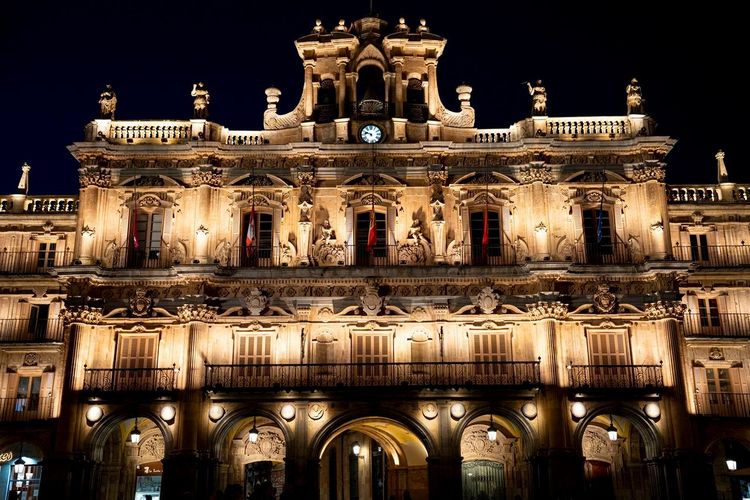
At some point during their stay, everyone converges on the Plaza Mayor (Plaza Mayor, 37002 Salamanca, rated 4.8/5 on Google from 45K reviews). Built in the 18th century to plans by Alberto de Churriguera, it is considered by many travelers to be one of the most beautiful squares in Spain.
At Christmas, the square changes its face three times a day. In the morning, the café terraces fill up with retirees and students running late for class. In the afternoon, the low light gilds the arcades and the sculpted medallions of kings, queens and historical figures running beneath the balconies. In the evening, a large Christmas tree and garlands strung between the facades take over from the sun, and it is probably the most photographed moment of an entire winter stay in the city.
During the holidays, the city council also schedules sound and light shows projected onto the facades of the square, as well as in the Patio Chico, between the two cathedrals. The shows are free and repeat several times each evening: arrive a few minutes early to position yourself facing the town hall, from where the projection is best seen.
You don't need to reserve a table to enjoy the atmosphere: with a hot chocolate in hand, simply settle under the arcades and watch the crowd blend with the lights. This is where the Ryo audio-guided tour of Salamanca begins, with several audio stops dedicated to the history of the square and its sculpted medallions of kings: a few minutes of listening is enough to understand why each stone tells a different century. If you could keep only one memory of your Christmas in Salamanca, it would probably be this one: the square empty at dawn, then packed to bursting at 9 pm, under the same garlands.
The Ciudad de la Navidad, Salamanca's Christmas Village
Don't imagine a large open-air market: the Ciudad de la Navidad (Torre de los Anaya, Plaza de Anaya, 37008 Salamanca, rated 4.7/5 on Google from 186 reviews) is an indoor installation, nestled in the Torre de los Anaya, on the Plaza de Anaya, a stone's throw from the cathedral. Designed by the artist Sergio Iván González, it recreates a miniature winter village inspired by the landscapes of central Europe and Lapland, with snow-covered houses, animated figures and meticulous details that keep children occupied far longer than expected.
Admission is free. During the 2025-2026 season, the Ciudad de la Navidad was open from November 27 to January 5, from 11 am to 2 pm and then from 5 pm to 9 pm, closed on the afternoons of December 24 and 31 and all day on December 25 and January 1. These hours are generally repeated from one year to the next give or take a few days, but check with the tourist office when you arrive.
Right in front, the Plaza de Anaya hosts the city's Christmas market, with its chalets of crafts, decorations and sweets. The municipal festivities also include nativity scenes in the Torre de los Anaya and in the former Fonda Veracruz.
And the ice rink? It is set up every winter on the Plaza de la Concordia, near the El Corte Inglés department store, from late November to early January. Allow 8 euros for a 45-minute session, skates included: bring your gloves, the rink is open-air.
The Belén de la Salina and Other Nativity Scenes to See in Town
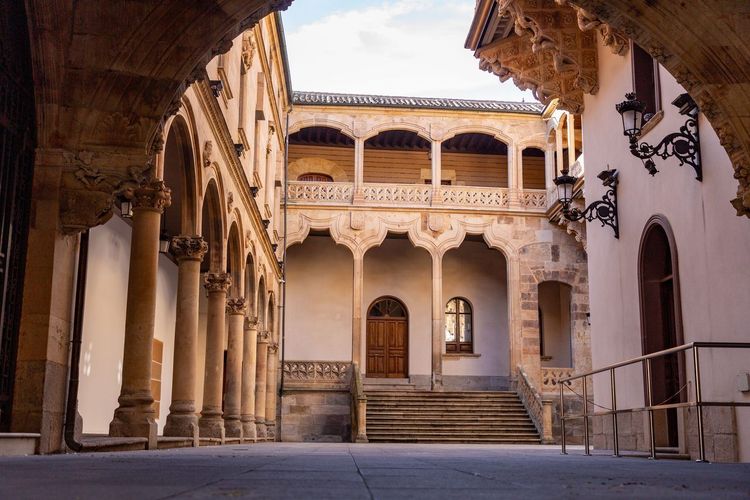
A few streets from the Plaza Mayor, the Palacio de la Salina (Calle de San Pablo 20, 37008 Salamanca, rated 4.5/5 on Google from 1,050 reviews) hosts the monumental belén of the Diputación de Salamanca every year, the Belén de la Salina. This 16th-century palace, seat of the provincial administration, is already worth a detour for its Plateresque facade with medallions and its Renaissance courtyard, whose gallery rests on large brackets carved with figures.
It is precisely in this courtyard that the nativity scene is set up: in 2025, it covered about 40 m² with nearly 200 figurines, with lighting and sound, and attracted some 70,000 visitors between early December and January 5. Admission is free, from 11 am to 9 pm during the holiday period, making it an easy stop to slip in between two paid visits.
Other nativity scenes appear in the shop windows of the Rúa Mayor and in several churches of the old town. Take the time to look up as well: many travelers head straight to the university without noticing the palace's facade.
The University of Salamanca, a Plateresque Jewel
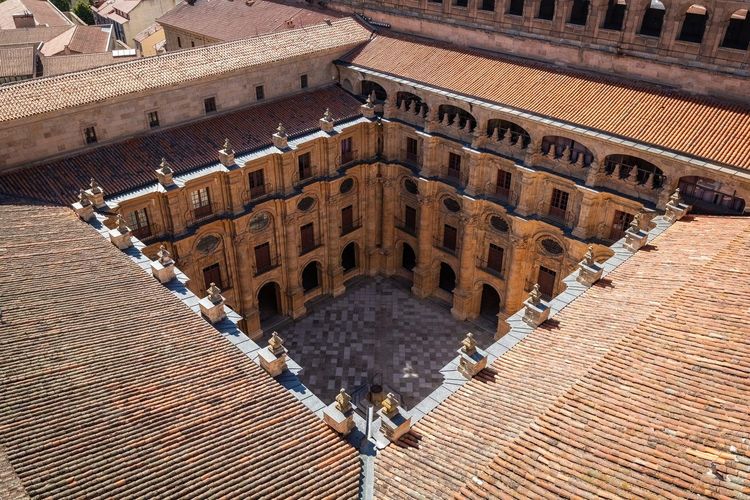
Founded in 1218, the University of Salamanca is the oldest university still in operation in Spain and one of the oldest in Europe. Its Plateresque facade, overlooking the small Patio de Escuelas, became one of the most photographed monuments in the country long before the Instagram era.
The facade is literally covered with medallions, coats of arms and plant motifs carved with almost obsessive precision. As local tradition has it, a small frog perched on a skull is hidden somewhere in this profusion of detail, and spotting it without help is said to bring good luck on exams, according to generations of students who pass the anecdote down. Take five minutes before moving on: most travelers walk past without even looking.
Inside, the historic rooms are worth the visit, notably the old lecture hall where Fray Luis de León taught and the old library, rich in medieval manuscripts. The Pontifical University of Salamanca, separate from the civil university but located right nearby, completes this ensemble with the Clerecía, its former Baroque Jesuit college whose towers overlook the Rúa Mayor.
These towers can be visited under the name Scala Coeli, and it is one of the best things to do in the city in December. After a climb up staircases and interior walkways, you emerge at bell height with, directly opposite, the mass of the two cathedrals and, below, the tiled roofs of the old town. Aim for the slot just before sunset: the stone turns orange-pink, then the first illuminations light up in the streets below.
In December, classes continue until around mid-December: you will still come across hurried students, backpacks over their shoulders, while tourists photograph the facade. In front of this portal, the Ryo audio guide tells the story of the lucky frog and then details the carved symbols around it, a good complement if you want to understand what you are looking at without booking a group tour.
The Cathedrals of Salamanca: The Vieja and the Nueva
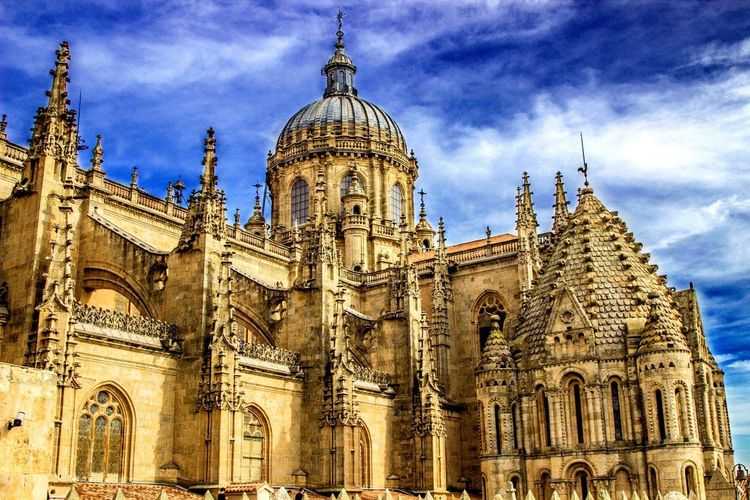
Salamanca has a rather rare feature in Europe: two cathedrals attached to one another, built centuries apart. The Catedral Vieja, Romanesque and dating from the 12th century, was preserved rather than demolished when the city decided, in the 16th century, to build a larger cathedral right next to it.
The Catedral Nueva (Plaza de Juan XXIII, 37008 Salamanca, rated 4.7/5 on Google from 19,397 reviews), late Gothic and then completed in Baroque style, took more than two hundred years to build, hence the mix of styles visible on its facade and bell tower. The two buildings are connected inside, which allows you to visit this "Double Cathedral" with a single ticket and compare two visions of Spanish religious architecture.
An anecdote amuses visitors who know where to look: in 1992, during the restoration of the Puerta de Ramos, the stonemason Miguel Romero slipped among the traditional motifs a figurine of an astronaut about thirty centimeters tall, along with other modern nods such as a dragon eating an ice cream. The detail has become a regular game for families visiting at Christmas: find the astronaut before the university's frog.
The towers, accessible via the Ieronimus circuit, offer a view over the golden roofs of the old town, superb in the late afternoon. If you follow the Ryo audio tour, an entire stop contrasts the Old and New Cathedrals and guides you to the astronaut: impossible to walk past without seeing it.
The Casa de las Conchas and Other Jewels of the Old Town
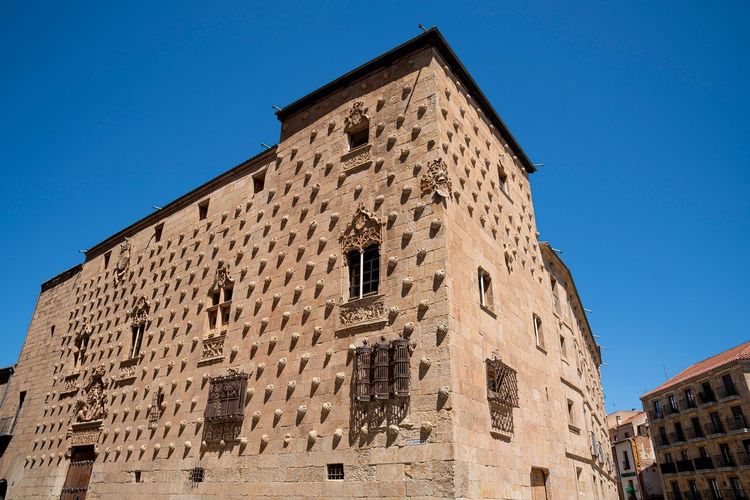
A stone's throw from the Plaza Mayor, the Casa de las Conchas owes its name to the roughly 300 scallop shells carved on its late 15th-century facade, an emblem linked to the Order of Santiago and to the family that had it built. The building now houses a public library, which means you can visit its inner courtyard for free during opening hours.
A little further on, the Palacio de Monterrey, owned by the House of Alba, is one of the high points of the Plateresque style, with its arcaded gallery topped with chimneys and pinnacles. Closed for a long time, it is now open to the public thanks to an agreement between the city council and the Casa de Alba Foundation: allow about 7 euros, and know that night visits have been added to the program.
A few minutes' walk away, the Convent of San Esteban is worth a detour for its Plateresque facade depicting the stoning of Saint Stephen, and for its Dominican cloister where Christopher Columbus is said to have defended his plan for a voyage to the Indies. The church preserves an impressive Baroque altarpiece by José Benito de Churriguera.
Heading back up toward the cathedral, the Anaya Palace, a former university college turned faculty of philology, closes off the Plaza de Anaya with its neoclassical facade. Its grand interior staircase can be glimpsed from the entrance, but access remains primarily reserved for students.
For a change of pace, the Casa Lis (Calle Gibraltar 14, 37008 Salamanca, rated 4.5/5 on Google from 8,623 reviews), an Art Nouveau and Art Deco museum housed in an early 20th-century mansion with colorful stained-glass roofs, displays antique dolls, jewelry, Lalique glassware and period furniture. It is also a good heated refuge on an icy December afternoon.
These five buildings are all within ten minutes' walk of one another. The Casa de las Conchas, the Palacio de Monterrey and the Convent of San Esteban also form a loop of the Ryo audio-guided tour, narrated on foot, which saves you from looking up each address on a paper map.
The Roman Bridge and the Huerto de Calixto y Melibea
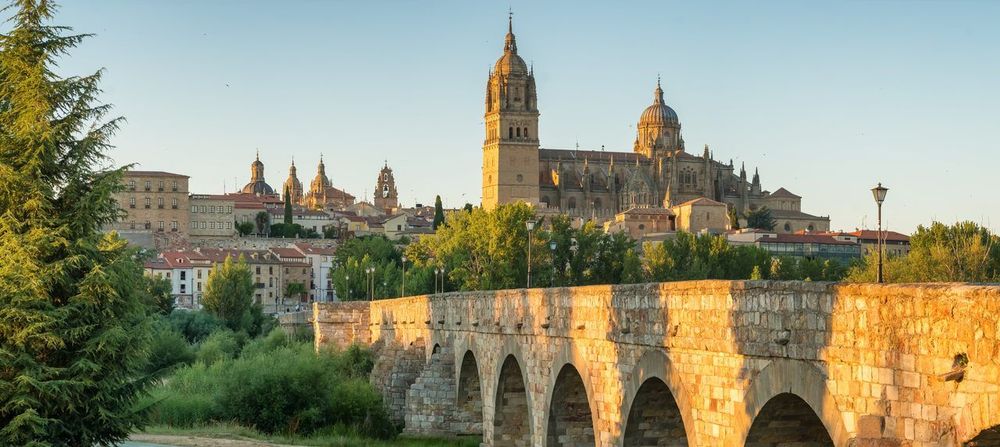
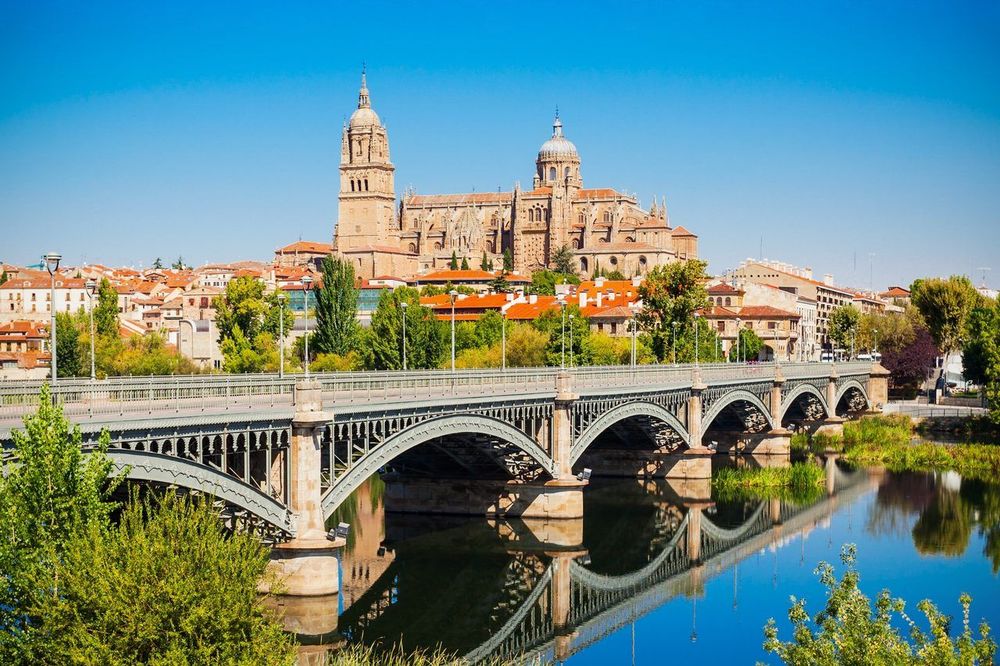
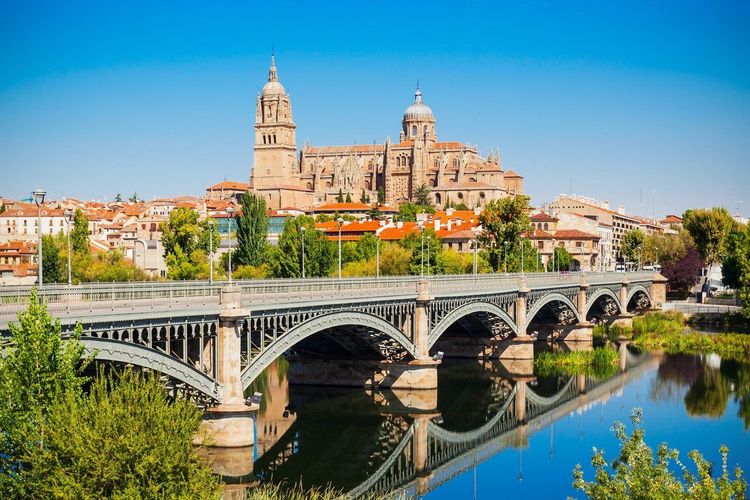
For the most famous view of Salamanca, head down to the Roman Bridge, which has spanned the Tormes since the 1st century, then turn back toward the city.
From the middle of the bridge, the two cathedrals, the university and the bell towers of the old town form the postcard skyline. At the entrance to the bridge, a stone sculpture of a boar, the verraco, recalls the pre-Roman origins of the site.
Just above, set against the old city wall, the Huerto de Calixto y Melibea (Calle San Buenaventura, 37008 Salamanca, rated 4.5/5 on Google from 13,757 reviews) offers the same skyline seen from above. This romantic garden takes its name from the lovers of La Celestina, a masterpiece of Spanish literature published in 1499 whose action is associated with the city. During the holidays, it also hosts a sound and light show scheduled by the city council.
In December, the garden closes earlier than in summer: aim for the late afternoon to enjoy both the natural light and the first illuminations on the cathedral towers.
Christmas Gastronomy in Salamanca
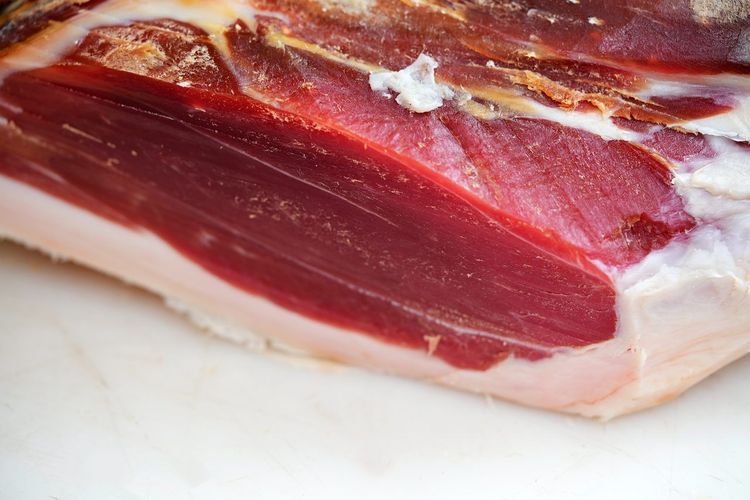
The province of Salamanca is a benchmark for jamón ibérico, thanks in particular to the town of Guijuelo, some fifty kilometers away, nicknamed the capital of Iberian ham. During the holidays, the tapas bars in the center multiply their platters of jamón de bellota, often at prices significantly more affordable than in Madrid or Barcelona.
The local dish to try remains the hornazo, a savory pie stuffed with chorizo, lomo and hard-boiled egg, traditionally associated with the Lunes de Aguas, the Monday after Easter week, but sold year-round in bakeries. In winter, Salmantinos often prefer chanfaina, a rice dish with offal, or sopas de ajo, a garlic and bread soup that is comforting on cold evenings.
On the sweet side, turrones fill every delicatessen, and the roscón de reyes, a brioche ring decorated with candied fruit, appears as January 6 approaches. If your stay overlaps with the evening of January 5, don't miss the Three Kings parade that crosses the city center.
To eat like the locals, head to the alleys around the Plaza Mayor and to Calle Van Dyck, where tapas bars frequented by Salmantinos rather than tour groups are concentrated. Asking for "una ración de ibérico" is enough to kick off a convivial meal, often standing, glass in hand, between two counters.
The Nochevieja Universitaria, the Unusual Student New Year's Eve Tradition
Few guides dwell on this ritual, yet it sums up the soul of Salamanca in December better than any monument: the Nochevieja Universitaria, the "university New Year's Eve." Every year, on a Thursday in mid-December, just before students head home for the holidays (December 18 in 2025), the Plaza Mayor celebrates the New Year two weeks early.
The evening begins around 8:30 pm with concerts, then everything converges on midnight: the town hall clock strikes twelve, and some 18,000 young people swallow, in time with the bells, not grapes but gummy candies, the gominolas, handed out free at the entrances to the square. Improvised costumes, confetti and songs accompany the scene, filmed and shared on social media every year.
No reservation is needed, but access to the square is controlled and quickly saturated: come early if you want to be in the center rather than under the arcades. Traveling with family or looking for calm? You are better off watching the arrival of the costumed processions early in the evening from the adjacent streets, then heading back before midnight, and choosing accommodation slightly away from the Plaza Mayor for that night: the party continues late in the bars of the center.
This celebration also explains why the city keeps a special energy in the depths of winter, when so many other destinations slow down between holidays.
When to Go and How Many Days to Plan for Visiting Salamanca at Christmas?
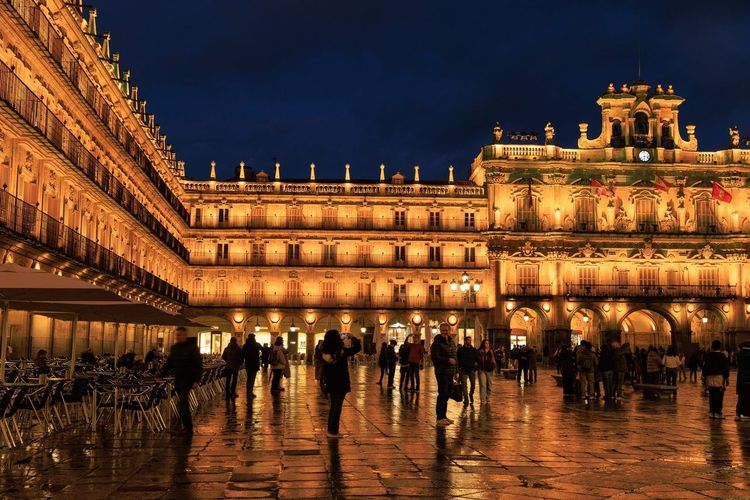
The illuminations are switched on in late November and stay up until January 6, Epiphany. The busiest period, with the Ciudad de la Navidad, the Plaza de Anaya market and the belén at La Salina all open, runs from early December to the first week of January.
As for the weather, expect daytime temperatures between 0 and 10 °C, with nights often below freezing and sometimes morning fog near the Tormes. The dry air makes the cold more bearable, as long as you bring a good jacket. Around the solstice, night falls at about 6 pm, which lets you enjoy the illuminations early.
Two full days are enough to cover the essentials: the Plaza Mayor, the university, the two cathedrals and the old town on the first day, then the Roman bridge, the palaces and the nativity scenes on the second. Three days let you add an excursion to Zamora, an hour away by road, or to Ávila, about an hour and a quarter away.
If you are aiming for the Nochevieja Universitaria, time your visit for the mid-December Thursday announced by the city: the date varies according to the university calendar.
How to Get to Salamanca and Where to Stay During the Holidays?
From Madrid, the train remains the fastest option: Alvia trains departing from Chamartín reach Salamanca in one hour thirty to one hour forty, with several departures daily. The bus, operated notably by Avanza, takes a little over two hours but is generally cheaper.
By car, allow about two hours and fifteen minutes from Madrid for a little over 210 km, via the A-6 (or the toll AP-6 to cross the Sierra de Guadarrama) then the A-50 via Ávila. The most convenient international airport remains Madrid-Barajas, the logical entry point for most foreign travelers.
Once there, forget the car: the historic center is largely pedestrianized and parking is scarce. Both the train station and the bus station are about twenty minutes' walk from the Plaza Mayor, and a few city bus lines shorten the trip if you arrive laden with suitcases on a rainy evening.
For accommodation, favor a place within a ten-minute walk of the Plaza Mayor or along the Gran Vía: you will walk back after the illuminations without depending on a taxi. Prices remain reasonable, with decent double rooms between 60 and 100 euros per night during the holiday period, and a few hostels under 30 euros.
Book ahead if your stay coincides with the Nochevieja Universitaria or the weekend before Christmas: the best accommodations in the center fill up quickly on these dates.



FAQ
What is the most beautiful city in Spain at Christmas?
There is no single answer, but Salamanca often ranks among the favorites thanks to its golden stone, which pairs beautifully with the lights, and an atmosphere less crowded with tourists than Madrid, Seville or Barcelona at the same time of year.
How many days do you need to visit Salamanca?
Two full days cover the essential monuments of the old town. Allow three days if you want to add an excursion to Ávila or Zamora, or simply enjoy a more relaxed pace over the holidays.
What is the most beautiful city to visit at Christmas?
In Europe, cities with old architecture and compact centers, like Salamanca, lend themselves particularly well to Christmas decorations: historic facades reflect the light of the illuminations in a way that modern city centers cannot reproduce.
What is the best destination in Spain to spend Christmas?
It depends on the atmosphere you are looking for. Madrid offers intensity and grand illuminated shop windows, Seville a milder climate, while Salamanca offers a more intimate, student-filled atmosphere and is significantly cheaper.
Is it cold in Salamanca in December?
Yes: daytime temperatures generally range between 0 and 10 °C, with nights often below freezing. The air stays dry, which makes the cold more bearable than by the sea, as long as you bring a good coat.
What budget should you plan for visiting Salamanca during the Christmas holidays?
Allow between 60 and 100 euros per night for decent accommodation in the city center and around twenty euros per day for meals if you favor tapas bars. The Ciudad de la Navidad, the belén at La Salina and the sound and light shows are free; budget 8 euros for an ice rink session and a few tickets for the university, the cathedrals or the Palacio de Monterrey.
Salamanca at Christmas is ultimately experienced less as a list of monuments than as a succession of atmospheres: the square that changes three times a day, the palace that houses a nativity scene, the facade that hides a lucky frog, and the square that becomes, two weeks ahead of schedule, the stage for a mock student New Year's Eve. To connect all these places without wasting time finding your way in the December cold, the Ryo audio-guided tour of Salamanca turns this list into a coherent itinerary, from your first step on the Plaza Mayor to the view from the Roman Bridge.