© Shutterstock
 Votre guide Ryo
Weekend in Bayeux in 2026: the Tapestry, Vieux Bayeux, and the D-Day Beaches
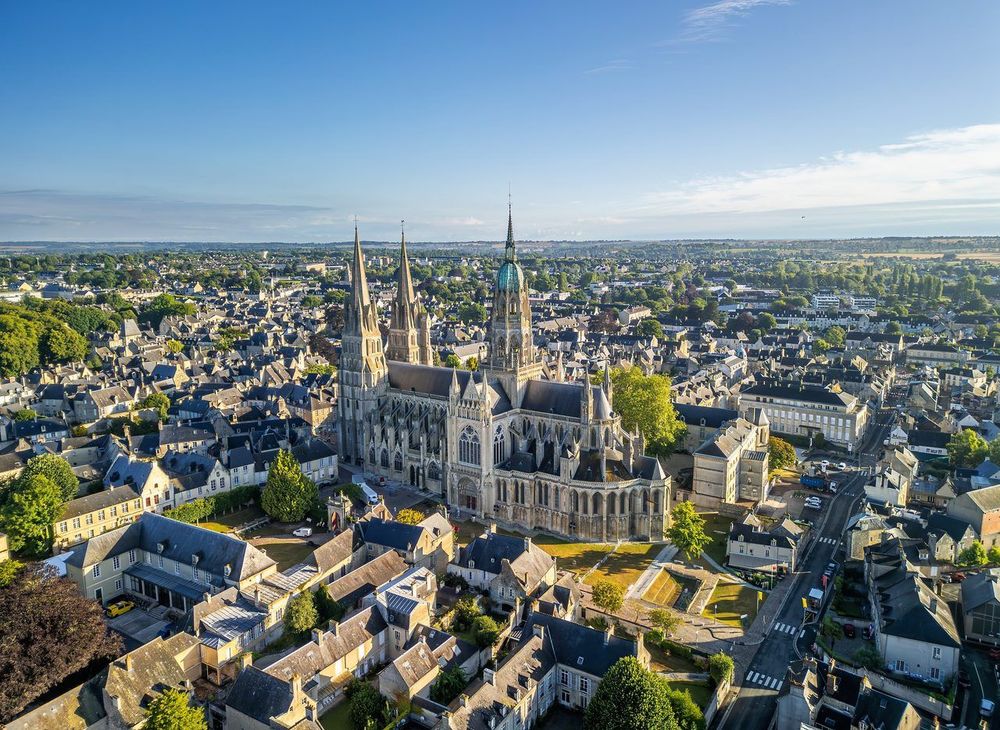
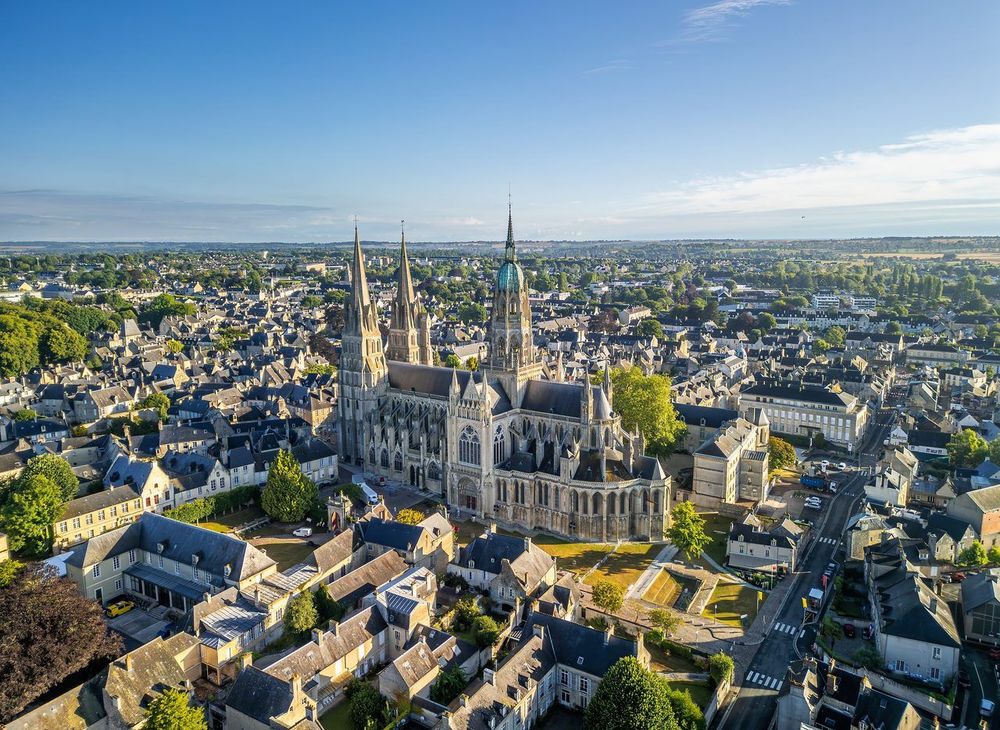
A weekend in Bayeux often starts with a surprise: the city almost entirely escaped the bombings of summer 1944, even though it sits just a dozen kilometers from the D-Day beaches. It is this stroke of luck that explains why its medieval center, its half-timbered houses and its Gothic cathedral are still standing today. This small Norman city can be explored entirely on foot, and its historic heart fits comfortably into one full day. One important note if you are visiting in 2026: the Tapestry Museum is closed for renovation until autumn 2027, and the embroidery itself is on display at the British Museum in London until July 2027. This takes nothing away from the appeal of the visit, but does change the way you plan it slightly.
There is still plenty to see: an exhibition devoted to the conservation of the tapestry, a British military cemetery planted with rose bushes rather than rows of perfectly aligned headstones, a conservatory where you can still watch lace being made with bobbins, a botanical garden with its listed weeping beech, and history-laden beaches just a quarter of an hour's drive away. Allow one full day for the center, two days if you add the beaches or the châteaux of the Bessin. And if you push on to Caen, the Ryo audio tour of Caen tells the story of William the Conqueror's city — the hero of the tapestry — across 22 audio tracks.
Bayeux in a Weekend: What You Need to Know Before You Go
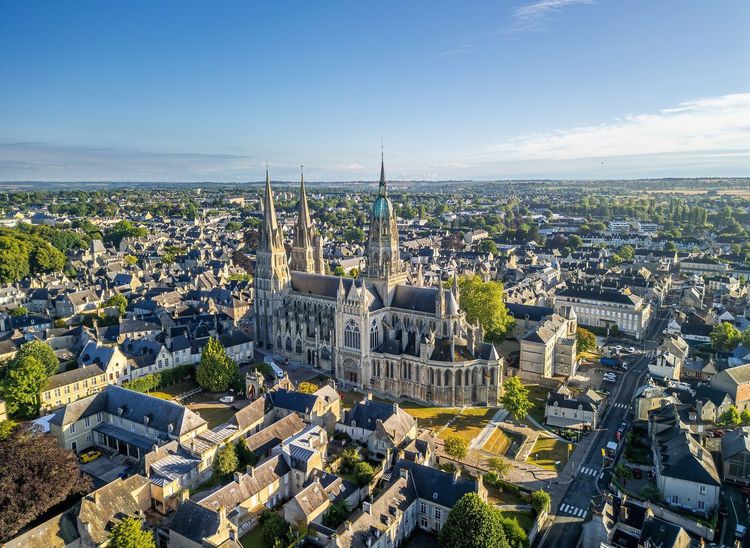
A weekend in Bayeux naturally divides into two parts. The first day is enough to cover the historic center: the cathedral, Vieux Bayeux, the museums, and the botanical garden can all be visited on foot in a loop, never more than twenty minutes' walk from one point to the next. The second day points outward: D-Day beaches, châteaux of the Bessin, or a detour to Caen, depending on what appeals to you most.
Bayeux has barely 13,000 inhabitants and its city center fits within a perimeter of about one kilometer. You can stay anywhere in the center without needing a car for the heritage part of your visit. One tip if your stay coincides with the June 6 commemorations: book your accommodation several weeks in advance, as the city is fully booked every year at that time.
The Bayeux Tapestry: the Must-See, Even During the Renovation
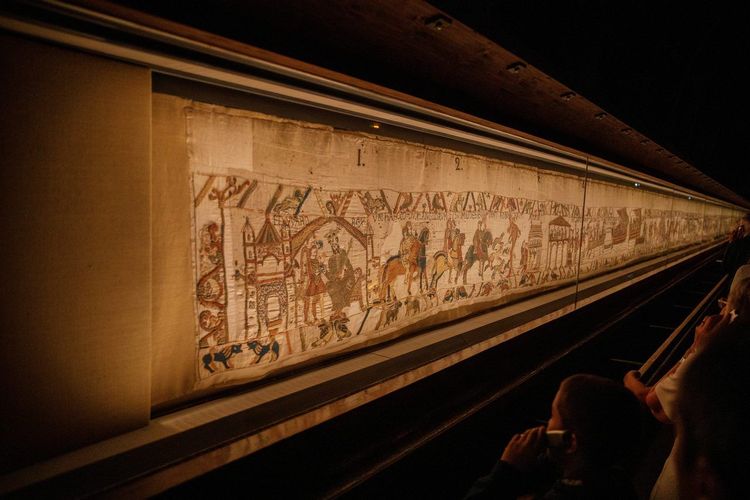
The Bayeux Tapestry is not actually a tapestry but an embroidery: 68.38 meters of colored wool stitched onto a linen cloth, roughly 50 centimeters tall. Created in the years following 1066, it unfolds, scene by scene, the conquest of England by William the Conqueror, from Harold's oath to the Battle of Hastings.
Before booking, one practical point is worth noting. The Tapestry Museum, housed in the former grand seminary on Rue de Nesmond, has closed for two years of renovation work, with a planned reopening in autumn 2027. In the meantime, the work has left Normandy: it is on show at the British Museum in London from 10 September 2026 to 11 July 2027, before returning to France for restoration. If you visit before then, you will not be able to see the original embroidery.
The city has made provisions to tell the story of its treasure in its absence. The exhibition "De lin et de laine", dedicated to the history of the tapestry's conservation, runs from 14 May 2026 to 19 September 2027 at the Musée Baron Gérard and the Musée Mémorial de la Bataille de Normandie, included in the admission ticket. From December 2026, an immersive experience will be installed at the Hôtel du Doyen (6 euros, free for children under 10), and the tourist office offers guided tours called "Les aventures de la Tapisserie dans Bayeux".
What strikes you when you discover the work, even in reproduction, is the rhythm of the narrative. Each scene follows on like a panel in a comic strip, with its Latin caption above and, in the borders, fabulous animals or scenes of everyday life that sometimes comment on the action with a very modern irony. It is this narrative construction that has earned the work its nickname of a medieval comic strip, eight centuries before the word was invented.
One detail to look out for: a comet embroidered in the sky, which men are pointing at shortly after Harold's coronation. This depicts the passage of Halley's Comet in 1066, interpreted at the time as an ill omen. Technically, the embroidery uses only ten colors of wool, obtained from three vegetable dyes (madder, weld, and woad), applied in stem stitch and laid work, the latter being known as the "Bayeux stitch".
To go further, our article on the history of Bayeux explores the context of the conquest in more detail. And since William made Caen his capital, the Ryo audio tour of Caen, subtitled "With William and Matilda", extends the story of the embroidery in front of the castle and the abbeys he had built.
Bayeux Cathedral
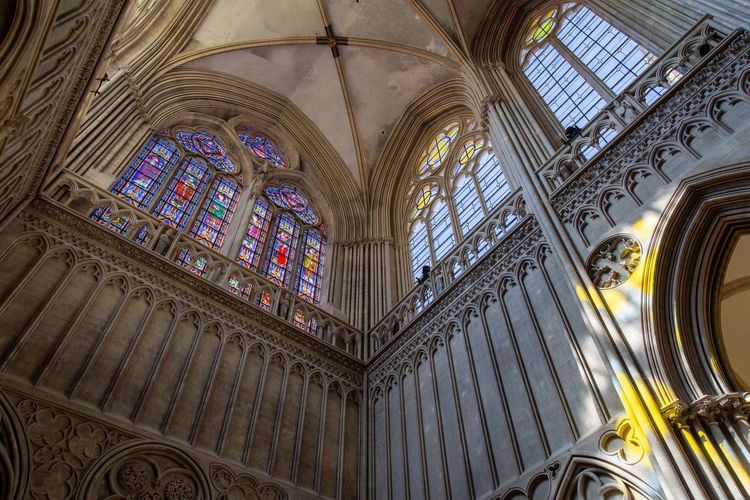
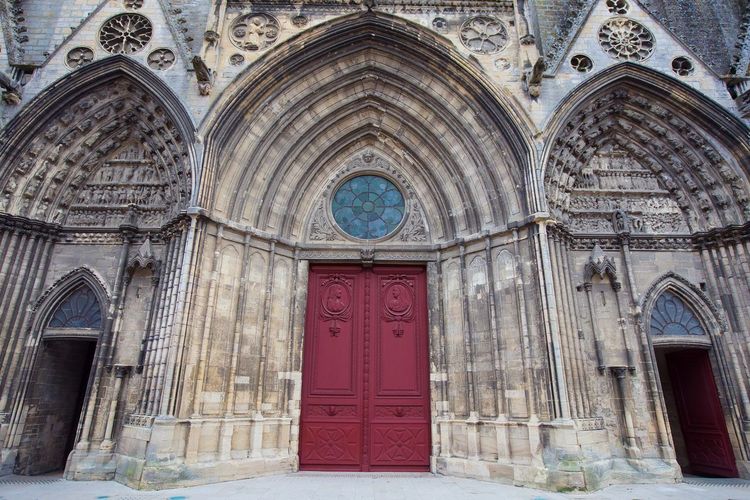
At the heart of the old city stands Bayeux Cathedral (Rue du Bienvenu, 14400 Bayeux, rated 4.7/5 on Google based on 8,364 reviews), a Norman Gothic nave consecrated in 1077 and extensively remodeled in the 13th and 14th centuries. The two façade towers still retain their original Romanesque base.
The interior rewards those who look up at the nave, whose Romanesque arcades are covered in sculpted motifs, and then venture down into the 11th-century crypt, decorated with 15th-century frescoes depicting musical angels. It was in this very cathedral that the tapestry was once displayed, hung around the nave during the Feast of Relics each summer.
You can visit the cathedral free of charge year-round. Take the time to walk around the exterior: it is from behind the building, between the buttresses, that you best appreciate the scale of the Gothic chevet.
Wandering Through Vieux Bayeux: Lanes, Mills, and Markets
The Vieux Bayeux stretches between the cathedral and the Aure river, a network of cobbled lanes where half-timbered houses stand alongside limestone townhouses. The mills that once lined the Aure were used to grind grain and tan hides; some have kept their wheel, visible from the small bridges that cross the river.
In terms of local life, Bayeux remains a lively town despite its modest size: independent shops, antique galleries, and cafés fill the ground floors of the center, and the atmosphere shifts noticeably depending on the day. Two markets punctuate the week: Wednesday morning on Rue Saint-Jean, and Saturday morning on Place Saint-Patrice (Place Saint-Patrice, 14400 Bayeux), the larger of the two, with farm produce, Norman cheeses, cider, and fresh fish from the coast. In summer, a craft market also sets up on Thursday evenings in front of the town hall.
To map out your itinerary in advance, our walking tour of Vieux Bayeux suggests a loop taking in the half-timbered houses, the banks of the Aure, and the cathedral, with all the key landmarks along the way.
Musée Baron Gérard and the Lace Conservatory: Artisanal Bayeux
Housed in the former bishop's palace, right next to the cathedral, the Musée Baron Gérard (MAHB) brings together paintings, lace, and ceramics. Its collection of Bayeux porcelain, produced in the city from the early 19th century to the mid-20th century, is among the most complete in existence. Until September 2027, it also hosts part of the "De lin et de laine" exhibition.
A short walk away, in the Maison d'Adam et Ève, a carved half-timbered façade, the Bayeux Lace Conservatory (6 Rue du Bienvenu, 14400 Bayeux, rated 4.5/5 on Google based on 43 reviews) keeps alive a craft passed down by the city's lacemakers since the 17th century. The lacemakers work in public, Monday to Saturday, giving demonstrations of needle lace and bobbin lace. Admission is free: take the opportunity to ask them questions while they move the bobbins across the pillow, a gesture that takes years to master.
In the Footsteps of D-Day: Beaches, the British Cemetery, and the Memorial Museum
Bayeux is considered the first city in metropolitan France to have been liberated, on 7 June 1944, the day after the Allied landings on the nearby beaches. A week later, on 14 June, General de Gaulle delivered his first speech on liberated French soil there, on the Place du Château, since renamed Place Charles-de-Gaulle.
The Musée Mémorial de la Bataille de Normandie traces, through uniforms, armored vehicles, and everyday objects, the 76 days of fighting that followed D-Day until the liberation of the region. The rooms follow a precise chronology that helps visitors understand the scale of the operation beyond the images of 6 June alone.
Opposite the museum lies the Bayeux British Military Cemetery, the largest British cemetery of the Second World War in France: 4,648 graves, including 3,935 British soldiers, as well as Canadians, Poles, and 466 German soldiers. The headstones are arranged among lawns and rose bushes in a silence that contrasts sharply with the bustle of the nearby center. On the other side of the boulevard, the memorial bears the names of more than 1,800 Commonwealth soldiers with no known grave. Read the Latin inscription on the pediment: it recalls that those whom William had conquered came back to liberate the Conqueror's land.
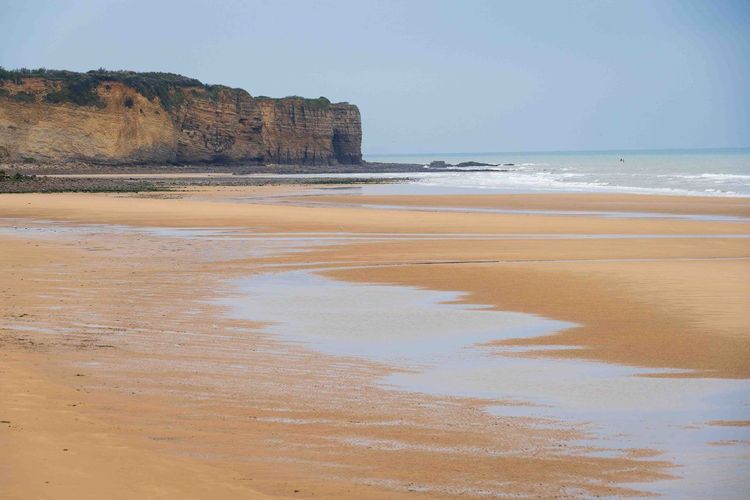
If time allows, extend the day to the beaches themselves. About fifteen minutes to the north, Arromanches still has in the sea the caissons of the artificial harbour built by the Allies to land men and equipment. Further west, Omaha Beach (Saint-Laurent-sur-Mer, 14710 Colleville-sur-Mer, rated 4.7/5 on Google based on 7,069 reviews), between Vierville, Saint-Laurent, and Colleville-sur-Mer, is a twenty-minute drive away: its long sandy beach, overlooked by the American cemetery, offers a much more physical experience than the museum.
A practical tip: visit the memorial museum in the morning, then the cemetery just across the road, before driving to the coast in the afternoon. That way you will have the context fresh in your mind when you walk on the sand.
Nature Around Bayeux: Botanical Garden, the Aure Valley, and the Maze
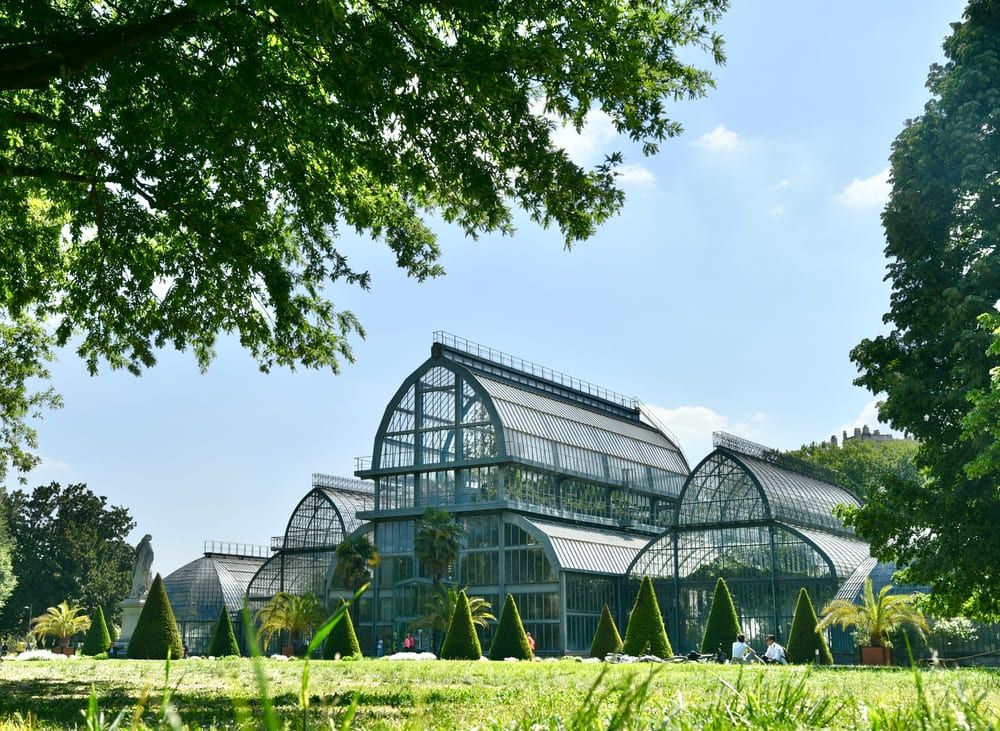
After a morning packed with history, the Bayeux Botanical and Historical Garden offers a genuine break. Created in 1859 and opened to the public in 1864, this 2.6-hectare landscaped park, designed by the Bühler brothers (also responsible for the Parc de la Tête d'Or in Lyon), is home to around 400 trees. Its star is a weeping beech listed as a natural monument since 1932 and recognized as a remarkable tree of France. Admission is free.
The Aure Valley nature trail (Rue de la Résistance, 14400 Bayeux, rated 4.7/5 on Google based on 78 reviews) forms a loop of around 2 kilometers along the river, right in the heart of the city, passing through small waterways and wetlands. An easy nature walk that lets you see Bayeux from a very different angle to that of the cobbled streets.
The Bayeux maze, the Laby'parc, is actually located in Mosles, about fifteen kilometers to the west: this corn maze, open during the summer season, promises around two hours of fun and getting lost.
What to Do in Bayeux with Children
Bayeux lends itself well to a family weekend, as long as you vary the pace. The city treasure hunt is played on a tablet: families solve puzzles as they move from street to street. The Le Baj'O orienteering courses add a sporty dimension, and the aquatic center is a useful backup on rainy days.
On the heritage side, go for shorter formats: the free demonstrations at the lace conservatory, a pause beneath the weeping beech, then the immersive tapestry experience at the Hôtel du Doyen from December 2026, which is free for children under 10.
Day Trip to the Châteaux of the Bessin: Balleroy, Colombières, and Fontaine-Henry
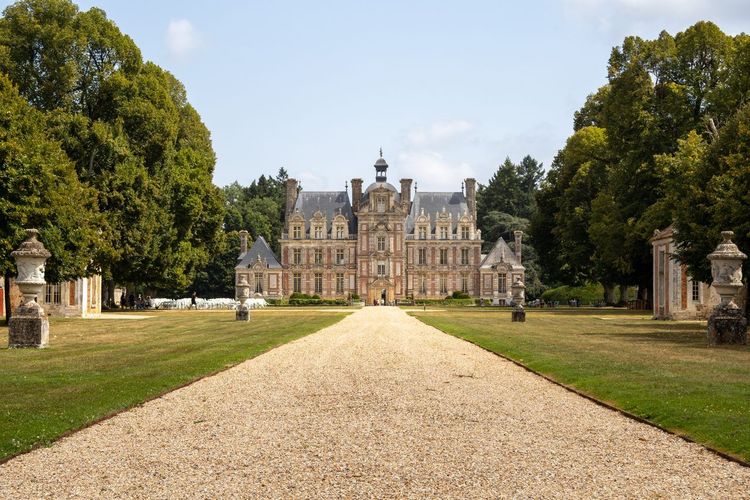
The Bessin, the countryside surrounding Bayeux, is home to three châteaux each worth a half-day trip by car from the center.
The Château de Balleroy, about twenty minutes to the southwest, was built from 1631 by François Mansart. It houses a balloon museum, a tribute to its former American owner Malcolm Forbes, who had a passion for hot-air balloons. The château is open from April to early November, with a park and a tearoom.
The Château de Colombières, between Bayeux and Isigny-sur-Mer, is one of the most remarkable feudal fortresses in Lower Normandy, listed as a historic monument. Its history spans the centuries through to 1944, when it became the first Allied psychological warfare center. Guided tours take place from July to September (7 euros for adults).
Finally, the Château de Fontaine-Henry (2 Route de Douvres, 14610 Fontaine-Henry, rated 4.3/5 on Google based on 1,067 reviews), about half an hour to the east, blends Gothic and Renaissance styles. Its "great pavilion" features a roof that rises to nearly 15 meters, earning it the reputation of having the tallest roofline in France. It is the most photogenic of the three, and the one to prioritize if you can only choose one.
A Day in Caen, the Perfect Companion Trip
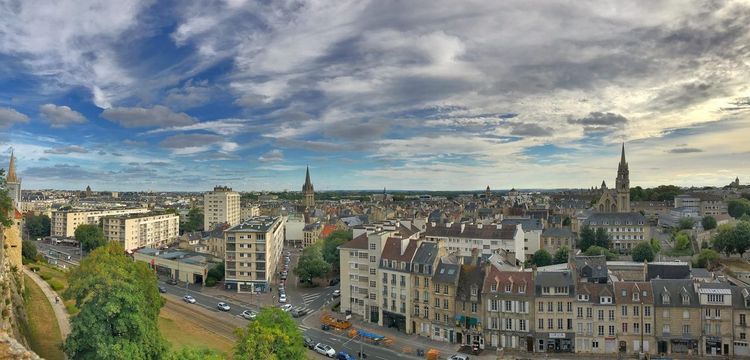
Caen is about twenty minutes from Bayeux by train, half an hour by car, making it an easy add-on to a weekend that stretches to three days. The city was largely rebuilt after 1944, but several major monuments survived the fighting.
The Caen ducal castle, founded by William the Conqueror around 1060, forms one of the largest fortified enclosures in Europe. Access is free and you can walk along the ramparts and enjoy an open view over the city.
A few streets away, the Abbaye aux Hommes (Esplanade Jean-Marie Louvel, 14000 Caen, rated 4.6/5 on Google based on 5,547 reviews) houses the tomb of William the Conqueror himself, a fitting way to bring full circle the story begun on the tapestry. If time permits, the Mémorial de Caen, dedicated to the Second World War and to peace, rounds off the day nicely in echo of the memorial museum in Bayeux.
To connect these sites without a map in hand, launch the Ryo audio tour of Caen: 22 audio tracks along a 4.6 km loop, taking around 1h50, from the ducal castle to the abbeys of William and Matilda.
Where to Stay and Where to Eat in Bayeux
For a weekend in Bayeux, it is best to stay in the historic center: everything is then within walking distance, including the walk back from a restaurant in the evening. Boutique hotels housed in former manor houses, such as the Hôtel d'Argouges, an 18th-century townhouse, offer rooms at prices that remain reasonable out of season.
For those on a tighter budget, several bed-and-breakfasts on the immediate outskirts of the center offer a good balance between tranquility and proximity to the sites. In high season, book at least a month in advance: Bayeux's hotel capacity is modest for a city that attracts so many visitors.
On the restaurant side, the Lion d'Or, a former coaching inn on Rue Saint-Jean, serves classic Norman cuisine, while La Rapière (53 Rue Saint-Jean, 14400 Bayeux, rated 4.8/5 on Google based on 652 reviews), tucked away in a courtyard near the same street, focuses on local produce and a menu that changes with the seasons. Be sure to book on Saturday evening.
Planning Your Stay: Getting There, Getting Around, and When to Go
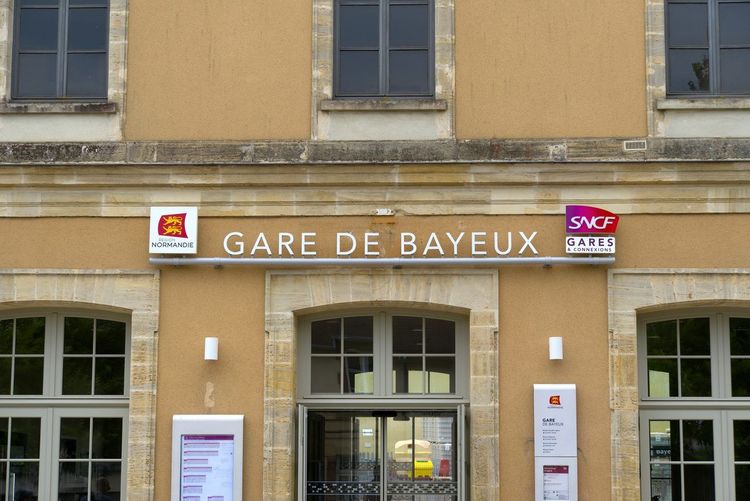
How to get to Bayeux? By train, allow around 2h20 from Paris Saint-Lazare on the fastest services, with tickets from 16 euros, and fifteen to twenty minutes from Caen. By car, Bayeux is about 270 kilometers from Paris, roughly 3 hours via the A13.
Once there, leave the car behind: getting around Bayeux without a car is straightforward, the station is a quarter of an hour's walk from the center and all the heritage sites are easily linked on foot. Exploring Bayeux by bike is also a pleasant option: electric bike rental companies will deliver directly to your accommodation, which is handy for reaching the coast.
This low-impact approach fits in with the low-carbon travel ethos that the region promotes: arrive by train, get around on foot or by bike, and keep the car for excursions to the châteaux of the Bessin, which are poorly served by public transport. If you add a third day, the train drops you in Caen in twenty minutes, where the Ryo audio tour launches directly from your phone, with no booking required.
On the events front, the city and its surroundings are shaped by a regular calendar of highlights: the D-Day Festival Normandy (free) around 6 June, medieval festivals in summer, the European Heritage Days in September, and the "Rue Panoramique" cultural events in Arromanches. Check the Bayeux Bessin tourist office calendar before you go if any of these dates interest you.


FAQ
How much time do you need to visit Bayeux?
One full day is enough to cover the historic center (cathedral, Vieux Bayeux, museums, botanical garden). Allow a second day if you want to add the D-Day beaches, the châteaux of the Bessin, or a trip to Caen.
Can you see the Bayeux Tapestry in 2026?
Not in Bayeux: the museum is closed for renovation until autumn 2027 and the work is on display at the British Museum in London from 10 September 2026 to 11 July 2027. On site, the exhibition "De lin et de laine" and themed guided tours take over.
What is the best way to get to Bayeux from Paris?
The train from Paris Saint-Lazare is the simplest option, with a journey of around 2h20 on the fastest services to Bayeux station, which is a quarter of an hour's walk from the center.
Can you visit Bayeux without a car?
Yes, with no difficulty for the city center: all the heritage sites are within walking distance of each other. A car, an electric bike, or an organized excursion becomes useful for the D-Day beaches and the châteaux of the Bessin.
What budget should you plan for a weekend in Bayeux?
Budget between 150 and 300 euros per person for two days, including accommodation and meals, depending on your standard of comfort. Several attractions are free (cathedral, botanical garden, lace conservatory), which helps keep costs down.
When should you visit Bayeux to avoid the crowds?
Spring and early autumn offer a good balance between pleasant weather and moderate crowds. June, due to the D-Day commemorations, and the height of summer attract the most visitors.
What can you see around Bayeux in a day?
The beaches at Arromanches and Omaha Beach, combined with the memorial museum and the British cemetery, make for a coherent day out. The châteaux of the Bessin and Caen are two other options depending on your interests.
Where should you stay in Bayeux for a weekend?
Choose accommodation in the historic center so you can do everything on foot. Hotels housed in former manor houses and bed-and-breakfasts on the immediate outskirts offer the best balance between peace and proximity to the sites.
A weekend in Bayeux comes together effortlessly: a compact historic center for the first day, then a choice between the sea, châteaux, or Caen for the second. Even without the tapestry until 2027, the combination of medieval heritage, D-Day memory, and wide Norman landscapes makes the city just as enjoyable to explore over two days as over a long weekend.
If you extend your stay, the Ryo audio tour of Caen completes the story begun in Bayeux: 22 tales to listen to with headphones on, in the footsteps of William the Conqueror and Matilda.
À lire également