© Shutterstock
 Votre guide Ryo
Hilltop Villages, Artists' Villages: the Most Beautiful around Nice in 2026
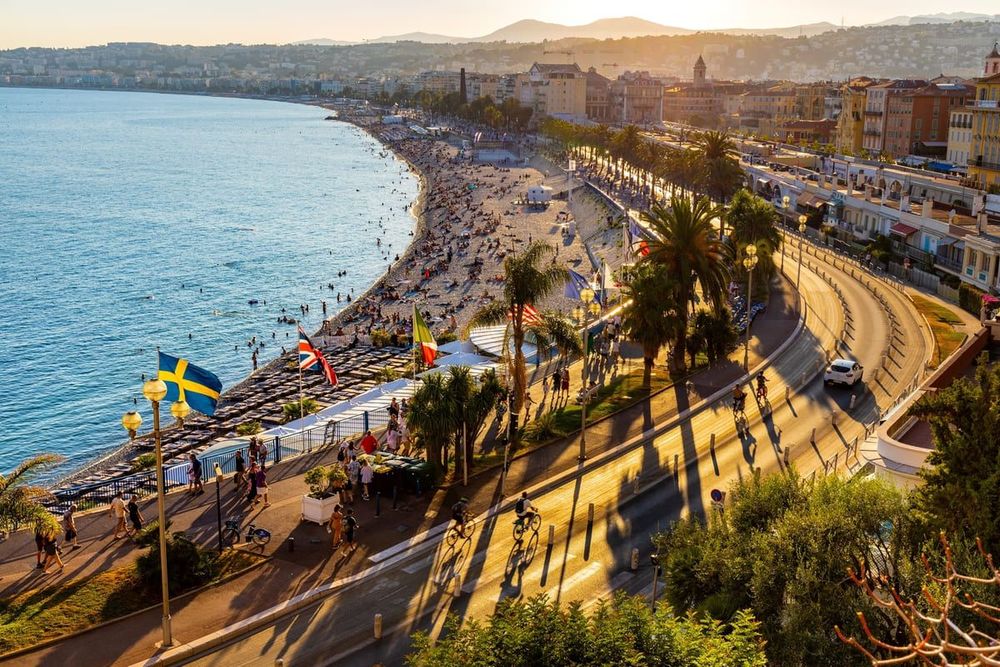
Just fifteen kilometers from the Promenade des Anglais, the hills change everything: palm trees give way to century-old olive trees, apartment blocks disappear, and golden limestone alleyways suspended above the Mediterranean come into view. This is where the most beautiful villages around Nice are hidden: more than thirty hilltop communes within an hour's drive, a density of historic villages that few corners of France can envy of the Nice region.
In the pages that follow, you will discover thirteen of the most beautiful villages around Nice, from the unmissable Èze, suspended at 429 metres above the sea, to the little-known Coaraze decorated with sundials designed by Cocteau, by way of the alleyways where Picasso spent his last twelve years and the village that Nietzsche used to climb on foot from the shore. Before leaving Nice, the Ryo audio-guided tour of Nice gives you the keys to understanding the mother city: 27 audio tracks, 7.1 km of walking and an introduction to Niçois culture that you will recognise in every bell tower and every fountain in the hinterland.
Villages of the Nice Corniche: Èze, La Turbie, Roquebrune
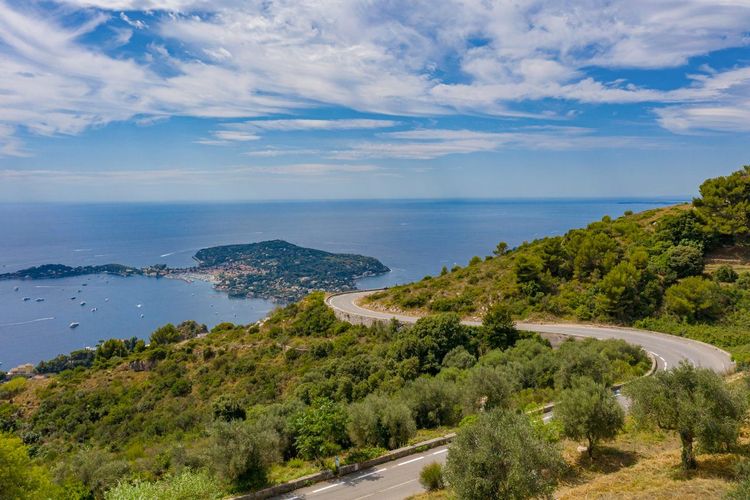
The Moyenne Corniche and the Grande Corniche connect Nice to Menton along vertiginous cliffs. Along this coastal route, three villages deserve a stop: they combine panoramas over the Mediterranean, Roman and medieval monuments, and a very variable tourist density — Èze attracts crowds that its two neighbours barely know.
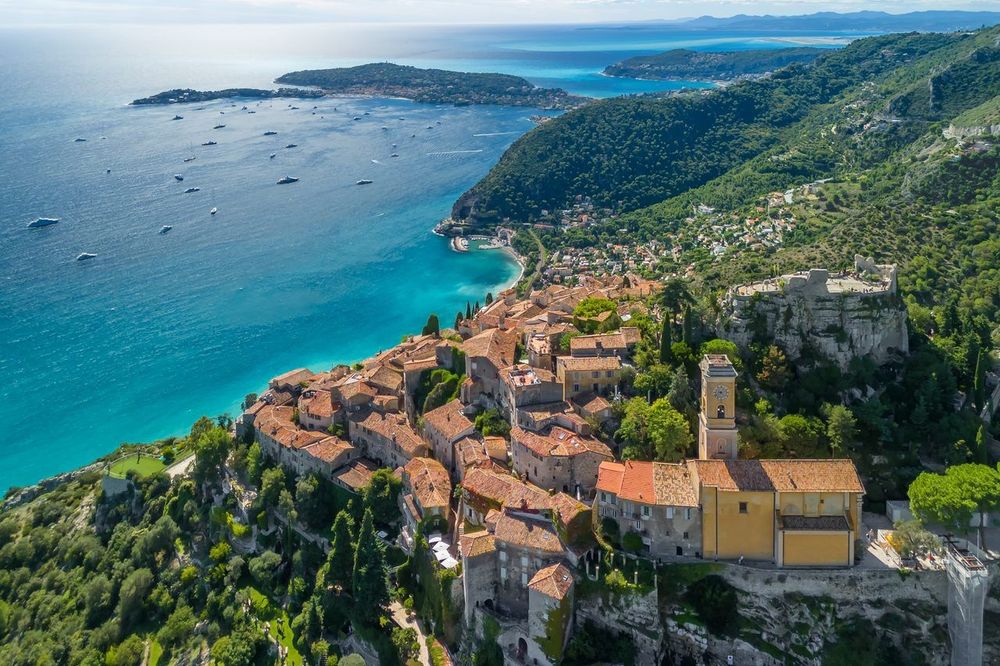
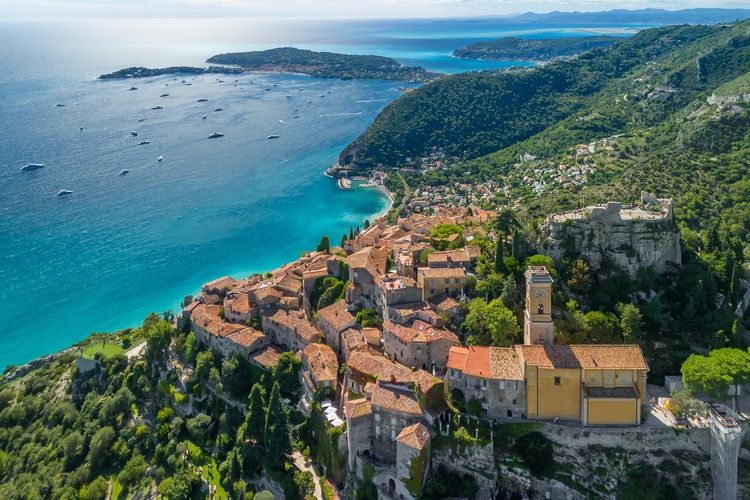
Èze is the most visited hilltop village in the Alpes-Maritimes, and for good reason. Clinging to 429 metres above the sea, it offers one of the most breathtaking panoramas on the Côte d'Azur: on a clear day, you can make out Corsica to the east and the snow-capped Alps to the north. The medieval village winds through a labyrinth of vaulted grey-stone alleyways, all climbing towards the Exotic Garden that crowns the former fortress. Allow 1h30 to 2h for a complete circuit, longer if you browse the craft shops and perfumery workshops. The Fragonard perfumery has a boutique here, but it is above all the view from the summit belvedere that justifies the effort of the climb.
Nietzsche loved this path so much that he used to walk it from Eze-sur-Mer — it is now known as the "Chemin de Nietzsche", a 45-minute hike from the seafront that leads directly into the old village. Set off before 9am or after 4pm in summer to avoid the crowds. Outside these peak times, even at the height of the season, there are still quiet, shady corners between groups of visitors.
Some 8 kilometres away, La Turbie is the perfect antidote to Èze's congestion. Perched at nearly 500 metres, this commune of 3,400 inhabitants has dominated Monaco from a strategic position the Romans understood well. Its landmark monument, the Trophée des Alpes (Avenue Albert 1er, 06320 La Turbie, rated 4.5/5 on Google with 1,393 reviews), is one of the best-preserved Roman monuments in Europe: erected in 6 BC on the orders of Augustus to commemorate his victory over 45 Alpine peoples, it originally stood 50 metres tall. The adjoining museum displays the original fragments and reconstructs the building as a model with remarkable precision. The village itself is compact and quiet — a handful of limestone alleyways, a Baroque church and a panoramic terrace overlooking Monaco are worth the detour on their own.
Roquebrune-Cap-Martin completes this Corniche trio. Its 10th-century castle, one of the oldest in France still standing, dominates a compact medieval village of stepped alleyways carved into the rock. In the old village, a thousand-year-old olive tree whose origins the locals trace back to the Carolingian era stands in the middle of a shaded little square. The "Cap-Martin" section is distinct: a residential and upmarket seafront where Le Corbusier built his tiny "Cabanon" in 1952, listed as a UNESCO World Heritage Site since 2016. For combining a medieval castle with a coastal hike in the same day, Roquebrune is the most versatile village on the Corniche.
The Nice Hinterland: Peillon, Peille, Aspremont, Coaraze
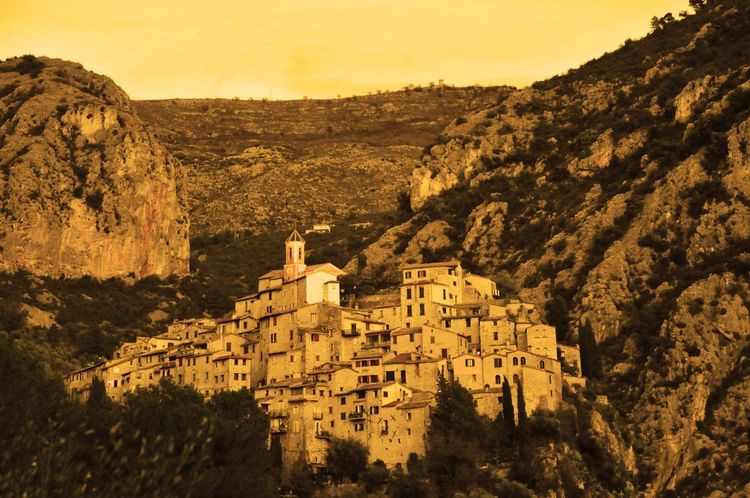
The Paillon valley and its tributaries conceal four villages that classic tourist circuits almost never mention. That is precisely their appeal. Our Ryo guide to the Nice hinterland describes this region well: a succession of hilltop villages that have come through the centuries in mutual isolation, each on its own rocky outcrop, each with its own distinct character.
Peillon regularly features in selections of the region's most beautiful hilltop villages, and the reputation is fully deserved. Perched at 376 metres in a bend of the Paillon, it has only about thirty year-round inhabitants. From the compulsory car park at the foot of the village, a single alleyway climbs to the summit: no cars, no shops inside, no souvenir stalls. The Chapelle des Pénitents Blancs preserves 15th-century Gothic frescoes attributed to Giovanni Canavesio, a treasure that few visitors truly see, as the chapel only opens on request at the town hall. Peillon is best visited slowly: an hour and a half is enough to walk through it, but you often feel like sitting on a low wall and doing nothing but watch the swallows circle the bell tower.
Some 15 minutes from Peillon, Peille is even more forgotten, and even more authentic. At 630 metres of altitude, this village has kept its medieval fountains, its 13th-century arcades and a small square with a wash-house still in use. On clear days, the view stretches to the sea from the upper alleyways. The parish church contains a remarkable altarpiece depicting Peille in the 15th century — one of the rare topographical representations from the Middle Ages for a village in the Alpes-Maritimes. On weekdays, outside July and August, you can find yourself entirely alone there for hours.
Aspremont is the closest village to Nice in this selection: just 20 minutes from the city centre. Dominating the lower Var valley at 560 metres, it offers a panorama that few guides mention: the whole of Nice at its feet, the Baie des Anges on either side, and the first Alpine peaks on the northern horizon. The ruined castle crowns the medieval town, and the arcaded alleyways display architecture typical of the pre-Napoleonic county of Nice. Its proximity to the city makes it an excellent option for the start or end of a day, without committing to a long mountain road.
Finally, Coaraze fully lives up to its reputation as the "village of the sun". At 640 metres in the upper Paillon valley, it owes its nickname not only to its microclimate — more than 300 sunny days a year — but also to its unique collection of ceramic sundials scattered across the facades of the houses. Jean Cocteau personally signed one of them during a visit in the 1950s. Around a small square shaded by a century-old cedar, the alleyways rise between houses with pastel shutters. It is one of the few hinterland villages to have maintained a genuine village life: a grocery, a restaurant, a few craftspeople.
The Artists' Villages: Saint-Paul-de-Vence, Mougins, Hauts-de-Cagnes
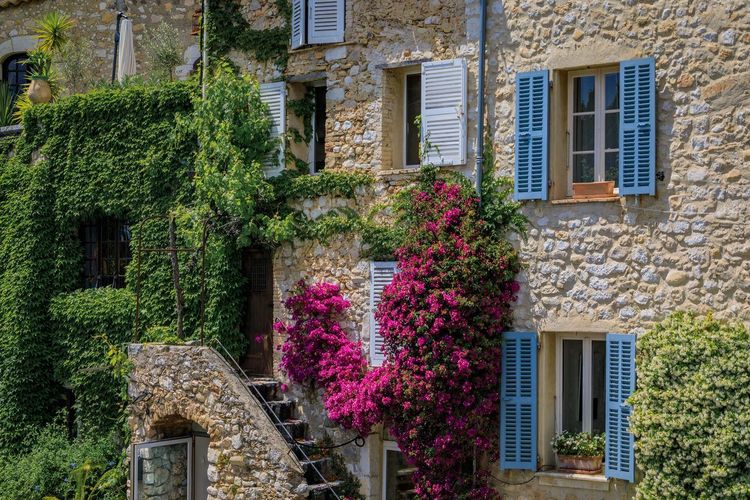
The Nice hinterland held a particular fascination for 20th-century artists. Mediterranean light, timeless villages, affordable prices in the interwar years: three communes concentrated this creative effervescence to the point of bearing its indelible mark today.
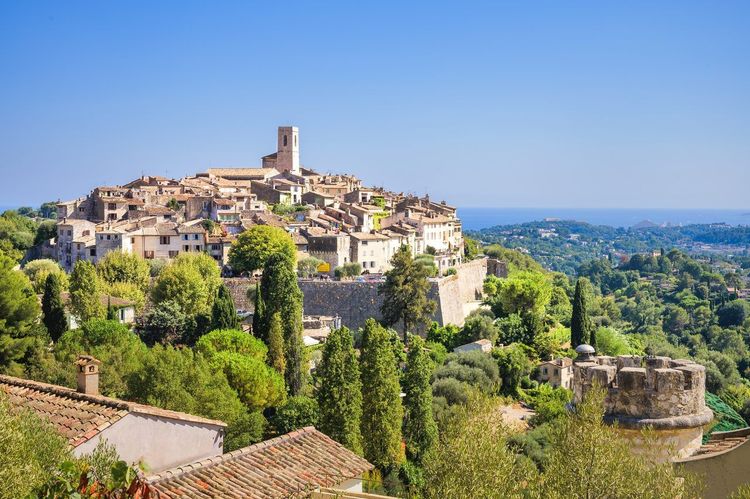
Saint-Paul-de-Vence is the most celebrated art village in the region. Its 16th-century ramparts, built under François I to defend the kingdom of France's border with the Duchy of Savoy, surround a village that was home in succession to Matisse, Chagall, Prévert, Léger and Picasso. The main alleyway overflows with contemporary art galleries, potters' studios and designer boutiques. Do not miss the village cemetery at the exit of the ramparts: Marc Chagall is buried there, and his grave is often adorned with spontaneous bouquets left by visitors from around the world.
Above all, reserve a half-day for the Fondation Maeght, just 500 metres from the village: inaugurated in 1964, it is one of the most important modern art foundations in Europe, with works by Miró, Giacometti and Braque integrated into an exceptional sculptural park. Josep Lluís Sert's architecture blends raw concrete and Mediterranean light in a constant dialogue between interior space and garden. Admission costs around €20, and a visit easily lasts 2 hours. Many visitors leave saying it is the best modern art museum they have ever seen — the setting has a great deal to do with that.
Some 30 minutes from Nice via the A8, Mougins was still a farming village in the 1930s when painters began to make their way up here. Picasso spent the last 12 years of his life here (1961–1973), and several houses in the old village bear commemorative plaques. Vieux-Mougins, with its white limestone alleyways, its 15th-century tower and its flower-filled terraces, is worth the climb, as is the Photography Museum, which presents portraits of Picasso by Dora Maar, Brassaï and other photographers of the Parisian era. Mougins is also one of the gastronomic capitals of the region: several Michelin-starred restaurants are established here, and the commune hosts the "Les Étoiles de Mougins" festival every September.
The Hauts-de-Cagnes form the medieval part of Cagnes-sur-Mer, a coastal commune often overlooked in favour of its neighbours. The village perched on the hill conceals a remarkable Château Grimaldi (Place Grimaldi, 06800 Cagnes-sur-Mer, rated 4.5/5 on Google with 617 reviews): built in the 14th century by Rainier Grimaldi of the Monaco family, converted into a Renaissance château in the 17th century, it now houses a museum dedicated to contemporary Mediterranean art. A few minutes away, Pierre-Auguste Renoir lived in Cagnes-sur-Mer from 1907 until his death in 1919: his house, "Les Collettes", has become a museum where you can see his intact studio, his last paintings produced despite arthritis, and the olive trees he depicted hundreds of times. Two visits to combine in the same half-day.
The Secret Villages of the Middle Country: Sainte-Agnès, Gourdon, Tourrettes-sur-Loup
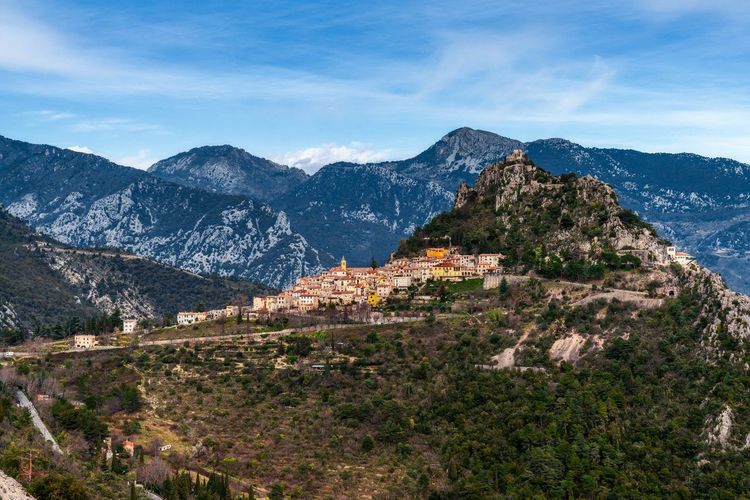
A few extra kilometres beyond the immediate hinterland, and the villages change in character. You climb higher, move further from the coast, and the crowds thin out proportionally. These three villages require between 40 minutes and 1 hour of driving from Nice, but each offers something impossible to find lower down.
Sainte-Agnès lays claim to the title of "highest coastal village in Europe" at 780 metres of altitude. The village is tiny — a few hundred inhabitants — and the alleyways are so narrow that all motor traffic is excluded. The view over the Principality of Monaco, the sea and the coastline as far as Italy on a clear day is truly breathtaking. But Sainte-Agnès's great surprise is hidden beneath the houses: the underground fort of the Alpine Maginot Line, blasted directly into the rock in the 1930s, extends 100 metres underground with its galleries, artillery pieces and soldiers' dormitories preserved exactly as they were. The approximately 45-minute guided tours reveal a remarkable military architecture completely overlooked by classic tourist circuits. This place alone is worth the journey.
Gourdon asserts itself from its rocky promontory at 760 metres as one of the most vertiginous panoramas in the region. Perched above the Gorges du Loup, it dominates a valley 400 metres deep on one side and the Mediterranean on the other — a double view that leaves you speechless at first sight. The village itself is narrow and elongated along the ridge: a single main street with a few craft shops specialising in local honey, olive oil and dried aromatic plants. The Château de Gourdon from the 12th century (privately owned, partially open to visitors) and its formal French gardens laid out in the 17th century offer the best panoramic terrace in the village. On the way to Gourdon, the Gorges du Loup are worth a stop: waterfalls, ochre-coloured limestone walls and a corniche road combine to create a high-mountain landscape just 45 minutes from the beach.
Tourrettes-sur-Loup is the least vertiginous of this trio — the village sits on a plateau at 400 metres — but one of the best architecturally preserved. The medieval houses that form the village's facade serve as a natural rampart: built back to back, their outer walls form a continuous enclosure pierced by a few gateways. Inside, the Grande Rue runs through the village from end to end beneath vaults and covered passageways. Tourrettes is known as the French capital of violets: since the 19th century, local growers have produced violets for the Grasse perfumery industry, and the Fête des Violettes in March transforms the village into a carpet of mauve flowers. Outside that period, the village remains calm and well shielded from the tourist masses.
What to Bring Back from the Hilltop Villages: Crafts and Local Products
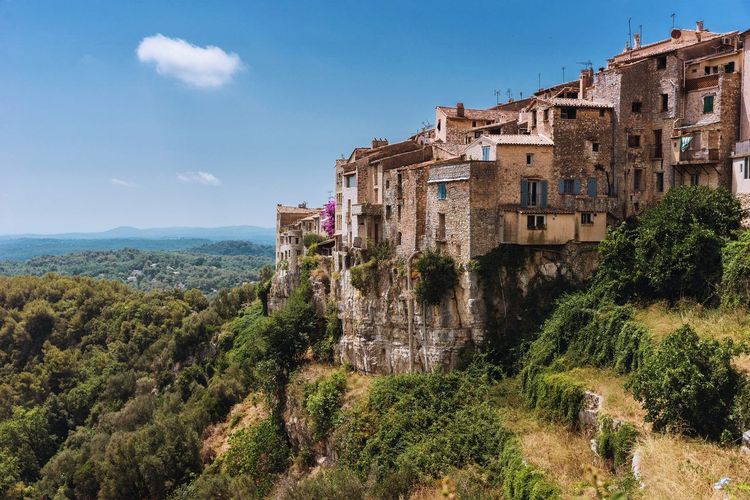
Each village has its speciality, and leaving with your hands full is part of the pleasure. In Tourrettes-sur-Loup, the violet capital, producers offer the flower in every conceivable form: syrup, crystallised sweets, jam, eau de toilette. Several workshops open their doors to the public and sell direct. In Èze, the Fragonard perfumery offers soaps, colognes and candles in its boutique, while the workshops of the old village line up pottery and handcrafted jewellery.
In the middle country, Gourdon has built a reputation around local produce: lavender and chestnut honey, olive oil from the Loup valley, floral waters and dried aromatic plants fill the shops along the main street. Saint-Paul-de-Vence concentrates art galleries and ceramicists' studios, in keeping with the pottery tradition of the Vençois countryside. And throughout the hinterland, village markets sell farmhouse goat's cheeses, garrigue honeys and olives from the latest harvest, often at prices far gentler than on the coast.
Village Festivals and Markets: the Calendar to Know
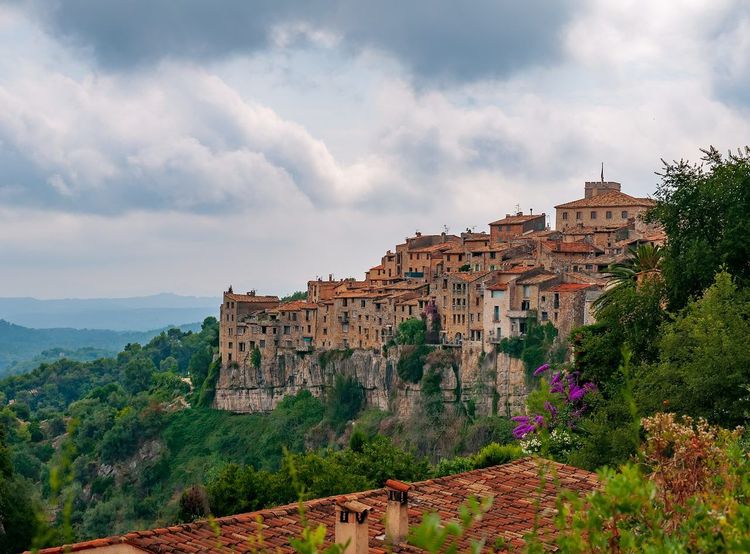
The hilltop villages take on a completely different dimension on festival days. In March, the Fête des Violettes in Tourrettes-sur-Loup transforms the village into a carpet of mauve flowers, with a floral parade, violet battles and a flower market — it is the most photogenic event in the hinterland. In September, Mougins hosts "Les Étoiles de Mougins", a gastronomy festival bringing together chefs from across France for open-air demonstrations and tastings.
In summer, almost every village celebrates its patron saint's day: processions, communal meals and dances in the square outside the church — all moments where you truly get to meet the locals. For markets, favour the mornings: Saint-Paul-de-Vence, La Turbie and Sainte-Agnès hold weekly markets where local produce and crafts sit alongside fresh fruit and vegetable stalls. Check exact dates with the Nice Côte d'Azur metropolitan tourist office before planning your day, as village festivals often fall on the weekend closest to the patron saint's date.
How to Organise Your Day Trips from Nice
The geography of the Alpes-Maritimes naturally lends itself to loop itineraries from Nice. Here is how to group the villages to avoid doubling back.
Corniche Loop (half-day to full day): Nice → Èze → La Turbie → Roquebrune-Cap-Martin. The Moyenne Corniche (D6007) then the Grande Corniche (D2564) connect these three villages in barely 40 km. Take the Grande Corniche on the way out for the views, and return along the seafront for variety.
Paillon Loop (full day): Nice → Aspremont → Coaraze → Peillon → Peille → return. This loop of around 90 km through the Paillon valley is the wildest in the region. The roads are narrow and winding — not recommended with a large vehicle. Start early, as village restaurant hours are strict.
Artists' Loop (half-day to full day): Nice → Hauts-de-Cagnes → Saint-Paul-de-Vence → Mougins → return via the A8. The road first follows the coast before heading inland. Allow at least 2 hours at Saint-Paul between the village and the Fondation Maeght — it is hard to do less.
Middle Country Loop (full day): Nice → Gourdon → Gorges du Loup → Tourrettes-sur-Loup → Sainte-Agnès → return via Menton. A grand circuit of 130 km combining altitude, gorges and coastline in a single day. By car, all these villages are easily accessible. For organised excursion options without driving in the mountains, our Ryo guide to activities around Nice lists the excursions available from the city. Before taking the wheel, our Nissa la Bella audio walking tour covers 7.1 kilometres from Port Lympia to the old town.
The Best Season to Visit the Hilltop Villages
The villages around Nice are accessible year-round, but each season has its own particular advantages.
Spring (March–May): the ideal season. Almond and cherry trees blossom in the valleys, temperatures are mild — 15 to 22°C in Nice, 5 to 8°C cooler at altitude — and tourists have not yet overrun the villages. The Fête des Violettes in Tourrettes-sur-Loup in March is worth the trip on its own.
Summer (June–August): high season at Èze and Saint-Paul-de-Vence, which become difficult to appreciate between 10am and 4pm. The hinterland villages — Peillon, Coaraze, Gourdon — remain noticeably quieter. Temperatures at altitude are perfect: 8 to 10°C cooler than on the coast, which makes all the difference for a long walk.
Autumn (September–November): the second-best period. The light is golden, the crowds have left Èze and Saint-Paul, and local markets overflow with mushrooms, fresh olives and chestnuts. Some museums and restaurants begin to close from November onwards — check before making the trip.
Winter (December–February): some middle-country villages may be difficult to access after a snowfall. But a hilltop village under snow, with the blue sea below, is a vanishingly rare sight that makes it worth taking the risk in fine winter weather.
Where to Eat in the Hilltop Villages
Dining in the hilltop villages of the Alpes-Maritimes ranges from the authentic village table to the restaurant overcharging for its sea view. Here is how to find your way.
In Èze, almost all restaurants in the old village charge high prices (menus from €35 to €40). The exception: a few pizzerias at the entrance to the village offer reasonable set menus. For a special dinner, the restaurant of the Château de la Chèvre d'Or hotel is exceptional, but reservations must be made several weeks in advance in summer, and the price matches the reputation.
In La Turbie, value for money is much better. The main square concentrates unpretentious cafés and Provençal restaurants with views over the Trophée des Alpes. It is one of the best lunch options in any village along the entire Corniche.
In Saint-Paul-de-Vence, the main alleyway is overrun with tourist restaurants. Look for the side streets running perpendicular — far less crowded. La Colombe d'Or, with its collection of artworks offered in exchange for board and lodging by 20th-century artists, remains an institution of the Côte d'Azur, even if the bill has followed the reputation.
In Mougins, the commune hosts the "Les Étoiles de Mougins" festival every September, bringing together chefs from across France — which reflects the general standard: several Michelin-starred restaurants sit alongside quality brasseries in the old village. The cuisine leans decidedly towards the gastronomic.
In the hinterland villages — Peillon, Coaraze, Aspremont, Peille — the choice is limited but often excellent: an inn, a café-restaurant offering a daily set menu at €15 to €18 with seasonal local produce. Call ahead before making the trip, especially outside the season. For authentic Niçois cuisine — socca, pissaladière, pan bagnat — stay in the city itself. Our Ryo guide to the culinary specialities of Nice details the essential addresses.
Transport and Parking: What You Need to Know
By car, this is the most practical mode of transport for visiting several villages in a day. Most access roads are narrow and winding — avoid large SUVs and campervans if possible. Village car parks (often free or €2 to €3 per day) fill up quickly in July and August: arrive before 9.30am or after 4pm.
By bus, the Lignes d'Azur network serves several villages from Nice:
- Line 112: Nice → Peillon → Peille
- Line 400: Nice → Saint-Paul-de-Vence → Vence
- Line 82: Nice → La Turbie
- Line 83: Nice → Èze (village)
Frequencies are limited — generally 2 to 4 return trips per day depending on the line — and the last return bus times may restrict your visits. Check the return timetable before you set off.
By train, the Nice–Tende line (nicknamed the "Train des Merveilles") stops at Peillon-Sainte-Thècle, a 20-minute walk from the village of Peillon (Route de Peillon, 06440 Peillon, rated 4.5/5 on Google with 23 reviews). This is the most practical car-free option for this village.
By taxi or ride-hailing, the fare from Nice ranges from €25 to €60 depending on the destination. For visiting several villages in a day, a daily car rental (from €35 to €50) remains more economical. Hikers will note that several villages are connected by waymarked trails of the GR 51 and GR 510, which cross the entire Nice hinterland.



FAQ
Which is the most beautiful village around Nice?
The answer depends on what you are looking for. Peillon is regularly cited as the most authentic and best-preserved, with its 15th-century Gothic frescoes and permanent residents. Èze offers the most spectacular panorama over the Mediterranean. Saint-Paul-de-Vence is the richest culturally, with the Fondation Maeght. And La Turbie remains the best compromise between Roman history, views over Monaco and the absence of tourist crowds. If you can only choose one: Peillon for authenticity, Èze for the sense of vertigo.
How do you get to the hilltop villages without a car?
Several villages are accessible by the Lignes d'Azur bus network from Nice: line 112 serves Peillon and Peille, line 82 reaches La Turbie, line 83 goes up to the village of Èze, and line 400 passes through Saint-Paul-de-Vence. Frequencies are limited, however, generally 2 to 4 return trips per day, and the last bus times may restrict you to short visits. The Train des Merveilles (Nice–Tende line) is the most comfortable option for Peillon. For other villages, a taxi or car rental remains the most practical solution.
Can you visit several villages in the same day?
Yes, as long as you group them by geographical area. The Corniche loop (Èze, La Turbie, Roquebrune) can be done in a half-day to a full day. The Artists' loop (Hauts-de-Cagnes, Saint-Paul-de-Vence, Mougins) likewise. Mixing Corniche villages with the Paillon hinterland in the same day means long drives — it is doable but exhausting and not very satisfying. Two days of excursions allow you to cover the essentials of the thirteen villages in this guide.
Are the hilltop villages suitable for children?
Generally yes, with a few caveats. The stepped alleyways and uneven ground make pushchairs impractical in most villages; a baby carrier is preferable. Children particularly enjoy the underground fort at Sainte-Agnès and the sundials of Coaraze. The Gorges du Loup, on the road to Gourdon, are also very popular with families. Bring water and sunscreen even at altitude, where the sun can be deceptive.
How long does it take to visit Èze ideally?
Allow 1h30 to 2h for a complete visit of the village: medieval alleyways, the Exotic Garden at the summit and the panoramic belvedere. If you add the ascent via the Chemin de Nietzsche from Eze-sur-Mer (45 minutes of hiking), plan for a full half-day. The village is ideally visited in the morning or late afternoon to avoid the heat and the concentration of visitors that characterise a summer midday.
When are the villages least crowded?
Spring (April–May) and autumn (September–October) are the best periods for tourist villages such as Èze and Saint-Paul-de-Vence. In summer, these two villages can be very congested between 10am and 4pm. The hinterland villages — Peillon, Peille, Coaraze, Aspremont — remain quiet even in July and August: their relative distance from classic tourist circuits naturally shields them from large crowds.
Conclusion
From the cliffs of the Corniche to the Gorges du Loup, the villages around Nice form a mosaic of stone and history that few regions in the world can rival. Thirteen addresses in this guide, and as many reasons to return. Get in the car early in the morning, choose your loop, and let yourself be surprised by what lies around every bend in the road.
To prepare your stay in Nice before heading out to explore the hinterland, the Ryo audio guide to Nice is the ideal tool: 28 audio tracks to understand the city while walking, from the Vieux-Nice to the Promenade des Anglais. This audio walking tour is the perfect starting point before exploring the hilltop villages that make this region so singular.