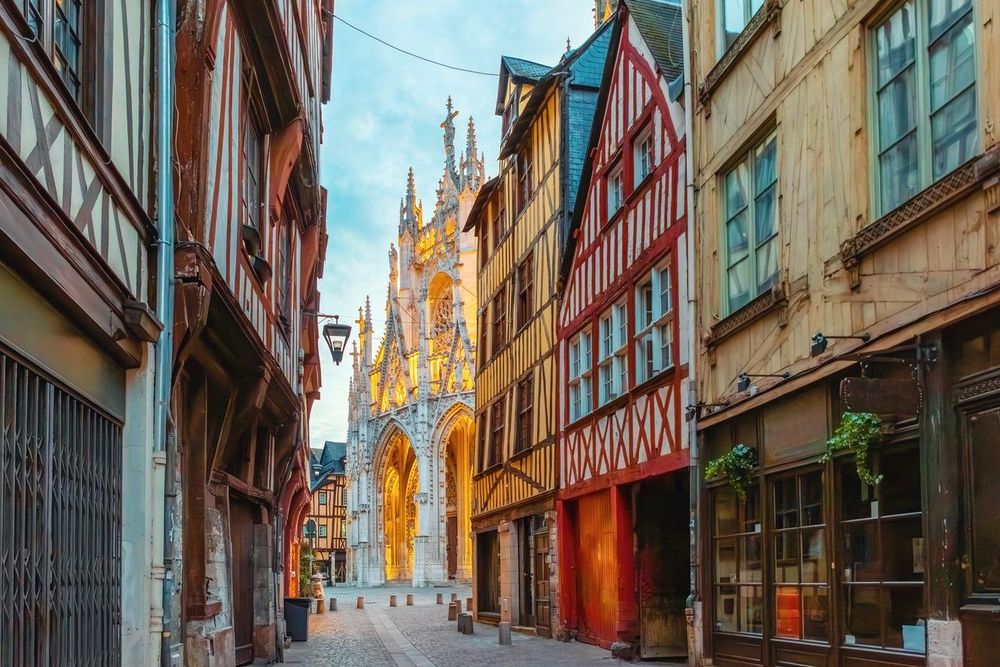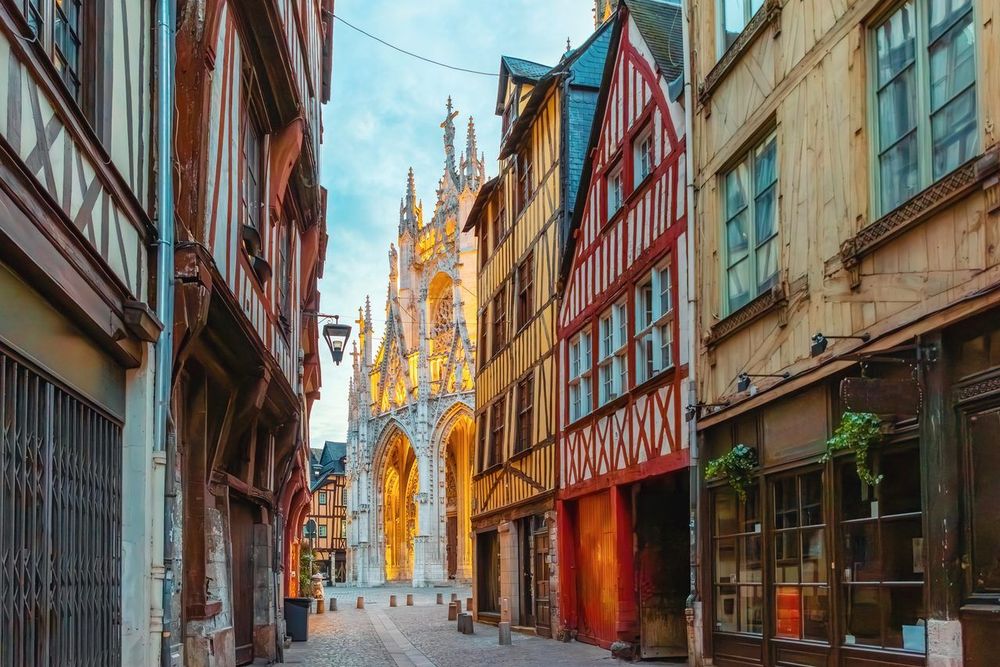
© Shutterstock
 Votre guide Ryo
Visiting Rouen in 3 Days: Complete Itinerary 2026
Rouen can be crossed on foot in half an hour, from the Gros Horloge to the cathedral, but visiting Rouen in 3 days changes everything: time to wander the medieval half-timbered alleyways, take a boat down to La Bouille, and push on to Giverny without ever needing a car. The city where Joan of Arc was burned at the stake in 1431 also hides an escape game inside a 13th-century dungeon, a state forest less than 20 minutes from the center, and kilometers of redeveloped quays along the Seine. Ryo's audio-guided tour of Rouen takes you from the historic heart to the lesser-known streets, a great starting point before crafting your own three-day itinerary.
In three days, you have time to see the Notre-Dame cathedral that Monet painted around thirty times, to climb the Sainte-Catherine hill for a panorama stretching across the entire bend of the Seine, and to choose between a ruined Norman abbey or Claude Monet's gardens at Giverny for your half-day excursion. This guide details a day-by-day itinerary, complete with the best addresses, rainy-day backup options, and answers to the questions you ask yourself before setting off.
Day 1: Cathedral, Gros Horloge, and Rouen's Historic Heart
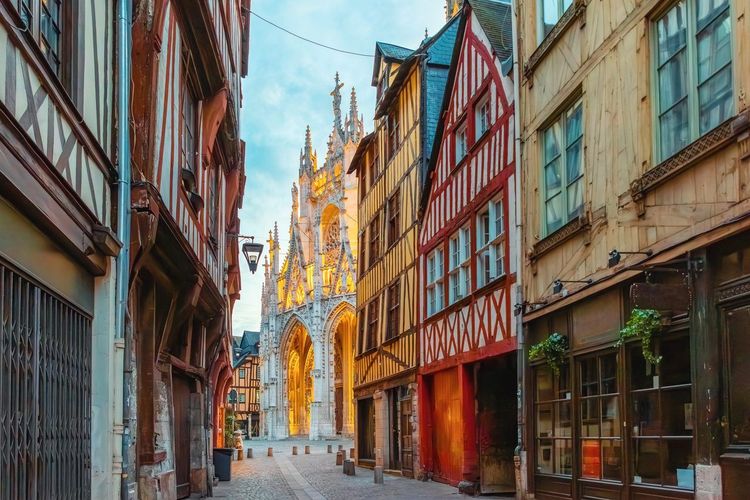
The first day unfolds entirely on foot, within a rectangle of less than one square kilometer that concentrates the essence of medieval Rouen. Allow a full day if you want to go inside each monument rather than admire them from the street.
The Notre-Dame Cathedral and the Place de la Cathédrale
You logically start with Notre-Dame de Rouen cathedral, which Claude Monet painted around thirty times between 1892 and 1894 from a window directly opposite, seeking to capture the changing light on its Flamboyant Gothic façade. With its cast-iron spire rising 151 meters, it was briefly the tallest structure in the world, a record held from 1876 to 1880 before Cologne Cathedral surpassed it.
Visiting the interior is free; allow 30 to 45 minutes to see the effigy of Richard the Lionheart, whose heart is preserved in the cathedral, and the archaeological crypt. On the way out, take time to sit at a terrace on the place de la Cathédrale to observe the façade from different angles, exactly where Monet set up his easel. This is also where the tourist office is located, handy from the moment you arrive for booking guided tours.
The Gros Horloge and the Half-Timbered Streets
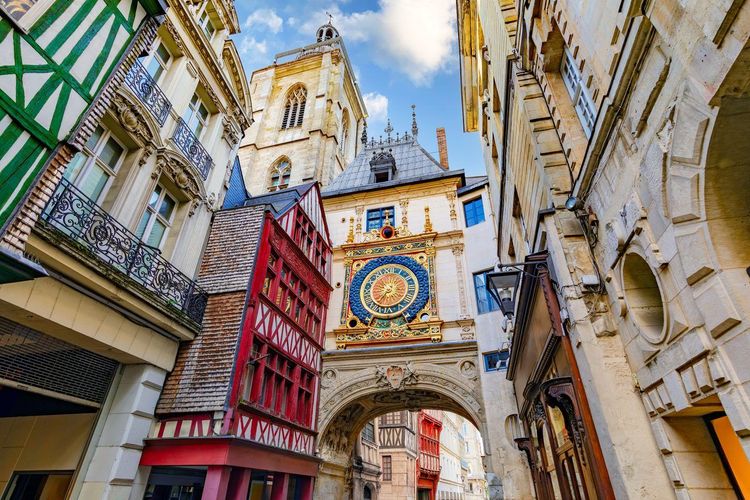
Walking up the rue du Gros-Horloge, a pedestrianized cobbled street, you come across the astronomical Gros Horloge, a 14th-century mechanism set in a Renaissance belfry that straddles the street. A single gilded dial displays the 24 hours, the phases of the moon, and the days of the week. Climb the belfry (paid entry) for a view over the slate rooftops of the historic center and to see the original mechanism, still visible behind a glass panel.
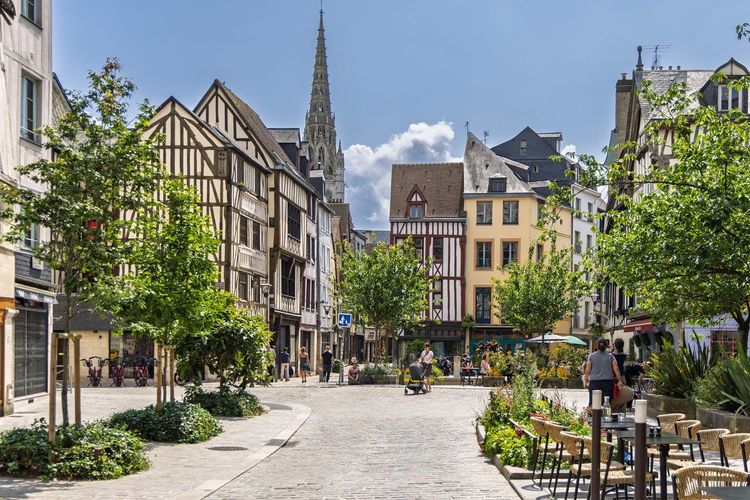
On either side of this central thoroughfare, the small perpendicular streets are worth getting lost in. The rue des Carmes lines up independent shops in 15th- and 16th-century half-timbered façades. The rue Saint-Romain, quieter, runs along the north side of the cathedral and is among the best-preserved streets in the city: leaning houses, sculpted jetties, almost no façade refaced from scratch. It leads, if you continue toward the Seine, to the pont Boieldieu (Pont Boieldieu, 76000 Rouen), a good spot for a photo of the river with the cathedral spire in the background.
The Place du Vieux-Marché and the Historial Jeanne d'Arc
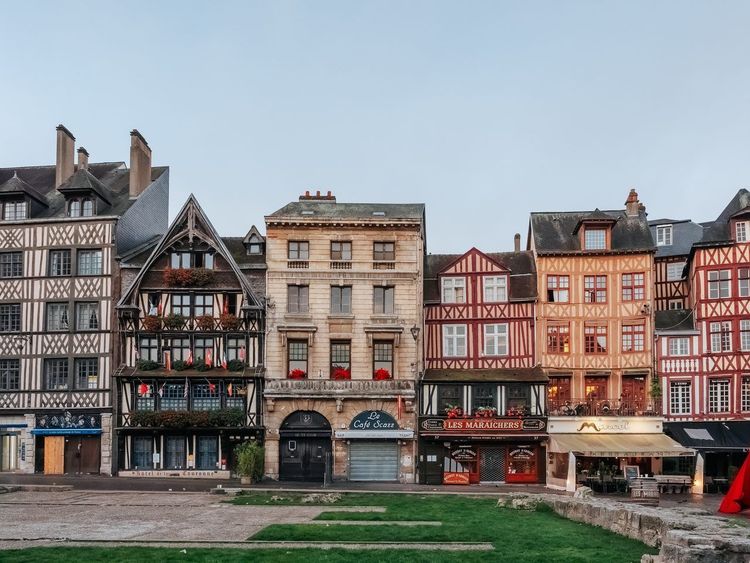
The place du Vieux-Marché is where Joan of Arc was burned at the stake on 30 May 1431, aged 19. A modern cross marks the approximate location of the pyre, right next to the église Sainte-Jeanne-d'Arc, recognizable by its undulating roof evoking flames and its 16th-century stained-glass windows salvaged from the église Saint-Vincent, destroyed during the 1944 bombings. The square itself is a great place for lunch, surrounded by covered market halls and brasseries serving all day.
The Historial Jeanne d'Arc, however, is not on this square but a ten-minute walk east, adjoining the cathedral: it occupies the former archiepiscopal palace on the rue Saint-Romain, the very place where the 1456 rehabilitation trial was held. The scenographic route retraces the trial through projections and reconstructions rather than period artifacts, which can disappoint visitors looking for relics. Allow around 1h30, headset on, and book a time slot in high season: groups depart at fixed times.
The Église and Aître Saint-Maclou, Antiques Quarter
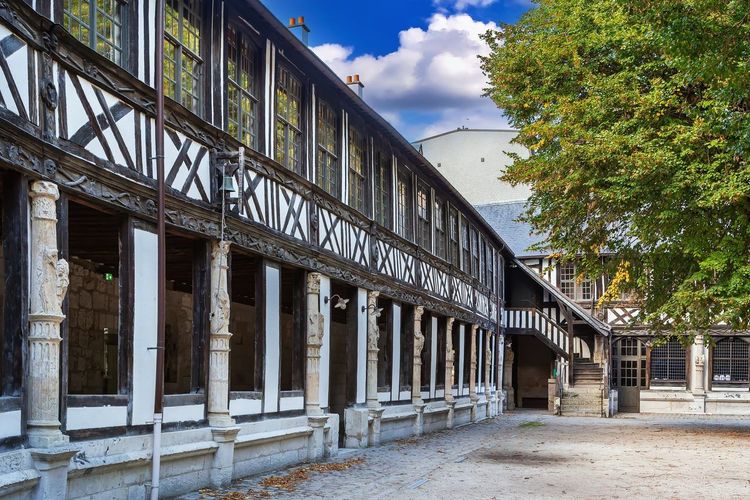
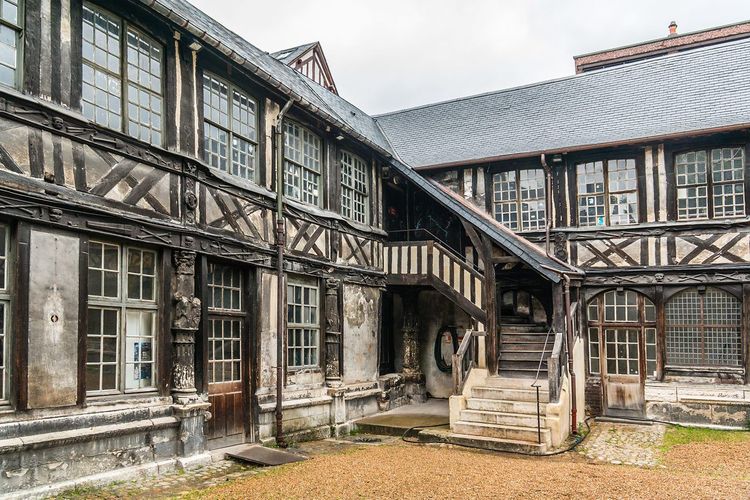
Ten minutes' walk to the east, the église Saint-Maclou displays a particularly dense Flamboyant Gothic façade, with a portal featuring five porches. Just behind it, in an alleyway you could easily miss, hides the Aître Saint-Maclou: a former 16th-century charnel ground transformed into a half-timbered courtyard, whose beams carved with skulls and crossbones recall its original function, linked to plague epidemics. Entry to the courtyard is free and open, making it one of the most striking visits of the stay without spending a penny.
The surrounding neighborhood, known as the quartier des Antiquaires, brings together around thirty second-hand dealers and antique shops along the rues Damiette and Eau-de-Robec. Even without any intention of buying, the stroll is worth it for the window displays: Norman furniture, Rouen faience, old prints. A flea market is held there on certain Sunday mornings.
The Rue Eau-de-Robec and the Abbatiale Saint-Ouen
The rue Eau-de-Robec runs alongside a channeled stream that once powered the dyers' mills. The pastel-colored half-timbered houses lining it are among the most photographed in Rouen, particularly in the late afternoon when the light grazes the façades.
End the day at the abbatiale Saint-Ouen, five minutes away. This former Benedictine abbey church, even more slender than the cathedral, impresses with the purity of its Gothic lines and its Cavaillé-Coll organ, considered one of the finest in France. Entry is free and the adjoining gardens, around the current Hôtel de Ville, offer a peaceful moment to close a day packed with visits.
If the pace feels too intense for a single day, note that this same route can be split over two half-days: cathedral and Gros Horloge in the morning, Saint-Maclou and Saint-Ouen in the afternoon. Ryo's audio-guided tour of Rouen follows roughly the same sequence.
Day 2: Panoramas, Museums, and a Walk Along the Seine Quays
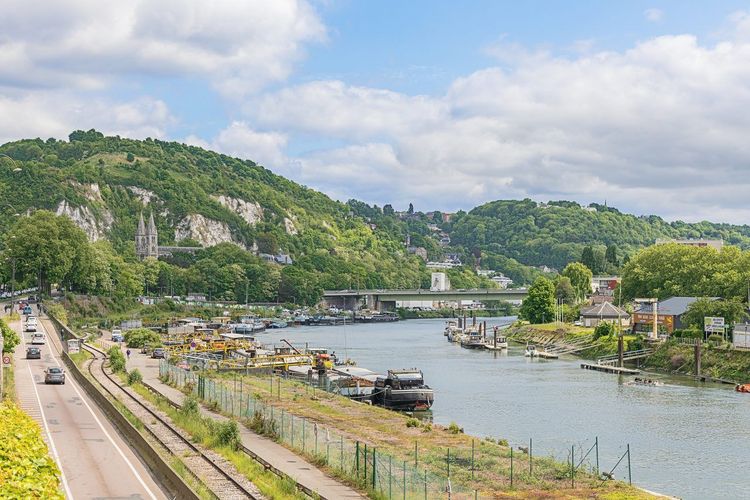
After the intensity of the first day, the second day alternates between gaining height and strolling along the water, between the right and left banks. To prepare this day neighborhood by neighborhood, our Ryo guide to Rouen's neighborhoods details the specifics of each bank.
The Sainte-Catherine Hill and the Panorama Over Rouen
Start early with the climb up to the colline Sainte-Catherine, also known as the côte Sainte-Catherine. Allow 25 to 30 minutes on foot from the center, or 15 minutes from the Martainville neighborhood, for around 100 meters of elevation gain. The effort is quickly rewarded: the panorama takes in the entire bend of the Seine, the industrial chimneys of the left bank, and the spires of the cathedral and Saint-Ouen piercing a sea of rooftops.
This is the best viewpoint in the city, and it costs nothing. One thing to know before copying an old guide: the Panorama XXL, the quayside rotunda that presented giant circular frescoes reconstructing Rouen at different periods, no longer exists. The Métropole ended its operation in September 2021 and the building has since been demolished, even though many articles still online recommend it as a flagship visit. For a historical perspective on the city, replace it with the Historial Jeanne d'Arc from the first day or the maritime museum described below. And if you're travelling with children who balk at the climb, the urban bus serves the côte Sainte-Catherine and spares you the elevation.
The Musée des Beaux-Arts and the Musée Le Secq des Tournelles
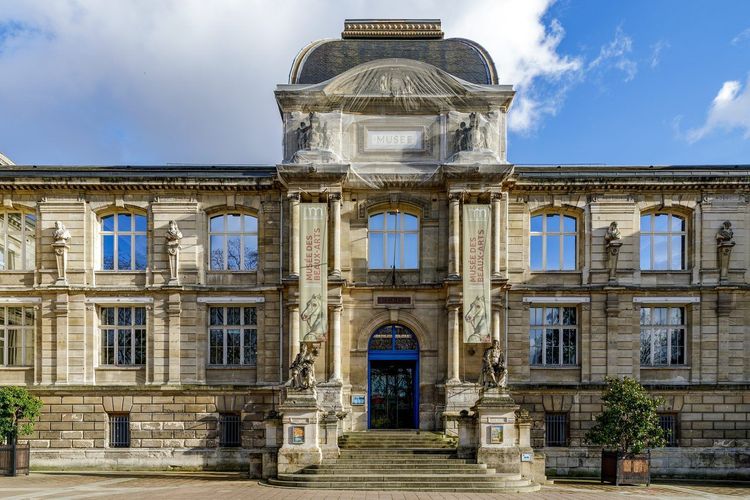
Head back down to the musée des Beaux-Arts de Rouen, one of the richest provincial collections in France, with paintings by Monet, Caravaggio, Rubens, and Velázquez spread across two floors. Entry to the permanent collections is free; allow 1h30 to 2h for a complete tour at a leisurely pace.
Five minutes' walk away, in a deconsecrated church, the musée Le Secq des Tournelles is devoted exclusively to ironwork: several thousand wrought-iron pieces, from medieval shop signs to 19th-century staircase railings. It is a niche museum, but the architectural setting — original Gothic stained-glass windows serving as a backdrop to the display cases — is reason enough to visit even for those who have never thought of being interested in ironwork. Here again, the permanent collection is free to visit, as in most museums across the Rouen metropolitan area.
The Seine Quays, the Guided River Cruise, and the Circuit Under the Bridges
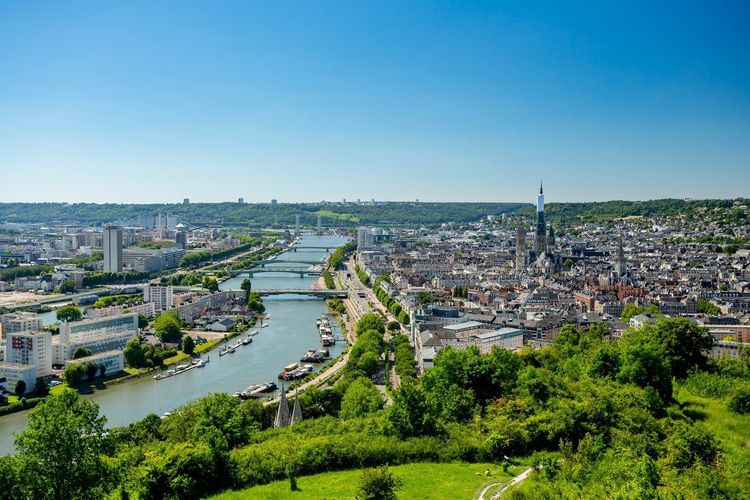
The afternoon turns toward the water. The quais de Seine, redeveloped over several kilometers on the right bank, combine cycle paths, pop-up terraces, and the musée maritime, fluvial et portuaire, housed in a former port warehouse that traces the history of the port of Rouen, long one of the most active in France for grain traffic. Check its opening days before crossing: it operates largely thanks to volunteers and does not open every day of the week.
For a change of perspective, a Seine river cruise departing from the quays lets you see the city from the river, with commentary on the history of the bridges and neighborhoods passed along the way. Some companies offer a guided boat trip down to La Bouille, a picturesque village about twenty kilometers downstream, renowned for its half-timbered houses and waterside restaurants. Allow half a day for the round trip, and note that these services are seasonal: they run from April to September.
If you prefer to stay on foot, the pedestrian circuit under the bridges runs along the left bank and allows you to observe, from below, the very different architecture of the six bridges spanning the Seine at Rouen, from the pont Mathilde to the pont Flaubert, the tallest lift bridge in Europe. It is a route little frequented by tourists, offering an unexpected angle on a city you have mostly seen from its streets.
The Jardin des Plantes and the Île Lacroix
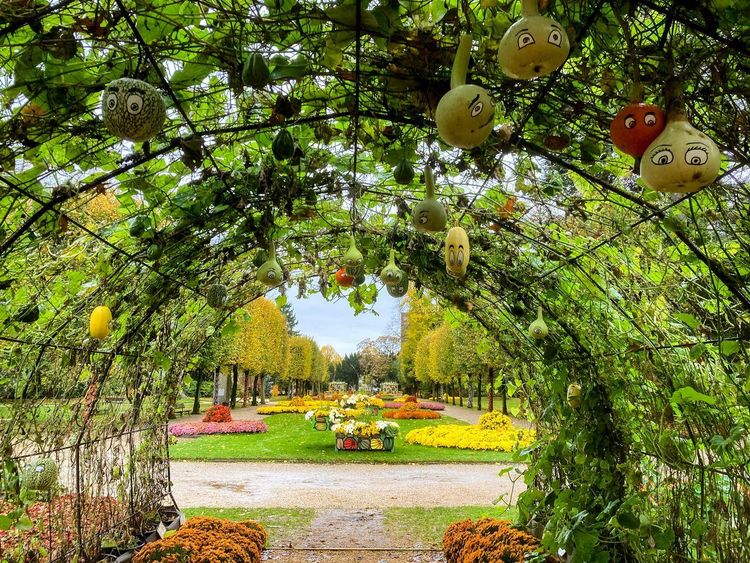
To end the day gently, two options depending on your remaining energy. The jardin des Plantes, on the left bank, blends tropical greenhouses, a rose garden, and botanical collections across around ten hectares, particularly pleasant as the light fades. Entry is free and the greenhouses, especially the succulent house, are worth a visit even in winter.
If you prefer to stay near the water, cross instead to the île Lacroix (Île Lacroix, 76100 Rouen, rated 4.2/5 on Google with 116 reviews), a river island connected to the center by several bridges, developed as a park with sports facilities and leisure amenities.
It is also one of the best vantage points when the Armada takes over the quays, a gathering of tall ships that returns every four to six years and completely transforms the city. Outside these occasions, the island remains a quiet green space, favored by Rouen joggers more than passing visitors. Outside these peak moments, Ryo's audio-guided tour of Rouen covers this same viewpoint at your own pace, before heading on to the Historial Jeanne d'Arc or the Musée Le Secq des Tournelles.
Day 3: Hidden Rouen, Nature, and Off-the-Beaten-Track Discoveries
Few tourist guides bring these four addresses together in a single day, and that is precisely what makes this third day different: little-known Jewish heritage, a historical escape game, nature on the outskirts, and industrial archaeology.
The Maison Sublime and the Place du Lieutenant-Aubert
Start with the Maison sublime, discovered by chance in 1976 during construction work in the courtyard of the courthouse. This Romanesque vestige, presented as the oldest preserved Jewish monument in France, was probably a Talmudic school or a study house from the early 12th century, identified thanks to a Hebrew inscription carved into the stone. The visit, by reservation and in limited groups, takes you into a vaulted room that is almost entirely intact, several meters below the current street level. Slots are rare and managed by the tourist office: book before you leave, not the evening before.
Nearby, the place du Lieutenant-Aubert is a small, more discreet space surrounded by old façades, contrasting with the medieval density of the rest of the center. Few guides mention it, making it a peaceful pause between two busier visits.
Escape Game at the Donjon de Rouen and Unique Activities
The Donjon de Rouen, also known as the tour Jeanne d'Arc, is the only remaining vestige of the castle built by Philippe Auguste in the early 13th century. It was in a room of this castle that Joan of Arc was threatened with torture during her trial. In recent years, the site has hosted an escape game whose scenario draws on this history: around 60 minutes to solve the riddles scattered through the vaulted rooms, best booked in advance as slots fill up fast at weekends.
It is a fun way to round off the visit to the site, ideally scheduled late in the morning to follow on with lunch in the Martainville neighborhood just next door. If the escape game is fully booked, visiting the dungeon on its own is still possible and much shorter — about thirty minutes is enough.
The Roumare Forest and Cycling Along the Seine
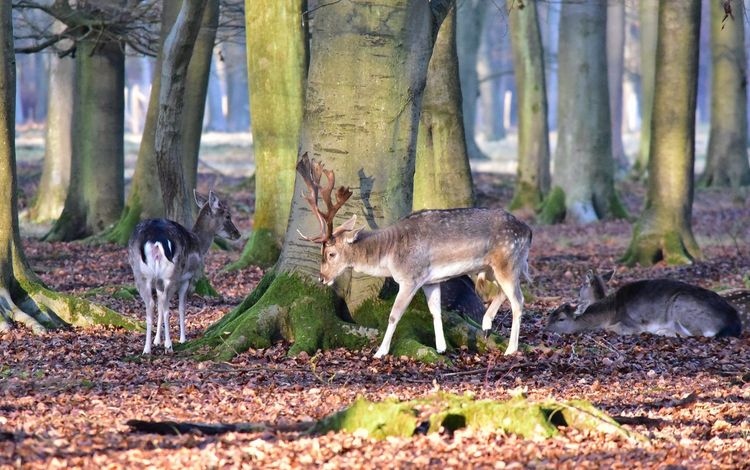
In the afternoon, switch worlds entirely by heading to the forêt de Roumare, about 20 minutes by car or bus from the center. This state forest of over 4,000 hectares, nestled in a bend of the Seine, offers marked trails through beech and oak woodland, as well as a wildlife park with free access where deer and wild boar can be observed in large enclosures — a stop that children particularly enjoy.
For a less strenuous version, the Seine can also be explored by bike thanks to the cycle route running along the river for several kilometers from the city center, with rental available on-site. This option suits a quieter late afternoon without the elevation of the forest, while maintaining the connection to the water that shapes all of Rouen's geography.
The Industrial Museum of the Corderie Vallois
End this third day at the musée industriel de la Corderie Vallois (122 Rue Ernest Renan, 76250 Notre-Dame-de-Bondeville, rated 4.8/5 on Google with 518 reviews), in Notre-Dame-de-Bondeville, about fifteen minutes from the center. This 19th-century textile mill, left almost entirely intact with its original machinery driven by a waterwheel, produced ropes and twine until the 1970s. The visit brings some of the machines to life in front of visitors — a striking contrast with the religious and medieval heritage that dominates the rest of the stay.
It is probably the least well-known address in this itinerary, and one of the most revealing about what Rouen was before it became a heritage destination: a major industrial and port city. These four stops require a little more organization than the first two days, particularly for the escape game and the Corderie which operate on fixed time slots. Book them before you leave rather than on the spot, or risk having to improvise a different afternoon program.
Half-Day Excursions from Rouen
If your stay extends beyond three days, or if you prefer to replace a half-day from the program above with a trip outside the city, three excursions stand out clearly from the rest. Our Ryo selection of Normandy's must-sees details further options if these are not enough.
The Abbaye de Jumièges and the Abbaye Saint-Georges de Boscherville
About thirty minutes by car to the west of Rouen, the abbaye de Jumièges is considered the most beautiful ruins in France, a description traditionally attributed to Victor Hugo. Founded in the 7th century, burned down and then sold as a stone quarry after the Revolution, it retains two western towers 46 meters high that today overlook a roofless nave and a park planted with remarkable trees.
About fifteen minutes from there, the abbaye Saint-Georges de Boscherville (76840 Saint-Martin-de-Boscherville, rated 4.5/5 on Google with 1,180 reviews) has survived intact: it is one of the rare complete Romanesque abbey churches in Normandy, with finely carved capitals and terraced gardens restored in the spirit of the French formal garden.
Both abbeys can be visited in a single half-day if you have a vehicle, and they complement each other well: one invites you to imagine what has disappeared, the other shows what has survived.
Giverny: Monet's House and Gardens
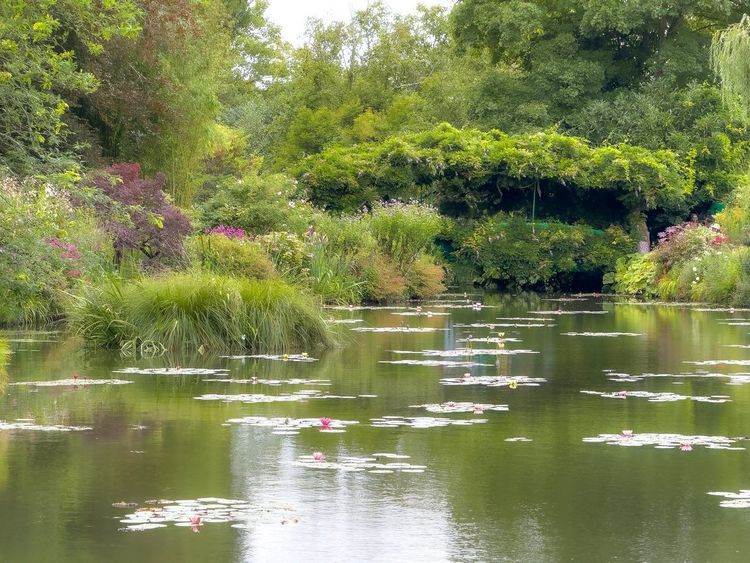
A little over an hour's drive to the east, Giverny draws visitors for one reason: Claude Monet's house and gardens, where the painter lived for 43 years and painted most of his Water Lilies. The water garden with its Japanese bridge remains instantly recognizable, even for those who only know Monet's work through reproductions.
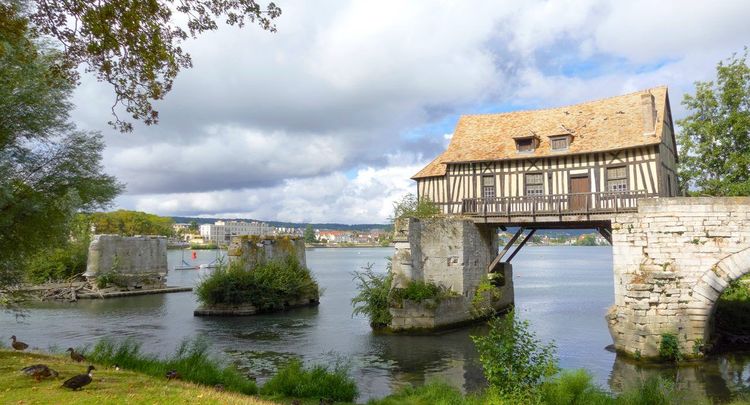
Book your time slot online several weeks in advance in high season — visitor numbers can make the garden tour quite crowded between May and July. Also note the calendar: the site closes in winter and generally reopens around late March. Without a car, Giverny can be reached by train to Vernon, then a shuttle or bike for about ten kilometers. If you pass through Vernon, the town itself is worth a one-hour detour for its old mill on stilts and its cobbled streets.
Le Havre: Modern Art and Perret Architecture
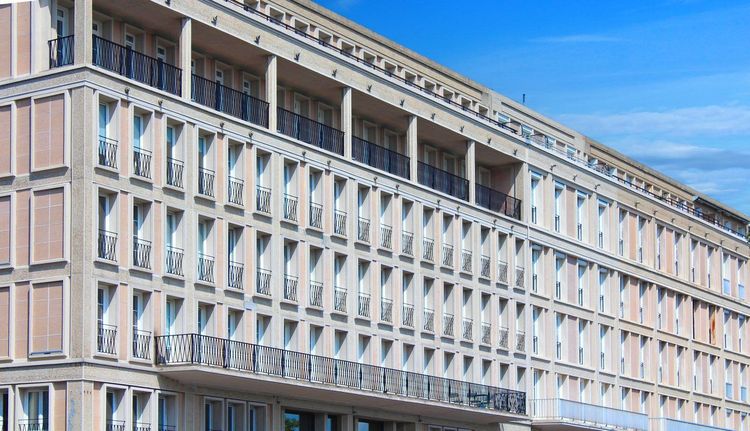
At the opposite end of the spectrum from Rouen's medieval character, Le Havre, just over an hour by road or train, offers radically different architecture. Largely razed during the 1944 bombings, the city was rebuilt under the direction of architect Auguste Perret using a reinforced concrete plan, listed as a UNESCO World Heritage Site since 2005 — a rare recognition for architecture this recent.
The église Saint-Joseph, with its 107-meter lantern tower pierced by colored stained-glass windows, is its most photographed symbol. Steps from the seafront, the musée d'art moderne André Malraux holds one of the most important Impressionist collections in France. A full day is enough for a solid overview; the city is easily walkable from the station to the beach.
Between the three, the choice depends mostly on your interests: the abbaye de Jumièges for history and nature, Giverny for art and gardens, Le Havre for a complete architectural break from the rest of the stay. Many visitors choose Giverny in summer for the flowering gardens, and Jumièges or Le Havre at other times of year.
In the Footsteps of Flaubert and Corneille in Rouen
Rouen was the birthplace of two major figures in French literature, two centuries apart, and their legacy remains visible at several addresses in the center.
Gustave Flaubert, born in 1821 in the wing of the Hôtel-Dieu where his father was chief surgeon, grew up surrounded by hospital wards and anatomy jars, an atmosphere that permeates much of his work. The musée Flaubert et d'Histoire de la Médecine (51 Rue de Lecat, 76000 Rouen, rated 4.4/5 on Google with 112 reviews), housed in that very wing, blends personal items of the writer — such as his desk and handwritten letters — with a rather striking collection of surgical instruments from the 18th and 19th centuries. It is a hybrid museum, halfway between a writer's house and a medical cabinet of curiosities, which often surprises visitors who came solely for Flaubert.
Pierre Corneille was born in 1606 in a half-timbered house in the historic center, on the rue de la Pie, now the maison natale de Pierre Corneille: it traces his career as a playwright through manuscripts and early editions of Le Cid or Horace. These two writers' houses open on more limited hours than the major museums, often just a few afternoons a week: check the schedule before making the trip, especially if you plan to visit both on the same day.
Beyond these two house museums, several plaques in the center point to other addresses connected to both writers: the statue of Corneille near the quays, or the school where Flaubert was a pupil before openly detesting it in his correspondence. This literary trail remains optional within a three-day stay, but it usefully complements the religious and medieval visits of the first two days for those interested in cultural heritage beyond architecture alone. For more detail, our Ryo article on the Corneille and Flaubert houses provides updated opening hours and admission prices, which change regularly depending on current temporary exhibitions.
Where to Stay in Rouen for Every Budget
The choice of neighborhood matters as much as the choice of hotel. Three areas stand out clearly for a three-day stay.
The historic center, around the cathedral and the Gros Horloge, puts everything within walking distance: monuments, museums, and the restaurants of the first day. It is also the most expensive and liveliest area in the evening, sometimes noisy at weekends in summer around the place du Vieux-Marché. Expect charming properties set in half-timbered buildings, with rooms that tend to be small given the age of the structures.
The Seine riverbanks, on both the right and left banks, offer more modern and more spacious establishments, some with river views. The walk to the historic center takes 10 to 15 minutes depending on the exact location — a reasonable compromise between peace and proximity.
For a stay of more than three nights or for families, aparthotels near the station allow you to cook on-site and often work out cheaper than a succession of standard hotel nights, while remaining 15 to 20 minutes' walk from the historic center. It is also the most flexible option if you combine Rouen with an excursion to Giverny or Le Havre requiring an early start.
Rates vary noticeably by day: a weeknight outside school holidays costs considerably less than a Saturday night in high season. If your stay falls on a weekend, consider arriving on Thursday or leaving on Monday to smooth out some of these price differences. Book at least a month in advance if you are visiting during the Armada or a major festival — two periods when hotel availability tightens considerably. Wherever you end up staying, Ryo's audio-guided tour of Rouen is walkable from most central accommodation, taking in the Gros-Horloge along the way.
Where to Eat in Rouen: Norman Specialties and the Best Addresses
Norman gastronomy can be savored in Rouen without having to look far. Three specialties appear on most menus in the historic center.
The canard à la rouennaise, prepared according to a method dating back to the 19th century in which the duck is smothered rather than bled so the blood is retained in the sauce, remains the dish most closely associated with the city. You will find it mainly in gastronomic or semi-gastronomic restaurants in the center, rarely in a simplified version.
Camembert, though produced throughout the Pays d'Auge region rather than in Rouen itself, appears on almost every cheese board, often accompanied by cider or calvados as a digestif. Teurgoule, a rice pudding baked slowly in an earthenware dish, rounds out the traditional Norman desserts — less well known outside the region but served in several addresses in the Saint-Maclou neighborhood. On the sweet side, also look out for sucres de pomme de Rouen, amber-colored sugar candy sold in sticks at shops throughout the center.
For meals, two areas stand out. The area around the place du Vieux-Marché concentrates brasseries and tourist restaurants, convenient between two visits but not always the best value for money. The rue Eau-de-Robec and its surroundings, further from the main drag, bring together more discreet addresses frequented by the locals themselves, often with excellent value for money on weekdays.
For an up-to-date selection of the best current restaurants, our Ryo article on Rouen's culinary specialties details dish by dish where to find them.
How to Get to Rouen and Get Around
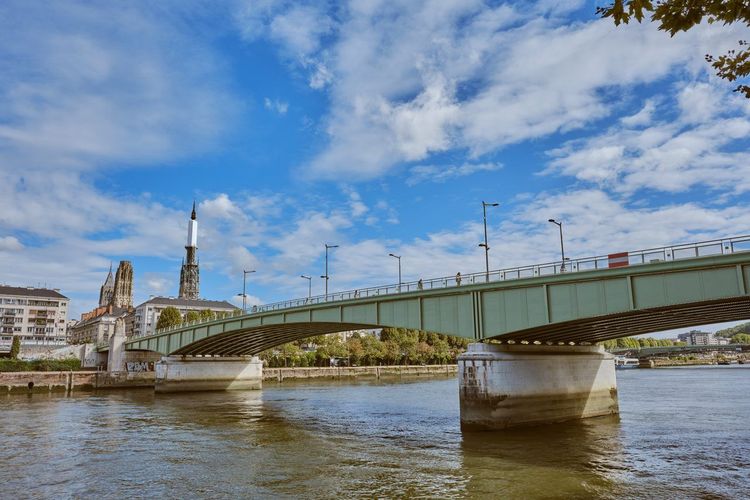
Rouen sits halfway between Paris and the Normandy coast, making it an easy destination to reach whatever your mode of transport.
Getting There by Train from Paris
From the gare Saint-Lazare, direct trains to Rouen run at a steady frequency throughout the day, with a journey of around 1h10 to 1h30 depending on intermediate stops. It is by far the simplest option for a three-day stay without a car: the gare Rouen-Rive-Droite is about fifteen minutes' walk from the historic center, and just a few metro-tram stops away.
Book if possible outside peak hours on Friday evenings and Sunday afternoons, when traffic between the capital and Normandy rises considerably. For a day trip in addition to your stay — such as an excursion to Le Havre — the same railway line continues further along the coast, allowing you to link up without going back through Paris.
Getting There by Car and Parking
By car, Rouen is reached via the A13 from Paris: around 135 kilometers, or 1h30 to 1h45 outside rush hours, longer on Friday evenings. The city is however more enjoyable to visit without a vehicle once you arrive, as the largely pedestrianized historic center makes parking and driving complicated.
If you come by car, opt for a park-and-ride on the outskirts combined with the public transport network, or a hotel with its own private parking to avoid searching for a space every evening. The car becomes useful again only for the third-day excursions to the Roumare forest or the Corderie Vallois, which are less well served than the city center.
Getting Around on Foot or by Public Transport
Once there, forget the car. The historic center can be crossed entirely on foot in 20 minutes, from the Gros Horloge to the Seine, and the bulk of the first day requires no public transport at all.
To reach the Sainte-Catherine hill, the jardin des Plantes, or the station from a hotel further out, the bus network, the metro-tram, and the TEOR lines cover the metropolitan area efficiently, with single tickets or day passes at a modest price. The metro-tram in particular crosses the center from north to south, passes under the Gros Horloge, and serves the left bank.
A useful reflex on arrival: the tourist office, located opposite the cathedral, offers a Rouen Pass in 24, 48, or 72-hour versions that bundles access to several paid sites and discounts on guided tours. Over three days combining the Gros Horloge belfry, the Historial, and a river cruise, it quickly pays off. This is also where guided thematic tours and Maison sublime time slots are booked.
For the third-day excursions to the Roumare forest or the Corderie Vallois, a rideshare, taxi, or half-day car rental remains more efficient than public transport, whose frequency drops noticeably outside the city center.
What to Do in Rouen When It Rains
Norman weather has a reputation for frequent rain, often exaggerated but not entirely unfounded. Fortunately, a good portion of the three-day itinerary already takes place indoors.
The two great churches of the first day, the cathedral and the abbatiale Saint-Ouen, remain open and free whatever the weather, with enough space to spend a full hour inside under cover. The Historial Jeanne d'Arc, entirely indoors, is particularly well suited to a rainy afternoon thanks to its scenographic route lasting around 1h30.
The second day can be converted almost entirely into a museum day: the musée des Beaux-Arts, the musée Le Secq des Tournelles, and the musée maritime, fluvial et portuaire can be visited in succession with barely a step outside, separated by short distances. Allow half a day for the first two and about an hour for the third.
If you are looking for a more fun activity to fill a rainy afternoon, the Donjon escape game works just as well in the rain as in the sunshine since it takes place entirely in the tower's vaulted rooms. It is often the option that saves a grey afternoon without sacrificing the planned program — provided you have booked your slot in advance.
Rouen with Kids: Activities for All Ages
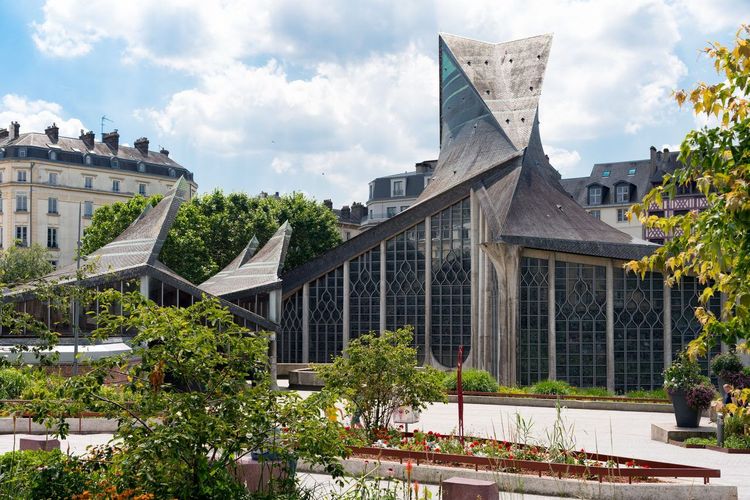
Rouen lends itself well to a family stay, provided you alternate heritage visits with more hands-on activities to avoid exhausting the younger ones.
The Historial Jeanne d'Arc, with its projections, darkened rooms, and story told like an investigation, holds children's attention far better than a Gothic façade commented on from the pavement. The Donjon de Rouen escape game is suitable for children from around 8 to 10 years old, depending on the difficulty of the chosen scenario, and turns a visit to a historic monument into a game rather than a history lesson. The Seine river cruise on the second day is also a big hit — the movement of the boat and passing under the bridges provide a welcome break in an otherwise very walking-heavy program.
The jardin des Plantes, with its greenhouses and large lawns, offers a space where children can run freely between more contemplative visits. The wildlife park in the Roumare forest, with free entry, pairs well with this option for an outdoor afternoon, as does the île Lacroix with its sports facilities.
For a three-day family stay, it is better to spread these activities out rather than cramming them into a single day: a heritage visit in the morning and a more hands-on activity in the afternoon, across each of the three days. This avoids the fatigue that often sets in on the second day of a dense cultural trip. Our Ryo article dedicated to Rouen with children details additional addresses and practical tips, including for families with very young children who tire more quickly on long walks.
How Long to Spend: Rouen in 1, 2, or 3 Days
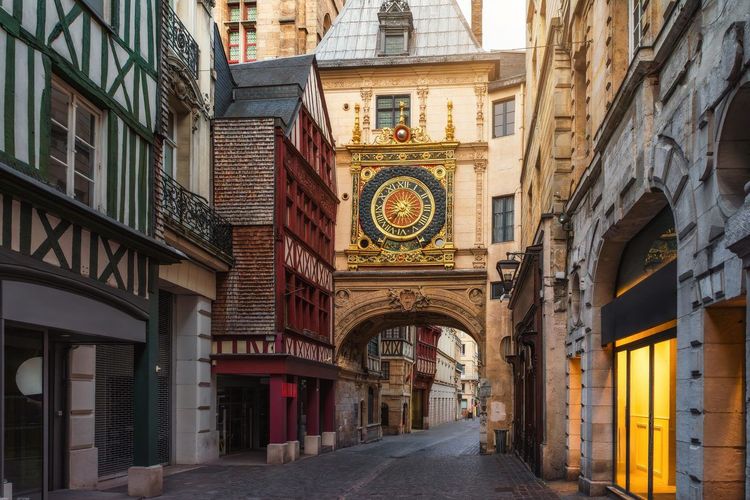
The three-day format detailed in this guide is not the only option. Here is how to adjust based on the time you actually have.
Visiting Rouen in 1 day means focusing on the first day of this itinerary, cutting the Historial Jeanne d'Arc if time is tight: the cathedral, Gros Horloge, place du Vieux-Marché, and Saint-Maclou are enough to give a solid overview of the historic center in a well-filled day. It is a realistic format for a stopover on a longer route, for example between Paris and the Normandy coast.
Visiting Rouen in 2 days allows you to add the Sainte-Catherine hill and a museum of your choice — usually the musée des Beaux-Arts — without necessarily extending to the quays and the Seine cruise. It is the most common format for visitors coming from Paris for a weekend, sufficient to leave with a comprehensive view of the heritage without any out-of-town excursion.
Three days on-site, the itinerary detailed in this article, adds the offbeat third day and leaves room for a half-day excursion to Jumièges, Giverny, or Le Havre. It is the format that allows you to go off the beaten track while keeping a reasonable pace. If you have more time, simply add one or two extra excursions from those detailed above rather than multiplying visits in the city center, already well covered in three full days.
Finally, if you really only have an hour on-site, between two trains or during a stopover, focus on the triangle of the cathedral, Gros Horloge, and place du Vieux-Marché: the three monuments are less than 500 meters apart and can be seen from the outside in barely 45 minutes. It is obviously not enough to go inside, but it gives an honest glimpse of the historic heart.
FAQ
How many days do you need to visit Rouen?
Two days are enough to see the essentials of Rouen's historic center: the cathedral, the Gros Horloge, the place du Vieux-Marché, and a museum. Three days allow you to add an offbeat day (Maison sublime, Donjon escape game, Roumare forest) and a half-day excursion to Jumièges, Giverny, or Le Havre. For a simple stopover between two destinations, a full day remains sufficient for a solid overview of the historic heart.
What should you see in Rouen in 1 day if you're short on time?
Focus on the triangle formed by the Notre-Dame cathedral, the Gros Horloge, and the place du Vieux-Marché with the église Sainte-Jeanne-d'Arc, all within less than ten minutes' walk of each other. Add the abbatiale Saint-Ouen and the rue Eau-de-Robec if the pace allows. This covers the monuments most associated with the city in a half-day to a full day depending on your speed.
What can you do in Rouen for free?
The Notre-Dame cathedral, the abbatiale Saint-Ouen, the église Saint-Maclou, and the courtyard of the Aître Saint-Maclou are all free to visit, as are the permanent collections of the musée des Beaux-Arts and the musée Le Secq des Tournelles. Strolling along the Seine quays, through the quartier des Antiquaires, or up to the panorama at the Sainte-Catherine hill also costs nothing. Our Ryo selection of free activities in Rouen lists further addresses with no admission fee.
What are the most unusual things to do in Rouen?
The Maison sublime, the oldest preserved Jewish monument in France, the escape game set inside the Donjon de Rouen, and the industrial museum of the Corderie Vallois form a trio that few guides bring together. Add the Roumare forest and its wildlife park for a nature touch less than 20 minutes from the center. Together, these spots make up a day that departs significantly from the classic heritage trail.
Can you visit Rouen entirely on foot?
Yes, the historic center can be explored entirely on foot — the Gros Horloge and the cathedral are just a few minutes apart. Only the Sainte-Catherine hill, which requires about 25 minutes of climbing, and the third-day excursions to the Roumare forest or the Corderie Vallois require a bus, metro-tram, or car to remain reasonable in terms of time.
What is the best time of year to visit Rouen?
Spring and early autumn offer the best balance between mild weather and moderate crowds. Summer remains pleasant but busier, particularly during major events like the Armada when it takes place. Winter suits a stay focused on museums and indoor monuments, with a noticeably quieter city and often softer accommodation rates.
Three days are enough to see Rouen from multiple angles: the religious and medieval city of the first two days, then the more secretive city of the third day, between little-known Jewish heritage and industrial archaeology. Few destinations within two hours of Paris offer such a density of visits without ever needing a car for the bulk of the program.
If you want to plan your own route rather than follow this day-by-day itinerary, Ryo's audio-guided tour of Rouen remains a good starting point for exploring the historic center at your own pace, with audio commentary on each monument along the way. Whether you stay one day, two, or the full three days detailed here, always leave some breathing room in your schedule: between the alleyways you stumble upon by chance and the terraces that invite you to linger, Rouen doesn't lend itself well to a tightly packed schedule.
À lire également