© Shutterstock
 Votre guide Ryo
Unusual Visit to Vannes: Legends, Secret Alleyways, and the Gulf of Morbihan
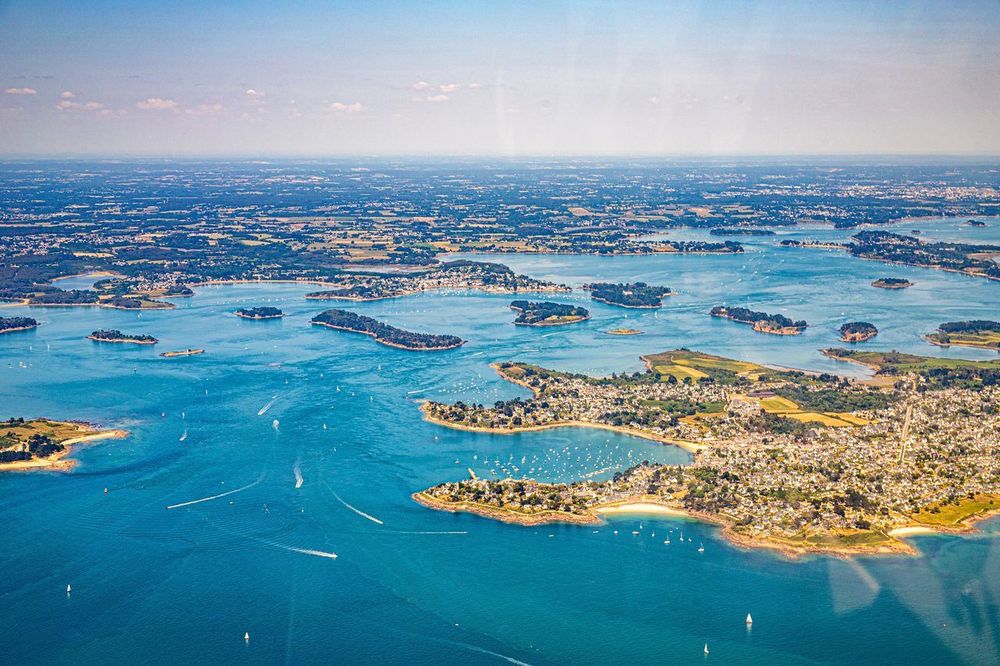
Vannes has the reputation of a Breton postcard: flowered ramparts, half-timbered houses, a small fortified port. What classic tours rarely reveal is that the moats of those same ramparts conceal French formal gardens that most visitors pass through without a glance, that a carved wooden couple has been watching over a shopfront in the centre for centuries, and that the nearby Gulf of Morbihan can be explored by helicopter, crossed by catamaran, or discovered on an e-foil. For an unusual visit to Vannes that goes off the beaten track, the Ryo audio-guided tour of Vannes is a great starting point: it lets you wander while listening to the stories that tourist signs leave out.
In the pages that follow, you will encounter a sculpture that has become the emblem of the city, a ceramicist who still works clay on the wheel, a dolmen over 5,000 years old less than an hour away by road, and a Cold War submarine moored in Lorient. Between ramparts, aerial thrills, nautical escapes in the gulf, and forgotten corners of the Morbihan, this unusual visit to Vannes and its surroundings deliberately avoids the six monuments listed everywhere else.
Vannes Behind the Scenes: Legends and Hidden Details of the Historic Centre
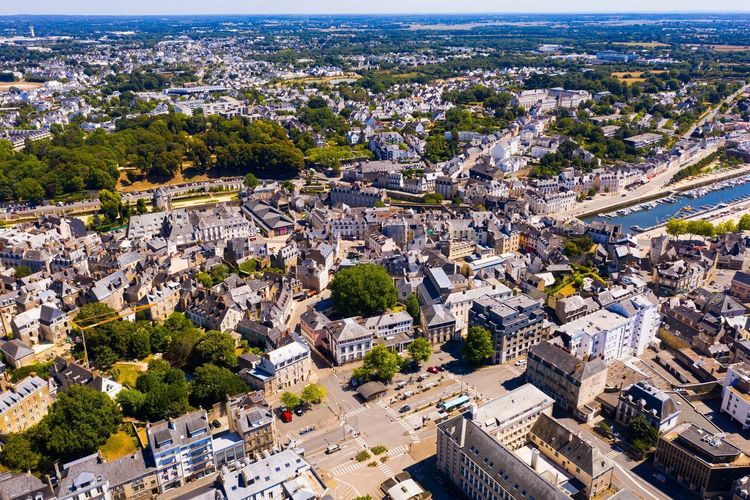
The fortified town centre of Vannes can be visited in just under an hour if you simply follow the tourist markers. Slow your pace and another city appears, made up of details that few visitors notice.
The Ramparts and the Jardin des Remparts, the Best View in the City
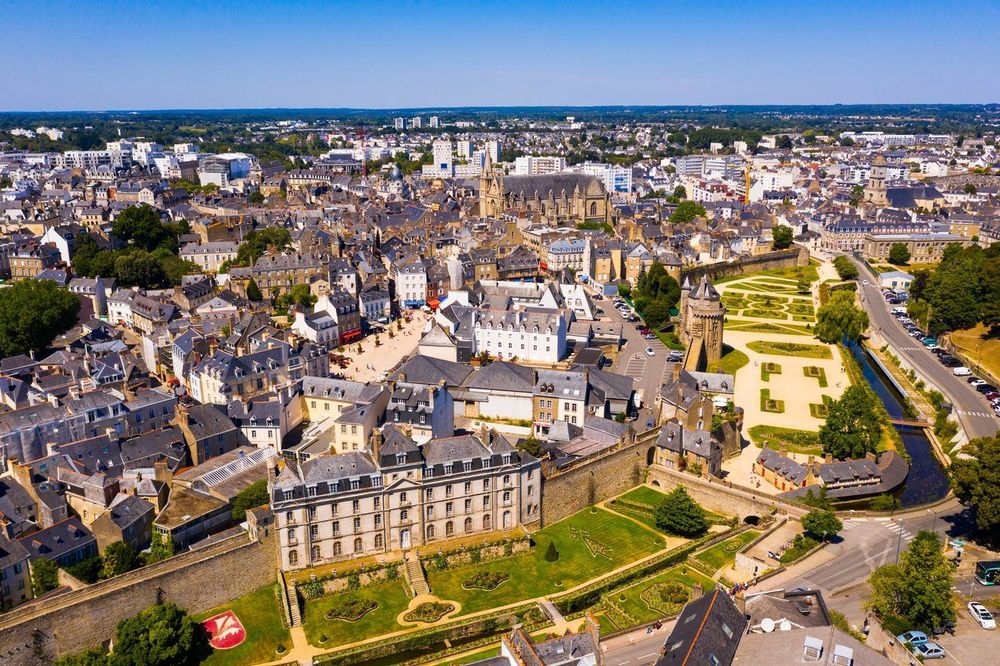
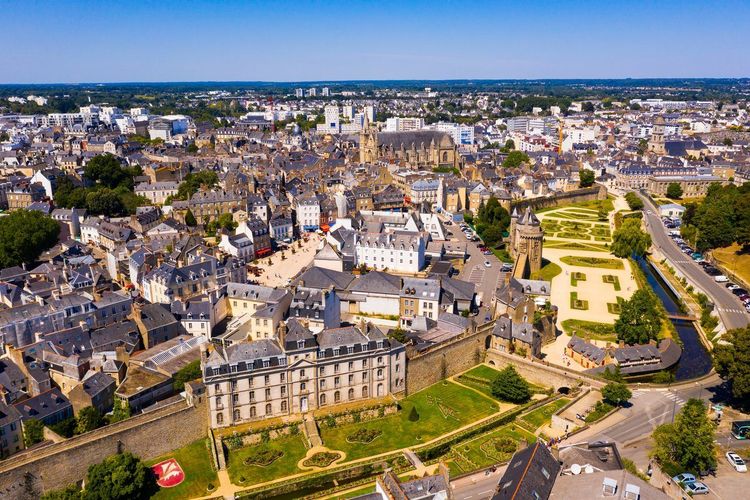
The ramparts of Vannes, stretching over a kilometre, are among the best preserved in Brittany. Built on Gallo-Roman foundations and then reconstructed and reinforced from the 13th to the 17th century, they still encircle the old town on the eastern side and border the Marle river, today channelled at the foot of the curtain walls.
What many visitors do not know is that the defensive moat has been transformed into the Jardin des Remparts: French formal flowerbeds, trimmed box hedges, and planted borders now occupy the former moat, open and free of charge all year round. The best vantage point is not from the garden itself but from the upper promenade near the Porte Prison: from there, the towers, the slate rooftops of the wash house, and the flowerbeds layer into a single frame. Come early in the morning before the light hits the western façades, or at the end of the day when the granite turns ochre.
La Cohue and the Famous Couple "Vannes et sa femme"
A stone's throw from the cathedral, La Cohue long served as a market hall and courthouse before becoming the city's fine arts museum. The people of Vannes used to come here to plead, sell fish, and buy cloth in the same building, which explains its curious double ground-floor entrance opening onto two streets at different levels.
A few dozen metres away, at the corner of Place Valencia and Rue Noé, look above a shopfront for two chubby, smiling polychrome wooden busts: that is "Vannes et sa femme", the most famous sign in the city, whose origin has been lost since the 16th or 17th century. An inn sign? A caricature of a merchant couple? No one really agrees, and every local guide will offer their own version. The duo has become the unofficial emblem of Vannes: you will find it on fridge magnets, posters, and even some municipal signs. Look up — it is very easy to miss.
Half-Timbered Houses and the Hôtel de Limur: Details to Spot
Place Henri-IV and Rue Saint-Salomon concentrate the finest collection of half-timbered houses in Vannes, some dating from the 15th century. Look up: carvings of merchants, fantastical animals, and trade scenes adorn the jettied beams, and the upper floors sometimes overhang the street by a metre — a medieval trick to gain floor space without paying more in land tax.
A little further on, the hôtel de Limur (Rue Thiers, 56000 Vannes, rated 4.7/5 on Google from 64 reviews), a private mansion built at the end of the 17th century, stands out with its classical granite architecture. A city-owned property, it now hosts temporary exhibitions: this is the easiest opportunity to see its interior staircase and wood panelling, which are otherwise invisible. You can join the Ryo audio-guided tour of Vannes to place these façades within the city's chronological story, neighbourhood by neighbourhood.
An Unusual Stroll Through the Old Streets of Vannes
Beyond the historic centre, Vannes lends itself well to a playful exploration rather than a simple stroll.
The Urban Rally, a Different Way to Explore
Several local operators offer an urban rally in the centre of Vannes: a tablet or a booklet of riddles guides a small group from street to alleyway, combining historical clues with team puzzles to solve. Allow 1h30 to 2 hours to complete the route — a format that works equally well for a group of friends or a family outing on a rainy day.
The appeal of the format lies less in the clues themselves than in the way it forces you to slow down. You then notice a forgotten coat of arms on a façade or a covered well in a courtyard — details you would normally walk past without seeing.
Porte Saint-Vincent and the Cathédrale Saint-Pierre: Behind the Anecdotes
The Porte Saint-Vincent, pierced through the medieval ramparts in the 17th century and remodelled in the following one, marks the most photographed entrance to the old town. Less well known: it was opened to connect the port directly to the commercial heart of the city, at a time when Vannes lived largely on maritime trade, and it takes its name from the saint whose statue occupies the niche on the port side.
A few metres away, the Cathédrale Saint-Pierre (Place Saint-Pierre, 56000 Vannes, rated 4.4/5 on Google from 2,693 reviews) blends styles across nearly six centuries of construction, from Flamboyant Gothic to Neoclassical. One of its chapels houses the tomb of Saint Vincent Ferrer, a Dominican preacher from Valencia who died in Vannes in 1419 and whose cult still draws visitors from Spain — a detail few guides mention. The article Top 6 Things to Do in Vannes details other ways to approach this neighbourhood differently.
Foodie Vannes: the City Centre Food Tour
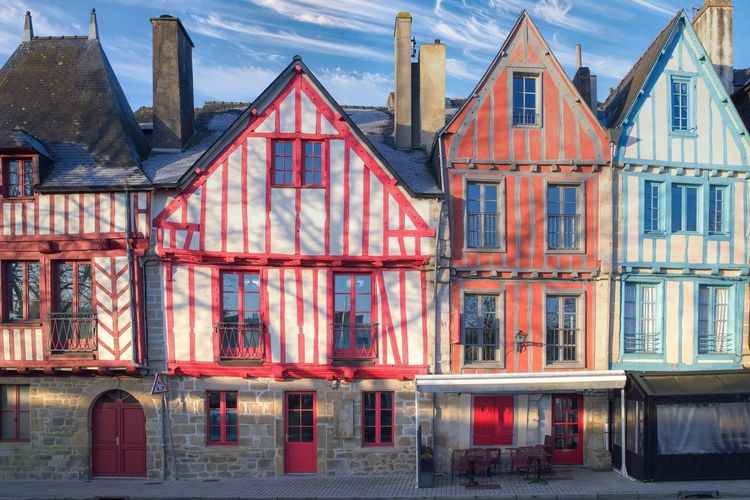
Navigating Vannes by taste rather than by monuments completely changes your perception of the city.
An organised food tour in the city centre strings together 4 to 6 stops at independent local producers: a crêperie, an artisan biscuit maker, a wine merchant, a cheesemonger. A short format — around 2h30 — designed for tasting rather than filling up at every stop, with a guide providing background on the history of the Vannes market halls.
The Breton specialities most commonly featured on this tour: kouign-amann, far breton, buckwheat galettes filled with local goat's cheese, and sometimes a tasting of farmhouse cider paired with oysters from the gulf. If you would rather put together your own tasting, head to the Halles des Lices on a Wednesday or Saturday morning — market days — where gulf producers are most concentrated. The article Top 10 Culinary Specialities in Vannes lists the addresses that come up most often on these gourmet tours.
Meeting an Artisan Ceramicist
Along the way, several food tours include a detour to the Galerie d'Art Terre Libre artisan ceramics workshop (56000 Vannes, rated 4.9/5 on Google from 16 reviews), where a potter still works the wheel using traditional methods. The visit lasts about twenty minutes: a wheel-throwing demonstration, explanations of glazes, and the chance to buy a unique piece at the end of the tour. It is an unexpected addition to a food tour, but it works well to break the pace between two tastings.
Thrills Above Vannes: Scenic Flights and Tandem Skydiving
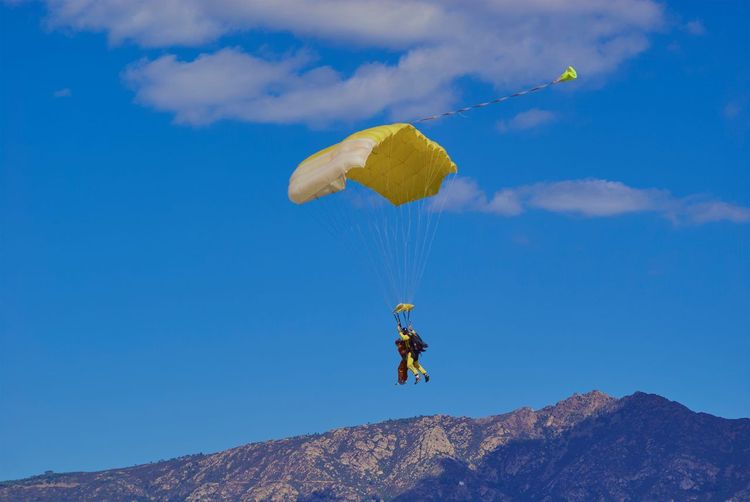
For a visit that takes altitude, head to the sky.
Scenic Helicopter Flight over the Gulf
A helicopter flight over the Gulf of Morbihan generally lasts between 15 and 30 minutes depending on the package chosen, departing from Vannes-Meucon aerodrome or a nearby base. From the air, the dozens of islands and islets in the gulf stand out clearly, with oyster beds visible as dotted lines on the water at low tide.
Book early in the morning or at the end of the day: the raking light sculpts the relief of the islands and the colours of the water change dramatically compared to a midday flyover. Flights remain subject to weather conditions — if you are coming for a weekend only, have a backup date in mind.
Tandem Skydiving and Paramotor Baptism
For those seeking more intense thrills, tandem skydiving in Vannes takes place from a plane at approximately 4,000 metres altitude, with around forty seconds of freefall before the parachute opens. No prior experience is required; you are harnessed to a qualified instructor and take off from Vannes-Meucon aerodrome, about fifteen minutes from the city centre.
A gentler but equally exhilarating option: a paramotor flight over the Baie de Quiberon, a slow flight in a powered wing that lets you follow the coastline at low altitude. Allow around an hour between briefing and flight for this activity, which is accessible to accompanied children from the age set by the club — generally around 8 years old.
On the Water: Off-the-Beaten-Track Excursions in the Gulf of Morbihan
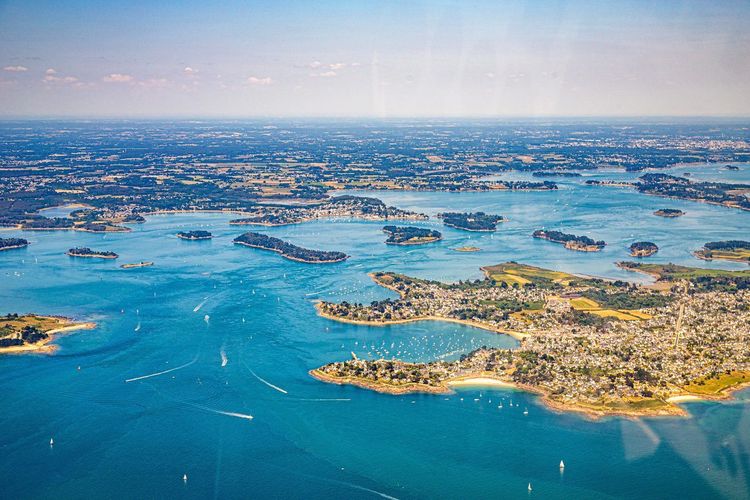
The Gulf of Morbihan is also best discovered from the water, and there is no shortage of formats.
Historic Sailing Boat and Catamaran in the Gulf
Boarding a historic sailing boat in the Gulf of Morbihan — often a former working boat rigged in the old style, or a replica of a sinagot, the red-sailed sailing vessel typical of the gulf — turns a simple trip out to sea into a foray into local maritime heritage. Outings generally last half a day, with the chance to lend a hand with the rigging under the crew's supervision.
Another option, more family-friendly: a catamaran trip in the Gulf of Morbihan, more stable and faster, allowing you to cover more islands in a single outing — Île aux Moines and Île d'Arz being the top picks. Watch out for the currents: the Jument passage, between Arradon and Île aux Moines, reaches several knots on the ebb tide and requires departure times aligned with the tides. To continue exploring the gulf once ashore, the article The Most Beautiful Spots in the Gulf of Morbihan to Discover lists several viewpoints accessible on foot.
E-Foil and Mermaiding: Two Uncommon Experiences
Head to the Baie de Quiberon for two more under-the-radar activities. The racing trimaran offers high-speed outings that let you feel the glide of a boat designed for competition — fully supervised and accessible with no sailing experience.
Even more surprising: an introduction to e-foil, the electric board that literally lifts off the surface of the water, and mermaiding offered along the south Breton coast — a discipline from the United States that involves swimming in a monofin, mermaid-style. Both are practised in a wetsuit, supervised by an instructor, with no particular swimming level required beyond being a comfortable swimmer. Allow an hour for an e-foil session — enough time to learn to stay upright without falling every thirty seconds.
A Little-Known History: Vannes, from Darioritum to Today
Behind the half-timbered façades, Vannes conceals nearly two thousand years of history, with a few twists that chronological timelines summarise far too quickly.
Darioritum, the City Founded by the Romans
Before being called Vannes, the city bore the name Darioritum, founded by the Romans in the 1st century AD on the lands of the Gaulish people known as the Veneti — the same people Julius Caesar had defeated in a naval battle off the Morbihan coast in 56 BC. The name appears in the writings of the geographer Ptolemy in the 2nd century. Remains from this period, mainly foundations and fragments of thermal baths, were uncovered during excavations around the Boismoreau district, but remain little signposted to the general public.
The Wars of Succession and the Decline of the Duchy
Between 1341 and 1364, the Wars of Succession of the Duchy of Brittany pitted the Montforts against the Blois-Penthièvres for control of the duchy, devastating the regional economy for over twenty years. Vannes, a strategic stronghold coveted by both sides, changed hands several times during the conflict and endured several sieges. It is from this troubled period that the successive reinforcements of the ramparts date — their thickness still betraying the anxiety of the defenders of the time. A century and a half later, it was again in Vannes, in 1532, that the Estates of Brittany ratified the union of the duchy with France.
The 19th Century: A New Face for Vannes
It was not until the second half of the 19th century that Vannes truly changed its face: the arrival of the railway in 1862, the development of the port and its quays, and administrative growth linked to its status as the prefecture of the Morbihan. It is this period that gave the city much of its bourgeois architecture, in sharp contrast to the intact medieval core, best appreciated on foot with our audio-guided tour of Vannes.
Ten Lesser-Known Places to Discover in the Morbihan, Within an Hour of Vannes
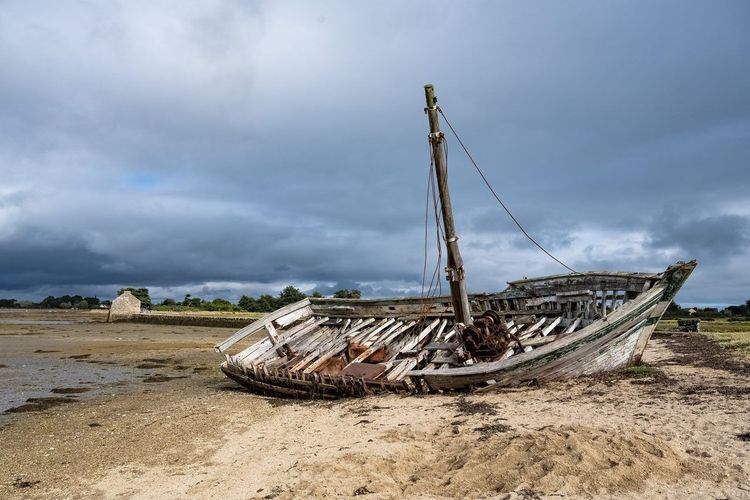
Beyond the gates of Vannes, the Morbihan continues to hold surprises, often grouped by classic guides into a simple list with no particular logic. Here is a selection organised by type of curiosity, within roughly an hour's drive. For a broader overview, the article What to Do in the Morbihan completes this selection with more outing ideas across the department.
Lesser-Known Châteaux and Fortresses
Half an hour from Vannes, the château de Suscinio, former residence of the Dukes of Brittany, raises its towers above the Rhuys Peninsula, surrounded by moats still filled with water. Restored over several decades after serving as a stone quarry in the 19th century, it preserves a pavement of medieval terracotta tiles among the best-preserved in France, discovered in the ruins of the chapel.
Further north, the château de Josselin has overlooked the Oust since the 11th century, with a river-facing façade that remains distinctly defensive and an elaborately carved granite courtyard on the interior side. It has belonged to the Rohan family for over six hundred years — a rare fact for a still-inhabited château — and houses a doll museum installed in the former stables.
Sacred and Legendary Sites
In Tréhorenteuc, on the edge of the Brocéliande forest, the Grail church stands out with its décor devoted as much to Arthurian legend as to the saints: the Round Table, the quest for the Grail, and the fairy Morgane sit alongside conventional Catholic iconography — the initiative of Abbé Gillard, who remodelled the building in the mid-20th century to root local legends in the place of worship.
A radically different atmosphere awaits at the Centre Bouddhique Drukpa in Plouray, where a Tibetan temple welcomes retreats and meditation sessions deep in the Morbihan countryside, about 1h15 from Vannes. More discreet still, the chapelle Saint-Gildas, built against a huge boulder on the banks of the Blavet at Bieuzy-les-Eaux, is worth a detour for its sheltered setting and its spring, reputed to have healing properties.
Finally, head to the coast for the dolmen de Crucuno in Plouharnel, one of the most impressive megaliths in Brittany: a single stone table weighing several dozen tonnes resting on its supports, re-erected at the end of the 19th century, and dating back to the Neolithic period — more than 5,000 years ago.
Industrial and Artistic Curiosities
On the border of the Morbihan and the Côtes-d'Armor, near Gouarec, the hamlet of Forges des Salles has preserved its 18th- and 19th-century ironworking village almost intact, with workers' housing, a charcoal barn, and a supply pond still in place. In Gourin, a replica of the Statue of Liberty, erected in the 1980s in memory of the thousands of Bretons who set off to seek their fortune in North America, surprises visitors around a bend in the road.
On the coast, the tour à feu de Pen Cadénic in Damgan — which locals also call the Tower of the English — was used as early as the 17th century to guide ships towards the port of Pénerf: it is one of the oldest lighthouse ancestors still standing in Brittany. In Lorient, the submarine Flore S645, a Cold War relic sitting in dry dock, can be visited with an audio guide that recreates life aboard for the crew, while the Lorient La Base site (Rue Alain Colas, 56100 Lorient, rated 4.1/5 on Google from 1,232 reviews), a former German submarine base now repurposed, today combines concrete blocks, a museum, and offshore racing bases.
Nature and Prehistory Around Vannes
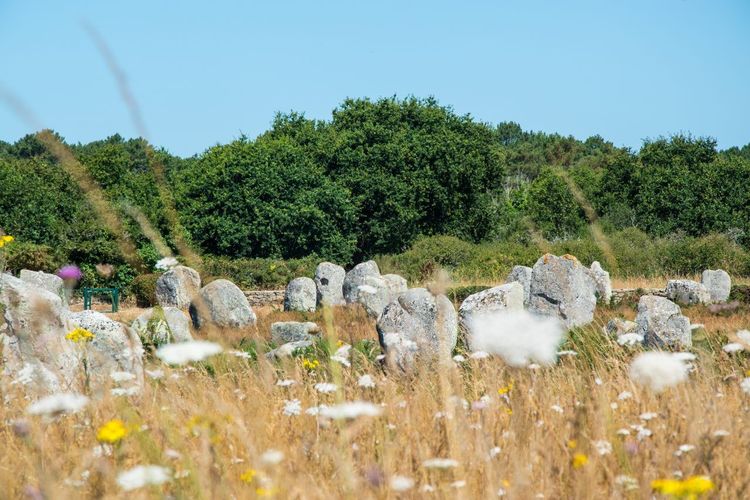
Another facet of the Morbihan, even older: that of the megaliths and the vast preserved natural spaces.
The Parc de Préhistoire de Bretagne and the Centre de l'Imaginaire Arthurien
In Malansac, about thirty minutes from Vannes, the Parc de Préhistoire de Bretagne unfolds across a former slate quarry an outdoor trail dotted with life-size dinosaurs and reconstructed prehistoric scenes, from the appearance of life to the first humans. Allow 2 hours to visit the hilly, wooded site — a format particularly popular with families with children.
In the Brocéliande forest, the Centre de l'Imaginaire Arthurien, housed in the château de Comper in Concoret, explores the legends of King Arthur and the fairy Viviane through exhibitions and storytelling walks in the château grounds, beside the pond where tradition places the fairy's crystal palace. Allow a good half-day to combine both sites, which are about 45 minutes apart by road.
The Kerzerho Alignments in Erdeven
Less well known than the nearby Carnac alignments, the Kerzerho alignments (56410 Erdeven, rated 4.6/5 on Google from 3,093 reviews) in Erdeven originally numbered over a thousand menhirs spread across about ten rows; fewer than two hundred remain today, including some giants approaching six metres in height. The advantage over their Carnac neighbours: access remains free and unrestricted all year round, with no fences or visiting hours, and the crowds are incomparably smaller.
On a more contemporary note, the Musée des Passions et des Ailes in Baden brings together aircraft, motorcycles, and vintage vehicles in a wonderfully improbable hangar, while the Maison Yves Rocher in La Gacilly traces the story of plant-based cosmetics in the founder's home village, botanical gardens included. To end on a more mysterious note, the Mystère Abgrall in Concoret offers a full-scale puzzle game deep in the Brocéliande forest, designed as a family treasure hunt lasting several hours.
Hiking and the Great Outdoors Around Vannes
If you prefer walking to driving, two very different playgrounds surround the city.
The Rhuys Peninsula
The Rhuys Peninsula, wedged between the gulf and the ocean, rolls out dozens of kilometres of waymarked coastal path along the GR 34, alternating between beaches, salt marshes, and rocky headlands. Allow a full day for a long loop, or choose a 2- to 3-hour section departing from Sarzeau or the Pointe de Penvins if time is short. The path passes at the foot of the château de Suscinio, making it easy to combine a walk and a visit in the same day.
The Landes de Lanvaux
To the north of Vannes, the Landes de Lanvaux offer an entirely different landscape: woodland, ponds, rocky outcrops, and former granite quarries along a long rolling ridge that feels quite unexpected for the region. Hikes around Vannes here are generally quieter than along the gulf shore, with far fewer tourists even in the height of summer. The megalithic site of Saint-Guyomard or the covered allées scattered through the woods provide a destination when the loop stretches on.
Practical Information for an Unusual Visit to Vannes
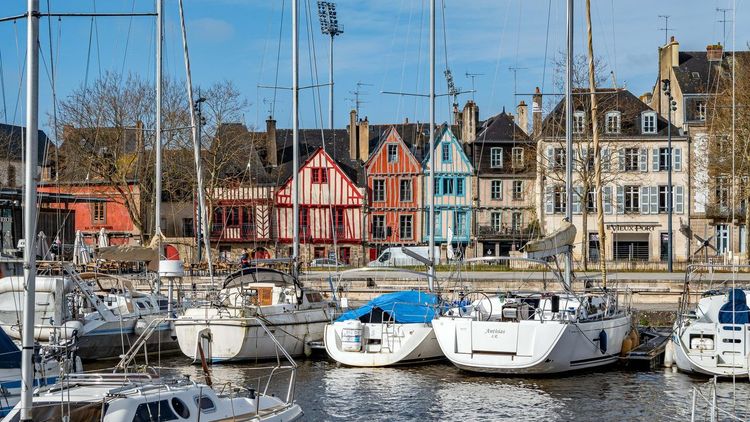
Before you set off, a few practical pointers to help you plan your unusual visit to Vannes.
When to Go and What to Do on a Sunday in Vannes
The best period remains spring or early autumn: mild temperatures, a less crowded gulf than in July and August, and nautical activity prices that are often more competitive outside peak season. May and September also offer spectacular spring tides in the gulf, when the current forces its way between the islands.
What can you do in Vannes on a Sunday? The historic centre stays lively: crêperies and cafés open, the port promenade and ramparts accessible at all hours, La Cohue museum open in the afternoon for much of the year, and several activity operators — urban rally or boat trips — maintaining their weekend slots. The Halles des Lices market, however, is held on Wednesday and Saturday mornings: do not count on it on a Sunday. Also check municipal museum opening hours out of season, which are often reduced, and book aerial and nautical activities in advance — they fill up days ahead in summer.
Where to Stay to Explore the Morbihan Differently
To extend the experience, several addresses offer unusual accommodation in the heart of the Morbihan: treetop cabins on the edge of the Brocéliande forest, yurts or tipis a few kilometres from the gulf, fitted caravans near the wild Quiberon coast, and even a few nights aboard a boat moored in one of the gulf's ports. These options generally need to be booked several weeks in advance during high season.
If you prefer to stay in the city, the old town of Vannes concentrates most of its charming hotels in historic buildings, within walking distance of all the sites mentioned above. Ryo's audio-guided tour of Vannes remains a good anchor point for organising your days around the historic centre.
FAQ
What Can You Do in Vannes on a Sunday?
The alleyways of the historic centre, the port promenade, the ramparts, and several nautical activities or the urban rally remain accessible on Sundays. The Lices market, however, is held on Wednesdays and Saturdays, and some municipal museums reduce their opening hours in the low season.
How Much Time Should You Plan for an Unusual Visit to Vannes?
Allow a full day for the historic centre and its stories, and a second day if you add a nautical or aerial activity in the gulf. To also explore the curiosities of the wider Morbihan area — châteaux, megaliths, and Brocéliande — plan for a full weekend.
What Original Family Activities Are There in Vannes?
The urban rally, the food tour adapted for children, the Parc de Préhistoire de Bretagne in Malansac, and a catamaran outing in the gulf are all well suited to families, with formats generally accessible from the age of 6–7.
Where Should You Stay to Explore the Gulf of Morbihan Differently?
Treetop cabins, yurts, and caravans scattered around the gulf and towards Brocéliande offer an alternative to the classic hotel, while the historic centre of Vannes concentrates the most centrally located charming addresses. Book early between June and September.
Which Lesser-Known Places Can You Visit Within an Hour of Vannes?
The château de Suscinio, the Grail church in Tréhorenteuc, the dolmen de Crucuno, the Kerzerho alignments, and the submarine Flore S645 in Lorient are among the most remarkable discoveries reachable within about an hour's drive.
When Is the Best Time to Visit Vannes in an Original Way?
Spring and early autumn offer the best balance between pleasant weather and manageable crowds, with often more attractive prices on nautical and aerial activities than in high summer.
Vannes is ultimately ill-suited to a rushed visit. Its ramparts, cathedral, and half-timbered houses can be photographed in an hour, but it is by slowing down, searching for the carved couple above a shopfront, or venturing out to the gulf for a helicopter flyover that the city truly reveals itself at its most surprising.
An unusual visit to Vannes plays out as much in the details of the historic centre as in the excursions towards the gulf and the Morbihan hinterland. Whether you stay intra-muros or push as far as the Kerzerho alignments and the château de Suscinio, the Ryo audio-guided tour of Vannes remains a solid base for composing your own itinerary, neighbourhood by neighbourhood, legend by legend.
À lire également