© Shutterstock
 Votre guide Ryo
Visit Vannes as a Couple: Cobblestone Lanes, Flower-Lined Ramparts and Gulf Islands (2026)
It's 7 p.m. in Vannes, the raking light on the ramparts turns orange, and on the place des Lices waiters are setting out the first terrace tables. Visiting Vannes as a couple means this above all: a small fortified city that keeps a low profile as evening falls, once the school groups have gone, the half-timbered lanes have emptied and nothing remains but the cry of seagulls above the port. To explore it without rushing, the Ryo audio guide of Vannes starts right in this historic centre, between the cathedral and the jardin des Remparts, and unfolds 18 audio stops over approximately 3 km.
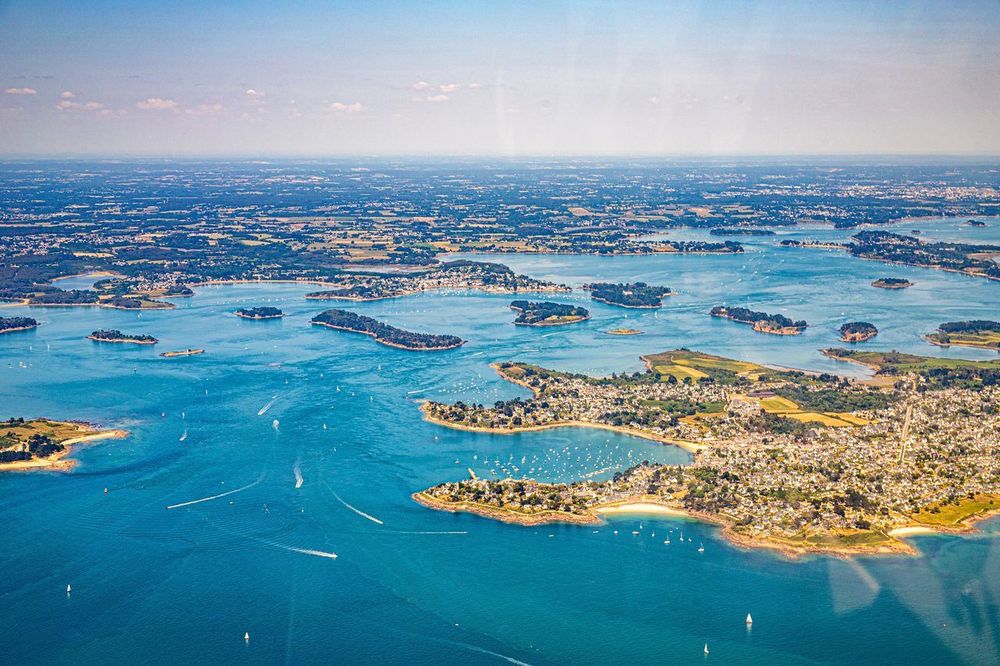
At the foot of the ramparts, there is a particular bench, facing the medieval towers, where you stop without a word. At Conleau, a shuttle heads to the île d'Arz in about a quarter of an hour. On the same peninsula, a coastal path passes more oyster beds than tourists. And half an hour's drive away, alignments of standing stones over 6,000 years old, inscribed on the UNESCO World Heritage List since 2025, await at Carnac. This guide details where to wander in the old town, how to organise a boat trip on the golfe du Morbihan, where to have an intimate dinner, where to stay in a charming property, and how to extend the weekend towards Auray, Josselin or Rochefort-en-Terre.
Why Vannes Is a Romantic Destination for a Weekend for Two
Vannes ticks a rare box for a romantic getaway: it is small enough to explore entirely on foot, yet rich enough in heritage to never feel repetitive. The historic city centre fits within a pocket-sized area, encircled by ramparts that are still largely intact, and opens directly onto a marina and then onto the golfe du Morbihan. Few Breton towns offer such a short sequence from stone to sea: in Saint-Malo you have to contend with the tides and the crowds, in Concarneau the old town is limited to the Ville Close. In Vannes, everything is connected on foot, never losing sight of a tower or a boat mast.
What truly sets a stay here apart is not a particular monument but a rhythm. You can follow a coffee in a cobblestone lane with a stroll at the foot of the ramparts, a boat crossing to a gulf island and a dinner in an intimate restaurant, all without getting back in the car. It is this compactness, more than any postcard image, that makes Vannes a comfortable base for alternating activity and calm without any logistical complexity. Many visitors come for the day from Nantes or Rennes; by staying overnight, you reclaim the two hours when the city empties — the ones that make the journey worthwhile.
Wandering through the Historic Centre and Its Cobblestone Lanes
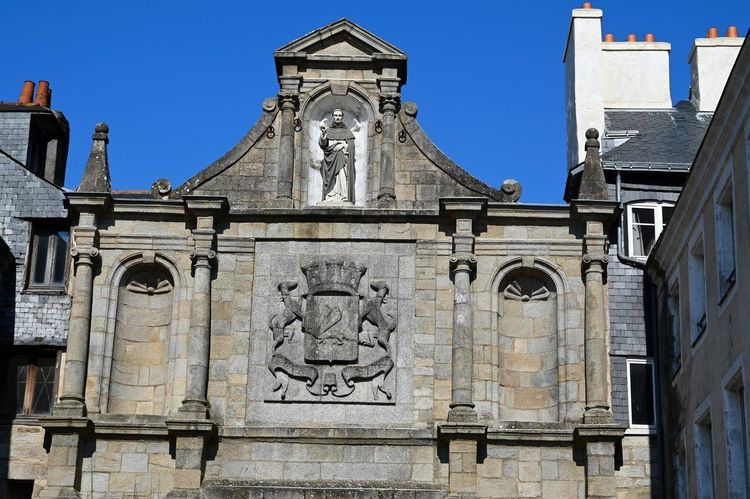
The historic centre of Vannes reveals itself when you look up: half-timbered houses from the 15th and 16th centuries, jettied upper storeys that almost lean across to touch each other from one street to the next, façades restored in stone and granite. More than a hundred of these timber-framed houses still stand, a remarkable number for a city of this size. The usual entry point is place Gambetta, facing the port, passing under the arch of the porte Saint-Vincent, rebuilt in the 17th century, before heading up towards the cathedral. But no route is really wrong: the cobbled lanes all intersect within a few minutes' walk.
At the heart of this web, the cathédrale Saint-Pierre of Vannes asserts itself with its uneven towers and its façade blending Flamboyant Gothic with later additions. The interior, more restrained than the exterior might suggest, houses the tomb of Saint Vincent Ferrer, a Spanish preacher who died in Vannes in 1419 and became the city's patron saint. The circular chapel in Italian Renaissance style deliberately contrasts with the rest of the Gothic building, a detail that many hurried visitors miss.
Right next door, place Saint-Pierre adjoins La Cohue, a former market hall and courthouse, now converted into a fine arts museum. The building has passed through seven centuries without losing its role as a place of exchange: once cloth and grain were sold here, today Breton paintings and contemporary works are exhibited in rotation. You can simply admire the façade from a terrace with a coffee in hand, or set aside an hour for the current exhibition.
Continuing along rue Saint-Guenhaël, one of the best-preserved streets in the old town, the timber frames close in and craft shop windows gradually replace tourist signs. It is a street to walk slowly, hand in hand, without any particular goal. It leads to place Henri IV, widely considered the most photogenic square in Vannes, with its 16th-century jettied houses. Around 6 p.m., when the sun rakes across the façades without yet hitting them head-on, it is the best window for a photo free of backlighting and crowds.
A few streets away hides a detail that many visitors miss: the sign known as "Vannes et sa femme", two polychrome stone busts, probably from the 16th century, set into a house on the corner of rue Noé and rue Pierre-René Rogue, at the edge of place Valencia. A woman on the left, a man on the right, jovial faces and hands now missing: nobody really knows who they represent, and it is precisely that mystery that has made them the city's emblem. Look for them together, glance upward and enjoy inventing their story.
Continuing towards the former city gates, Porte Prison (Rue Alexandre Le Pontois, 56000 Vannes, rated 4.4/5 on Google with 220 reviews), one of the few fortified gates still standing, is a reminder that the city walls were once crossed through half a dozen passages. It marks a natural transition towards the ramparts, where the next walk begins.
Behind these façades, the history of Vannes deserves a few lines to add depth to the walk. The city takes its name from the Veneti, a Gaulish seafaring and trading people who dominated Atlantic navigation before being crushed by Caesar in 56 BC, an episode that Julius Caesar himself recounts in his commentaries on the Gallic Wars. It would take until the Middle Ages for Vannes to become a centre of power again: in the 14th and 15th centuries it became one of the favourite residences of the Dukes of Brittany, a golden age during which the ducal court settled at the château de l'Hermine and a good number of the half-timbered houses still admired today were built. It was in Vannes that the union of the duchy with the Kingdom of France was sealed in 1532, marking the start of a long commercial decline, before tourism gave these lanes a new lease of life centuries later.
To make sure you miss none of these details while walking, the Ryo audio guide of Vannes strings together 18 stops over about 1 hour 20 minutes through this historic centre: the cathedral, place Henri IV, the famous busts and the ducal golden age are all covered in the order you encounter them, without having to pull out a paper guide at every corner or search for a connection, as the app works offline once the audios have been downloaded.
The Ramparts and the Flower Garden: the Finest Walk for Two
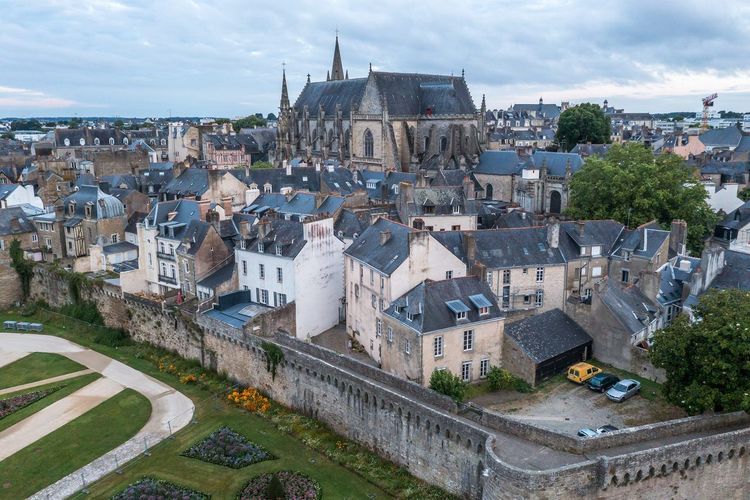
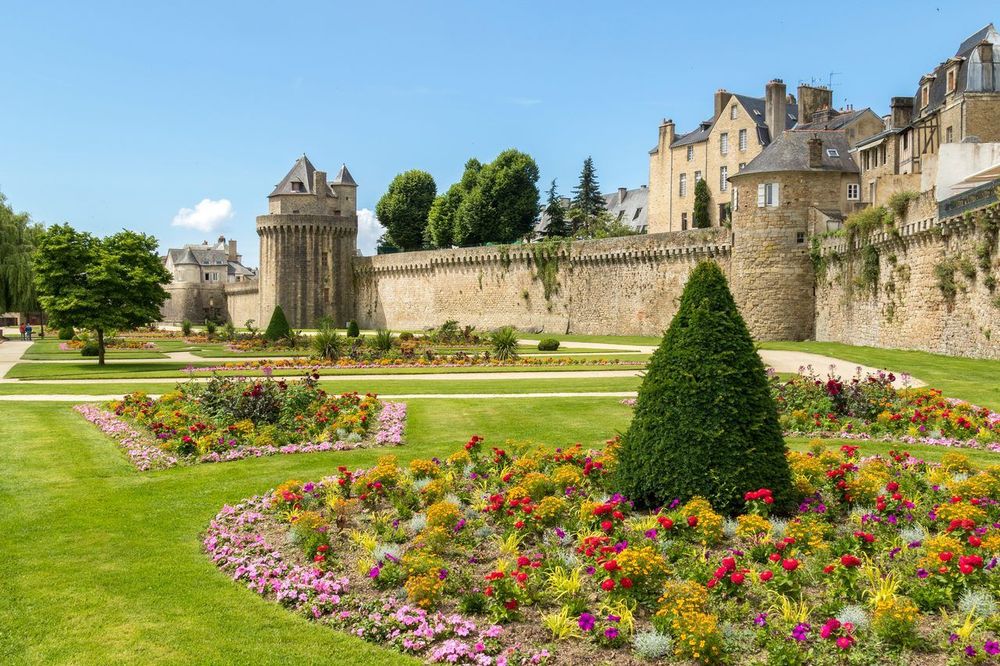
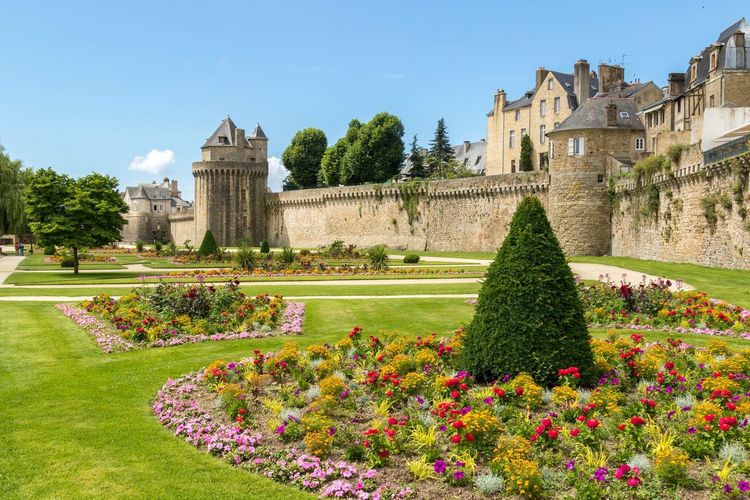
If a single walk were to sum up Vannes, it would be this one. The ramparts of Vannes, among the best-preserved in Brittany, still enclose a large part of the old town, with towers spanning from the 13th to the 15th century. They are best walked along the bottom, along the promenade de la Garenne, where the view is also the finest. A single stretch of the wall walk is permanently open to the public, between the tour Joliette and the tour de la Poudrière, accessed via rue des Vierges: just a few dozen metres above ground, but with a plunging view over the gardens below.
Below stretches the jardin des Remparts, a formal French garden planted with flowerbeds that change colour with the seasons: tulips in spring, dahlias and roses in summer, chrysanthemums in autumn. The view, with the towers and slate rooftops in the background and colourful beds in the foreground, is one of the most reproduced images of the city, and for good reason: few urban ramparts have such a well-tended garden at their feet. The massive tour du Connétable, raised in the 15th century, dominates the whole scene. The best time to admire it is late afternoon, when the raking light brings out the green of the lawns against the grey stone.
Right below the fortifications stand the old lavoirs de la Garenne, beside the stream that once filled the defensive moats. Washerwomen were still beating linen here just last century, and their slate roofs set flush with the water, framed by the towers behind, make up one of the most photographed compositions in Vannes. Across from them, the château de l'Hermine, an 18th-century mansion built on the site of the old ducal fortress, is a reminder that the dukes once lived here, at the foot of these walls. Take the time to sit on one of the benches facing the towers: it is a simple, free vantage point, and one of the locals' favourite spots at the end of the day.
At this spot, the Ryo audio guide tells the story of the wash houses, the old moats and the life of the ducal court at the foot of the city walls — enough to turn a simple photo of stones into a small story to share.
Heading back inside the ramparts, you emerge onto place des Lices (Place des Lices, 56000 Vannes, rated 4.4/5 on Google with 410 reviews), a former jousting ground that today hosts the market twice a week. The very name of the square, inherited from the medieval lists where knights and jousters competed, contrasts sharply with its current, decidedly more peaceful use.
The Marina and the Golfe du Morbihan at Sunset
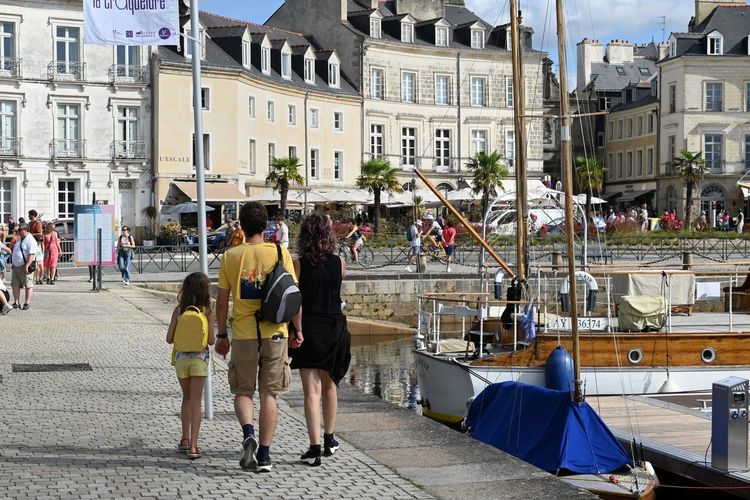
From the ramparts, just a few minutes' walk downhill leads to the marina of Vannes, where several hundred sailing boats and motorboats are moored along the promenade de la Rabine. This is not a fishing harbour but a leisure port, lined with terraces that catch the setting sun full on, its tidal basin reaching right to the foot of the old town.
This is where Vannes stops being a city of stone and becomes a city of water. The port opens onto a channel that joins the golfe du Morbihan through a landscape of mudflats where herons and egrets can be spotted at low tide. The maritime scenery shifts completely depending on the hour: flat, silvery water in the morning, orange reflections at sunset, when the sailboat masts are silhouetted against the sky. An aperitif on a terrace, just before dinner, is an almost obligatory transition into an evening for two. In season, you will also see the excursion boats setting off from here on tours of the gulf.
A Boat Trip to the Gulf Islands
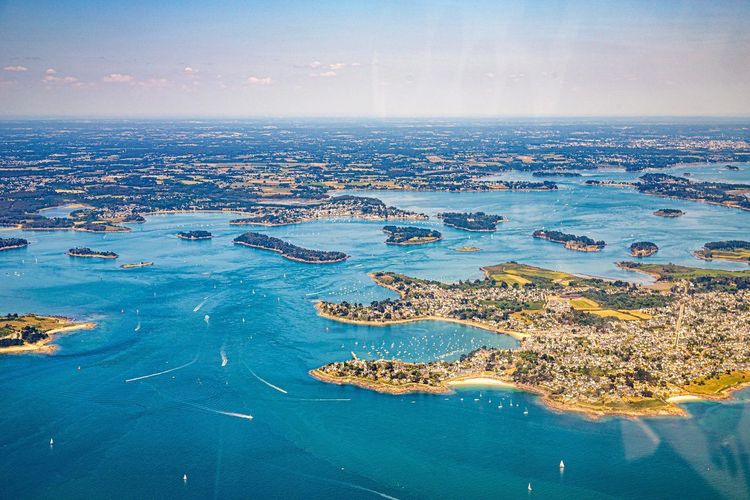
The golfe du Morbihan contains around forty islands and islets, inhabited or otherwise, which explains why the Bretons named it the "little sea", the literal translation of Mor-Bihan. From Vannes, several companies run boats in season to the main islands without any need to hire a private craft; some lines operate as regular shuttles, others as commented excursions of two to three hours circling the gulf, with or without a stop.
The île aux Moines, the largest and most visited, is easily explored by bike or on foot in half a day. Its sheltered coves, hydrangea-lined paths and flower-filled village make it a classic destination for a waterside lunch, well away from the mainland bustle. From Vannes, allow around an hour's crossing depending on the route; the quickest option is the Port-Blanc shuttle from Baden, which takes only a few minutes. Bicycle hire on the island lets you cover it at a leisurely pace.
The île d'Arz (Île d'Arz, 56840 Île-d'Arz, rated 4.6/5 on Google with 268 reviews), smaller and quieter, is reached by the shuttle that departs from the Conleau landing stage in Vannes and docks at the Béluré slipway in about a quarter of an hour. People come here above all to walk the coastal path, car-free, with no sound but the wind in the gorse. Some visitors deliberately stay the night to extend the sense of disconnection until the following morning; the island has only a handful of shops, so meals must be planned if you stay past the last shuttle.
If you would rather stay on the mainland while still following the shore of the gulf, the presqu'île de Rhuys to the south offers a driving alternative: wider beaches on the ocean side, oyster-farming villages and above all the château de Suscinio, former summer residence of the Dukes of Brittany set beside the marshes, to be explored at your own pace with no boat timetable to keep. It is also the easiest option if one of you is prone to seasickness.
Before boarding, take a detour through the port: the Ryo audio guide pinpoints the best viewpoints over the water and gives you the references to recognise, once on the île aux Moines or the île d'Arz, what you heard about the maritime history of the Veneti.
The Conleau Peninsula: a Nature Escape Just Minutes from the Centre
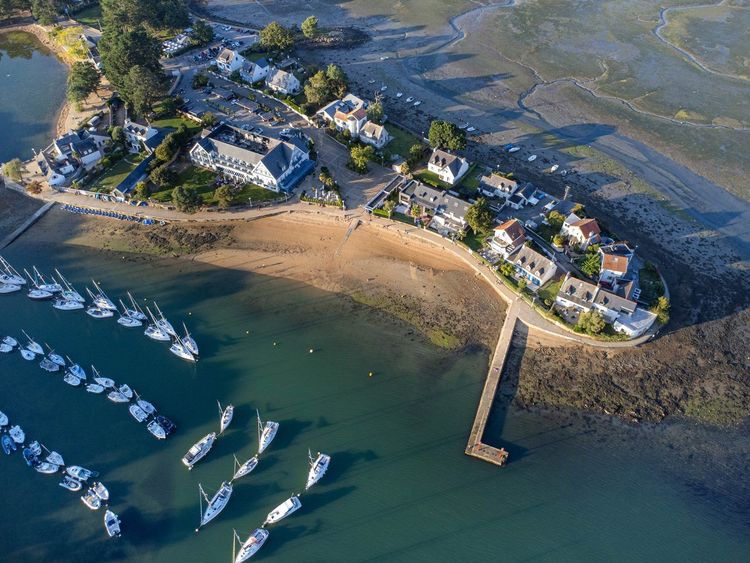
About 3 km south of the historic centre, the Conleau peninsula (Presqu'île de Conleau, 56000 Vannes, rated 4.6/5 on Google with 458 reviews) offers a very different break from the rest of the visit. Long a village of fishermen and oyster beds, it is connected to the mainland by a causeway and can be walked around in just under an hour, with no hills to climb. You can reach it on foot from the port by following the promenade de la Rabine and then the wooded riverbanks, by bike in about fifteen minutes, or by city bus on rainy days.
The path that circles it alternates between pine woods, oyster shacks and small, discreet coves where you can stop undisturbed. Its best-known attraction is a seawater pool built on the foreshore, refilled at every high tide: a free swim, facing the islands, that the people of Vannes flock to in summer. Further along, the Vincin wood extends the walk through the trees as far as the river. The best time is late in the day, when the light catches the boats moored along the causeway and most visitors have already headed home.
Wear closed shoes: the path, pleasant but sometimes damp depending on the tide, is not always manageable in sandals. After the 18 stops of the Ryo audio guide through the old town, Conleau is the natural sequel for unwinding: the same maritime thread, but this time without cobblestones or façades, just water and silence. It is also the departure point for the île d'Arz shuttles, making it easy to combine both in a single half-day.
Where to Have a Romantic Dinner: Intimate and Gourmet Tables
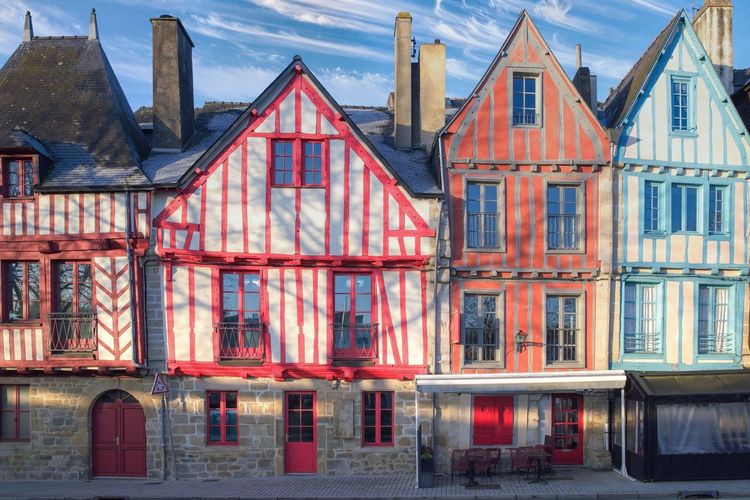
Vannes does not have the gastronomic reputation of Lyon or Bordeaux, but it compensates with a surprising density of small restaurants, often set in half-timbered houses with no more than six or eight tables. It is precisely this intimate scale that makes a dinner for two easier to get right here: little noise, service that has time to talk through the menu, and a concise list built around produce from the gulf rather than an endless à la carte.
For a slightly more dressed-up dinner, several gastronomic restaurants in the city centre and around the port offer tasting menus built on seasonal produce: gulf oysters, line-caught sea bass, scallops in winter, langoustines in summer. Book several days ahead at weekends; these restaurants rarely have more than twenty covers and fill up from Friday onwards in high season.
For something more relaxed, start the day at the marché des Lices (Place des Lices, 56000 Vannes, rated 4.4/5 on Google with 1,966 reviews), held on the square of the same name on Wednesday and Saturday mornings. Producers from the presqu'île de Rhuys, cheese makers, fishmongers, greengrocers: it is the perfect occasion to put together a picnic to take to the jardin des Remparts or to Conleau, rather than booking a table. Arrive before 11 a.m. to avoid the Saturday crowds and find the best stalls; the neighbouring covered market completes the offer with its indoor fishmongers.
Between the two, a middle option works well if you want neither a full restaurant nor a picnic: the wine bars and crêperies of the historic centre, where you can nibble without a reservation on a terrace, for a bill that rarely exceeds 25 to 30 euros per person. A galette complète and a bowl of local cider remain the simplest and most authentically Breton dinner you can have. To discover the addresses and products that locals mention most often, our article on the culinary specialities of Vannes covers ten dishes and products not to miss during your stay.
Where to Stay: Charming Hotels, Spas and Romantic Rooms
Staying in Vannes as a couple opens up two quite different options. In the city centre, several charming hotels occupy former townhouses, with mansard rooms, exposed beams and sometimes a small spa or private jacuzzi available at an extra cost. The advantage is obvious: the entire historic centre, ramparts included, is walkable, with no need to get back in the car in the evening. Around the port, other establishments lean towards views over the basins and morning light on the water.
For a longer or more secluded stay, eco-lodges and cabins around the gulf offer a different experience: silence, water views, often a private terrace overlooking the mudflats. Many travellers combine both formats — one night in the city and one night on the île d'Arz or in the presqu'île de Rhuys — to alternate between an urban atmosphere and complete isolation.
If you are planning three or four nights, holiday rentals (apartments in the old town, houses with gardens on the outskirts) often work out cheaper than an equivalent hotel and offer more independence for morning meals. Simply check car access: some streets in the historic centre are pedestrianised or heavily restricted, which can complicate unloading luggage if the accommodation has no dedicated parking.
Book early if a spa or private jacuzzi is on your list: these rooms, limited in number, go first on spring and summer weekends, and even earlier around Valentine's Day, when some establishments fill up as early as January.
Extending the Getaway around Vannes and the Golfe du Morbihan
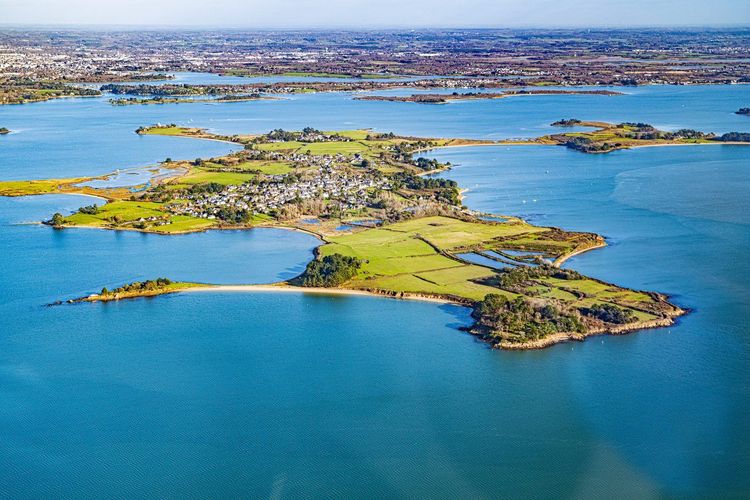
If your stay extends beyond two days, several day trips allow you to round out the visit without travelling far. They fall naturally into three groups, depending on what you are looking for: maritime heritage, prehistory or villages of character further inland. For an overview of the islands, headlands and villages of the little sea, our selection of the most beautiful spots in the golfe du Morbihan makes a useful complement to this chapter.
The first maritime stop, Auray, about twenty minutes by road, is well worth the detour for its Saint-Goustan quarter: 15th-century half-timbered houses clustered around an old river port, where Benjamin Franklin landed in December 1776 to seek France's support in the American War of Independence. It makes an excellent complement to Vannes for those wanting a second historic centre in miniature, less visited, with its own waterside fish restaurants on the banks of the Loch river.
For prehistory, the Carnac alignments bring together nearly 3,000 standing stones spread across several sites, erected more than 6,000 years ago for reasons still debated by archaeologists, between ritual hypotheses and astronomical calendars. Since 12 July 2025, they have been part of the "Megaliths of Carnac and the shores of Morbihan" UNESCO World Heritage Site, which groups together more than 12,000 standing stones. Half an hour's drive from Vannes, the walk between the Ménec and Kermario alignments is best done early in the morning or at the end of the day. A little further on, at Locmariaquer, the Grand Menhir brisé, now lying in four pieces, and the Table des Marchands, a dolmen with a carved burial chamber, complete the visit. If you want to go deeper, our article dedicated to Carnac covers the sites in detail.
Further inland, two villages of character stand clearly apart from the rest. Josselin, about 45 minutes by road, is almost entirely defined by its château, the Rohan fortress rising above the Oust: the riverside façade, with its slender towers reflected in the water, remains one of the most striking images in inland Morbihan, while the courtyard façade, sculpted in Flamboyant Gothic style, conceals an interior still partly inhabited by the Rohan family.
Rochefort-en-Terre (Rochefort-en-Terre, 56220 Rochefort-en-Terre, rated 4.7/5 on Google with 1.6K reviews), listed among the Plus Beaux Villages de France, rounds off this excursion nicely: sloping cobbled lanes, granite houses covered in geraniums from spring to autumn, and a particularly photogenic atmosphere at the end of the day once the tour groups have left the village. It owes part of its fame to the American painter Alfred Klots, who bought the château at the beginning of the 20th century and encouraged the flowering of the façades.
To organise these excursions without losing time on the road: allow half a day for Auray, a full day for Carnac and Locmariaquer combined, and a full day for Josselin and Rochefort-en-Terre together, the two being close enough to each other to pair easily.
Practical Information: When to Come, How to Get There and How Long to Allow
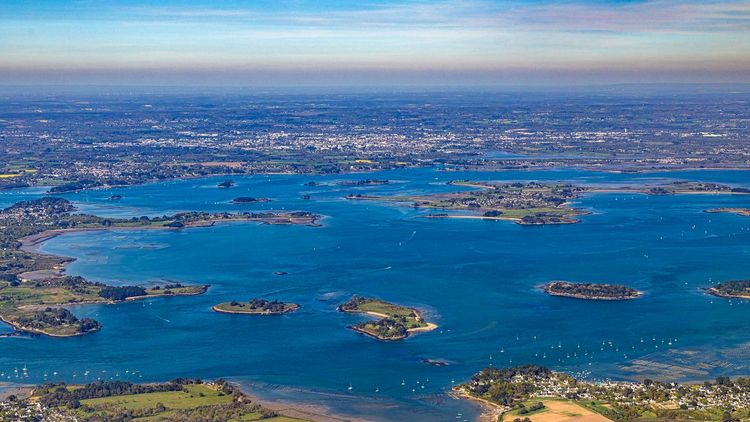
The best time depends largely on what you are looking for. Spring (April to June) and early autumn offer a good balance: blooming gardens, less crowded ramparts and softer accommodation rates than in summer. July and August guarantee the best weather for boat trips to the gulf islands, but also the most people on place Henri IV and in the port; winter, quieter still, suits a weekend centred on heritage and gastronomy rather than the gulf.
To reach Vannes by train, the TGV from Paris-Montparnasse arrives at Vannes station in around 2 hours 30 minutes, with several daily services. From Rennes, allow just over an hour, and the BreizhGo regional network covers connections to Auray or Quiberon. The station is about fifteen minutes' walk from the historic centre, making it a very practical option for travelling without a car.
By car, Vannes is reached via the N165 expressway (Nantes–Brest axis), with several exits leading directly into the city. For parking, several car parks (République, Le Pontois, port) surround the pedestrian historic centre; they are generally easier to use in the evening than during the day, a useful detail if you are mainly planning a dinner and an overnight stay. Avoid looking for a space in the old town itself: most streets are pedestrianised or heavily restricted.
How long to allow? Two full days are enough to cover the historic centre, the ramparts and a boat trip. Allow three days if you want to add Conleau and a day trip to Carnac or Josselin without rushing. The layout of Vannes is easy to commit to memory: the entire old town reads as an oval enclosed by the ramparts, with the port as its opening onto the gulf, making it hard to get lost even without a map.

FAQ
How much time should I plan to visit Vannes as a couple?
Two full days are enough to cover the historic centre, the ramparts and a boat trip on the gulf. Allow three to four days to add the Conleau peninsula and a day trip to Carnac, Auray or Josselin without having to rush from one stop to the next.
What is the best time of year for a romantic weekend in Vannes?
Spring and early autumn offer the best balance between blooming gardens and moderate crowds. Summer guarantees more reliable weather for boat excursions, but the historic centre and the terraces are noticeably busier, especially around 15 August.
How do I get to Vannes from Paris or Rennes?
The TGV connects Paris-Montparnasse to Vannes in around 2 hours 30 minutes, with the station about a fifteen-minute walk from the historic centre. From Rennes, allow just over an hour by train. By car, the N165 leads directly into the city from Nantes or Brest.
Where can I park to visit the historic centre of Vannes?
Several car parks surround the pedestrian city centre, notably near République, Le Pontois and the port. They are generally easier to find in the evening than during the day, which suits a stay planned around dinner and an overnight stay in the city rather than day trips back and forth.
What is there to do in Vannes when it rains?
La Cohue and its fine arts museum, the cathédrale Saint-Pierre and the small craft galleries along rue Saint-Guenhaël can all be visited under cover. It is also a good time for a long, leisurely lunch in an intimate restaurant in the historic centre, while waiting for a break in the clouds before heading back out to the ramparts or the marché des Lices.
Is Vannes a good destination with children?
Yes: the pedestrian historic centre, the port and the Conleau peninsula lend themselves well to a family visit, with short distances and little traffic to watch out for. Boat trips to the île aux Moines or the île d'Arz are generally as popular with children as with adults, combining beach and cycling, and the Conleau seawater pool is a universal hit in summer.
Should I book a spa hotel in Vannes well in advance?
Yes, these rooms are few and far between in the city centre and go quickly on spring and summer weekends, as well as around Valentine's Day. Booking a month ahead is the safest margin for this type of accommodation, even more so for suites with a private jacuzzi.
When all is said and done, what makes Vannes so endearing is not any single monument but the ease with which everything flows together: the ramparts, the port, a gulf island, a dinner for two, without ever getting back in the car between stops. Even longer day trips to Carnac or Josselin fit into a weekend without disrupting the city-centre programme. To follow that thread at your own pace, without depending on a guided tour schedule, the Ryo audio guide of Vannes and its 18 audios are available offline on your phone, ready to start wherever you are in the old town.
À lire également