© Shutterstock
 Votre guide Ryo
Visiting Munich Without a Car in 2026: The Complete Guide on Foot, by Bike and by Public Transport
In Munich, a car is more of an obstacle than a solution: the historic centre is largely pedestrianised, and parking around Marienplatz often costs more than a U-Bahn ticket for the entire day. Visiting Munich without a car is therefore not a constraint; it is the most logical way to discover the Bavarian capital. As soon as you leave the airport, the S-Bahn S1 or S8 drops you in the heart of the city in about forty minutes, with no queues and no parking stress. After that, a network of U-Bahn, S-Bahn and trams serves everything, from the royal palace of the Residenz to the Eisbach surf wave. Between the lanes of the old town, the Viktualienmarkt market and the 3.7 km² of the Englischer Garten, this guide details every way of getting around, the must-see places accessible without a car key, the 2026 fares and two train excursions to Dachau and Lake Constance. To explore the historic centre at your own pace, the Ryo audio-guided tour of Munich comments step by step on Marienplatz, the Residenz and the most discreet façades of the district.
How to Get Around Munich Without a Car: The Public Transport Network
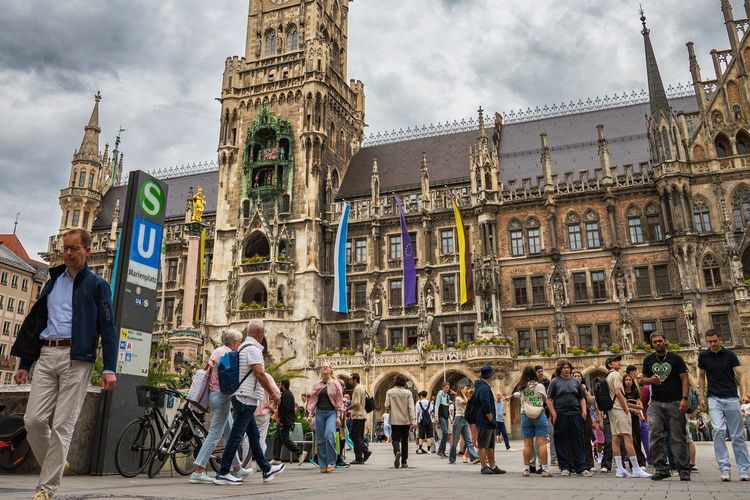
Munich is organised around a single integrated network, the MVV (Münchner Verkehrsverbund), which merges U-Bahn, S-Bahn, tram and bus under one fare system. Eight U-Bahn lines run beneath the city, while the S-Bahn lines all converge on the central section Hauptbahnhof-Marienplatz-Ostbahnhof, a tunnel that is saturated at rush hour but remarkably efficient for linking the two main stations in a few minutes.
On the surface, a dozen tram lines serve districts the metro ignores, from the student district of Schwabing to the gates of Nymphenburg park. Buses complete this network in the outlying areas, but inside the Altstadtring, the boulevard that encircles the historic centre, you will almost never need them: everything is done on foot.
This is the key point to understand before even choosing a ticket: Munich's city centre, from Marienplatz to the Isartor, can be crossed entirely on foot in 20 to 25 minutes. Many visitors buy a day ticket only to end up using the metro just two or three times, to reach the airport or Nymphenburg.
Trains run from around 4:30 am until 1 am, with extended service at weekends. If you arrive late on a Friday or Saturday, the night lines, prefixed with N, take over until regular service resumes. A practical tip: download the MVV or MVGO app before you arrive; they calculate connections in real time and sell tickets directly on your phone.
To get your bearings, remember that almost the entire city and its tourist sites are in Zone M, the single fare zone that covers the whole municipal area since the 2019 MVV reform. Zones 1 to 6 then extend in rings towards the suburbs, with the airport in Zone 5. This simplicity avoids the classic visitor mistake of buying a ticket for too wide a zone. One last useful landmark: Marienplatz station is literally beneath the square of the same name, so you can come back up to the surface in the middle of winter without feeling cold for a moment.
Tickets, Passes and Public Transport Prices
The MVV ticketing system offers several options depending on the length of your stay. The single ticket (Einzelfahrkarte) costs €4.20 in Zone M in 2026 and suits a one-way trip. For short, repeated journeys, the StreifenKarte (strip ticket) remains the most flexible option: you stamp a number of strips proportional to the distance, and it can be shared between several travellers.
From two trips a day, the day ticket (Tageskarte) becomes worthwhile: €10.10 for one person in Zone M. A group version covers up to five adults, worthwhile from three travellers. It remains valid until 6 am the next day, making it a good choice after a late evening at the Hofbräuhaus followed by a last metro.
For a stay of several days, the CityTourCard combines unlimited transport with discounts at around fifty museums and attractions, some of which are mentioned below. It comes in several durations, in a Zone M version or a full-network version, the latter including Dachau and the airport.
Before buying, a simple rule: always validate your paper ticket before boarding, even on trams and buses where nobody will ask for it at the entrance. Checks are random, but the €60 fine far exceeds the price of a ticket.
Accessible Transport: Accessibility for All Travellers
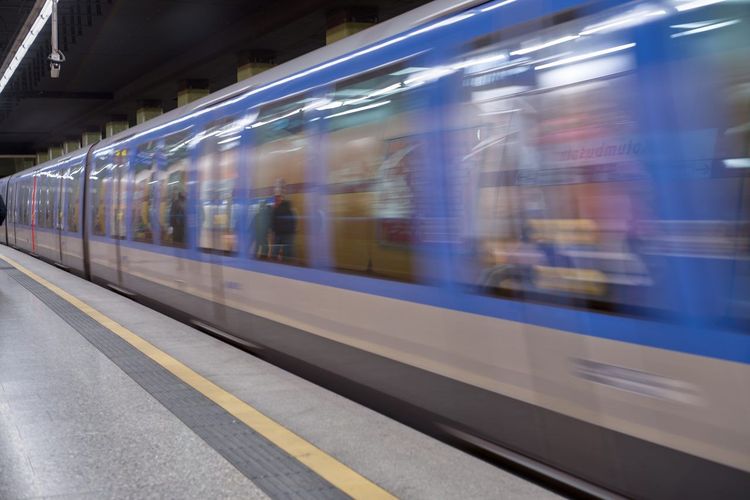
The MVV network is among the most accessible in Europe for travellers with reduced mobility. Almost all U-Bahn and S-Bahn stations have lifts, marked on the official maps, and recent trams are low-floor.
At the airport, free airport assistance can be arranged on request at least 48 hours before the flight, both for boarding and for the journey to the S-Bahn. Similar assistance is available at the main station for long-distance connections.
In the city, the main pedestrian routes in the centre are wide and well maintained, which makes Marienplatz and the Viktualienmarkt passable in a wheelchair without any major detour. Some older stations still have an offset lift: check your route on the MVV app before setting off.
Getting to the City Centre from the Airport Without a Car
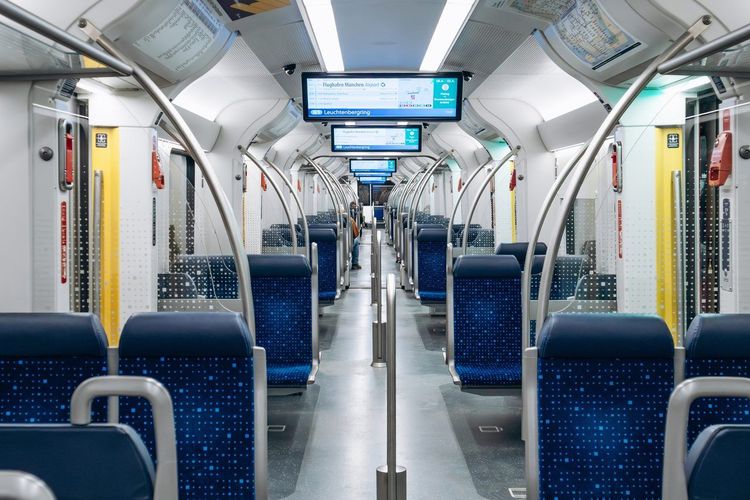
Munich Airport (MUC) is nearly 40 km from the centre, but two S-Bahn lines, the S1 and S8, connect the terminals directly to Marienplatz and the main station. Allow about 40 to 45 minutes for the journey, for €15.10 for a single ticket (zones M-5) in 2026. For two or more people, the group Airport-City-Day-Ticket, valid all day for five people, quickly becomes cheaper.
The S8 crosses the east of the city while the S1 goes through the north-west before joining the same central section: both arrive at the same place, so simply take the first one that leaves.
Travelling with big suitcases and dreading stairs? The Lufthansa Express Bus connects the airport to the main station via Schwabing Nord in about 45 minutes, with departures every 20 minutes from 5:15 am to 10:25 pm, 365 days a year. The ticket costs slightly more than the S-Bahn.
Avoid taking a taxi unless you have a strict time constraint. Between the traffic jams on the A9 or A92 at rush hour and a fare well over €60, the S-Bahn is both faster and significantly cheaper from the moment you step off the plane.
Munich by Bike: Rental, Cycle Paths and Guided Tours
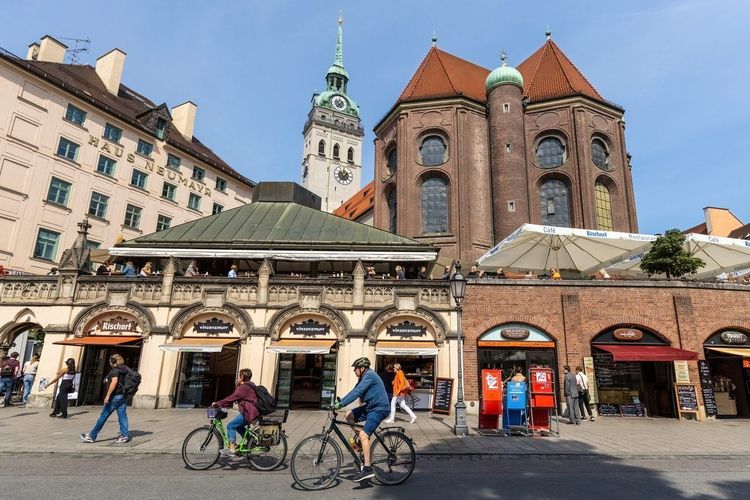
Munich boasts more than 1,200 km of cycle paths, a dense network that makes cycling a credible alternative to walking for slightly longer trips, for example to Nymphenburg or along the Isar.
The MVG Rad self-service bike stations dot the city centre and nearby districts; unlocking is done via an app, with a per-minute rate or longer passes. For several days, independent rental companies offer standard or electric bikes, sometimes delivered to your hotel.
The Isar, the river that runs through the city from south to north, offers one of the finest cycling routes in the city: a continuous path runs along its banks for nearly 15 km, passing gravel beaches where Munich residents sunbathe at the first rays of sun.
If you prefer a guided visit without the effort of navigating, several operators offer guided bike tours of about 3 hours, which take in Marienplatz, the English Garden and sometimes Nymphenburg depending on the package. A good option for a group or a family who want to cover more ground than on foot.
And if you would rather stay seated, the tourist hop-on hop-off bus serves a loop of about fifteen stops covering the main sights, with a ticket valid for 24 or 48 hours. Less immersive than cycling, it is a help in case of rain or tiredness at the end of your stay.
The Old Town and Marienplatz on Foot
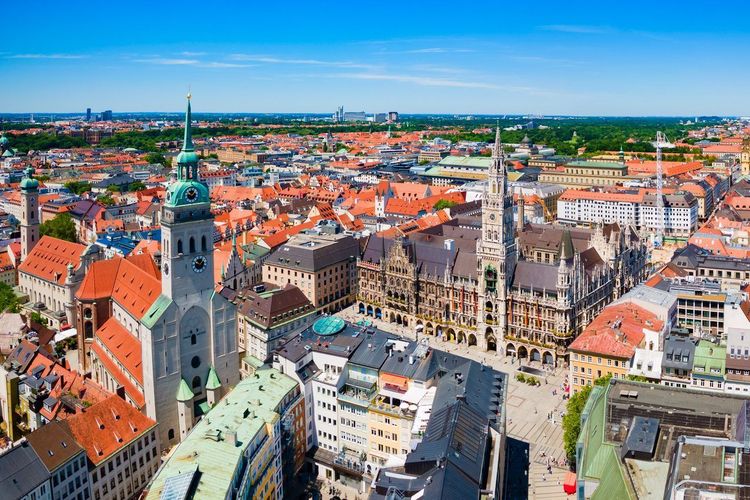
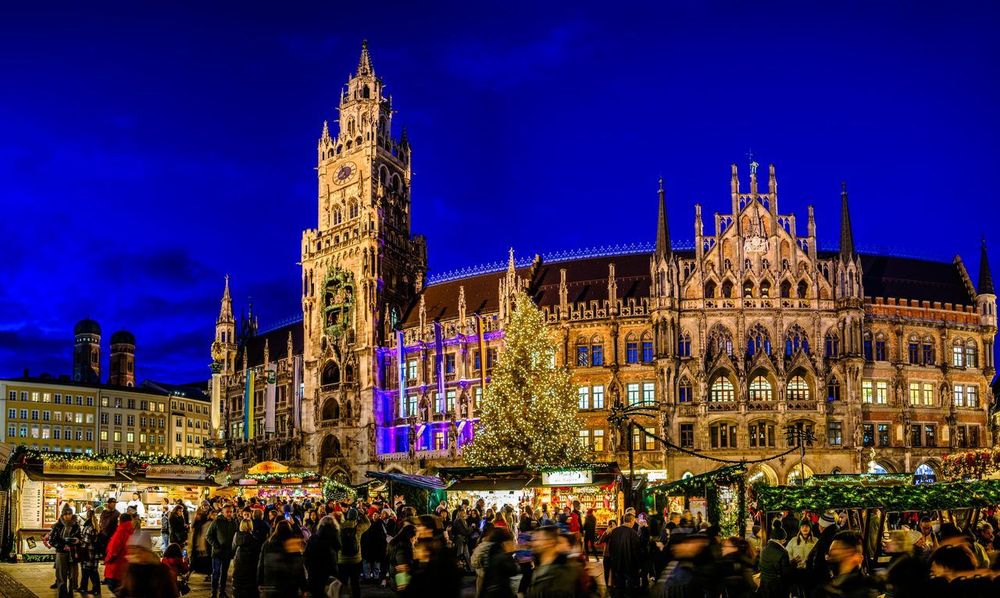
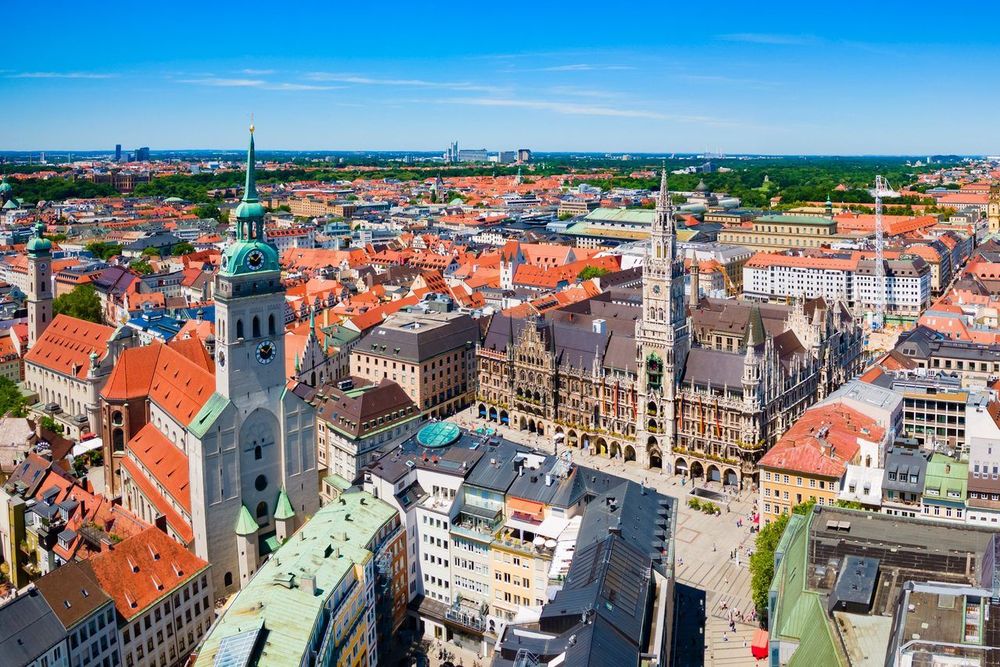
It is impossible to visit Munich without passing through Marienplatz at some point. This central square has concentrated the city's political and religious power for eight hundred years, and it remains today the absolute landmark: all the S-Bahn lines and two U-Bahn lines cross here, making it the natural starting point for any day of sightseeing on foot.
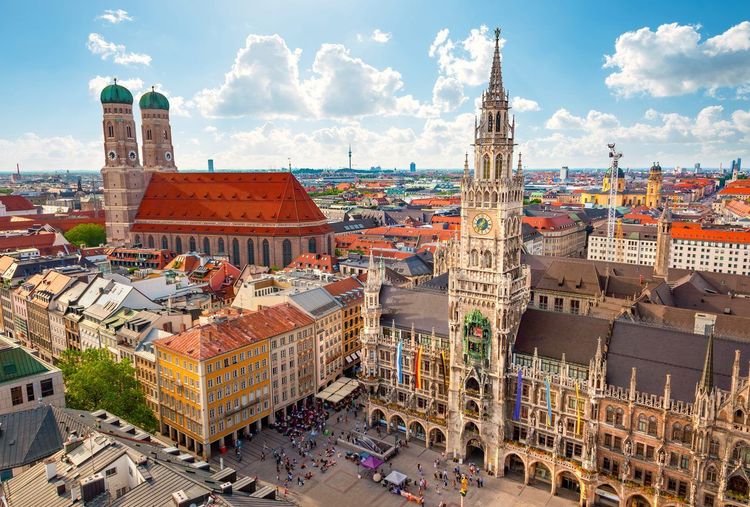
On the north side of the square stands the Neues Rathaus (new town hall), a neo-Gothic façade completed in the early 20th century whose tower houses the famous glockenspiel. Every day at 11 am and 12 pm, and also at 5 pm from March to October, 32 life-size figures re-enact a knights' tournament and the coopers' dance, a show of about ten minutes that draws a dense crowd every time. Arrive ten minutes early to find a spot with a clear view, especially in high season.
Just behind, two minutes on foot away, St. Peter's Church (Alter Peter (Rindermarkt 1, 80331 Munich, rated 4.7/5 on Google from 5,583 reviews)) offers one of the best effort-to-reward ratios in the city: 306 spiral steps, with no lift, leading to a platform overlooking the rooftops of the old town, with the Alps visible when the foehn wind blows. Climb it in the late afternoon, when the low light gives the Neues Rathaus and the towers of the neighbouring Frauenkirche their most photogenic colours.
The district around Marienplatz can be explored without any imposed logic: you happily get lost between the Kaufingerstraße, pedestrianised and full of shops, and the more discreet Rindermarkt. It is precisely the kind of city centre where a car would have been of no use, except to pay for an overpriced car park and then walk the same 800 metres as everyone else.
To explore this district further without having to work out where to look, the Ryo audio guide to Munich's historic centre goes right through Marienplatz, the Neues Rathaus and St. Peter's Church, with commentary triggered at each stop: your nose pointed up at the façades rather than glued to a map.
Viktualienmarkt, the Great Historic Market
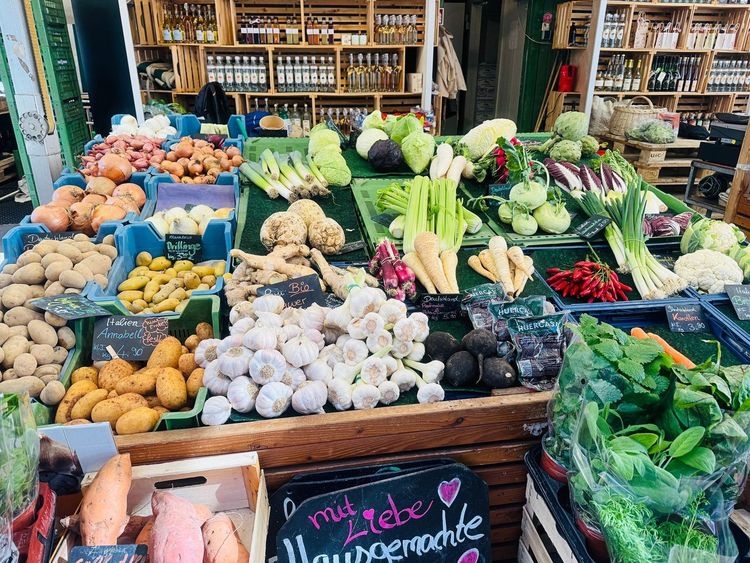
A five-minute walk separates Marienplatz from the Viktualienmarkt (Viktualienmarkt 3, 80331 Munich, rated 4.6/5 on Google from 64,197 reviews), an open-air market that has been here since 1807. More than a hundred stalls sell Bavarian cheeses, cold cuts, flowers and exotic fruit, around a large blue-and-white maypole planted in the centre.
It is the ideal place for a quick lunch break: the stands offer Weißwurst (white sausages) or Brezn from the morning, to eat standing up or on the wooden benches scattered between the stalls. Note that the market is closed on Sundays, like most German shops, and it is frequented as much by Munich residents doing their shopping as by visitors.
One detail amuses regulars: the market's Biergarten serves the beer of the six great Munich breweries in turn, only one at a time. So there is no way to know in advance which one will be served on the day you visit.
The Munich Residenz, Former Palace of the Kings of Bavaria
For more than four centuries, the Munich Residenz (Residenzstraße 1, 80333 Munich, rated 4.6/5 on Google from 23,873 reviews) was the seat of power of the dukes, electors and then kings of Bavaria. This urban palace, ten minutes on foot from Marienplatz, has more than 130 rooms open to visitors, including the Antiquarium, a 66-metre-long Renaissance hall entirely covered in frescoes.
The royal treasury, displayed in a separate wing, holds crowns, jewels and liturgical objects accumulated over several centuries of Bavarian monarchy, a collection that many visitors discover by chance while thinking they are only making a quick tour of the palace.
Allow one to two hours for the visit depending on your interest in Bavarian history, and wear comfortable shoes: the rooms follow one another along a fairly long route, with no real shortcut possible.
Short on time? The short version of the Ryo audio-guided tour The Secret Capital passes in front of the façade of the Residenz and tells its royal history directly in your earphones, a way to extend your discovery of the historic centre without a flesh-and-blood guide.
The Englischer Garten and the Urban Surf Spot
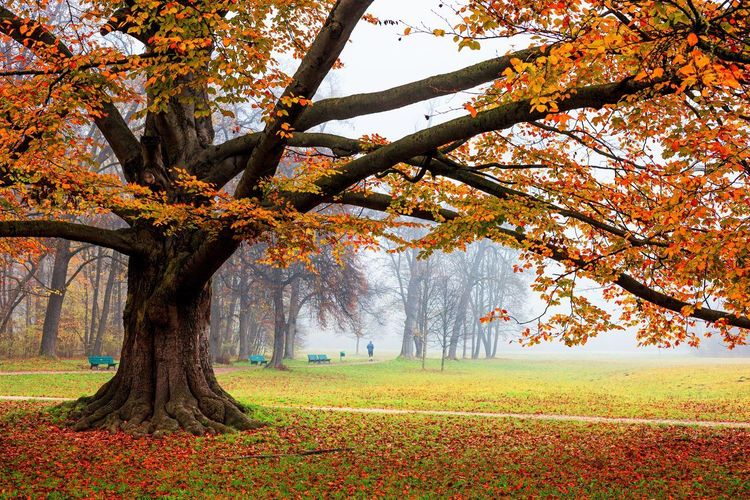
Just north-east of the Residenz, the Englischer Garten (Englischer Garten, 80538 Munich, rated 4.7/5 on Google from 47K reviews) (English Garden) covers 3.7 km², one of the largest urban parks in the world, larger than Central Park in New York. Laid out from 1789 in the English landscape style, it blends meadows, streams and groves, far from any French-style symmetry.
At its heart, the Chinesischer Turm, a wooden pagoda rebuilt after the war, overlooks one of the busiest biergartens in the city, where you can bring your own picnic as long as you buy your drink on site.
The most surprising detail is at the park's southern entrance, on the Eisbach, a canal diverted from the Isar: a standing wave attracts surfers there all year round, even in the snow. A note for 2026: the wave disappeared in autumn 2025 after the canal bed was dredged, before re-forming in spring. The city reopened it in May 2026, but only to experienced surfers and until 10 pm.
Not a surfer? Simply settle on the Prinzregentenstraße bridge to watch the successive runs in the icy water, a free show that no postcard truly captures.
The park can be reached on foot from the historic centre in about ten minutes, or in a few bus stops if you prefer to keep your legs fresh. The Ryo audio-guided tour, centred on the old town, also leaves you a stone's throw from the southern entrance: a logical follow-up to end the day in the greenery.
Nymphenburg Palace, Accessible by Tram
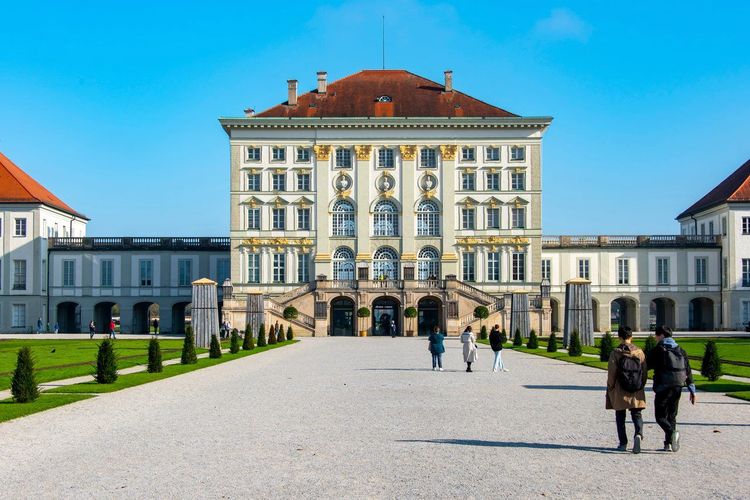
West of the centre, Nymphenburg Palace was the summer residence of the Bavarian rulers for more than two centuries. Its Baroque façade, over 600 metres long with its symmetrical pavilions, is reflected in a great canal that runs up to the entrance gates, a panorama almost unchanged since the 18th century.
The interior houses the Gallery of Beauties, a collection of portraits commissioned by King Ludwig I, as well as the room where the future King Ludwig II, the Neuschwanstein king, was born in 1845. The park, free to enter even without a ticket for the palace, deserves an hour's stroll among the canals and the outlying pavilions.
For a lunch break on site, the Schlosswirtschaft Schwaige serves classic Bavarian cuisine in a rustic setting, a stone's throw from the former royal stables turned into a carriage museum (Marstallmuseum).
How do you get there? The simplest way is tram 17, which reaches the Schloss Nymphenburg stop (Schloss Nymphenburg 1, 80638 Munich, rated 4.6/5 on Google from 40,896 reviews) from the main station in about twenty minutes; bus 51 also serves the palace. The tram drops you a few steps from the canal, and a Zone M day ticket is enough for the round trip.
The BMW Museum and BMW Welt
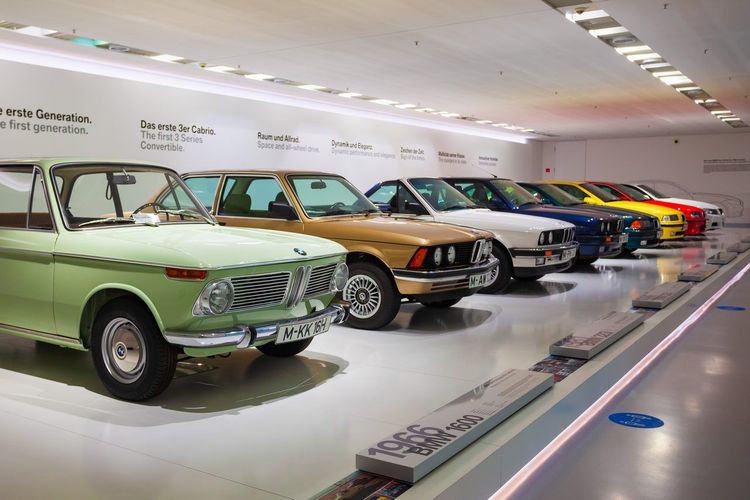
North-west of the centre, the Olympiapark district is home to two must-see addresses for anyone interested in cars, without a private car playing any role: you get there by U-Bahn, line U3, Olympiazentrum stop.
The BMW Museum, housed in a silver bowl-shaped building, traces more than a century of the brand's history through motorbikes, racing cars and prototypes, along a spiral route.
Just opposite, BMW Welt (Am Olympiapark 1, 80809 Munich, rated 4.7/5 on Google from 41,321 reviews) works as a giant, free showroom, where customers come to collect their new car in front of visitors, in an almost theatrical staging. Entry is free, unlike the museum, which requires a ticket: an easy stop to add even if you are not a car enthusiast.
Allow about two hours for both sites, then simply cross the footbridge to the neighbouring Olympiapark to carry on within the same half-day.
Munich's Olympic Park
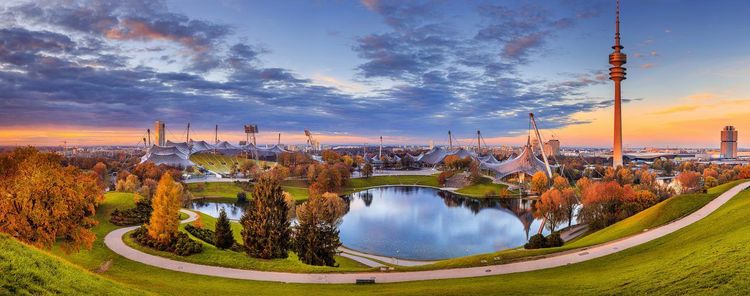
Getting off at the same Olympiazentrum stop as BMW Welt, you are already in the Olympiapark, which has kept most of its infrastructure since the 1972 Summer Olympics. The main stadium, with its tensile fabric roof suspended by cables, remains one of the city's most recognisable architectural silhouettes.
For the Olympic Tower, 291 metres high, a clarification is needed: its observation platform and revolving restaurant have been closed for renovation since June 2024, with a full reopening announced for early 2027. In the meantime, the Skylift, a temporary observation tower, lifts you 70 metres above the park.
The park itself lends itself to a quiet stroll around the artificial lake, with an overview of the stadium, the Olympic swimming pool still open to the public and, in clear weather, the silhouette of the Bavarian Alps from the Olympiaberg. Everything can be visited on foot once you leave the metro.
Where to Eat in Munich: Breweries and Market
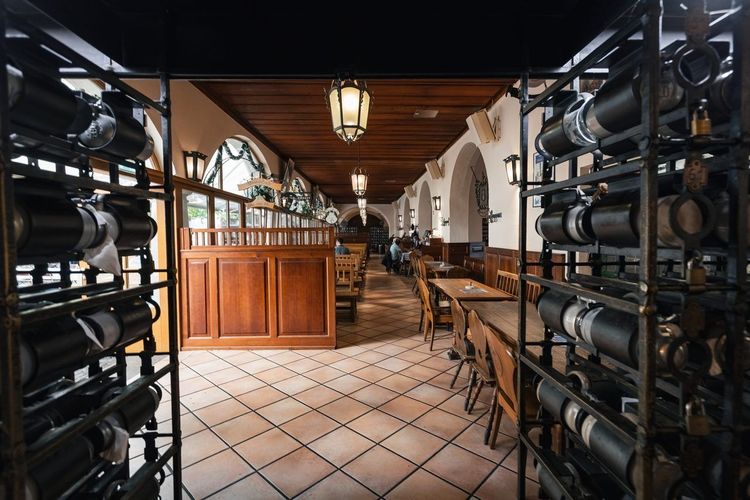
It is impossible to talk about Munich's gastronomy without starting with the Hofbräuhaus, the city's most famous brewery, founded in 1589 as the court brewery. Its great vaulted hall, with a Bavarian band in traditional costume, welcomes up to 3,000 people around one-litre steins and generous dishes such as Schweinshaxe (roast pork knuckle).
An openly touristy experience, sometimes noisy, but an almost obligatory stop for a first evening, provided you accept sharing your table with strangers at peak times.
For a more local atmosphere, the Augustiner Klosterwirt (Augustinerstraße 1, 80331 Munich, rated 4.5/5 on Google from 14,839 reviews), opposite the Frauenkirche, serves the beer of the oldest brewery in the city still independent, founded in 1328. The Edelstoff is often drawn from a wooden barrel there, which noticeably changes the taste according to regulars.
The Viktualienmarkt, already mentioned above, remains the most flexible option for a quick meal between two visits: you put together your plate from several stands, with no service-hour constraints.
Biergartens, often set under chestnut trees, work on a self-service principle: you order your beer at the counter and can bring your own food, away from the tables with tablecloths reserved for restaurant customers. An old Bavarian rule that often surprises visitors.
Car-Free Excursions: Dachau and Surroundings by Train
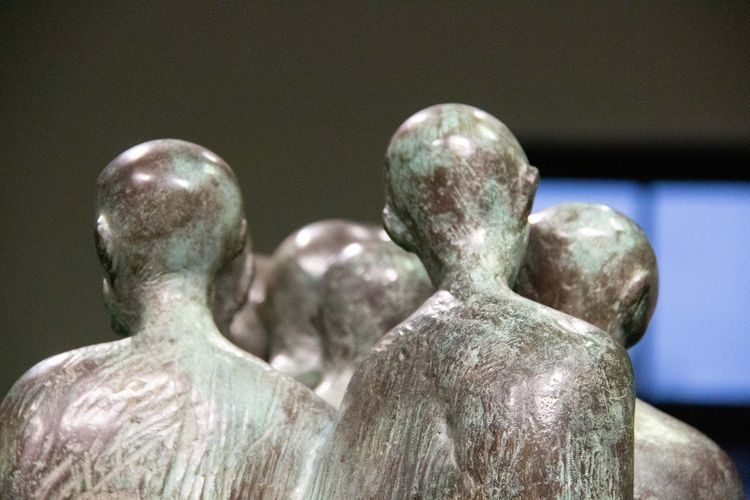
Two excursions deserve a full day outside the city centre, and both are done entirely by train, without any parking constraints or driving on the German motorway.
The Dachau concentration camp memorial can be reached by S-Bahn S2 to Dachau station, then by bus 726 to the site entrance. Allow 45 minutes to 1 hour from the centre. Entry is free, with an audio guide available in several languages.
The visit, dense and necessarily sombre, requires at least three hours to see the reconstructed barracks, the documentary museum and the memorials. Many visitors devote an entire morning to it rather than combining it with another activity.
For a lighter outing, Lake Constance (Bodensee), on the border between Germany, Austria and Switzerland, can be reached in 2 to 2.5 hours by train from the main station. Lindau, a small island town linked to the mainland by a bridge, is the most accessible destination for a day trip, with its harbour guarded by a Bavarian lion and a view of the Austrian Alps.
Back in the city, keep one last tip in mind: the Munich museum line, bus 100 (Museenlinie), links the main station to the Ostbahnhof, passing in front of about twenty museums, including the Pinakotheks and the Bavarian National Museum. It is a simple bus on the MVV network, covered by your day ticket.
The Ryo audio-guided tour, for its part, stays focused on the historic centre: save Dachau or Lake Constance for once you have explored the lanes of the old town and the palaces on foot.
Where to Stay in Munich: Well-Connected Neighbourhoods
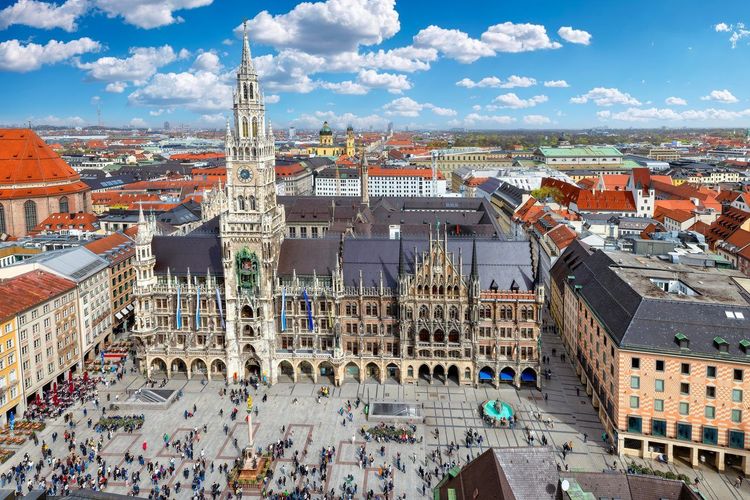
When visiting Munich without a car, the choice of neighbourhood matters almost as much as the choice of hotel. Altstadt-Lehel, the historic centre around Marienplatz, remains the most practical for doing everything on foot, at the price of more expensive accommodation.
Schwabing, to the north, right next to the Englischer Garten, offers a more student atmosphere and slightly gentler prices, two or three U-Bahn stops from the centre.
Around the main station (Hauptbahnhof), the offer is dense and prices are competitive, a good compromise for short stays since all the S-Bahn lines, including those to the airport and Dachau, pass through it.
Whatever the neighbourhood, check the walking distance to the nearest station rather than the distance to the centre in kilometres: ten minutes by metro is often worth more than twenty minutes' walk in a neighbourhood poorly served at night.
How Much Time to Plan: Itineraries from 1 Day to One Week
The time needed depends mostly on your appetite for excursions, as the historic centre itself can be covered fairly quickly.
For a stopover of a few hours, between two trains or before a flight, focus on Marienplatz, the Neues Rathaus glockenspiel and the view from St. Peter's Church: all of it can be covered in 3 to 4 hours on foot from the main station.
A full day lets you add the Residenz and the Viktualienmarkt, with a lunch break in a brewery in the centre.
On a two-day weekend, include the Englischer Garten and the Eisbach on the first day, then Nymphenburg or the Olympiapark on the second, alternating walking and tram depending on tiredness. Our detailed programme for a weekend in Munich offers an hour-by-hour breakdown.
For a four-day stay, add the BMW Museum and an excursion to Dachau, setting aside an entire morning for the latter.
Finally, with a full week, Lake Constance becomes accessible as a day trip, as do other Bavarian towns served by the regional train. At this point, the question is no longer whether you can visit Munich without a car, but how many days it would take to see everything.



FAQ
Can you really visit Munich without a car?
Yes, and it's actually the most practical option: the historic centre is largely pedestrianised, the MVV network (U-Bahn, S-Bahn, tram, bus) serves the whole metropolitan area, and outlying sites such as Nymphenburg or the BMW Museum can be reached directly by tram or metro.
Which transport pass should you choose to visit Munich?
From two trips a day, the day ticket (Tageskarte, €10.10 in Zone M in 2026) is the best value. For a stay of several days with museum visits, the CityTourCard combines unlimited transport with discounts. For occasional use, the StreifenKarte remains the most flexible option.
How many days do you need to visit Munich on foot and by public transport?
One full day is enough for the historic centre (Marienplatz, Residenz, Viktualienmarkt). Allow two days to add the Englischer Garten and Nymphenburg, and four days or more to include the BMW Museum and a trip to Dachau.
How do you get from Munich airport to the city centre without a car?
The S-Bahn S1 or S8 connects the airport to Marienplatz and the main station in 40 to 45 minutes, for €15.10 for a single ticket. The Lufthansa Express Bus is a direct alternative to the main station and Schwabing Nord, running every 20 minutes.
How do you get to Dachau from Munich by public transport?
Take the S-Bahn S2 to Dachau station, then bus 726 to the memorial entrance. The whole journey takes between 45 minutes and 1 hour from central Munich.
Is Munich a good city for pedestrians and cyclists?
Yes: the historic centre can be crossed entirely on foot in 20 to 25 minutes, and the city has more than 1,200 km of cycle paths, including a continuous route along the Isar of nearly 15 km.
Conclusion
Munich boils down fairly well to a simple equation: a compact historic centre to explore on foot, a public transport network that covers everything else, and a few train excursions to see further afield. The car brings no real advantage here, only parking constraints that even Munich residents avoid. To enjoy this logic without thinking at every crossroads, our Ryo audio-guided tour of Munich accompanies you from the first step on Marienplatz to the façade of the Residenz, and you will find more ideas in our selection of things to do in Munich.
À lire également