© Shutterstock
 Votre guide Ryo
Atocha Train Station in Madrid: Tropical Garden, Memorial and AVE Connections (2026)
Atocha Madrid station is not one of those that only serve to catch trains. As soon as you cross the threshold of the Victorian nave, you find yourself facing a 4,000 m² tropical forest: tree ferns climbing up to the iron and glass canopy, turtles moving between the pools, and a diffuse light that has nothing to do with the neon lighting of ordinary stations. It's one of Madrid's first surprises, and perhaps the least expected. Atocha station is also Spain's most important railway hub, from where high-speed AVE trains depart to Sevilla, Barcelone or Valencia, Cercanías for Madrid's suburbs, and main lines to the rest of the country. It carries a heavy history: the memorial to the 191 victims of the March 11, 2004 attacks is installed there, discreet and overwhelming. This guide answers all your questions, orientation, services, access, what's around, so you'll be ready even before arriving. To explore Madrid beyond the station, the Ryo Madrid audio-guided tour offers 23 audio tracks over 6.1 km, from the Royal Palace to La Latina.
The History of a Twice-Centennial Station
Atocha is Madrid's oldest station. Its first version opened on February 9, 1851, on a line connecting the capital to Aranjuez, a 49 km journey that Queen Isabella II inaugurated in great pomp. The original building was quickly deemed insufficient, and a fire accelerated things: engineer Alberto de Palacio and architect Rafael Cabrera Sánchez designed a new station, whose spectacular metal structure was completed in 1892. This metal and glass hall was directly inspired by the great European stations of the late 19th century, Crystal Palace at the forefront.
For a century, Atocha remained the beating heart of the Spanish railway network. But the explosion in traffic and the announced arrival of high speed made the Victorian building obsolete for railway operations. In the 1980s, architect Rafael Moneo was tasked with designing a modern extension. His solution was audacious: rather than destroying the old hall, he emptied it of its tracks, transformed it into a winter garden and built an adjacent contemporary terminal. The new station, Puerta de Atocha, opened in 1992, just in time for the inauguration of the first AVE Madrid-Sevilla line, symbol of Spain's post-transition industrial renewal.
Since then, a new extension dedicated to Cercanías, the suburban trains, has been added on the south side. The complex now forms a set of three interlocking buildings that daily handles more than 100,000 passengers.
The Victorian Nave: A Tropical Garden Under the Canopy
When Rafael Moneo took over the old Atocha hall, he chose to give it a radically different second life. Rather than converting it into a shopping center or museum, he planted. Literally. A 4,000 m² tropical garden was installed under the 152-meter long, 30-meter wide and 26-meter high glass canopy. Inaugurated in 1992, the invernadero now welcomes more than 7,000 plants distributed among 260 species: palm trees, ferns, banana trees, philodendrons, ficus and numerous species from America, Asia, India, China and Australia.
The atmosphere is both strange and pleasant. Travelers waiting for their train sit on wooden benches arranged along the paths, surrounded by vegetation that filters the natural light falling from the canopy. The heat is constant, around 22 to 24°C year-round, with humidity maintained between 60 and 70%, making it an appreciable refuge during Madrid winters when temperatures regularly drop below zero outside.
The freshwater turtles are the most famous inhabitants of Atocha station's garden in Madrid. Several hundred individuals live in the pools and on the land islets in the middle of the plants. They have the particularity of being perfectly visible from the elevated walkways that cross the garden, and children as well as adults invariably stop to observe them. It's not a zoo or botanical park in the strict sense, it's simply a breathing space in the middle of a railway hub, an idea that few cities have had the audacity to implement.
Access to the garden is completely free. You don't need a train ticket to enter, the Victorian nave is open to everyone, every day. Opening hours generally extend from 6:00 AM to 10:00 PM, although it's advisable to check for any seasonal adjustments. It's a place that many Madrileños frequent simply to relax, away from the city noise.
The Modern Puerta de Atocha-Almudena Grandes Station
The contemporary part of the station bears the official name Puerta de Atocha-Almudena Grandes (Glorieta del Emperador Carlos V 1, 28045 Madrid, rated 4/5 on Google for 26,001 reviews) since 2021, in homage to novelist and author Almudena Grandes, who died that same year. This name coexists with the historical designation "Atocha" that everyone continues to use, including Renfe and SNCF reservation systems.
Rafael Moneo's terminal, inaugurated in 1992, is a sober and functional building. Its large brick and glass facade facing the Glorieta del Emperador Carlos V immediately identifies the station from the street. Inside, the large departure hall occupies several levels connected by escalators. The AVE platforms are on the lower level, accessible after security checks, a Spanish particularity: unlike French stations, access to high-speed platforms requires passing through a security gate with ticket verification, like at an airport.
The station houses several commercial and dining spaces spread over two levels. On the ground floor, on the tropical garden side, there are cafes, a supermarket and some shops. The intermediate level, between the main hall and the AVE platforms, concentrates sandwich shops and coffee kiosks for hurried travelers. The signage is clear and bilingual (Spanish and English), which facilitates orientation even for a first visit.
An underground connection directly links the Moneo terminal to the Cercanías station, built as an underground extension in the 2000s, as well as to the Atocha Renfe metro station (line 1, red). This underground network allows you to go from a high-speed train to a suburban train or metro without ever coming to the surface.
The March 11, 2004 Memorial
On March 11, 2004, four suburban trains were hit by ten simultaneous explosions during morning rush hour. 191 people were killed and nearly 2,000 injured in one of the worst terrorist attacks in European history. Three of the four targeted trains departed from or passed through Atocha. The attack remains the deadliest ever committed on Spanish soil.
The first memorial, inaugurated on March 11, 2007, took the form of a cylindrical glass tower 11 meters high erected in the hall, on whose walls thousands of messages left by citizens after the attacks were transposed. This glass tower was dismantled in 2024 as part of the extension work for metro line 11 that crosses Atocha.
A new memorial was inaugurated on March 10, 2024, just below the location of the former monument, in the hall that connects the railway station to the metro station. This underground space of nearly 2,000 m², four times larger than the previous one, is clad in cobalt blue walls chosen by victim associations. The names of the deceased are engraved there, accompanied by memory messages in several languages, and the ceiling is illuminated with 193 points of light in tribute to the victims. The effect is sober and deeply moving.
The memorial space is freely accessible, without tickets, from the central hall. It is silent, carefully maintained, and fresh flowers are placed there every March 11 during official commemorations.
It would be a shame to pass through Atocha without taking a few minutes to visit this memorial. Many hurried travelers don't spot it: look for the "11-M" signage in the liaison area between the station and metro, tropical garden side, and go down to the space below.
Trains From Atocha: AVE, Cercanías and Main Lines
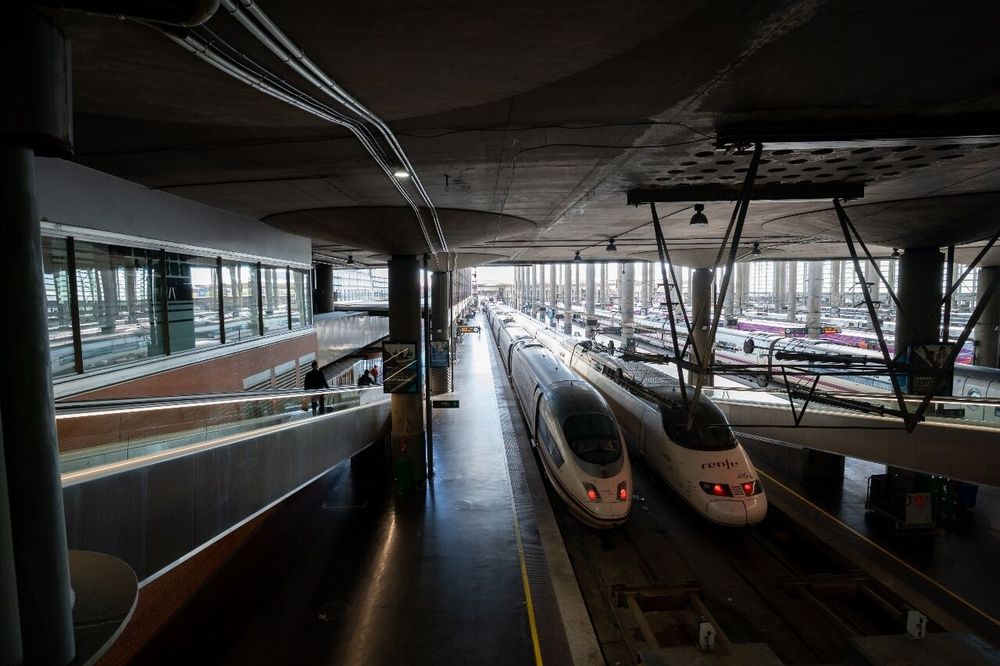
Atocha is the departure point for almost all high-speed trains (AVE) departing from Madrid. The main destinations and frequencies in 2026:
- Madrid-Sevilla: about 2h30, several departures per day, the first Spanish AVE line, inaugurated in 1992
- Madrid-Barcelone: about 2h30 for direct AVE, with more than 20 daily departures (Renfe, as well as operators Iryo and Ouigo)
- Madrid-Valencia: about 1h50, very frequent service
- Madrid-Málaga: 2h30, with possible connection to Granada
- Madrid-Bilbao: Alvia service, about 4h30
- Madrid-Córdoba and Madrid-Jaén: AVE or Media Distancia depending on schedules
The Cercanías (suburban trains) depart from the underground level and serve the entire Madrid region across ten lines (C1 to C10). They constitute the fastest way to reach certain neighborhoods not served by metro, like Alcalá de Henares, Aranjuez or El Escorial. A single ticket costs between €1.75 and €3.40 depending on the fare zone.
AVE tickets are booked on the Renfe website (renfe.com) or via comparison apps like Trainline or Omio. Prices are dynamic and the lowest prices disappear quickly: for popular routes like Madrid-Barcelone, booking three to four weeks in advance often allows finding tickets between €15 and €35. The full fare can exceed €100. Cercanías tickets, on the other hand, don't need to be booked and are purchased directly at counters or automatic terminals.
Useful information: if you're traveling from France with Renfe-SNCF, the Paris-Madrid train (via Irún) also arrives and departs from Atocha, with a journey time of about 9h30 to 10h30 depending on stops.
Atocha Station Map: Getting Your Bearings
Atocha station (Glorieta del Emperador Carlos V, 28045 Madrid, rated 4/5 on Google for 26,001 reviews) is physically divided into three distinct areas that must be identified upon arrival to avoid wasting time:
Area 1, The Victorian Nave (tropical garden): the historic iron and glass building, open to the public without tickets. It serves only as a walking and relaxation space, with no active platforms. Main entrance facing Glorieta del Emperador Carlos V.
Area 2, The Moneo Terminal (high speed and main lines): this is where you'll find Renfe ticket offices, ticket printing terminals, AVE boarding halls and long-distance train platforms. Security check for AVE is on level -1, before platform access.
Area 3, Cercanías Station: access by escalators from the Moneo terminal or from the entrance on calle de Méndez Álvaro. Cercanías lines C1, C2, C3, C4, C7, C8 and C10 pass through here. The Atocha Renfe metro station (line 1) is directly connected to this area.
Internal signage is generally good, with signs in Spanish and English. Departure boards are located in the main hall of the Moneo terminal (area 2). If you're looking for the 11-M memorial, it's in the transition area between the Moneo terminal and the Victorian nave, below ground level.
Getting to Atocha Station
Atocha is well served from all Madrid neighborhoods:
Metro: Atocha Renfe station (Glorieta del Emperador Carlos V, 28045 Madrid, rated 4.1/5 on Google for 8,280 reviews) (line 1, red). One stop from Sol, two from Gran Vía. The station is directly connected to the station's Cercanías terminal without going outside.
Bus: several EMT lines stop in front of the station. Lines 10, 14, 19, 32, 45, 57 and the Circular serve the Glorieta del Emperador Carlos V. The night bus (Búho) also passes nearby.
Walking from downtown: from Puerta del Sol, count about 20 minutes on foot going down via Carrera de San Jerónimo, passing in front of the Congress of Deputies, then along the Paseo del Prado. It's a pleasant route that allows you to walk along the facades of the Prado Museum.
By taxi or VTC (Uber, Cabify): drop-off is directly in front of the main entrance. Outside rush hours, count 10 to 15 minutes from downtown. During busy hours (8-9:30 AM and 6-8 PM), plan for double.
From Adolfo Suárez Madrid-Barajas Airport: the Cercanías C1 line directly connects the airport (terminals T1/T2/T3) to Atocha in about 25 minutes. The combined metro + Cercanías ticket costs €2.60. It's the fastest and cheapest option to reach the station from the airport. Once at Atocha, our audio-guided tour The Landscape of Light heads up the Paseo del Prado to the Prado Museum and Puerta del Sol.
Luggage Lockers and Practical Services
Atocha station has automatic lockers located in the main hall of the Moneo terminal (area 2, ground floor). Rates vary according to locker size: from €3.50 to €6 per 4-hour period approximately for small or large luggage. They operate from 6:30 AM to 10:00 PM and accept card payments. There's also a manual luggage service operated by private providers in the immediate vicinity of the station for oversized baggage.
Among other services available in the station: ATMs (several banking networks), currency exchange office, pharmacy, bookstore-newsstand, free Wi-Fi access throughout the terminal, and a premium waiting room accessible to Renfe Plus Gold cardholders or certain Club ticket holders.
Public restrooms are paid (€0.50) in the main terminal, free in the Victorian nave.
What's Around Atocha Station
Atocha is surrounded by a concentration of museums and gardens that makes it one of Madrid's richest areas for visitors. Within a ten-minute walk, you'll find:
The Prado National Museum, 500 meters north on Paseo del Prado. One of the world's most important museums, with Velázquez, Goya and Raphael collections. It opens at 10 AM and closes at 8 PM Monday to Saturday.
The Reina Sofía Museum, 200 meters south of the station. It houses Picasso's "Guernica" and major Spanish modern and contemporary art collections. Entry is free on Tuesdays, Saturdays after 2:30 PM and Sundays after 1:30 PM.
The Royal Botanical Garden (Real Jardín Botánico), directly adjacent to the Prado. Several thousand species of plants and trees on 8 hectares, open daily from 10 AM. Entry €7, free for under 10s.
The Retiro Park (Plaza de la Independencia, 28001 Madrid, rated 4.8/5 on Google for 212,060 reviews) is about 800 meters east. This 118-hectare green lung, listed as a UNESCO World Heritage Site in 2021, houses the artificial lake and the Crystal Palace. Entry is free.
This exceptional neighborhood explains why many visitors choose to stay in the Atocha or Las Letras district, halfway between the station and the pedestrian center.
How to Enjoy Madrid After Atocha
Arriving at Atocha doesn't mean immediately launching into conquering the city. First take ten minutes to store your luggage and cross the tropical garden, it's a gentle way to enter Madrid, away from the hustle and bustle of metro exits.
If it's your first stay in the Spanish capital, the La Latina district and its medieval streets, the San Miguel market for a first glimpse of local gastronomy, or the climb to Plaza Mayor are good first stops. To orient yourself in the city with historical and cultural context, the Ryo Madrid audio guide covers 23 points of interest in a 2h30 route.
If you're more attracted to grand boulevards, museums and Paseo del Prado near Thyssen, the Madrid audio-guided tour, The Landscape of Light covers 7.3 km across 20 audio tracks around the grand avenues and Paseo museums.
In both cases, Atocha is a convenient starting point: you're already in the southern part of the historic center, within walking distance of the main sites without needing to take the metro. Our Heart of the Old City audio walking tour picks up right there, between Plaza Mayor and the La Latina district.
FAQ
Is Atocha station open to the public without a train ticket?
Yes. The Victorian nave with its tropical garden is freely accessible to everyone, without a ticket, generally from 6:00 AM to 10:00 PM. The March 11, 2004 memorial is also open without any ticket requirement. However, AVE and main line train platforms require a valid ticket and passing through a security check, like at an airport.
How much time should you allow before an AVE train departure?
Plan to arrive at the station at least 30 minutes before departure, ideally 45 minutes to 1 hour if you need to collect your ticket at terminals or if the station is busy. The security check before AVE platforms can create waiting times during peak hours. For Cercanías, 10 minutes is sufficient.
Is Atocha's tropical garden free?
Yes, access to the tropical garden in the Victorian nave is completely free. With its 4,000 m² and some 7,000 plants of 260 species, it's a public space integrated into the station, not a museum or paid park. You can enter and leave freely, without presenting any documents.
How to get to the airport from Atocha station?
The Cercanías C1 line directly connects Atocha to terminals T1, T2 and T3 of Madrid-Barajas airport in about 25 minutes. Frequent departures every 15 to 30 minutes. The ticket costs €2.60 (combined Cercanías + metro fare). It's the fastest and least expensive solution. A taxi or VTC from Atocha to the airport costs between €25 and €40 depending on traffic.
Can you go to Barcelone from Atocha by train?
Yes, it's one of Europe's most frequented AVE connections. The Madrid-Barcelone train from Atocha takes about 2h30 with direct AVE services (Renfe, Iryo and Ouigo services). Departures are offered throughout the day, generally from 6:00 AM to 9:00 PM. The cheapest tickets (from €15) can be found by booking several weeks in advance on the Renfe website.
To Start Your Madrid Stay Well
Atocha station is not a simple transit infrastructure, it's already, in itself, an introduction to what Madrid knows how to do: transform the functional into spectacle, the utilitarian into experience. The tropical garden under the Victorian canopy, the silent memorial in the heart of the hall, the museum density within a ten-minute walk: everything flows naturally from this starting point.
To extend this entry into the city, the Ryo Madrid audio-guided tour accompanies you from the station exit to the streets of La Latina and the facades of the Royal Palace, with historical context at each step.