© Shutterstock
 Votre guide Ryo
20 Places to Visit in Switzerland to Discover an Extraordinary Country (2026)
Switzerland is one of those destinations that rarely disappoints but almost always surprises. As soon as you wonder what to do in Switzerland, the list grows faster than any holiday allows: you come for the mountains and leave with memories of medieval old towns, lakes of startling clarity, and trains that climb to summits at 3,454 metres above sea level. Before you leave, the Ryo audio-guided tour of Geneva provides an ideal introduction to the history of the city at the end of the lake. This country of four languages and twenty-six cantons packs into a territory twice the size of Brittany a range of landscapes that would take months to exhaust: slowly retreating glaciers, medieval fortresses on their lakeside rocks, financial cities with twenty-first-century architecture, and cheese-making villages where time seems to have stopped in the Middle Ages.
Whether you are planning a three-day city break or a two-week road trip from one end of the country to the other, the challenge is not knowing what to do in Switzerland — it is choosing. The Jungfraujoch reaches 3,454 m and is accessible by rack railway without an ice axe. Berne has 6 kilometres of covered arcades listed as a UNESCO World Heritage Site. The Swiss National Park has protected 170 km² of strictly wild nature since 1914, and Basel has 40 museums for 180,000 inhabitants. That should be enough to start making decisions.
1. Zermatt and the Matterhorn, the Absolute Icon of the Alps
There are images that reality surpasses. The Matterhorn (Cervin) is the most striking example across the entire Alpine arc. Seen from Zermatt, this pyramidal summit of 4,478 metres dominates the landscape with an almost architectural regularity: four faces oriented towards the four cardinal points, a silhouette instantly recognisable in any photograph.
Zermatt itself has been a car-free town since the 1930s: the only motorised vehicles permitted are electric, which gives the resort's streets an unusually peaceful atmosphere for such a busy mountain village. More than 2 million visitors come here every year. In summer, 400 kilometres of marked trails allow you to approach the Matterhorn from every angle; Stellisee lake (Stellisee, 3920 Zermatt, rated 4.8/5 on Google from 254 reviews) (at 2,537 m altitude) offers, at sunrise, the iconic photograph of the peak reflected in the dark water.
In winter, the Zermatt-Cervinia ski area links Switzerland to Italy at over 3,800 metres, one of the few cross-border ski areas in Europe. The Théodule glacier allows skiing in July and August. To go higher without mountaineering, the cable car to the Klein Matterhorn rises to 3,883 metres, making it the highest point reachable by cable car in Europe.
Practical information: Zermatt is accessible only by train from Täsch (15 min, every 20 min). Bring warm clothing even in summer, as temperatures drop sharply above 2,500 m. Nights in Zermatt are expensive; some travellers stay in Täsch or Visp to halve the cost.
2. The Jungfraujoch, the Top of Europe by Train
The Jungfraujoch is one of the most breathtaking experiences Switzerland has to offer: a rack railway journey to 3,454 metres above sea level, through the flanks of the Eiger and the Jungfrau, emerging onto a glacial plateau where scientists have been working since 1931 in the highest research station in Europe.
The journey from Grindelwald or Lauterbrunnen takes about two hours, but it would be a shame to treat it as a mere transport ticket. The Wengernalp line (WAB), built between 1893 and 1912, runs alongside vertiginous rock faces and passes through two stops inside the mountain itself — Eigergletscher and Eismeer — where windows carved into the rock look out onto the glacier below.
At the summit, the 'Top of Europe' observation platform offers a panorama over the Aletsch glacier, the longest glacier in the Alps, stretching 23 kilometres below. The weather station has been recording climate data without interruption since 1898, and its archives constitute one of the longest continuous climate series in the world.
The ice palace carved into the glacier lets you walk through a 1,000-metre tunnel hand-cut into living ice. The sculptures change every winter. For thrill-seekers, glacier sledging is possible from May to October depending on the weather.
Practical tips: the 'Good Morning Ticket' from Interlaken costs around 145 CHF (reduced rate for travellers arriving before 8 a.m.) versus 210 CHF at full price. Book in advance during high season — train seats are limited and demand regularly exceeds supply in July and August. Weather can change quickly; check forecasts the day before and reschedule if needed, as tickets can be exchanged free of charge within 24 hours.
The Ryo article Visiting the Jungfraujoch, the Top of Europe details the transport options and pass combinations available.
3. Lucerne and Lake Lucerne
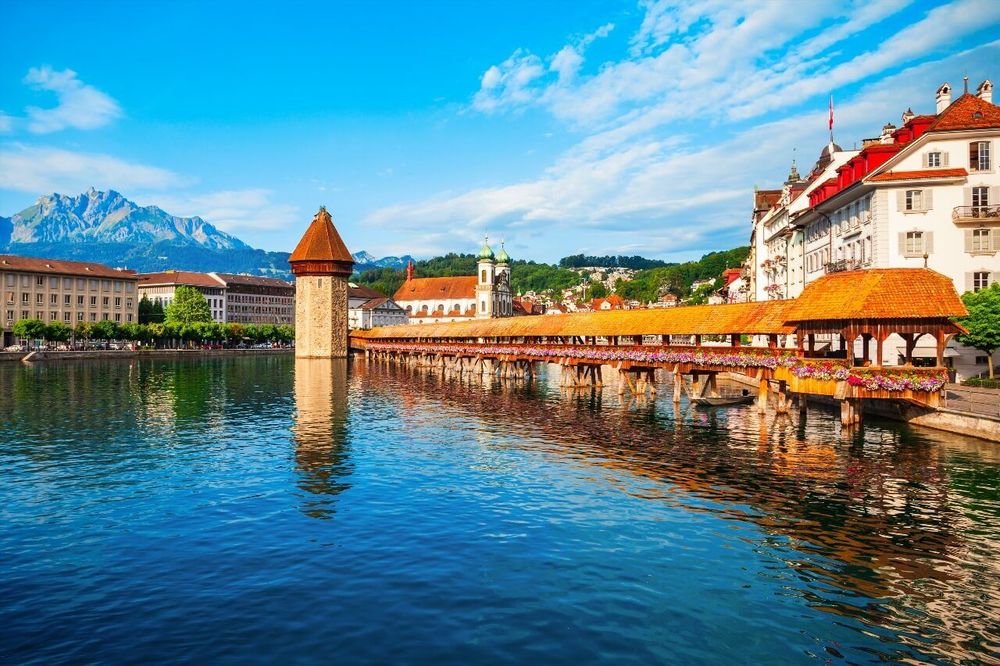
There is probably no more photographed view in Switzerland than that of the Chapel Bridge in Lucerne with Mount Pilatus in the background. This covered wooden bridge, 204 metres long, dates from 1333 and remains one of the oldest covered wooden bridges in Europe. It partially burned down in 1993; the townspeople rebuilt it in eight months.
Lucerne sits at the north-western end of Lake Lucerne (Lucerne, 6003 Lucerne, rated 4.8/5 on Google from 8K reviews) (Vierwaldstättersee), a deep lake with jagged shores that winds between forested mountains. Regular cruises allow you to reach Brunnen, Flüelen or the Rütli meadow, a lakeside field where, according to tradition, the three founding cantons of the Swiss Confederation took their oath in 1291.
The Swiss Museum of Transport (Verkehrshaus), ten minutes' walk from the centre, is the most visited museum in Switzerland with more than 800,000 visitors per year. It traces the history of trains, aircraft, automobiles and communications from the nineteenth century onwards, with interactive simulators for adults and children alike. Nearby, the Lion Monument (Löwendenkmal), carved directly into the rock face in 1821, measures 9 metres in length; Mark Twain described it as 'the most mournful and moving piece of stone in the world'.
If you would like to explore Lucerne at your own pace with a guide in your ear, the Ryo audio-guided tour In the Land of Dragons takes you through the city's medieval legends, from the ramparts to the lakeside quays.
4. Interlaken, between Two Lakes and Facing the Giants
Interlaken (Höheweg, 3800 Interlaken, rated 4.5/5 on Google from 34 reviews) owes its name to its geographical position: the town stretches between the lakes of Thun and Brienz, in an alluvial plain surrounded by the peaks of the Bernese Alps. The Eiger, the Mönch and the Jungfrau form the triptych of summits visible from the main promenade, provided the clouds do not conceal them.
Beyond access to the Jungfraujoch, Interlaken offers paragliding (departures from Beatenberg or Grindelwald), canyoning in the Simme gorges, and bungee jumping from the Stockhorn cable car. If you are looking for what to do in Switzerland to combine mountains with thrills, this is one of the most versatile base camps in the country: kayaking on Lake Thun, via ferrata, and even summer toboggan runs from the heights of Grindelwald. For a quieter day, Lake Brienz with its turquoise-clear waters and the village of Brienz, known for its wood-carving workshops, are worth the detour. The steam boat trip between Interlaken and Giessbach (where a waterfall plunges directly into the lake) takes about an hour; the landing stage is ten minutes' walk from Interlaken Ost station, and the historic Giessbach funicular, in service since 1879, climbs to the Belle Époque hotel overlooking the falls.
5. The Aletsch Glacier, a Colossus Disappearing
The Aletsch glacier (Bettmeralp, 3992 Bettmeralp, rated 4.4/5 on Google from 300 reviews) is a geography lesson in real time. 23 kilometres long and up to 900 metres wide in places, it is the largest glacier in the Alps and one of the natural sites listed as a UNESCO World Heritage Site in the Jungfrau-Aletsch region since 2001. But it is retreating: measurements taken since 1870 show a withdrawal of 3.7 kilometres over 150 years.
The best viewpoint is the terrace of the Bettmerhorn (2,872 m), accessible by cable car from Bettmeralp. On a clear day, the view extends to the Monte Rosa summits and, in very fine weather, to Mont Blanc more than 100 kilometres away. The Bettmeralp area is itself car-free — another Swiss village without motor traffic.
To get closer, the glacier trail from Märjelensee (a natural ice-dammed lake) follows the lateral moraine for about two hours' walking. In winter, the slopes around Bettmeralp form a family-friendly ski area less crowded than Zermatt, with virtually no queues on weekdays.
What makes the Aletsch glacier unique is also the complexity of its structure: it is not formed from a single flow of ice but from the junction of three tributary glaciers — the Grosser Aletschfirn, the Jungfraufirn and the Ewigschneefeld — which converge in a basin called the Konkordiaplatz. From the air (helicopter flights from Brig or Sion), the configuration looks like a three-lane motorway in slow fusion.
6. Geneva and Lake Geneva, between Diplomacy and Nature
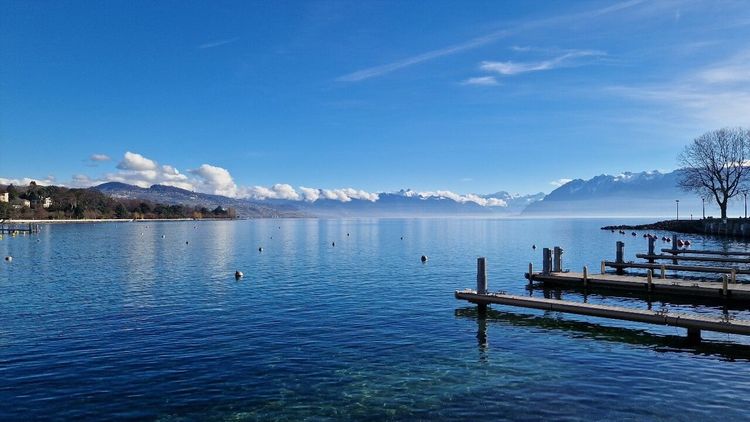
Geneva is often described as the 'capital of the world' — a slightly excessive label, but not entirely wrong. The city hosts the European headquarters of the United Nations, the global headquarters of the Red Cross, CERN (where the Higgs boson was experimentally discovered in 2012) and more than 200 international organisations. Yet the Geneva that leaves its mark on visitors is often more intimate: the lanes of the Maisons Tanner district, the terraces of the old town on the heights of the Cité, or the jet d'eau rising 140 metres above the lake on a calm day.
Lake Geneva is the largest alpine lake in Western Europe: 582 km² of surface, shared between Switzerland and France. CGN (Compagnie Générale de Navigation) cruises link Geneva to Lausanne, Montreux, Évian and Yvoire aboard restored Belle Époque steamboats. In summer, free public beaches line both shores; on the Swiss side, the Bains des Pâquis (Quai du Mont-Blanc 30, 1201 Geneva, rated 4.6/5 on Google from 9,667 reviews) and the Hermance beaches are among the most popular.
The Palais des Nations offers guided tours giving access to the Human Rights Council chamber and its monumental frescoes by José María Sert. The Old Town — with Saint Peter's Cathedral (whose towers offer a 360° panorama), the Museum of Art and History and the Bastions Park — can be explored on foot in a full day. To make the most of the city's history, the Ryo audio guide for Geneva offers a structured itinerary from the quays up to the old-town hill.
For targeted advice on activities and local gastronomy, the article Top 7 Things to Do in Geneva is a useful resource before you go.
7. Berne, the Federal Capital with Its Medieval Arcades
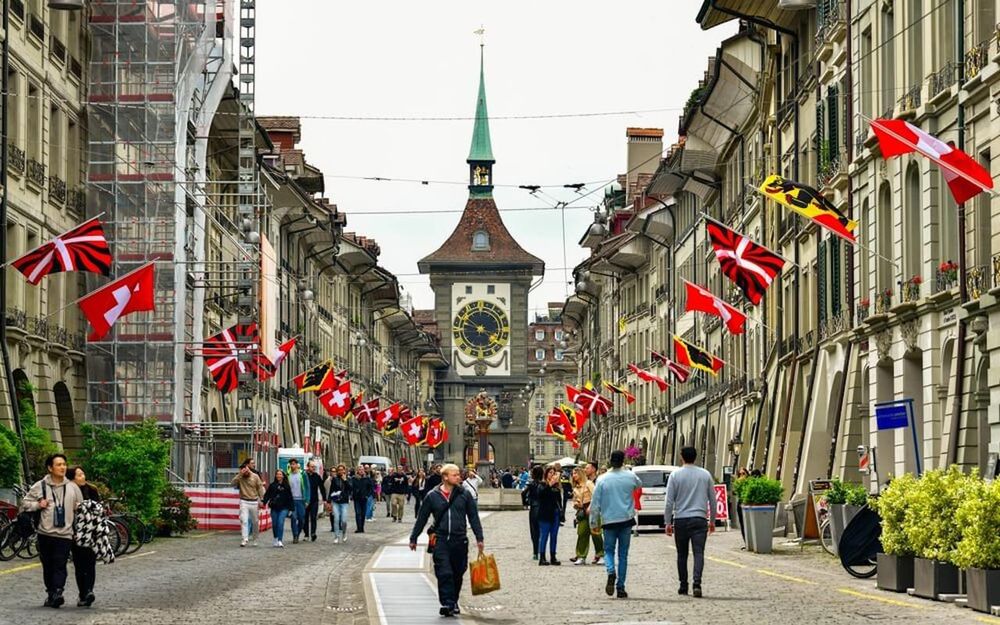
Many visitors discover Berne almost by accident, passing through between Geneva and Zurich. That is a mistake. The Swiss federal capital is one of the best-preserved medieval cities in central Europe: 6 kilometres of covered arcades (the 'Lauben') have been sheltering pedestrians since the thirteenth century, allowing you to cross the old town in the rain without ever opening an umbrella.
The Zytglogge (Bim Zytglogge 1, 3011 Berne, rated 4.6/5 on Google from 5,458 reviews) (Clock Tower), built in the twelfth century, is one of the most photographed monuments in the country. Four minutes before every hour, an astronomical automaton animates mechanical figures — a bear, a cockerel, Chronos — in a choreography that has been running since 1530. Albert Einstein lived on the street alongside the tower when he wrote his 1905 papers on special relativity: his home, at number 49 Kramgasse, is today a museum.
The Bear Park (Bärengraben), on the banks of the Aare, has housed since 2009 a naturalistic enclosure where several brown bears live — the emblematic animal of the city since the twelfth century, whose name features in the etymology of Berne according to legend. The view from the Rose Garden terrace over the old town and the Aare bend is one of the finest urban vistas in Switzerland.
The Zentrum Paul Klee museum, designed by Renzo Piano and opened in 2005, houses 4,000 works by Bernese painter Paul Klee — the largest collection of this artist in the world. The building itself, with its three undulating metal hills, is worth the trip. Back in the old town, Ryo's 24-stop Bear Pit audio walking tour follows the Aare down to the bears themselves.
To explore Berne with a guide in your ears, the Ryo Berne audio tour The Bear Pit reveals the legends of the old town among arcades and Renaissance fountains.
8. Zurich, the Country's Largest City and Cultural Capital
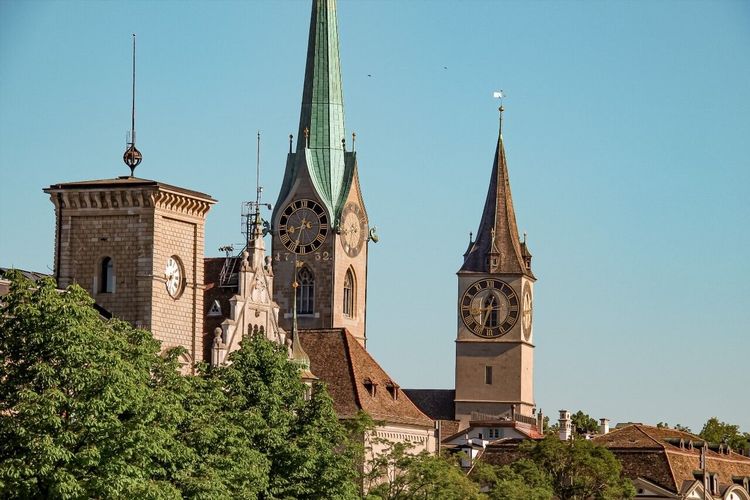
Zurich is Switzerland's largest city (440,000 inhabitants) and is regularly ranked among the world's most liveable cities. This stems from a rather particular combination: a near-perfect transport infrastructure (the Zurich tram runs with legendary punctuality), a remarkable density of museums and galleries for a city of this size, and direct access to nature — Lake Zurich right in the city, vineyards on the hills of the left bank, the Züriberg forest thirty minutes from the Bahnhofstrasse.
The Bahnhofstrasse, one of the world's most famous commercial streets, runs through the city from north to south for 1.4 kilometres from the main station to the lake. According to estimates, its underground vaults hold a significant share of the world's gold reserves — hence the name of the local tour.
The Kunsthaus Zurich, expanded in 2021 with a new wing by Chipperfield Architects, is now the largest art museum in Switzerland. It holds collections ranging from Monet to Giacometti, including Munch and Chagall. The Niederdorf district, on the right bank, concentrates the medieval lanes, international restaurants and bars of Zurich's nightlife. In summer, swimming in the Limmat from the public baths (Flussbäder) is a common local practice.
To explore Zurich with anecdotes about its banks, its architecture and its legends, the Ryo Zurich audio tour All the Gold in the World offers a walking itinerary from the station to the lakeside quays.
9. Chillon Castle, the Fortress on the Water
Chillon Castle (Avenue de Chillon 21, 1820 Veytaux, rated 4.7/5 on Google from 23,990 reviews) is one of the most visited tourist sites in Switzerland with more than 400,000 visitors per year. Built on a lakeside rock on the shore of Lake Geneva, at Veytaux near Montreux, it rises with its towers and machicolations directly above the water.
The fortress has been inhabited since the ninth century and served as a residence for the Counts of Savoy from the twelfth to the fourteenth century. Lord Byron visited it in 1816 and wrote 'The Prisoner of Chillon', a poem inspired by the real prisoner François Bonivard, who was kept chained in the dungeons for four years. The grooves worn by his footsteps into the stone of the pillars are still visible today. A self-guided visit (no compulsory guide) takes about an hour and a half.
10. The Rhine Falls at Schaffhausen, the Largest in Europe
The Rhine Falls (Rheinfallquai, 8212 Neuhausen am Rheinfall, rated 4.8/5 on Google from 84,301 reviews), at Neuhausen am Rheinfall near Schaffhausen, are the largest waterfalls in Europe by flow rate: 150 metres wide with a drop of 23 metres, and an average flow of around 600 m³ of water per second that rises beyond 800 m³/s during summer snowmelt. The two central rocks, reachable by rowing boat from the bank (around 6 CHF), allow you to stand right at the heart of the falls.
Schaffhausen, five kilometres away, is a medieval town often overlooked by standard tourist itineraries; its half-timbered houses and fresco-painted façades make it one of the best-preserved old towns in German-speaking Switzerland. The Munot fortress, built in the sixteenth century to plans inspired by Dürer's theories, overlooks the Rhine and can be visited free of charge; its circular terrace offers one of the finest views over the rooftops of the old town.
11. Gruyères and the Gruyère Region, Cheese, Dragons and Castles
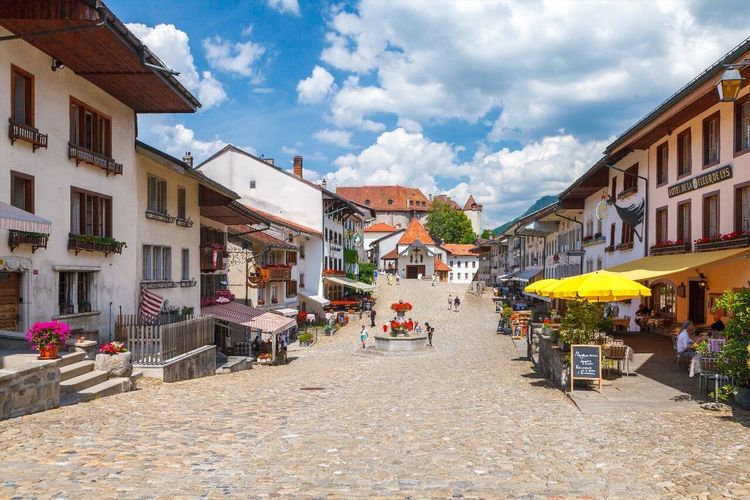
The village of Gruyères looks as if it has stepped out of a medieval miniature: a single cobbled street climbing towards a twelfth-century castle, half-timbered façades, and not a car in sight (the village is pedestrianised). The Counts of Gruyères' castle overlooks a panorama spanning the Fribourg Pre-Alps.
In the village, the HR Giger Museum (named after the creator of the Alien film) houses sculptures and paintings from another world — a striking contrast with the village architecture; the adjoining bar, entirely clad in biomechanical structures, is worth the detour on its own. The Maison du Gruyère, in Pringy (at the foot of the village), offers a tour of the production of one of the world's most exported cheeses: you can watch the copper vats in which pasture milk is heated, and learn that it takes around 400 litres of milk to make a single 35-kilogram wheel. Real AOP Gruyère has no holes, unlike Emmental, its Swiss cheese rival. To continue the culinary indulgence, the Maison Cailler in Broc (ten minutes by train) traces the history of Swiss chocolate and ends with an all-you-can-eat tasting room.
12. Lugano and Ticino, Italy without Leaving Switzerland
Ticino (Ticino) is the only Italian-speaking region of Switzerland. Its cantonal capital, Lugano (Piazza della Riforma, 6900 Lugano, rated 4.6/5 on Google from 1,051 reviews), borders a blue lake fringed with palm trees, with Monte San Salvatore on one side and Monte Brè on the other, and a cuisine that owes as much to neighbouring Lombardy as to the Alemannic tradition.
Monte San Salvatore (912 m), accessible by funicular from Paradiso, offers a 360° view over the lake and the southern Alps. MASI (Museo d'Arte della Svizzera Italiana), opened in 2015, exhibits modern and contemporary art in a building that dialogues with the Parliament square. Outside Lugano, the village of Gandria, accessible only by boat or on foot, is one of the best-preserved villages in the canton, with its houses stepping down to the water's edge.
13. Grindelwald and the Eiger, the Most Mythical North Face in the Alps
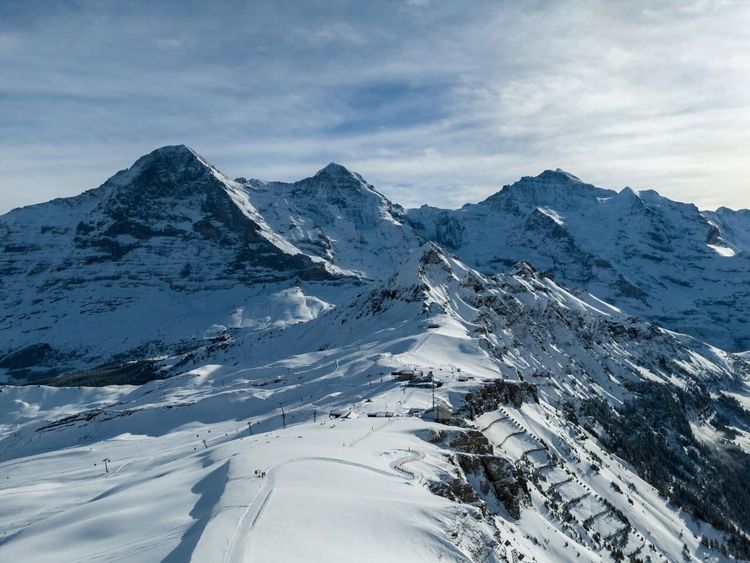
The village of Grindelwald lives in the shadow of Europe's most famous wall: the north face of the Eiger (3,967 m), 1,800 metres of near-vertical rock, long nicknamed the 'Mordwand' (murder wall). The first attempts to climb the face date from the 1930s; it was not conquered until 1938 by a German-Austrian rope team after five days of climbing.
Since 2020, the new Eiger Express gondola links Grindelwald Terminal to Eigergletscher in exactly 15 minutes, where the journey once took more than an hour. From Eigergletscher, you connect to the Jungfraubahn station to continue to the Jungfraujoch. Beyond the Jungfraujoch, the hikes around Grindelwald are among the most spectacular in the Bernese Oberland: the Bachalpsee trail (First, 3818 Grindelwald, rated 4.8/5 on Google from 598 reviews) (a mountain lake at 2,265 m) takes about two hours from First and rewards with a perfect reflection of the Bernese Alps.
Grindelwald is also the starting point of the Eigertrail, a path that runs along the foot of the north face through suspended pastures between 1,800 and 2,200 metres, with direct views of the face and the glaciers flanking it. On the way back, the village restaurants serve a traditional Bernese rösti — the real thing, with smoked alpine bacon and caramelised onions.
14. Saint-Moritz and Engadine, Luxury at 1,800 Metres
Saint-Moritz (San Murezzan in Romansh, Switzerland's fourth official language) is perhaps the world's most famous ski resort — double Olympic gold medallist in 1928 and 1948, and three-time host of the Alpine Ski World Championships. The village, perched at 1,856 metres in the Engadine valley, is home to palace hotels founded in the nineteenth century, luxury boutiques on the Via Serlas, and a frozen lake that hosts polo races on snow every February.
But Engadine goes far beyond Saint-Moritz. The valley stretches for 80 kilometres from Maloja to Martina, with a succession of stone villages adorned with sgraffito houses (patterns scratched into plasterwork) that are remarkably well preserved: Sils Maria (7514 Sils im Engadin, rated 4.7/5 on Google from 4K reviews) (where Friedrich Nietzsche spent his summers), Silvaplana (a kitesurfing and windsurfing spot on the lake), Zuoz (a medieval village with a bear fountain at the centre of the main square).
The Morteratsch glacier, in the valley of the same name from Pontresina, can be approached on foot from a car park. A sign marks the position of the glacial front in 1900, 1920, 1940, 1960, 1980, 2000 and today — a visual chronology of climate retreat along a single walking trail. In summer, hikes from the Diavolezza (cable car from Bernina) allow you to cross the glacier in the high mountains with ice axes and crampons, led by certified guides.
15. Montreux and the Vaud Riviera, Palm Trees and Jazz
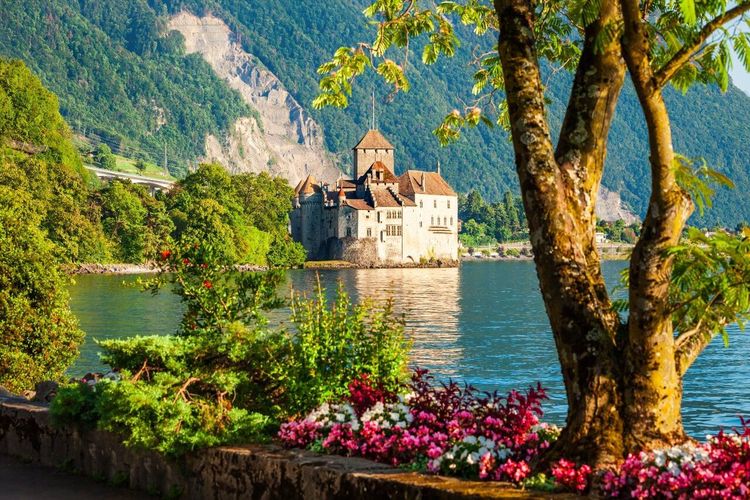
Montreux (Quai du Casino, 1820 Montreux, rated 4.2/5 on Google from 4,980 reviews) owes its fame to two things: the Jazz Festival, founded in 1967 by Claude Nobs, which draws hundreds of thousands of spectators and some of the world's greatest artists every July, and its lakeside promenade lined with palm trees, daffodils and roses, ranked among the most beautiful in Europe.
The Vaud Riviera stretches from Lausanne to Villeneuve along the northern shore of Lake Geneva. Lausanne deserves a separate visit for its Gothic cathedral (the best-preserved in Switzerland), its Olympic Museum (the largest museum dedicated to the Olympic movement in the world) and its old-town stairways that tumble down to the port of Ouchy. Between Lausanne and Montreux, the Lavaux Terraces — terraced vineyards on slopes of up to 30° overlooking the lake — are listed as a UNESCO World Heritage Site. The slopes are so steep that the harvest is still done entirely by hand.
16. Valais and Its Terraced Vineyards
Valais is Switzerland's leading wine-growing canton by cultivated area: 5,300 hectares of vines, much of it on vertiginous terraces between Martigny and Sierre. The most emblematic local grape variety is Fendant (Valais chasselas), but the region also produces rare indigenous varieties such as Petite Arvine and Humagne Rouge.
Sion, the cantonal capital, is dominated by two hills crowned with medieval castles — Valère and Tourbillon — visible from the entire Rhône plain. The Valère basilica houses the oldest playable organ in the world, built around 1430 and used every summer during an international festival. The wine route between Sion and Sierre can be cycled along a path following the Bisse canal — these medieval irrigation channels carved into the mountainside that have been carrying glacier water down to the vineyards since the thirteenth century. For anyone still wondering what to do in Switzerland off the beaten track, a wine tasting at a producer in Fully or Chamoson, followed by a walk along a shaded bisse, offers a respite far from the crowds of the Oberland.
17. Basel, the Secret Capital of Contemporary Art
Basel always surprises travellers who stop there without having really planned to. Switzerland's third-largest city by population, at the confluence of the Rhine with the French and German borders, carries a cultural reputation that far exceeds its size: this is where Art Basel takes place every June — the world's most influential contemporary art fair, which transforms the city into an open-air museum for ten days.
But Basel cannot be reduced to one week a year. The city has 40 museums for around 180,000 inhabitants — one of the highest museum densities in the world. The Kunstmuseum Basel, founded in 1661, is the world's first public art museum: it holds works by Holbein the Younger, Cranach, Rembrandt and a remarkable Impressionist collection. The Fondation Beyeler (Baselstrasse 101, 4125 Riehen, rated 4.6/5 on Google from 7,284 reviews), in Riehen (ten minutes by tram), holds a private collection of 200 works displayed in permanent dialogue: Picasso facing Bacon, Monet facing Warhol.
The old town of Basel, perched on the left bank of the Rhine, concentrates the Münster (a Romanesque and Gothic cathedral whose south tower offers a view over three countries), the Marktplatz with its flamboyant red Town Hall and sixteenth-century painted façades, and a series of contemporary fountains by modern artists scattered through the pedestrian streets. In summer, the local tradition of Rheinschwimmen — swimming across the Rhine from a public bathing spot — attracts thousands of swimmers every weekend.
Basel is also the birthplace of the Herzog & de Meuron practice (Tate Modern in London, the National Stadium in Beijing) and hosts, two kilometres away, the Vitra Campus — an open-air architecture museum bringing together buildings by Frank Gehry, Zaha Hadid, Álvaro Siza and SANAA. Architecture enthusiasts can easily spend half a day there.
To explore Basel in the footsteps of its art dealers, humanists and architects, the Ryo audio-guided tour of Basel crosses the old town from the cathedral to the banks of the Rhine.
18. The Swiss National Park, the Country's Only Strict Nature Reserve
The Swiss National Park (Ofenpassstrasse, 7530 Zernez, rated 4.8/5 on Google from 1,710 reviews) (Schweizerischer Nationalpark), founded in 1914, is the oldest national park in the Alps and one of the only ones in Western Europe classified as IUCN Category Ia — the strictest level of protection that exists. The rule is simple: no human intervention for more than 110 years. No hunting, no picking, no construction, not even the collection of dead wood.
The result is a forest of fallen spruces rotting where they lie, trails demarcated by ropes that must not be crossed, and wildlife that has returned naturally after centuries of intensive hunting. You can observe chamois, ibex, red deer (the park holds one of the largest concentrations of Alpine red deer), marmots just metres from the trails, and golden eagles soaring above the Inn valley.
The park covers 170 km² in the upper Engadine valley, between Zernez and Müstair. The village of Zernez is the main entry point and houses the Centro dal Parc, the ecosystem interpretation museum. The trails have been numbered and marked since the early twentieth century; the most accessible set out from the Ofenpass (Pass dal Fuorn). For ornithologists, the Cluozza valley, at the heart of the park, is considered one of the best spots in Europe for observing the black grouse.
19. The Great Alpine Passes, Old-World Switzerland
Crossing Switzerland by its mountain passes is like reading the country's history in its roads. The Great St Bernard Pass (Col du Grand-Saint-Bernard, 1937 Bourg-Saint-Pierre, rated 4.8/5 on Google from 83 reviews) (2,469 m), on the border with Italy, is the oldest Alpine pass in continuous use since Roman antiquity. Napoleon crossed the Alps here with 40,000 soldiers in 1800. The Great St Bernard Hospice, run by Augustinian canons, has existed without interruption since 1049.
The Furka Pass (2,429 m) is the road on which James Bond faced Auric Goldfinger in the 1964 film — the opening scene was shot on this winding road with the Aston Martin DB5. The Gotthard Pass, at 2,106 metres, links German-speaking Switzerland to Ticino; its old cobbled road (the Tremola, with its 24 hairpin bends) is one of the best-preserved historic roads in Europe.
20. Appenzell, the Most Traditional Switzerland
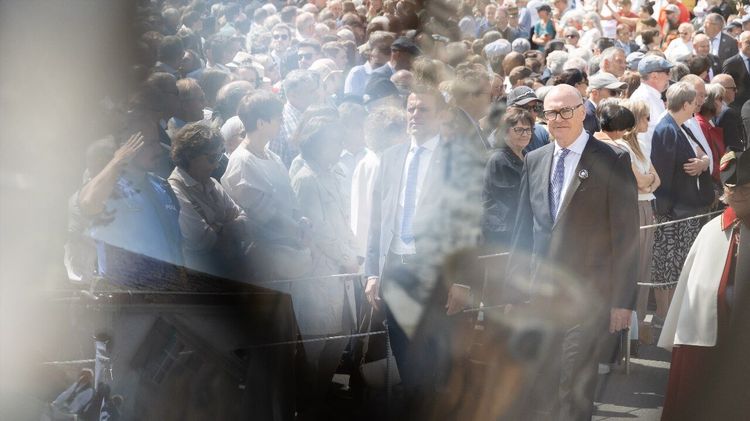
The half-canton of Appenzell Innerrhoden (Hauptgasse, 9050 Appenzell, rated 4.7/5 on Google from 8K reviews) remains the symbol of the most archaic form of direct democracy: until 1990, citizens voted by a show of hands in the village square during the Landsgemeinde, the annual popular assembly. It was also the last Swiss canton to have refused women the right to vote, until the Federal Supreme Court imposed it that same year.
The village of Appenzell itself is a postcard of deep Switzerland: wooden-clad houses painted in vivid colours, façades decorated with floral motifs, cheeses matured in cellars dug beneath the pastures. Appenzeller cheese (brined with alpine herbs using a recipe that has been kept secret for 700 years) can be tasted directly at the producers. The region is also known for its hikes between alpine pastures, particularly towards the Säntis (2,502 m), the highest point of the Alpstein massif.
FAQ
What is the best time to visit Switzerland?
Summer (June–September) is ideal for hiking, lake cruises and access to glaciers, with mountain transport running at full capacity. Winter (December–March) is ski season, with resorts such as Zermatt, Saint-Moritz and Verbier offering some of the largest ski areas in Europe. Avoid public holidays in May and the weeks of July–August if you want to escape the crowds at the Jungfraujoch or in Zermatt.
How many days do you need to visit Switzerland?
For a first visit, 7 to 10 days allow you to combine two or three cities (Geneva, Berne, Zurich or Lucerne) with a high-altitude excursion (Jungfraujoch or Zermatt) and a natural region (Engadine or Ticino). With 3 days, it is better to focus on one city and its immediate surroundings rather than rushing from one end of the country to the other — distances are short, but changes in altitude slow the days down.
Is it worth buying the Swiss Travel Pass?
For a stay of 7 days or more with a lot of travel by public transport, the Swiss Travel Pass is often worth it: it gives unlimited access to trains, buses and boats, and discounts of 25 to 50% on cable cars. For a 3–4 day stay focused on one region (Jungfrau Region or Engadine), regional passes or combined tickets are often more cost-effective. Compare prices online on the SBB website.
Is Switzerland too expensive for tight budgets?
Switzerland is indeed one of the most expensive countries in Europe: budget 80–120 CHF per day for a hostel with simple meals, and easily 200–300 CHF per day for a mid-range hotel with mountain excursions. To cut costs: stay in medium-sized towns (Thun, Solothurn, Aarau) rather than Zurich or Geneva, shop at Coop or Migros for lunch, and take advantage of the many free activities — public beaches, old towns, parks.
Do you need to speak German to travel in Switzerland?
Switzerland has four national languages: German (74% of the territory), French (23%, in the west), Italian (4%, in Ticino) and Romansh (less than 1%, in Engadine). In tourist areas and on public transport, English is widely understood. French is the natural language in Geneva, Lausanne, Montreux, Fribourg and Neuchâtel. A few words of Grüezi (hello in Swiss German) or Buongiorno in Ticino are always appreciated.
Can you hike in Switzerland without being a mountaineer?
Absolutely. Switzerland has 65,000 kilometres of official marked trails, divided into three categories: hiking trails (yellow, for everyone), mountain trails (white-red-white, for regular hikers) and alpine trails (white-blue-white, requiring mountain experience). Routes such as the trails around Grindelwald, the Rhône path or walks in Engadine can be completed without mountaineering equipment.
Switzerland cannot be reduced to a single type of trip. A stay in its cities reveals a dense urban culture — medieval architecture, world-class museums, refined gastronomy. A stay in the mountains exposes you to a nature that has no equivalent in central Europe. These twenty places are just a starting point for deciding what to do in Switzerland according to your interests: every region has its own secrets. To begin your exploration in Geneva or Basel, the Ryo audio-guided tours are a way to enter the city through history rather than through tourist brochures.