© Shutterstock
 Votre guide Ryo
Things to Do in Cambridge in 2026: 18 Experiences Between Colleges and River
Cambridge needs neither a royal palace nor a big wheel to draw nearly eight million visitors a year — its thirty-one Gothic colleges and a narrow river more than suffice. What to do in Cambridge when the entire city seems to fit within the back gardens of those institutions, separated by a waterway barely ten metres wide? The question deserves careful thought, especially since our Ryo article on the University of Cambridge already covers the history of this eight-century-old institution in detail.
Here, a chapel completed in 1515 houses the world's largest fan vault. A library designed by Christopher Wren preserves Isaac Newton's own annotations on his laws of motion. A wooden bridge from the eighteenth century has fuelled for 270 years the legend of Newton as architect, a story firmly contradicted by university archives. Add a clock being devoured by a mechanical grasshopper, meadows where Virginia Woolf swam at dawn, and a Second World War airfield where a full Concorde can be visited for free — and Cambridge ceases to be a mere stop on the road to Oxford. Pick up a map of Cambridge as soon as you arrive at the station: the colleges often hide their finest courtyards behind discreet doors that give nothing away from the street.
1. King's College Chapel
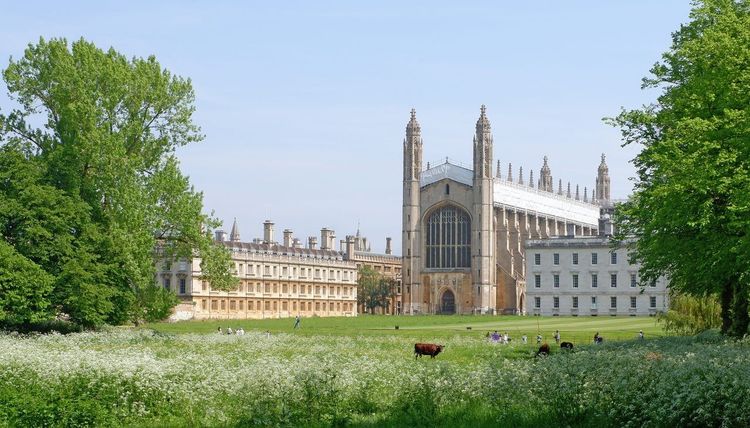
King's College Chapel (King's Parade, CB2 1ST Cambridge, rated 4.7/5 on Google from 2,190 reviews) has dominated the Cambridge skyline for more than five centuries. Begun in 1446 on the orders of King Henry VI, its construction stretched over nearly seventy years and three reigns, interrupted by the Wars of the Roses before being completed under Henry VIII in 1515.
What strikes you on entering is not so much the length of the building — 88 metres — as its vault: a continuous stone fan 24 metres high, considered the largest such structure in the world. No central pillar interrupts the nave, a technical feat that the architects of the day never replicated at this scale. Beneath this ceiling, sixteenth-century carved wooden stalls frame a rood screen gifted by Henry VIII, and the altarpiece features a canvas by Rubens, the Adoration of the Magi, donated to the chapel in 1961.
You can visit the chapel during the day with a ticket, but the most memorable experience remains free: attending the evensong sung by the King's College Choir, in the late afternoon on most days during term time. Arrive twenty minutes before the service to be sure of a seat; no booking is possible and the pews fill quickly in high tourist season. The evening light streaming through the sixteenth-century stained-glass windows — which survived the English Civil War virtually intact — makes this moment hard to match anywhere else in the city.
Every 24 December, the chapel hosts the famous Festival of Nine Lessons and Carols, a Christmas carol service broadcast on radio worldwide since 1928. Securing a seat on that day is an achievement in itself: some regulars queue from dawn for the handful of benches open to the public without a ticket. For the rest of the year, the daily evensong offers a more intimate version of the same acoustics that have made the King's Choir world-renowned. If you could do only one thing in Cambridge at the end of the day, this would probably be it.
2. Trinity College and the Wren Library
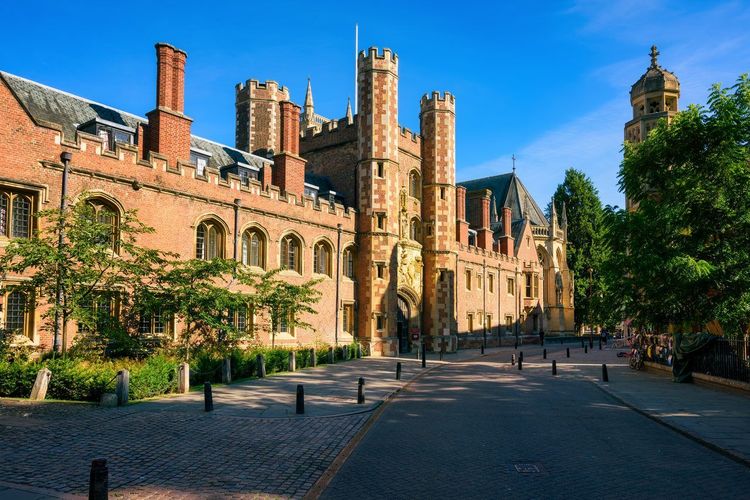
Founded in 1546 by Henry VIII through the merger of two older colleges, Trinity College counts 34 Nobel Prize winners among its alumni — a figure higher than that of many entire countries. Isaac Newton, Francis Bacon, and Prince Charles all studied here.
The college's Great Court, the largest in all of Cambridge, serves as the setting for a student tradition: each year, a handful of students attempt to run around it within the 43 seconds it takes the clock to strike noon, a challenge popularised by the film Chariots of Fire. You will also see the central fountain, fed since the sixteenth century by an aqueduct that is still operational.
In front of the college's Great Gate, along the street, a young apple tree catches the eye of those in the know: it is said to be a direct cutting from the tree at Newton's family farm, the fall of whose apple supposedly inspired his theory of gravitation. The apple story is partly legendary, but Newton himself recounted it to several biographers towards the end of his life, and the college tends the tree with an almost ceremonial care.
But the college's true treasure lies in the Wren Library, designed by Christopher Wren between 1676 and 1695. On its shelves rest the original manuscript of A. A. Milne's Winnie-the-Pooh, a Gutenberg Bible, and above all Newton's personal copy of the Principia Mathematica annotated in his own hand. Entry is free on weekday afternoons, but access is limited in number: expect a short queue outside July and August, longer in peak season. Photography is strictly forbidden, a rule firmly enforced by staff. Look up at the marble busts lined along the bookcases: they represent the great minds who passed through Trinity, including a Newton sculpted by Roubiliac, considered one of the finest portraits of the scientist.
3. St John's College and the Bridge of Sighs
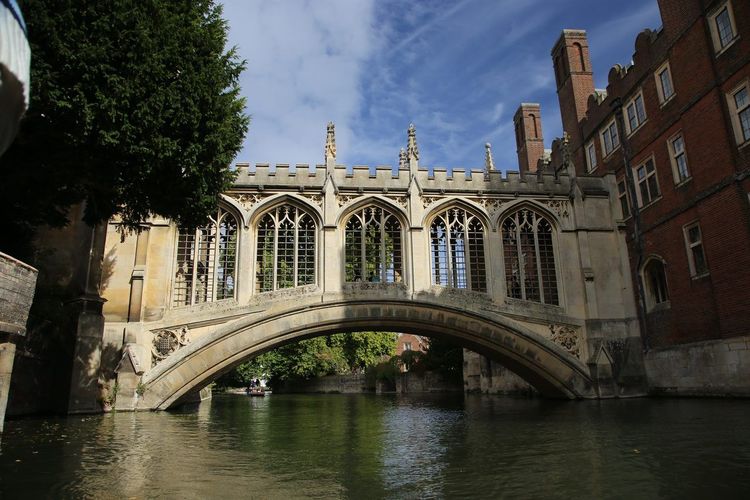
Less photographed than King's but equally rich in history, St John's College (St John's Street, CB2 1TP Cambridge, rated 4.5/5 on Google from 276 reviews) owes much of its fame to the covered bridge linking its two banks over the Cam.
Built in 1831, this Bridge of Sighs draws direct inspiration from its Venetian namesake, though with no true architectural connection: the name was coined by a Cambridge professor charmed by the atmosphere of the Italian bridge during a study trip. You can cross it on foot from the college's inner courtyard, or admire it from the neighbouring Kitchen Bridge, the preferred photographic angle for visitors on punts along the river.
The college also holds the second largest library in Cambridge after the university's own, and a neo-Gothic courtyard built in 1831 in a style that contrasts sharply with the rest of the campus. Behind the college hides the School of Pythagoras, considered the oldest surviving building in Cambridge — a twelfth-century stone house now restored as an archive room. Few visitors know it exists, and it appears on almost no tourist map of the city.
If you visit only one college beyond King's, make it this one: admission is cheaper and the crowds are noticeably thinner. Do check opening hours before you go, however, as St John's regularly closes its doors to visitors during exam periods, from mid-April to mid-June, when students revise in the courtyards.
4. The Mathematical Bridge at Queens' College
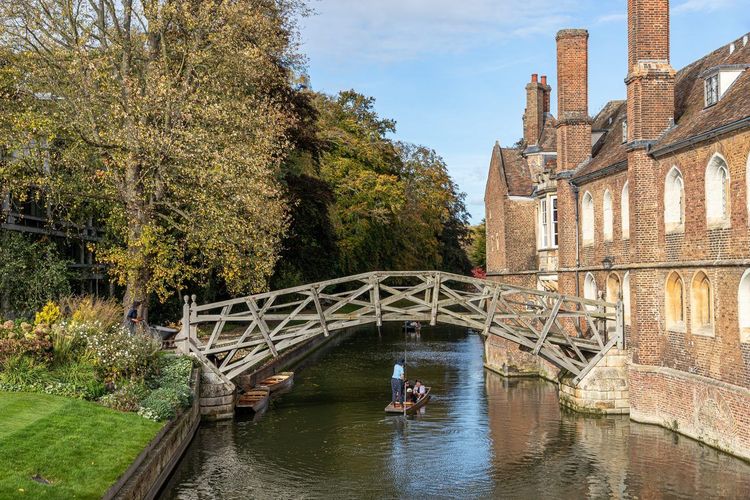
A few minutes' walk away, the Mathematical Bridge (Silver Street, CB3 9EG Cambridge, rated 4.5/5 on Google from 1,408 reviews) has spanned the Cam in front of Queens' College since 1749.
A persistent legend attributes its design to Isaac Newton, who supposedly built it without a single screw or nail, only for curious students to take it apart to understand how it worked and then find themselves unable to reassemble it without bolts. The story is appealing but false: the bridge was designed by engineer William Etheridge twenty-two years after Newton's death. The wooden lattice structure itself, however, is genuine and rests on a real engineering principle — a geometric tangent that distributes weight without requiring an arch.
The current bridge dates from 1905, a faithful reconstruction of the original design after several replacements. You can cross it for free from the street when you enter Queens', but the best view is from a punt passing underneath, or from the nearby Silver Street bridge, where tourists gather in the late afternoon to photograph the wooden lattice reflected in the water. The college itself, with its fifteenth-century half-timbered Cloister Court, ranks among the most picturesque in Cambridge and can be visited for a modest entry fee.
5. Punting on the River Cam
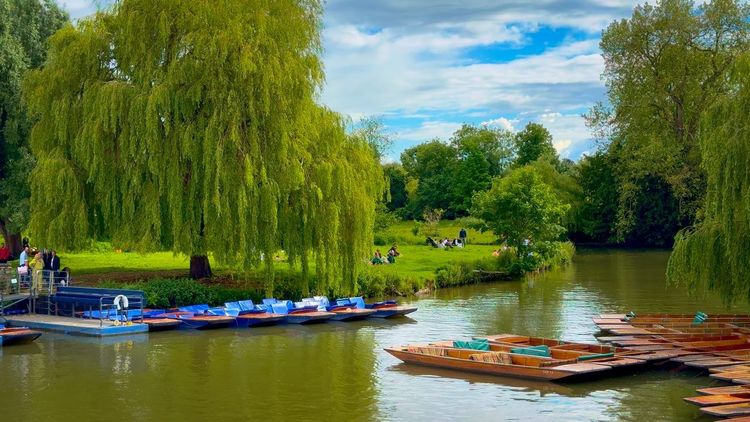
If one activity defines Cambridge on a postcard, it is this: gliding in a punt — a long flat-bottomed boat propelled by a pole — along the River Cam. The historic company Scudamore's (Granta Place, Cambridge CB2 1RS, rated 4.5/5 on Google from 5,600 reviews) has been hiring out boats since 1910 and remains the reference for this activity.
Two options are available. The first is the chauffeured punt: a student or local guide poles you along for 45 minutes to an hour past the gardens of King's, Clare, Trinity, and St John's, commenting on the history of each college as you pass under the bridges. The second is self-punting: you take the pole yourself, with a deposit and a generous dose of humour, since most beginners end up soaked or spinning in circles to the amusement of onlookers on the banks.
Prices vary considerably with the season and time of day, the chauffeured option being noticeably more expensive than self-hire. For the most peaceful atmosphere, book an early morning outing before the groups arrive at midday; for a livelier experience, choose late afternoon in summer when punts pass almost continuously under the Bridge of Sighs. The stretch of river known as The Backs (Queen's Road, CB3 9JU Cambridge, rated 4.6/5 on Google from 810 reviews), between Magdalene Bridge and Silver Street, offers the densest sequence of colleges visible from the water — a perspective impossible to obtain from the street.
No prior experience is needed for self-punting, but collisions between boats are common during summer peak hours. A tip for the chauffeur, while not obligatory, is standard practice if you enjoyed the guided commentary. Beware of touts who approach tourists around Magdalene Bridge and King's Parade: prices quoted on the spot are sometimes higher than those booked online in advance, and not all operators are equal when it comes to insurance and boat maintenance.
6. A Walk Along the Backs
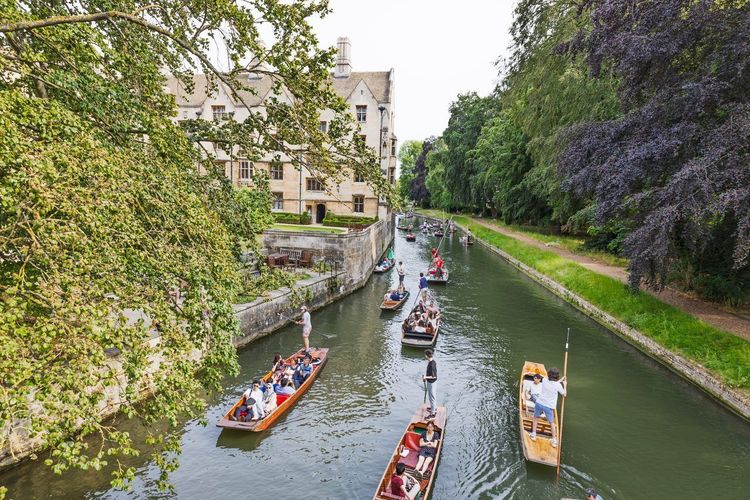
Even without boarding a punt, you can walk or cycle along the Backs — the strip of lawns and bridges that borders the river behind six of the city's oldest colleges.
The path, largely public and free, crosses lawns that college gardeners have maintained for centuries, dotted with weeping willows and, in summer, cows still grazing in places — an agricultural tradition deliberately preserved at the heart of the city. You will pass Clare Bridge, the oldest surviving bridge in Cambridge, dating from 1640 and decorated with fourteen ornamental stone balls. One of them deliberately has a missing segment: local legend has it that the stonemason, unhappy at having been underpaid, removed the piece out of spite, though no archive confirms the story.
This is also a walk recommended by the Ryo app for exploring the city centre on foot, without depending on boat timetables. Allow 45 minutes to an hour for a leisurely stroll from Magdalene Bridge to Silver Street, stopping regularly to observe the garden-facing façades, which are often more ornate than those facing the street. In spring, the lawns of King's and Clare are carpeted with thousands of daffodils and crocuses — a fleeting spectacle that draws photographers every year from the first fine days of March.
7. Climbing to the Top of Great St Mary's Church
Known as the University Church, Great St Mary's Church (Senate House Hill, CB2 3PQ Cambridge, rated 4.6/5 on Google from 1,584 reviews) has served as the official place of worship for Cambridge since the twelfth century, but its tower is the main draw for visitors seeking a view.
For a modest entry fee, you climb 123 spiral steps to an outdoor platform overlooking the rooftops of the historic centre, including King's College Chapel. It is one of the few elevated viewpoints accessible in Cambridge — a city that, unlike many English towns, has no skyscrapers or modern observation towers. Patience is required at busy times: the staircase is narrow and only allows people to pass at certain points.
From the platform, face west to spot the silhouette of King's College Chapel and, beyond it, the old city rooftops merging into the Backs. Interpretation panels help identify each spire and dome on the campus. Note that the tower closes in high winds or driving rain for safety reasons: it is worth checking the weather — notoriously changeable in Cambridge — before climbing the steps. Inside the church, you will also find the historic reference point from which all road distances to Cambridge were once measured.
8. Browsing Cambridge Market
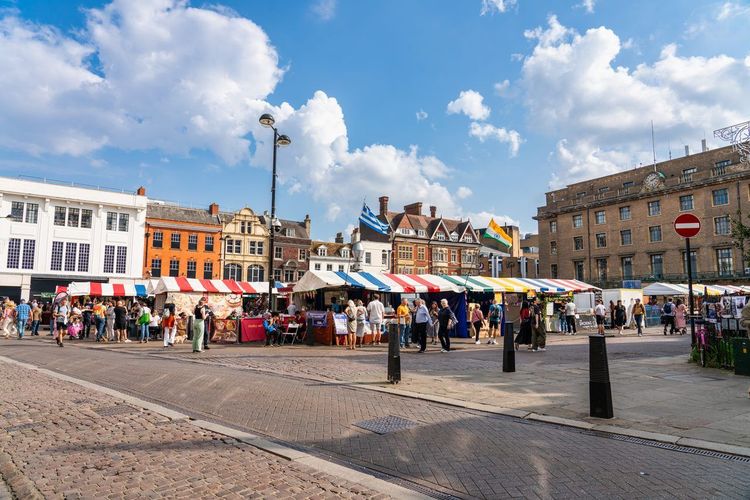
A stone's throw from the Senate House, Cambridge Market Square (Market Hill, CB2 3NJ Cambridge, rated 4.5/5 on Google from 3,991 reviews) has hosted a near-daily market since medieval times.
The stalls vary by day: farm produce and local cheeses on weekdays, antiques and vinyl records on Mondays, crafts and vintage clothing at weekends. It is also the easiest spot for a quick bite between sightseeing, with a surprising density of street-food stands for such a small square — from Taiwanese dumplings to Breton crêpes and fish and chips.
The market has occupied this square without interruption since the Middle Ages, making it one of the oldest continuously operating markets in England. Around it, a few addresses are worth a detour for a break: the independent tea rooms of Rose Crescent at the north-west corner, and the secondhand bookshops lining the neighbouring lanes. It is also the best landmark for getting your bearings in the centre: almost all the pedestrian streets converge on this square, and finding it again is all you need to reorient yourself towards any college.
9. The Fitzwilliam Museum
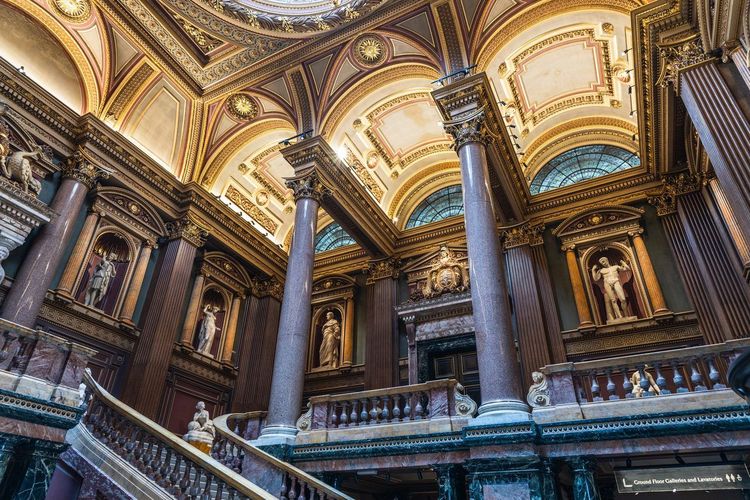
Founded in 1816 thanks to the bequest of Viscount Fitzwilliam, the Fitzwilliam Museum (Trumpington Street, CB2 1RB Cambridge, rated 4.7/5 on Google from 9,271 reviews) ranks among the world's richest university museums — and admission is entirely free.
Behind its neoclassical façade with Corinthian columns lie more than half a million objects: Egyptian mummies and sarcophagi, ancient Greek ceramics, Japanese armour, and a painting collection ranging from Titian to Monet and Picasso. The Impressionist gallery, often overlooked by visitors in a hurry, brings together canvases by Renoir, Degas, and Cézanne acquired throughout the twentieth century by private donors.
Allow at least two hours to move through the main collections at a relaxed pace, more if art history is a passion. The Egyptian galleries on the ground floor attract the most families, while the upper floor, quieter, suits a more contemplative visit. A free audio guide available at the entrance usefully supplements the labels, which can be concise on some major pieces.
The museum also organises temporary exhibitions renewed several times a year, often devoted to a specific artist or civilisation. Check the programme before your visit if a particular theme interests you, as some rooms close temporarily during rehang rotations. Useful for families: the museum provides free activity booklets at the entrance, and the café under the dome offers an affordable mid-visit break — without any need to have paid an admission fee, since the museum is entirely free.
10. The University Botanic Garden
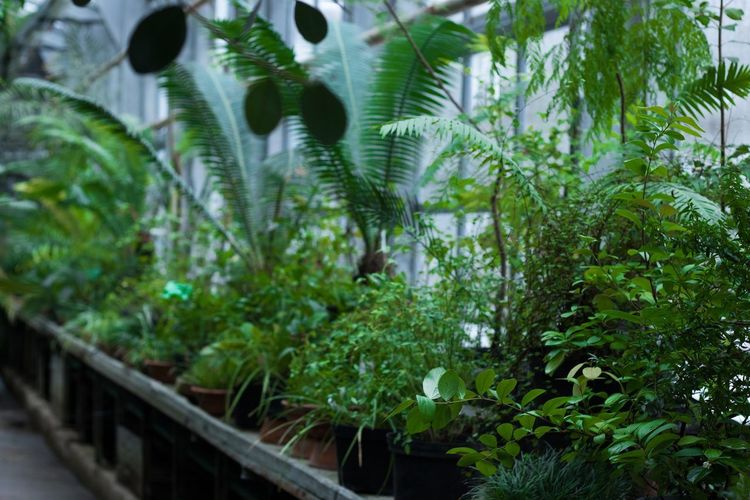
Fifteen minutes' walk from the centre, the Cambridge University Botanic Garden (1 Brookside, CB2 1JE Cambridge, rated 4.7/5 on Google from 7,604 reviews) spreads across 16 hectares founded in 1831 by botanist John Stevens Henslow, mentor to a certain Charles Darwin.
The garden holds more than 8,000 plant species arranged in themed zones: an arboretum, a rock garden fed by a system of artificial streams, heated tropical glasshouses, and one of the most complete conifer collections in the United Kingdom. In autumn, the arboretum turns to particularly photogenic shades of red and gold — a moment that regulars consider the best time to visit, before the spring crowds.
Admission is charged but remains modest compared to equivalent London museums, and is free for accompanied children. Allow at least 90 minutes to walk the full circuit, longer if you bring a picnic to one of the open lawns — a practice permitted outside the protected beds. Do not miss the alpine glasshouse and the scent garden, designed to be appreciated with eyes closed: it is one of the few British botanic gardens with a sensory trail conceived also for visually impaired visitors. The garden also serves as a living laboratory for university researchers studying plant adaptation to climate change; certain experimental plots, marked with discreet signs, show how Mediterranean species are now acclimatising to the climate of eastern England.
11. The Round Church
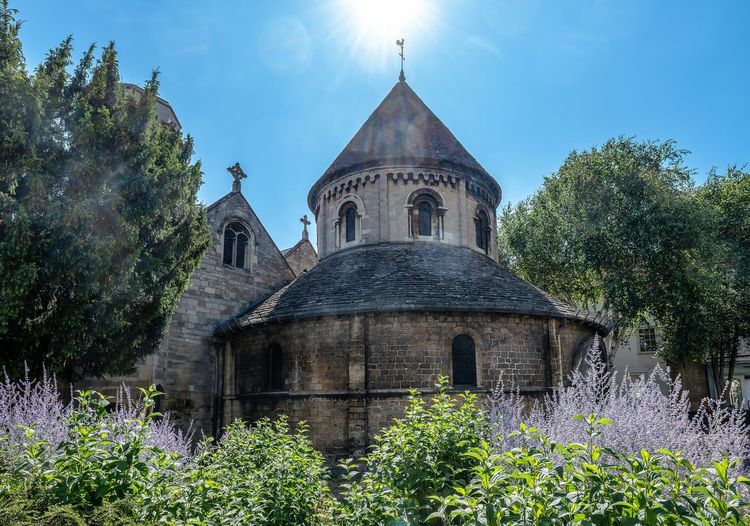
Among the only four medieval round churches still standing in England, the Church of the Holy Sepulchre, known as the Round Church (Round Church Street, CB5 8AD Cambridge, rated 4.5/5 on Google from 620 reviews), was built around 1130 by knights returning from the Crusades.
Its circular plan draws direct inspiration from the Church of the Holy Sepulchre in Jerusalem. The interior, restored in the nineteenth century after centuries of successive modifications, now houses a small visitor centre and an exhibition on the Christian history of the city. The visit takes barely fifteen minutes, but the building merits a detour for its architectural rarity alone.
Note that the church is no longer an active parish but a centre managed by a Christian organisation: access to the nave requires a small contribution that funds the permanent exhibition. Just opposite, Bridge Street and its half-timbered houses are among the few surviving medieval secular remains in the centre, most original buildings having disappeared through successive university reconstructions. It is also the ideal starting point for walking to Magdalene College and the old tavern quarter, slightly off the tourist flow of King's Parade, worth comparing, once back in London, with Ryo's Royal Tour audio-guided walk.
12. The Corpus Clock
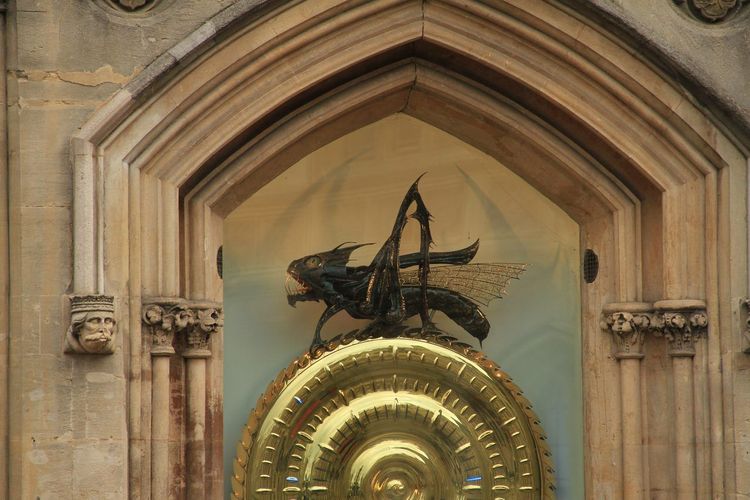
Unveiled in 2008 by physicist Stephen Hawking himself, the Corpus Clock (Bene't Street, CB2 3PT Cambridge, rated 4.6/5 on Google from 1,278 reviews) adorns the corner of Corpus Christi College with a mechanism as fascinating as it is unsettling.
There are no conventional hands: a gold disc 1.5 metres in diameter displays the time through waves of blue LEDs, while a giant metal grasshopper, known as the Chronophage ("time eater"), crawls around the rim and snaps its jaw shut every passing minute, as if physically devouring time. Its creator, clockmaker John Taylor, deliberately designed a mechanism that slows down and speeds up irregularly: the displayed time is accurate only once every five minutes.
It can be admired for free from the street at any hour, but its effect is most striking at dusk, when the LEDs stand out against the dark stone of the façade.
A few metres from the clock, on the same Bene't Street, do not miss the pub The Eagle: it was here that, on 28 February 1953, researchers Francis Crick and James Watson reportedly announced to all present that they had "discovered the secret of life" — in other words, the double-helix structure of DNA. A plaque commemorates the scene, and the ceiling of the back room still bears the names of British and American airmen scratched or burned in by candle during the Second World War. You can have lunch there or enjoy a pint in a setting deliberately kept period: it is one of the most historically charged dining spots in the entire city.
13. Kettle's Yard
Less well known than the Fitzwilliam, the house-museum Kettle's Yard (Castle Street, CB3 0AQ Cambridge, rated 4.6/5 on Google from 1,428 reviews) attracts modern art lovers looking to escape the crowds.
The space was created between 1957 and 1973 by Jim Ede, a former curator at the Tate Gallery in London, who transformed four cottages into a gallery-residence conceived as a living space rather than a conventional museum. Works by Henri Gaudier-Brzeska, Barbara Hepworth, and Ben Nicholson blend with furniture, pebbles gathered from beaches, and natural light filtered through deliberately transparent curtains.
Entry to the house is free but limited to a set number of simultaneous visitors — a constraint designed to preserve the intimate atmosphere of the place. A tip also shared by the Ryo audio guide: schedule this kind of stop late in the morning, before the school groups that often fill the small rooms in the early afternoon. An adjoining contemporary gallery, also free, hosts temporary exhibitions renewed several times a year. The principle Jim Ede had in mind can be summed up in a single sentence: nothing is labelled, nothing is behind glass, and visitors are invited to sit in the armchairs, open the books, and watch how daylight shifts shadows through the hours. Few British museums offer an experience this un-museum-like, and that is precisely what draws visitors tired of crowded major institutions. Allow a good hour to appreciate the atmosphere without rushing.
14. The Museum of Zoology
At the heart of the science campus, the Museum of Zoology (Downing Street, CB2 3EJ Cambridge, rated 4.7/5 on Google from 2,335 reviews) welcomes visitors of all ages for free beneath the gaze of a blue whale skeleton suspended from the atrium ceiling.
The collections bring together specimens gathered since Charles Darwin's voyage on the HMS Beagle, alongside dodo skeletons, fossils, and a gallery devoted to evolution. Allow an hour for a full visit, somewhat less if you are travelling without children keen to linger at every display case.
The blue whale suspended at the entrance, more than twenty metres long, washed ashore on a Sussex beach in the nineteenth century and is among the first skeletons of its kind to have been put on display in the United Kingdom. Inside, do not miss the specimens Darwin brought back from his Beagle voyage, including birds that directly informed his thinking on the origin of species. Completely renovated in the late 2010s, the museum now features bright spaces and family-friendly displays, making it one of the most appreciated free visits for travellers with children. Worth noting: the museum shares its building with the David Attenborough Building, named after the celebrated British naturalist who graduated from Cambridge and personally opened the renovated galleries. It is also a good option on rainy days — frequent in the region — when punting and walks along the Cam become less appealing.
15. Grantchester Meadows
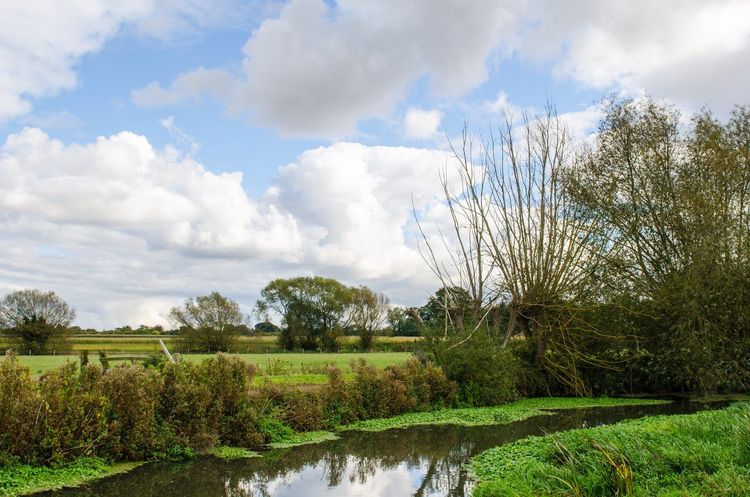
Three kilometres south of the centre, Grantchester Meadows (Grantchester, CB3 9ND Cambridge, rated 4.7/5 on Google from 980 reviews) offer the rural breathing space that few British university cities can claim so close to their historic heart.
You can walk there from Cambridge by following the river — a roughly forty-five-minute stroll lined with cows and willows — or travel by punt all the way to the village of Grantchester itself. The place owes its literary fame to the poet Rupert Brooke, who lived here before the First World War and received in his garden an entire circle of writers, including Virginia Woolf, who was known to bathe naked in the river — an anecdote still recounted by local guides. Pink Floyd also immortalised the place in a 1969 instrumental track bearing its name.
Once there, the historic tea room The Orchard, set among apple trees since 1897, still serves afternoon tea in deckchairs arranged between the trees — a tradition that in its time welcomed Alan Turing and members of the Bloomsbury literary group. Book ahead if you come on a sunny Sunday: the outdoor tables fill quickly as soon as fine weather returns. To round off the outing, continue to the village church, which holds part of Rupert Brooke's memory, then return along the opposite bank to vary the views across the flood meadows, which are designated a conservation area for their biodiversity.
16. Parker's Piece
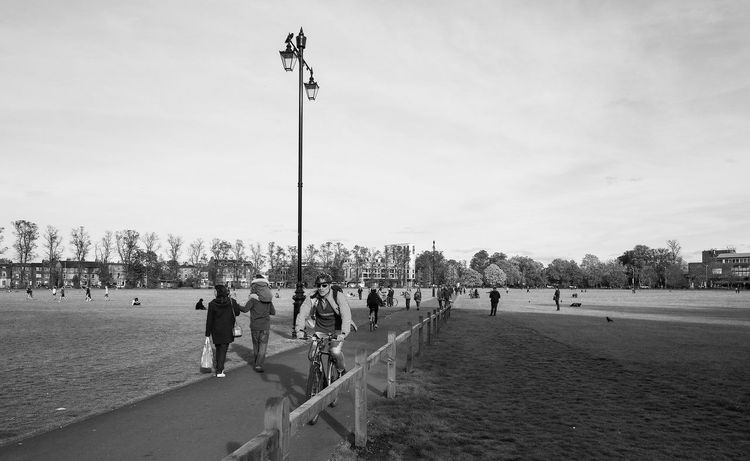
A large expanse of grass a short walk from the station, Parker's Piece (CB1 1JG Cambridge, rated 4.5/5 on Google from 6,641 reviews) has a little-known historical role: it was here, in 1848, that Cambridge students drew up the first written rules of modern football, the Cambridge Rules.
A central lamp post, nicknamed Reality Checkpoint by students, traditionally marks the symbolic boundary between the university world and real life. The park today serves as a place for picnics, jogging, and impromptu matches, with no entry fee or fixed hours.
The nickname "Reality Checkpoint" dates from the 1970s and has never received an official explanation: for some it marked the border between the university bubble and the real world of the outer neighbourhoods; for others it served as a landmark for revellers finding their way home in the small hours. At the end of the year, a temporary ice rink and a winter funfair sometimes set up on the grass, transforming the usually peaceful esplanade into the lively heart of the city. The rest of the time, it is simply the best place to catch your breath between the station and the centre, halfway along a walk that links the train arrival to the first colleges.
17. Day Trip to Ely Cathedral
Just twenty minutes by train, the small city of Ely is worth a day trip for its cathedral (The Gallery, Ely CB7 4DL, rated 4.8/5 on Google from 8,200 reviews), visible for miles around across the flat Fenland landscape.
Nicknamed "the Ship of the Fens" because of the way its silhouette dominates the surrounding marshy landscape, the cathedral was founded in 673 by Queen Etheldreda before being rebuilt in Norman stone from 1083. Its most spectacular feature is the Octagon — a unique octagonal lantern tower in Europe, built in the fourteenth century after the original central tower collapsed in 1322. From inside, the lead-covered timber structure rises to 43 metres and floods the interior with a quality of light that medieval architects had never before achieved at this scale.
The guided tower tour, accessed via a narrow spiral staircase, takes you outside the Octagon for a panoramic view over the surrounding Fens and, on clear days, all the way to Cambridge itself. The cathedral also houses the Stained Glass Museum, the only one of its kind in the United Kingdom, installed in the south gallery and tracing several centuries of the art of stained glass through hundreds of panels removed from redundant churches. Allow half a day for the return train journey, a visit to the cathedral, and a stroll around the small historic centre of Ely, known for its Thursday market and its proximity to the house where Oliver Cromwell once lived, now a museum.
If you are looking for things to do around Cambridge on a full day out, this excursion remains one of the most accessible without a car, as Ely station is served several times an hour from Cambridge.
18. Day Trip to the Imperial War Museum Duxford

Half an hour by road or bus south of Cambridge, the Imperial War Museum Duxford (Duxford, CB22 4QR Cambridge, rated 4.8/5 on Google from 18,481 reviews) occupies a former Royal Air Force airfield active since the First World War.
The site houses one of the largest collections of historic aircraft in Europe, spread across several themed hangars: Spitfires and Hurricanes from the Battle of Britain, Second World War bombers, Cold War fighter jets. The most spectacular exhibit is undoubtedly a full-size Concorde, which visitors can board for free — radio headsets included — to explore the supersonic cabin as it operated until 2003.
One of the hangars, the American Air Museum, was designed by architect Norman Foster and houses the largest collection of American military aircraft on display outside the United States, including a B-52 bomber whose wingspan alone fills the entire building. Duxford also organises several air shows each year, where authentic vintage aircraft take to the skies in front of thousands of spectators — an event to book well in advance as tickets sell out fast. Outside those dates, allow a full half-day to walk through all the hangars at a leisurely pace: the site is large and largely outdoors, so dress for the English weather, which is changeable even in summer. A direct bus runs from Cambridge bus station to Duxford several times a day in good weather, making the outing possible even without a car.
FAQ
How much time do you need to visit Cambridge?
One day is enough to see the historic centre highlights: King's College Chapel, Trinity College, and a punt trip. To include museums, the botanic garden, and a day trip to Ely or Duxford, plan for two to three full days.
Cambridge or Oxford: which should you visit first?
Both university cities share a collegiate architectural style, but Cambridge stands out for its punting river and the Backs gardens, while Oxford offers more free museums. Neither is objectively better — the choice mainly depends on your starting point from London.
What should you do in Cambridge in just one day?
Focus on King's College Chapel in the morning, a punt trip at midday, then the Fitzwilliam Museum or a stroll around the market in the afternoon. This itinerary covers the most iconic sites without too much walking.
Where should you stay in Cambridge?
Hotels in the historic centre near King's Parade cost more but put everything within walking distance. Booking a hotel closer to the station is often cheaper while still leaving you fifteen minutes on foot from the main colleges.
What are the best day trips from Cambridge?
Ely and its cathedral, twenty minutes by train, and the Imperial War Museum Duxford, thirty minutes by road, are among the most popular day trips from Cambridge. Grantchester, reachable on foot or by punt, is a good option for a shorter outing.
Is Cambridge easily accessible by train from London?
Yes, direct trains from King's Cross or Liverpool Street reach Cambridge in 45 to 90 minutes depending on the service, making it an easy day trip from the British capital.
Conclusion
What to do in Cambridge, ultimately? The city lends itself equally to a packed single day or a three-day stay, as layers of history accumulate from one college to the next. Between a Gothic chapel, a punt on the Cam, and a Concorde to visit for free thirty minutes away by road, it offers a density of experiences rare for its modest size — and more than enough to fill a travel journal well beyond the classics of King's and Trinity.
To make the most of every step between colleges, let the Ryo app and its audio guide lead the way: it places every bridge, every courtyard, and every façade within eight centuries of university history, at your own pace and without depending on tour schedules. And if you want to go deeper before you leave, our Ryo guide to the University of Cambridge remains the best entry point for understanding how eight centuries of academic life have shaped every stone of the city.
À lire également