© Shutterstock
 Votre guide Ryo
Visiting Antibes Solo in 2026: Itinerary, Must-See Sights and Practical Tips
Visiting Antibes solo often starts with a surprise: at 7:30 am, the Cours Masséna still smells of the salty night air from the port, before the stalls of the Provençal Market cover everything in the scents of basil and orange blossom. It is at that hour, alone on the still-damp cobblestones, that you understand why the city lends itself so well to a solo visit: small enough to explore on foot in a day, lively enough that you are never truly isolated, and well enough marked out by its ramparts that you almost never get lost. For those who prefer to move by ear rather than with their nose in a map, that is the whole appeal of the Ryo audio-guided tour of Antibes, which links the ramparts, old town and seafront on foot, and which you will find further on.
On the program of this guide: a Fort Carré from the 16th century that you can climb without a group reservation, an eight-meter white sculpture that draws photographers at sunset, a coastal path carved into the rock where the waves sometimes lap at the trail, and three beaches with such different atmospheres that you would think you were changing city each time. We also add the questions you really ask yourself when traveling solo: where to eat without feeling watched, where to sleep without breaking the bank, and whether the city is as safe at night as during the day.
Old Antibes, Its Ramparts and the Provençal Market

The Provençal Market fills the Cours Masséna every morning, beneath a 19th-century metal hall open on all four sides. You will find the usual stalls of fruit, cheese and spices, but also producers who sell their olive oil or lavender honey directly, without the intermediary of a shop. From September to May, the market is closed on Mondays; from June to August, it runs seven days a week, from 7:30 am until early afternoon. Just check the day of your arrival before planning your morning around it.
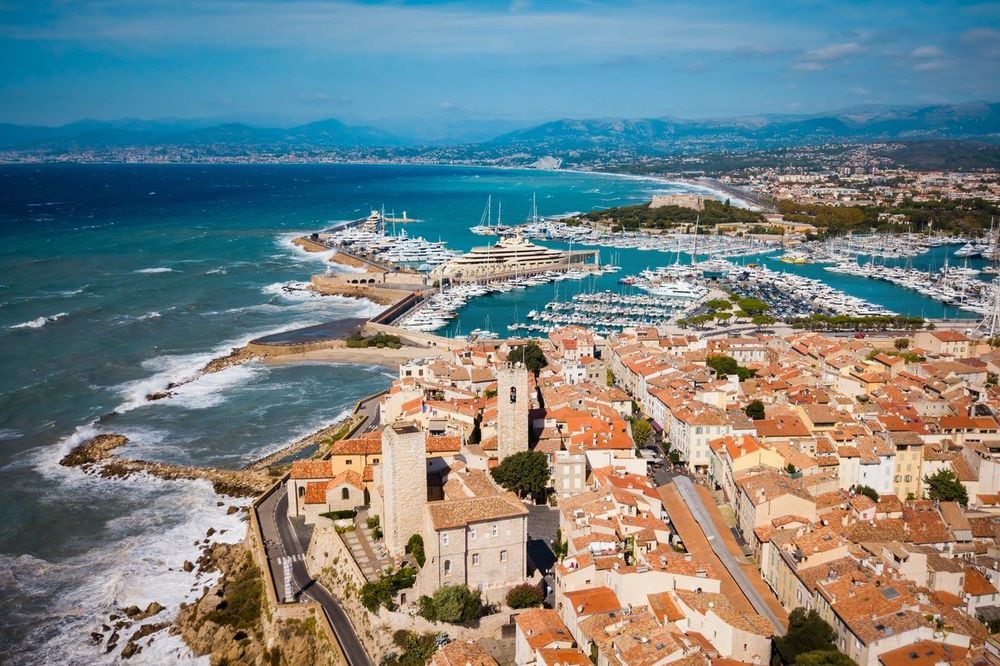
The ramparts of Antibes run along the sea for nearly a kilometer, from the Bastion Saint-André to the Port Vauban (Avenue du 11 Novembre, 06600 Antibes, rated 3.9/5 on Google from 367 reviews). Vauban reinforced them at the end of the 17th century, but their layout follows much older fortifications, Greek and then Roman, the city having been founded as a Phocaean trading post under the name Antipolis. Walking along the wall walk, between the ramparts and the Mediterranean, remains the most direct way to understand the geometry of Old Antibes.
For a solo stroll, favor the Safranier neighborhood, just behind the cathedral: its narrow, flower-filled lanes are pedestrian-only, lively in the evening with a few restaurants without being noisy, and small enough that you always run into the same shopkeepers. It is often the area regulars name when asked which is the nicest neighborhood in Antibes, ahead of the more touristy Old Town around Rue Sade.
The Port Vauban, at the other end of the ramparts, is among the largest marinas in Europe: more than 1,600 boats are moored there, including the mega-yachts lined up along the Billionaires' Quay, which attract the curious as much as photographers. You can stroll there for free, and it is a good landmark for getting your bearings before heading back up toward the center.
The Ryo audio-guided tour follows precisely this route, from the ramparts to the Provençal Market and then through the lanes of the old town, with audio commentary on the history of every corner of the neighborhood. Ideal for moving at your own pace, with no group and no imposed schedule.
The Picasso Museum and the Château Grimaldi
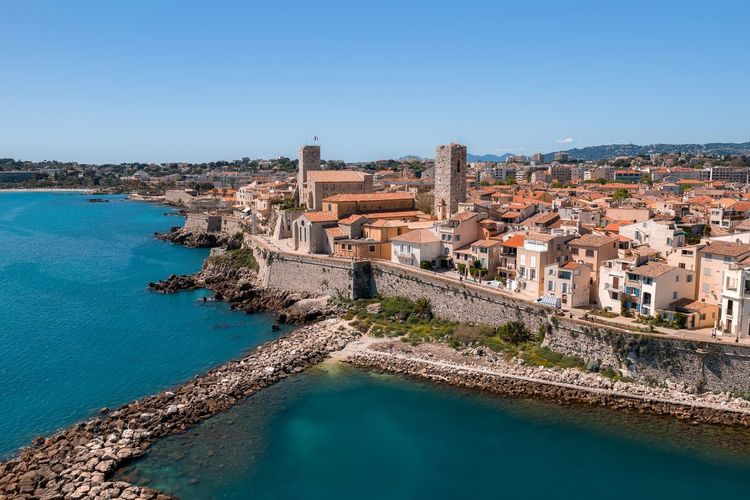
The Picasso Museum (Place Mariejol, 06600 Antibes, rated 4.3/5 on Google from 7,392 reviews), housed in the Château Grimaldi, occupies the oldest site in Antibes: a medieval fortress built on Greek foundations, remodeled by the Grimaldi family and then turned into a municipal museum in 1925. Picasso worked there during the summer of 1946, after the curator at the time offered him the rooms as a studio; in exchange, the artist donated much of his output from that period, joyful, marine-themed canvases that still form the heart of the collection.
The museum is open Tuesday to Sunday (closed on Monday, January 1, May 1, November 1 and December 25), with a lunch break from 1 pm to 2 pm outside summer. Expect to pay 12 euros for the full rate; if you also plan to go up to the Fort Carré, the combined ticket at 15 euros, valid for seven days, includes four municipal sites and quickly pays off. The rooms are not huge, which means you can see everything in an hour without rushing, unlike larger museums where a solo visit can quickly become tiring.
The real bonus of the place, especially on your own, is the outdoor terrace: 17th-century cannons lined up facing the sea, and a view that reaches as far as the Cap d'Antibes in clear weather. You can stay there for twenty minutes without anyone being surprised, which is not always the case in busier museums.
If you are traveling off-season, aim to arrive at opening time: groups tend to arrive in late morning, and the first hours often offer nearly empty rooms, a rare luxury for such a well-known collection. It is also when museum staff are most available to answer questions, a small plus when you are visiting with no one to discuss the works with.
The Bastion Saint-Jaume and the Sculpture Le Nomade
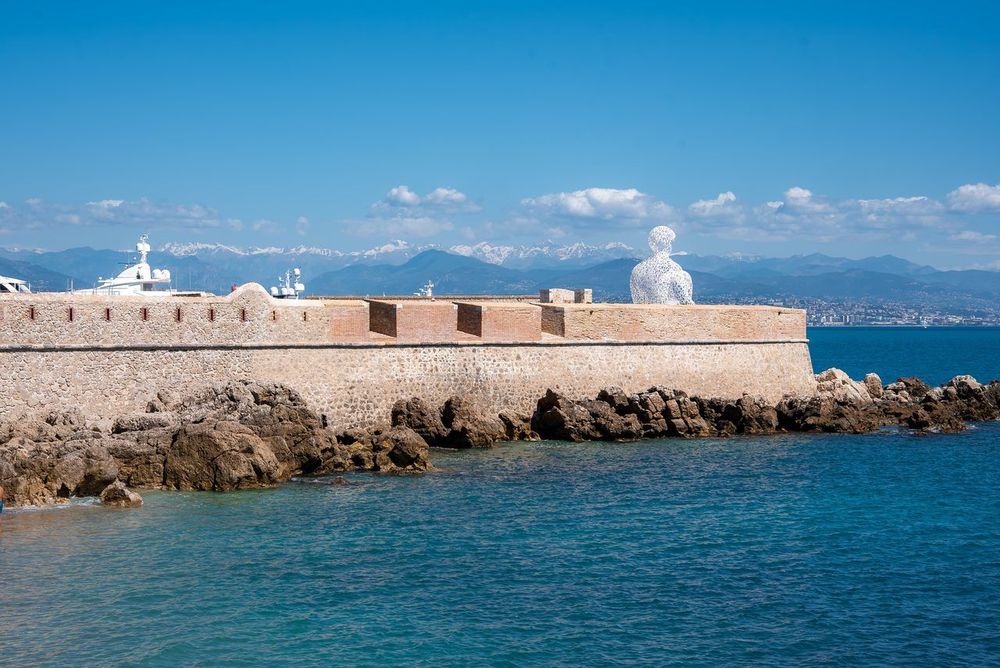
The Bastion Saint-Jaume, a small fortified promontory on the ramparts, serves above all as the pedestal for a work that has become one of the visual symbols of Antibes: Le Nomade (Bastion Saint-Jaume, Boulevard Albert 1er, 06600 Antibes, rated 4.6/5 on Google from 913 reviews), an eight-meter-tall white sculpture designed by the Catalan artist Jaume Plensa, exhibited here from 2007 and permanently installed in 2010. From a distance, it is a seated figure gazing out to sea; up close, you discover that it is made entirely of letters of the alphabet, cut from stainless steel painted white, like a lace of metal.
Access is free, at any hour, which makes it a classic sunset rendezvous: the orange reflections literally pass through the sculpture and cast letter-shaped shadows on the stone. When traveling solo, it is one of the few places in the city where sitting alone for half an hour looking at the horizon never seems out of place, as other visitors are doing exactly the same thing a few meters away.
Allow five minutes on foot from the Picasso Museum along the wall walk: the Bastion lies exactly halfway between the old town and the Port Vauban, on the most photogenic stretch of ramparts on the promenade.
The Fort Carré, Panorama over the Baie des Anges
The Fort Carré (Avenue du 11 Novembre, 06600 Antibes, rated 4.3/5 on Google from 3,308 reviews) overlooks the bay from a rocky outcrop north of the port, about a 20-minute walk from the center. Built in the mid-16th century under Henri II and later reinforced by Vauban, this star-shaped fort with four bastions long served as a prison: Napoleon Bonaparte, then a young officer, was briefly held there in 1794 before being cleared.
The visit must be done with a guide, included in the 5-euro ticket (3 euros at the reduced rate), with departures at 11 am, 2 pm and 4 pm from Tuesday to Sunday. Good news if you are traveling solo: no group reservation is needed, you simply join the next departure. So time your arrival around one of these slots, and expect a short climb up steps in the open air; the fort may also close in bad weather.
The panorama at the top justifies the climb on its own: the Baie des Anges on one side, the rooftops of Old Antibes on the other, and in clear weather, the line of the Alps closing the horizon. It is one of the few viewpoints in the city accessible without a car or technical effort, and one of the places where solo visitors most easily exchange a few words with their fellow group members during the guided tour.
The Cap d'Antibes: The Garoupe Lighthouse and Chapel
The Cap d'Antibes forms a wooded peninsula south of the city, lined with discreet villas and private coves. Its highest point, the Garoupe plateau, brings together two sites that are almost always visited together: the Garoupe lighthouse and the Notre-Dame de la Garoupe chapel (Chemin du Calvaire, 06160 Antibes, rated 4.7/5 on Google from 911 reviews).
The lighthouse, blown up in 1944 and rebuilt in 1948, raises its square tower of about thirty meters at the top of the plateau, one of the highest viewpoints on the Riviera coast: from the esplanade, you can make out the Esterel to the west and the first peaks of the Alpes-Maritimes to the northeast in good weather. The interior cannot be visited, but the esplanade is more than enough to enjoy the view.
Right next door, the chapel houses dozens of ex-votos left by sailors and their families, some dating back to the 17th century: model boats, naive paintings, thank-you plaques after a successful crossing. It is a discreet place of contemplation, often empty on weekdays, where a solo visit naturally takes on a slower pace.
To walk up from the center of Antibes, allow a good hour of walking along the coastline; by bus, line 2 drops you a few minutes from the plateau. Before heading out to the Cap, the Ryo audio guide will already have told you, on the ramparts, the story of this coast that you will then see from above.
Walking the Coastal Path (Tire-Poil Path)
The coastal path (Boulevard de Bacon, 06160 Antibes, rated 4.7/5 on Google from 291 reviews), locally nicknamed the Tire-Poil path, runs along the tip of the Cap d'Antibes from the Garoupe beach to the surroundings of the Villa Eilenroc: about 2.7 kilometers of coastline, and nearly 5 kilometers for the full loop through the interior. Its name comes from the wind that funnels through in places, strong enough to mess up the hair of anyone venturing there on a mistral day, which gives a good idea of the atmosphere of the route: wild, mineral, right at water level.
The terrain alternates between rocky slabs, pine roots and a few staircases cut into the rock. Bring closed shoes, even in summer: flip-flops slip on wet rock and sea urchins are never far from the places where you step into the water. A bottle of water is not superfluous either, as long stretches offer no shade before noon.
For a solo hike, two simple precautions are enough: set out in the morning, when the path is busiest and therefore most reassuring, and check the state of the sea before leaving. The path is occasionally closed by municipal order when the swell is too strong, as some sections pass just a few meters from the waves. These closures are posted at city hall and on site, but rarely announced in advance.
The appeal of the route, beyond the scenery, is that it is almost impossible to get lost: the sea on one side, the marked trail on the other. You regularly meet other walkers, often solo as well, which makes it one of the most naturally sociable activities in the city without ever obliging you to talk to anyone if you prefer silence. Allow 1.5 hours for the coastal stretch alone, two hours for the full loop.
Antibes Beaches for Solo Travelers: Gravette, Ponteil and Salis
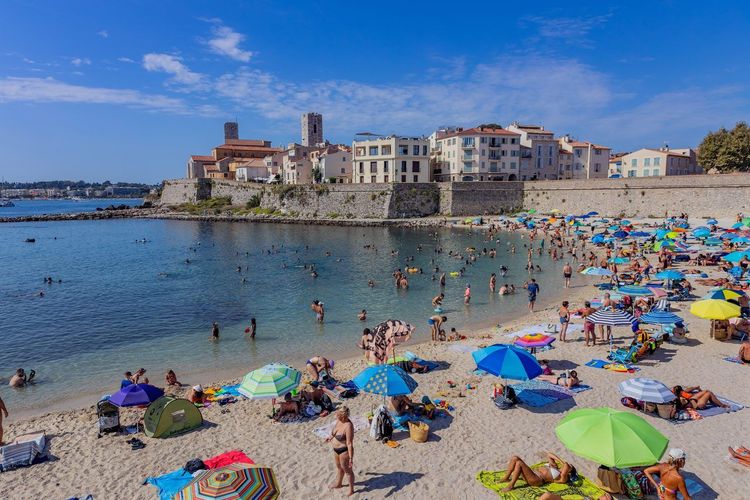
Antibes has three main beaches, close enough to one another that you can try several in the same day.
The Gravette beach, the smallest, is nestled just below the ramparts, a stone's throw from the port. Fine sand, calm water sheltered by the jetty, and a rather local atmosphere: it is often the favorite of residents for a quick swim between two shopping trips at the market.
Leaving the old town toward the south, in the direction of the Cap, the Ponteil beach stretches out facing the ramparts. Larger than the Gravette, shallow and supervised in season, it attracts more families and remains a good compromise for those who want sand without too many people outside July-August.
Just after, separated from the Ponteil by the small Pointe des Pendus, the Salis beach (Avenue de Beaumont, 06160 Antibes, rated 4.8/5 on Google from 4 reviews) unfolds nearly a kilometer of sand facing the Alps, whose snow-capped peaks remain visible until spring in clear weather. Its length makes it possible to find a quiet corner even in high season, and it is from here that you will take the best photo of the ramparts backed by the mountains.
When traveling solo, this variety is a real asset: the Gravette for a quick break in the city center, the Ponteil for a more relaxed afternoon, the Salis for a true nature break with mountain views. To walk from the Ponteil to the Salis without taking out the GPS, simply follow the seafront: the two beaches almost touch. Our selection of the most beautiful beaches in Antibes also details the coves of the Cap.
None of the three beaches requires a reservation: private concessions rent loungers by the day, but most of the sand remains public and free, towel laid out wherever you like. Just remember to arrive before 10 am in July-August if you are aiming for a spot close to the water.
What to Do and Where to Eat Alone in Antibes
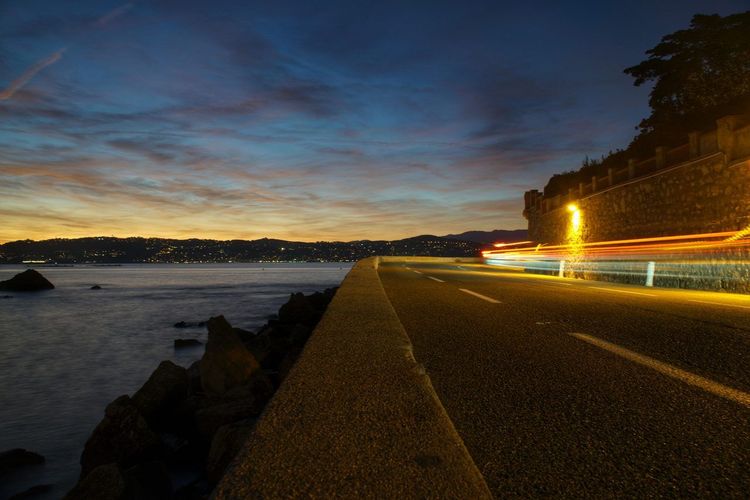
Eating alone should never be a complicated calculation, and Antibes makes things rather easy thanks to a selection of counters and small tables where sitting down solo is the norm, not the exception.
The covered market halls, beneath the structure of the Cours Masséna, house several counters that serve takeaway or on a high stool: Niçoise socca, seafood platters, a glass of local rosé. You eat standing or perched, surrounded by people, which removes any awkwardness about eating without company.
In the lanes around Rue Sade and the Rue de la République, several tapas and wine bars rely on U-shaped counters rather than large tables: you naturally sit among other customers, often themselves alone or in a small group open to conversation. It is a warmer option than a classic restaurant for a solo dinner, and generally cheaper.
For breakfast or a reading break, the terraces overlooking the Port Vauban offer a double advantage: a view of the sailboat masts that keeps your eyes occupied, and a pace of service slow enough that you never feel pressured to give up your table.
As for activities, several Provençal cooking or pottery workshops accept individual registrations, often posted directly at the market or in local tourist offices; it is a simple way to spend two hours in good company without having organized anything in advance. Likewise, guided tours of the market, when they exist, are generally done in small mixed groups, a format that often convinces hesitant solo travelers to sign up on their own.
The Provençal Market, already encountered at the start of the day, deserves a second visit in late morning for food lovers: that is when producers offer tastings of goat cheese or olives, an inexpensive and sociable way to snack without settling anywhere. One last useful tip: ice cream counters and cafés with a view of the port stay open late in summer, which lets you extend the evening without looking for a nightclub, a format that is not always comfortable when solo.
What Walking Itinerary to Follow to Visit Antibes in One Day
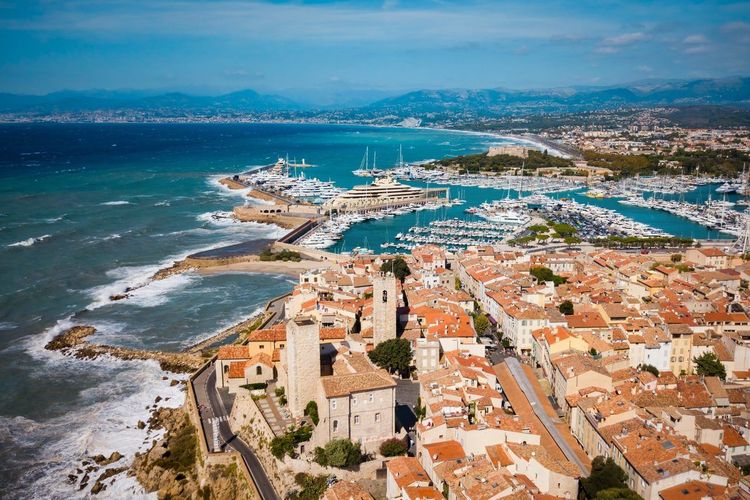
If you only have one day, here is a sequence that revisits the previous sites in a logical order, without unnecessary backtracking.
Start early at the Provençal Market, while it is still buzzing with deliveries and before the midday heat. Then head back along the ramparts to the Picasso Museum and on to the Bastion Saint-Jaume and its sculpture Le Nomade: this stretch, entirely pedestrian, takes a little under an hour to stroll.
Next, head to the Fort Carré, twenty minutes on foot along the port. Allow an hour on site with the guided tour and the climb. For the early afternoon, two options: go straight to one of the central beaches, Gravette or Ponteil, for a swim break, or continue to the Cap d'Antibes for the lighthouse and the Garoupe chapel, by bus or on foot depending on how much energy you have left.
If you would rather not improvise your route, the Ryo audio-guided tour of Antibes covers the heritage part of this program: audio stops that follow one another on foot, with no need to check a map at every intersection. Start it in the morning in the old town, then keep the afternoon for the Cap and swimming.
Those arriving by train for the day from Nice or Cannes will benefit from slightly reversing the order: starting directly at the Fort Carré or the Port Vauban, a stone's throw from the station, before heading up to the market in late morning, when the lanes are already wide awake. The essentials remain the same whatever starting point you choose: alternate heritage stretches, dense with information, with more breathable stretches by the water, to avoid the fatigue that often lurks in overloaded solo visits.
If you have two days rather than just one, it is better to spread things out: old town and museums on the first day, Cap d'Antibes and beaches on the second, keeping some room for the hike on the coastal path, which deserves half a day on its own without rushing.
Where to Sleep and What Budget to Plan for a Solo Stay
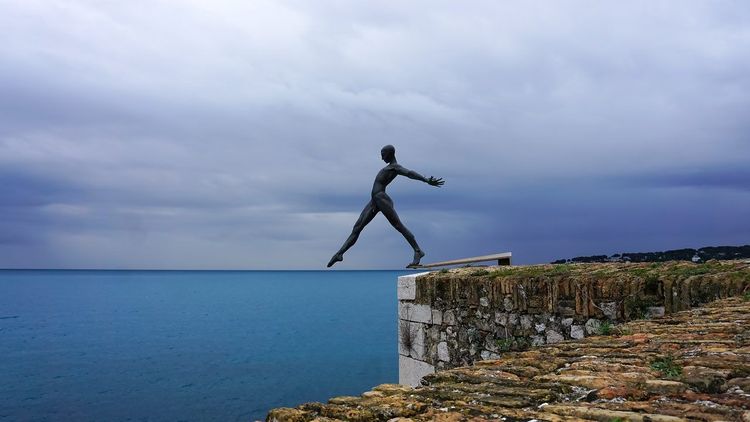
For a solo stay, the choice of neighborhood often matters more than the hotel itself. Two areas stand out: Old Antibes, for sleeping within walking distance of everything described above, and the area around the SNCF train station, ten minutes on foot from the center, convenient if you arrive without a car and plan to head easily back to Nice or Cannes.
As for budget, expect around 70 to 90 euros per night for a decent single room in low season, and more like 120 to 160 euros in July-August, when prices climb sharply across the whole Côte d'Azur. Hostels and budget hotels are mostly found around the station and along Avenue Robert Soleau, a little cheaper than addresses with a view of the port.
One simple tip for solo travel: favor accommodation within walking distance of the center rather than a cheaper but out-of-the-way option. In Antibes, the price difference between the two often remains limited, while the difference in comfort, when returning alone late in the evening, is very real.
If your stay goes beyond one day, the Ryo guide devoted to visiting Antibes in 2 days details a day-by-day breakdown that complements the express itinerary presented here.
Safety, Transport and Best Time to Visit Antibes Alone
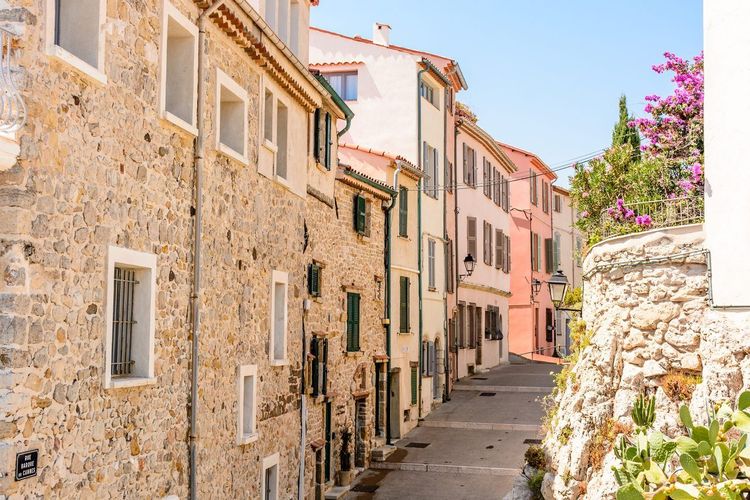
Antibes is easy to reach by train: about 20 minutes from Nice, 15 minutes from Cannes, with trains running several times an hour during the day. The station is ten minutes on foot from Old Antibes, which makes the city perfectly feasible as a day trip, without renting a car.
As for safety, Antibes is among the Côte d'Azur cities generally considered safe for a person on their own, including in the evening in the historic center and around the port, areas that stay lively until late in summer. The precautions remain the classic ones for a tourist city: keep an eye on your belongings on the beaches and at the market, where the crowds also attract a few pickpockets, and avoid isolated stretches of the ramparts or the coastal path once night has fallen, for lack of lighting.
Solo female travelers will also find Antibes rather reassuring compared with other coastal towns: the lanes of the center remain lined with shops and lit until a late hour in season, and the rare late returns are most often made on foot over short distances between restaurant and accommodation. Outside the center, it is still best to keep night walks to the main roads, and save the ramparts or coastal path stretches for daytime.
As for timing, the most comfortable compromise is in May-June or September: pleasant temperatures for walking and swimming, sites less crowded than in midsummer, and the Provençal Market just as lively. July-August bring sometimes oppressive heat for long walks on the coastal path, and more frequent queues at the Fort Carré and the Picasso Museum. Winter, conversely, offers nearly deserted ramparts, but several shops and some water activities close, which somewhat limits the program.



FAQ
What can I see and do in Antibes in a single day?
In one day, you can fit in the Provençal Market, the ramparts, the Picasso Museum, the Bastion Saint-Jaume and its sculpture Le Nomade, then the Fort Carré, before finishing at one of the central beaches or, with a bit of extra energy, at the Garoupe lighthouse. It is packed but doable on foot, especially if you start early in the morning.
What are the must-see places to visit in Antibes?
The must-sees remain the Picasso Museum in the Château Grimaldi, the ramparts and the Provençal Market in Old Antibes, the Fort Carré, the sculpture Le Nomade at the Bastion Saint-Jaume, and on the Cap d'Antibes side, the Garoupe lighthouse and chapel.
What is the nicest neighborhood in Antibes?
The Safranier neighborhood, behind the cathedral, comes up most often in local recommendations: flower-filled pedestrian lanes, small restaurants and a village atmosphere in the heart of the city, less touristy than the Old Town around Rue Sade.
What are the best walking routes for visiting Antibes?
Two routes complement each other well: the Old Antibes loop, which links the ramparts, market, museum and bastion, and the Tire-Poil coastal path around the Cap d'Antibes, which connects the beaches and the Garoupe lighthouse along the coast.
Is it safe to visit Antibes solo?
Yes, overall: the historic center and the port remain lively and well lit in the evening, and the city is visited year-round by solo travelers. The usual precautions mainly apply to isolated stretches of the ramparts or the coastal path after dark.
How much time should I plan to visit Antibes on my own?
One day is enough for the main sights of the center and the Cap. Two days allow you to add the full coastal path hike, an unhurried beach morning, and some time for the museums and solo-friendly workshops at the market.
Antibes proves to be one of the easiest destinations on the Côte d'Azur for solo travel: compact, well marked out by its ramparts, and rich enough to fill an entire day without ever needing company to find your way or feel at home. Between the Provençal Market in the morning, the Fort Carré at midday and the sunset over Le Nomade, the itinerary almost builds itself.
For those who prefer to delegate the route rather than put it together themselves with a map in hand, the Ryo audio-guided tour of Antibes remains the simplest way to rediscover, in order and with the historical context that goes with it, the essentials of what this guide has just detailed.
À lire également