© Shutterstock
 Votre guide Ryo
12 Completely Free Things to Do in Beaune in 2026
In Beaune, the scent of the cellars rises from the cobblestones before you even push open a single door. The capital of Burgundy wine has another, lesser-known side, though: a good part of its heritage can be discovered without opening your wallet. Free activities in Beaune are not limited to window shopping. They include a Romanesque collegiate church with 15th-century tapestries, two courtyards hidden behind old façades, a viewing terrace perched 21 metres above the vineyards, a park where families picnic by the water and a 22-kilometre route winding through the UNESCO-listed climats. To link these places without searching for your way, the Ryo audio-guided tour of Beaune comments on them over a single walk, at your own pace.
Further down you will also find a cinema mural, the Saturday market, what you can see of the Hospices without a ticket and the places where you can taste a wine without booking a tour. Twelve ideas in all, with, for each one, what is genuinely free to access and what remains paid, to avoid unpleasant surprises once you are there.
1. The Collegiate Church of Notre-Dame, the Romanesque Heart of Beaune
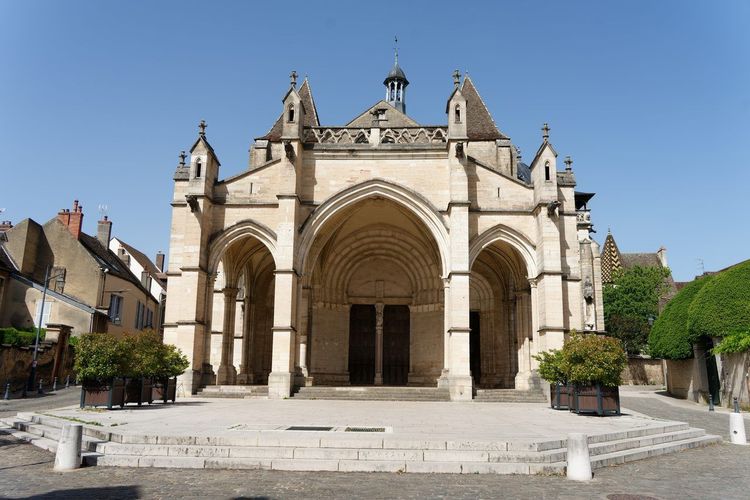
The Collegiate Church of Notre-Dame in Beaune (Place Notre-Dame, 21200 Beaune, rated 4.5/5 on Google from 1,183 reviews) is among the last great Romanesque churches in Burgundy. Begun around 1120 under the influence of Cluny Abbey, it received a Gothic porch and apse over the centuries, then a Renaissance bell tower. Entry to the nave is free, with no ticket or reservation, outside of services.
You will also see it referred to as the Basilica of Notre-Dame in Beaune: it is indeed the same building, and the parish itself uses this title. The real treasure is hidden in the choir. Five 15th-century tapestries tell the life of the Virgin in 21 scenes, based on cartoons commissioned in 1474 from the painter Pierre Spicre. Woven in wool and silk in the "mille fleurs" style, they are displayed during the summer season. Check the dates before coming: out of season, they are put away for safekeeping.
Take the time to walk around the exterior along the lanes that run beside the chevet: the view of the apse and its flying buttresses is more interesting there than from the square in front. In the morning, the nave is calm and light enters through the high windows, the best time to observe the carved capitals without meeting groups. Those who love details will spot 15th-century wall paintings in the side chapels, partly faded but still legible. The collegiate church is a stone's throw from Place Carnot: if you come on a Saturday, combine it with the market. During Mass, visits are made in silence, and appropriate dress is expected.
The collegiate church is also one of the landmarks of the Ryo audio-guided tour of Beaune: by listening to the stop dedicated to it, you understand on the spot the transition from Romanesque to Gothic, before heading off to the rest of the historic centre.
2. The Secret Courtyards of the Historic Mansions in the City Centre
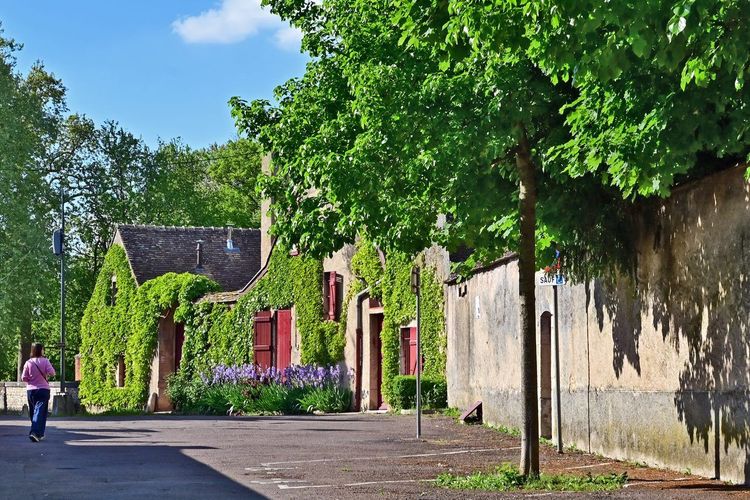
Beaune hides several courtyards that you can enter freely, and most visitors walk past without suspecting it. The most famous is that of the former Hôtel des Ducs de Bourgogne, which houses the Musée du Vin de Bourgogne. The museum is paid, but the shaded courtyard reveals the half-timbered façades of the ducal mansion and a collection of old wine presses, visible from the outside. The tourist office even recommends it for a picnic in the shade of the trees.
Less well known, the courtyard of the Bibliothèque municipale Gaspard Monge (11 Place Marey, 21200 Beaune, rated 4.4/5 on Google from 23 reviews) occupies the former Minims convent. There you will find a pond full of fish and a statue of Étienne-Jules Marey, the Beaune-born physiologist and pioneer of chronophotography, a forerunner of cinema. The library is named after Gaspard Monge, a mathematician born in Beaune in 1746 and the founder of descriptive geometry. Consulting books, comics and magazines on site is open to all, a welcome break on a rainy day.
The two courtyards are only a few minutes' walk from each other. For this kind of stroll among private mansions and wine merchants' houses, the Ryo audio-guided sub-tour Between Stones and Grands Crus offers 19 audio stops over 2.5 km, or about an hour's walk in the old town.
3. The Grande Vadrouille Mural, a Nod to Cinema
On a wall of Place du Docteur Jorrot, near the Saint-Jean rampart, the Fresque de la Grande Vadrouille (Place du Docteur Jorrot, 21200 Beaune, rated 4.4/5 on Google from 76 reviews) pays tribute to Gérard Oury's 1966 film starring Bourvil and Louis de Funès. The link with Beaune is far from trivial: several scenes of the film were shot at the Hospices de Beaune, and the town has retained a lasting affection for it.
The painting reproduces the faces of the two actors and a scene featuring the director. It can be viewed at any hour, without a ticket. Allow five minutes, a little more if you are looking for the perfect angle for a photo. At the end of the day, the low light brings the colours to life.
4. The Maison des Climats, Understanding the Grands Crus Before Tasting Them
Before heading into the cellars, make a detour to the Maison des Climats (6 Boulevard Perpreuil, 21200 Beaune, rated 4.5/5 on Google from 91 reviews). This exhibition space, open since 2015, explains what makes the Burgundy vineyards so unique, and admission costs nothing.
The centrepiece is a 9-metre-long model of the vineyard, which you explore in augmented reality using tablets. Explanatory panels and an introductory video complete the visit. The word "climat" here refers to a precisely delimited vineyard plot, sometimes only a few ares in size, whose soil, slope and exposure give the wine its character. The Climats of the Burgundy vineyards were inscribed on the UNESCO World Heritage List in 2015, with more than 1,200 plots spread between Dijon and the Maranges.
Allow a short half hour. With children, the interactive model holds their attention far better than a panel. You will come out with the keys to reading a label: village appellation, premier cru, grand cru. When you resume your walk, the Ryo audio-guided tour of Beaune helps you link these notions to the streets and wine merchants' houses of the centre.
5. Parks for Relaxing: Square des Lions and Parc de la Bouzaize
The Square des Lions occupies part of the old moats that once surrounded the old town. This 7,500 m² garden, laid out in the 19th century, becomes the meeting point for Beaune's pétanque players in fine weather. Its shaded benches make it an ideal stop between two visits.
Bring your boules if you have them: games are readily improvised in the late afternoon, and it is one of the few places in the centre where you meet more locals than tourists.
To the north-west of the centre, the Parc de la Bouzaize (Avenue du Parc, 21200 Beaune, rated 4.5/5 on Google from 2,838 reviews), sometimes spelled Parc de la Bouzaise, stretches around a lake fed by the river of the same name. Laid out in the late 19th century in a landscape style, it is the favourite green lung of the people of Beaune: lawns, tall trees, ducks and swans on the water.
Families picnic there at the weekend, enjoy the playground and watch the birds. The flat paths suit strollers. For walkers, trail no. 12, marked in yellow, leaves the park for the heights, where the view opens onto the rooftops of the town. Only the boat rental, offered in season, is paid. More ideas for children await you in our guide to visiting Beaune with family.
6. Walking or Running on the Voie des Vignes
The Voie des Vignes links Beaune to Santenay over about 22 kilometres, passing through the most renowned villages of the Côte de Beaune: Pommard, Volnay, Meursault, Puligny-Montrachet and Chassagne-Montrachet. The Beaune starting point is at the Porte des Avaux, south of the old town.
The route follows small roads and vineyard tracks, with a few sections shared with residents and farm vehicles. The cumulative elevation gain remains modest, around 220 metres over the whole route, which makes it a popular terrain for family cyclists and runners alike. After Santenay, the route continues towards Nolay on a former railway line converted into a greenway.
For a short outing, Pommard can be reached in under an hour's walk from Beaune. Meursault, about 8 kilometres away, requires a good half-day round trip on foot, or a leisurely hour by bike. No bike? Several rental shops in the centre offer classic or electric models by the day, the only possible expense of this outing. Shade is rare among the vines: in summer, set off early, with water and a hat. During the grape harvest in September, stay alert for tractors and teams of pickers occupying the paths.
In every village, the estate signs and dry-stone walls remind you that you are walking among classified plots. The names of Volnay or Meursault take on a different flavour once you have seen their hillsides up close.
7. Strolling Through the Beaune Market
The Beaune market (Place Carnot, 21200 Beaune, rated 4.3/5 on Google from 99 reviews) takes place on Saturday morning, on Place Carnot and under the covered market, with a more modest session on Wednesday morning. Cheesemongers, market gardeners, butchers and producers from the Côte-d'Or set up their stalls early and pack up around midday. On Wednesdays, the offering narrows to food: fewer stalls, but a more local atmosphere, conducive to chatting with producers.
The atmosphere counts as much as the products. Some producers let you taste their cheese, gingerbread or blackcurrant cream with no obligation to buy, and you often leave with a recipe or an address picked up between two stalls. Look out for époisses, the washed-rind cheese emblematic of the region, and mustard, another Burgundian pride.
Come before 10 a.m. on summer Saturdays to avoid the crowds, and bring a cloth bag. The market is also the best place to put together a takeaway picnic for the Square des Lions or the Parc de la Bouzaize.
8. The Viewing Terrace of the Cité des Climats et Vins de Bourgogne
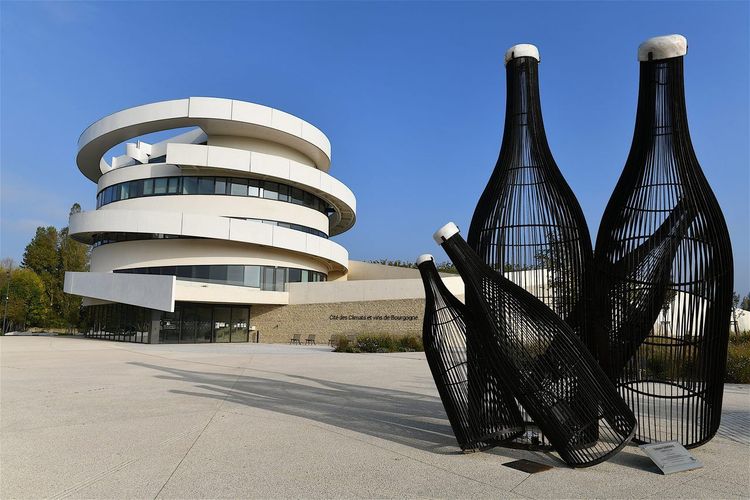
Opened in 2023 in the Parc de la Chartreuse, the Cité des Climats et vins de Bourgogne (21 Avenue Charles de Gaulle, 21200 Beaune, rated 4.4/5 on Google from 931 reviews) charges admission for its exhibition tour. Its viewing terrace, however, remains freely accessible.
Perched on the 5th floor, 21 metres high, this rooftop terrace is reached by an outdoor spiral ramp. Once at the top, the view takes in the vineyards of the Côte and the Hautes-Côtes, with the rooftops of Beaune in the foreground. The building itself, whose silhouette is inspired by a vine tendril, is worth a look.
On-site parking is free, and a shuttle links Place Carnot to the Cité. Go up in the late afternoon, when the low light picks out every row of vines.
9. Tasting Wine Without Breaking the Bank
Beaune has an impressive number of wine merchants' houses and cellars. You still need to distinguish paid tours from the glasses handed to you without asking for anything.
The Big Wine Houses and the City-Centre Wine Shops
Let's be clear: tours of the big wine houses are paid. At Patriarche Père & Fils (7 Rue du Collège, 21200 Beaune, rated 4.2/5 on Google from 1,857 reviews), housed in the former Visitandines convent, the self-guided tour of the largest cellars in Burgundy with tasting costs €25 per person in 2026. The same principle applies to most historic houses that open their underground galleries.
Free tastings do exist, though, on a smaller scale. Some wine shops and wine merchants in the centre let you taste one or two wines at the counter when you are hesitating over a purchase, without charging for the glass. It is never a right, rather a commercial gesture: simply ask politely.
The Wine Estates at the Gates of Beaune
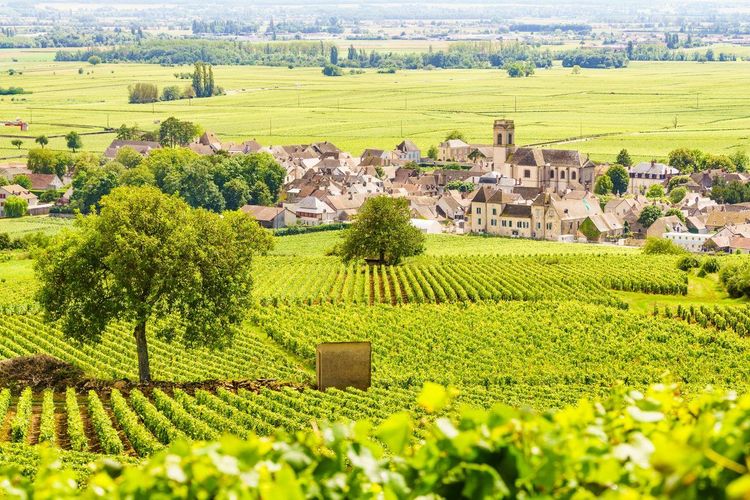
It is in the neighbouring villages that cellar-door tastings without charge remain most common. In Pommard, Volnay, Savigny-lès-Beaune or Meursault, many family estates welcome visitors to their cellar and let them taste a few cuvées, hoping for an order without requiring one. Call ahead the day before, especially at weekends and during the grape harvest, when winemakers are out in the vines.
The unwritten rule: say right away that you are there to discover, and do not feel obliged to buy. Most winemakers prefer frankness to an awkward moment at the end of a tasting. For a self-guided outing, combine this tour of cellars with the Voie des Vignes by bike: the estates of Pommard and Meursault lie directly on the route. If you are driving or cycling, do as the professionals do and use the spittoon. To arrive at the cellar with a bit of vocabulary, the Ryo audio tour Between Stones and Grands Crus tells, in an hour's walk, the links between the town, its merchants and its vines.
10. The Hospices de Beaune Seen from Outside: What You Can See Without a Ticket
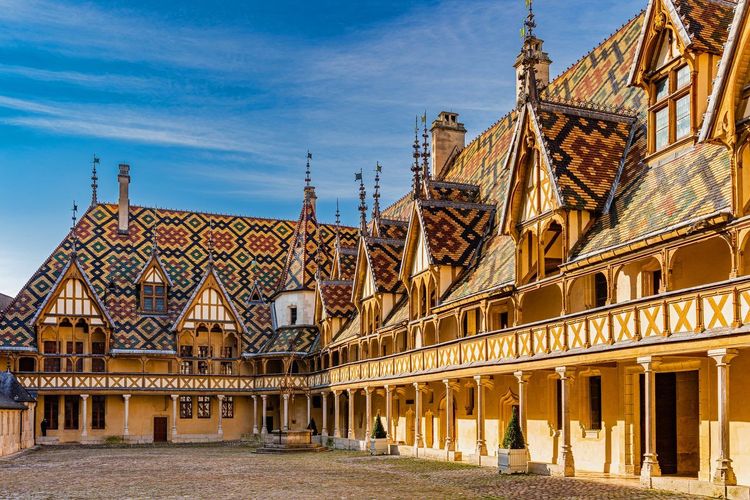
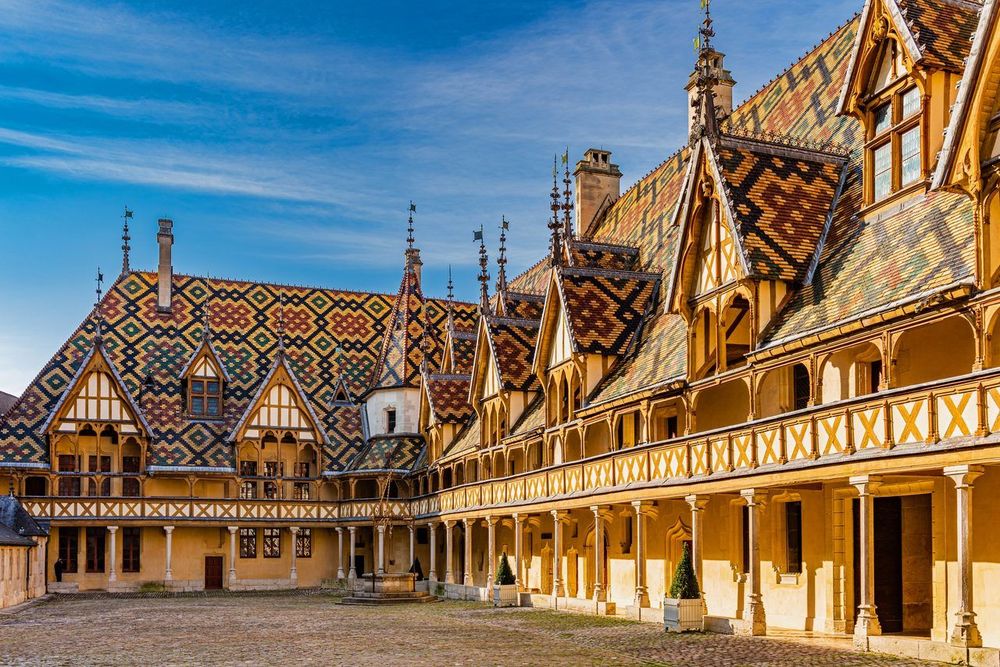
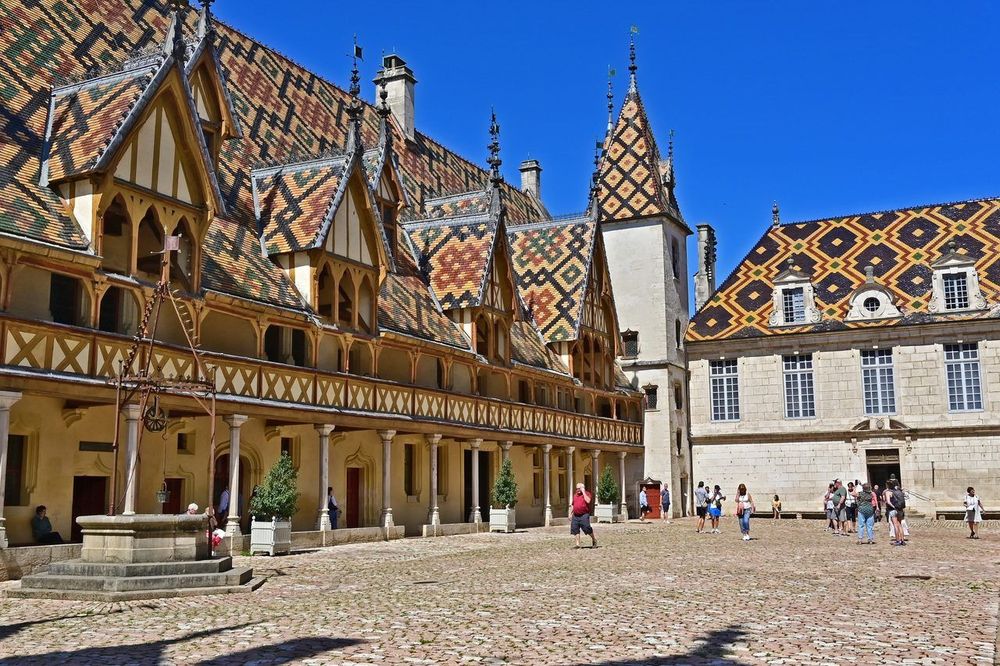
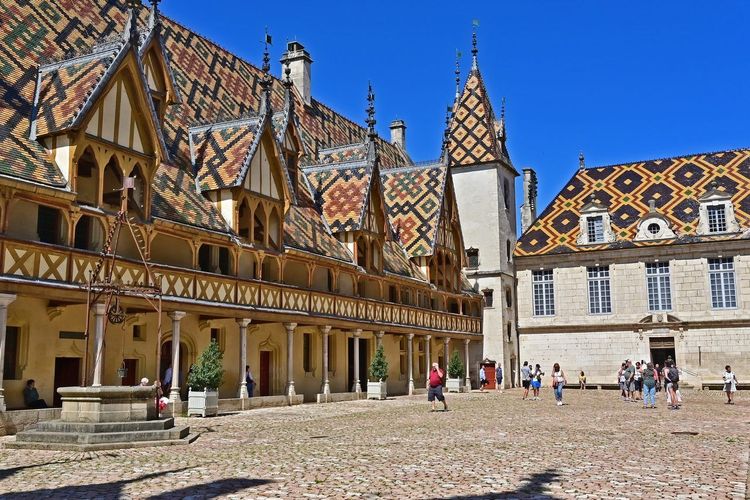
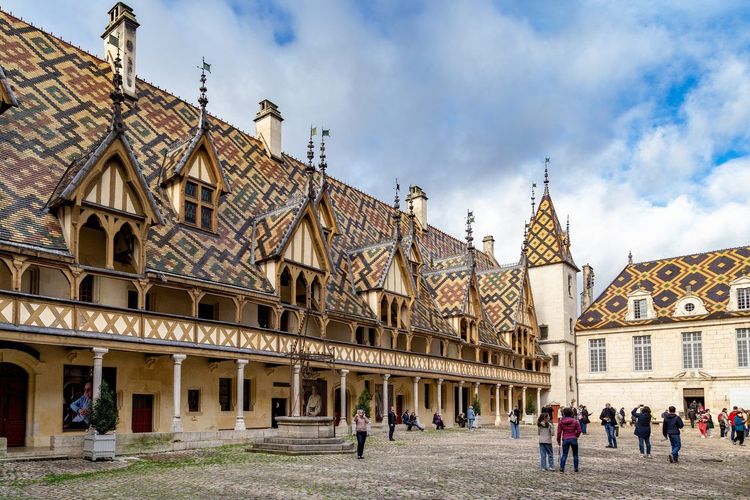
The Hospices de Beaune, or Hôtel-Dieu (Rue de l'Hôtel Dieu, 21200 Beaune), were founded in 1443 by Nicolas Rolin, chancellor to the Duke of Burgundy Philip the Good, and his wife Guigone de Salins. Their glazed-tile roofs with geometric patterns have become the symbol of Burgundy.
A detail that few guides mention: these famous polychrome roofs are mainly visible from the main courtyard, and therefore after the ticket office. From the street, you see the stone façade, its large slate roof bristling with dormer windows and pinnacles, and the Gothic canopy sheltering the entrance. It is sober, almost austere, a deliberate contrast between the street and the interior.
Step back from Place de la Halle, just opposite: it is the best spot to frame the entire façade. In the morning, before the groups arrive, the square is almost empty and the stone takes on a golden hue.
The paid visit opens the Grande Salle des Pôvres, the kitchen, the apothecary and Rogier van der Weyden's Last Judgment altarpiece. If your budget is tight, the façade and the square facing it are enough for a photo and a first impression. But if you were to pay for only one admission in Beaune, this would probably be it.
11. Free Events You Shouldn't Miss
Beyond the permanent sites, Beaune schedules several events open to all. Dates change every year: check the tourist office's calendar before you leave.
The Wine Auction and the City Centre Highlights
The big moment of the year remains the Hospices de Beaune Wine Auction, the most famous charity wine auction in the world. Its 166th edition takes place on the weekend of 14 and 15 November 2026. While the auctions and major tastings are paid, the atmosphere in the streets, the entertainment and the buzz around the covered market can be enjoyed without a ticket. Book your accommodation very early: the town is fully booked.
In September, the European Heritage Days open places that are usually closed or paid. In August, the Nuit des étoiles, held every year across France, features stargazing sessions run by astronomy clubs, away from the city lights.
Events at the Cité des Climats
Open all year round, the Cité des Climats et vins de Bourgogne regularly schedules evenings, talks and special days, some of them free, such as the festivities organised for its third anniversary in 2026. The calendar is confirmed a few weeks in advance on its website.
12. Practical Information: Access, Parking and Surrounding Villages
Getting Around and Parking in Beaune
The historic centre, enclosed by its ramparts and boulevards, can be explored entirely on foot: most of the places in this article are within fifteen minutes' walk of each other. The train station is about ten minutes' walk from the centre, with direct trains from Dijon in about twenty minutes, as well as from Lyon.
If you are driving, it is better to aim for the outside of the boulevards. The simplest solution remains the Cité des Climats car park, which is free and from which the shuttle reaches Place Carnot. Inside the ramparts, spaces are often paid during the day.
Once parked, walk around the old town along the boulevards that follow the ramparts. This enclosure, among the best preserved in Burgundy, unfolds about two kilometres of walls, bastions and towers, some of them converted into cellars or private gardens. The loop takes about forty minutes, ideal for digesting a picnic.
Excursions and Nearby Villages
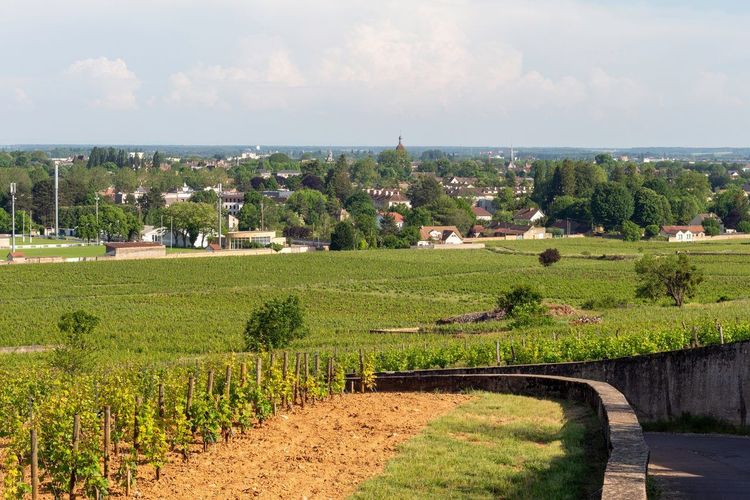
The wine villages around Beaune, Pommard, Volnay, Meursault, Savigny-lès-Beaune or Aloxe-Corton, can be visited freely: their streets, churches and viewpoints over the vines are open to all. To the north-west, the Montagne de Beaune offers a wide panorama over the town and the plain, accessible on foot from the Parc de la Bouzaize.
The best season for these outings remains spring and early autumn, when the vines change colour and the village terraces are less crowded. To go further, our selection of what to see around Beaune details the sites within an hour's drive.



FAQ
Is a visit to the Hospices de Beaune paid?
Yes, visiting the inside of the Hôtel-Dieu requires a ticket. From the street, you can admire the façade, the Gothic canopy and the large slate roof. The polychrome roofs are mainly visible from the main courtyard, after the ticket office.
Can you taste wine for free in Beaune?
Yes, but not everywhere. Cellar tours at the big wine houses are paid (€25 at Patriarche in 2026). However, some wine shops in the centre and many estates in the neighbouring villages let you taste a few wines without charging, hoping for a purchase without requiring one.
Where can you easily park in Beaune?
Parking at the Cité des Climats et vins de Bourgogne is free, and a shuttle connects it to Place Carnot. Inside the boulevards, parking is often paid during the day.
What is the best season to discover Beaune without spending money?
Spring and early autumn offer the best compromise: colourful vines, fewer crowds and pleasant temperatures for walking the Voie des Vignes. Summer has the advantage of the tapestries on display at the collegiate church, and November the atmosphere of the Wine Auction.
How much time should you plan to visit Beaune on a small budget?
One full day is enough to take in the collegiate church, the two courtyards, the mural, the Maison des Climats, the viewing terrace and a stop at the market. Add half a day to walk the Voie des Vignes to Pommard or Meursault.
Is Beaune's market paid?
No, access to the market is completely free, whether you want to stroll among the stalls or taste the products offered by some producers. There is no obligation to buy with these tastings.
Conclusion
Beaune can be discovered without opening your wallet, as long as you know where to look: a Romanesque collegiate church and its summer tapestries, two courtyards hidden behind old façades, a cinema mural, a viewing terrace above the vines and kilometres of paths among the classified climats. The paid sites, the Hospices first among them, keep all their appeal, but a good half of the town remains accessible to all, from morning to night. Well chosen, free activities in Beaune easily fill an entire day, even a weekend.
To move from the collegiate church to the historic courtyards and then the parks without wasting time looking for your route, the Ryo audio-guided tour of Beaune accompanies you at your own pace, with no group or fixed schedule, and a story to listen to at every stop.
À lire également