© Shutterstock
 Votre guide Ryo
Perched Castles in Auvergne-Rhône-Alpes: 12 Breathtaking Fortresses (2026)
Set on basalt dykes or rocky spurs carved by rivers, the castles of Auvergne-Rhône-Alpes belong to an entirely different tradition from the palatial châteaux of the Loire. Here, stone does not seek to seduce: it defends, dominates, and watches. Twelve edifices traverse the centuries with total audacity — medieval fortresses braced against volcanic flows, keeps clinging to the gorges of the Loire, Renaissance manor houses discovered around a bend in a chestnut forest. To explore the region's cities on foot and understand the historical context that gave rise to these fortresses, the Ryo audio guide of Lyon offers an excellent entry point: the regional capital was itself shaped by centuries of feudal conflict.
This guide takes you from the Puy-de-Dôme to Haute-Savoie, from the Loire to the Dauphiné. You will discover a castle still inhabited by its owners for seven centuries, ruins commanding the entire Rhône valley from their limestone spur, a manor house whose frescoes depict scenes of daily life in 1430, and a fortress said to have inspired the castle of Sleeping Beauty. Allow a week to visit them all, or several targeted weekends by geographical area.
Château de Murol: the Volcanic Fortress of the Puy-de-Dôme
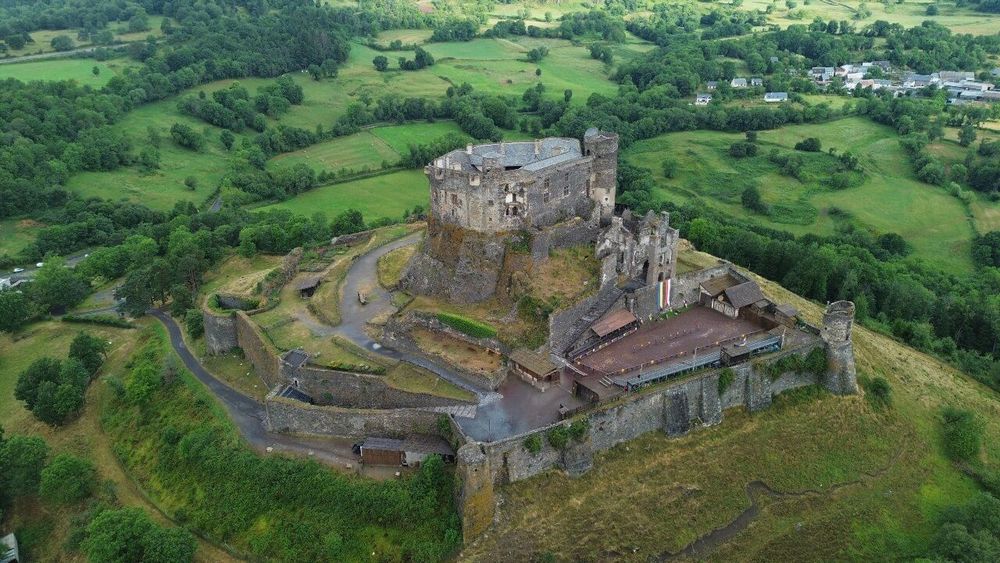
It is hard to find a more theatrically positioned castle than the château de Murol (Place du Château, 63790 Murol, rated 4.6/5 on Google from 10,129 reviews). Perched on a trachyte cone at an altitude of 806 metres in the heart of the Parc naturel régional des Volcans d'Auvergne, the edifice has dominated the meadows of the val d'Isoire since the 13th century. The volcanic rock itself is part of the architecture: the walls incorporate the raw basalt of the mountain without transition, making it difficult to distinguish the natural from the constructed from a distance.
Construction dates back to the 12th century, but it was in the 14th century that Guillaume de Murol gave the fortress the appearance it retains today. A central keep surrounded by a double enclosure, flanked by round towers offering 360-degree firing angles. The defensive strategy is legible in every stone: arrow slits, machicolations, elevated wall walks. Few castles in France allow the medieval military logic to be grasped so clearly without the mediation of an artificial reconstruction.
The walk up from the village takes about twenty minutes along a steadily sloping path. At the top, the view encompasses the Sancy massif to the south-west, the Cézallier plateau to the east, and on a clear day, the first foothills of the Cantal. The owning association manages the site with care. In July and August, historical costumed performances bring daily life in a medieval fortress to life: archery, blacksmithing demonstrations, and falconry. Actors embody the castle's inhabitants and interact with visitors while staying in character.
Out of season, the castle remains open but without the performances, which has the advantage of keeping tourist coaches away. The September light, raking across the golden trachyte, more than compensates for the absence of spectacle. The entrance fee is around 11 euros for adults, with free entry for children under 10. Murol is located 36 kilometres south of Clermont-Ferrand via the D978. There is no direct public transport from Clermont: a vehicle is necessary. If you are staying in the area, lac Chambon 2 kilometres away makes a natural swimming stop after the visit.
Château d'Anjony: Seven Centuries in the Same Family (Cantal)
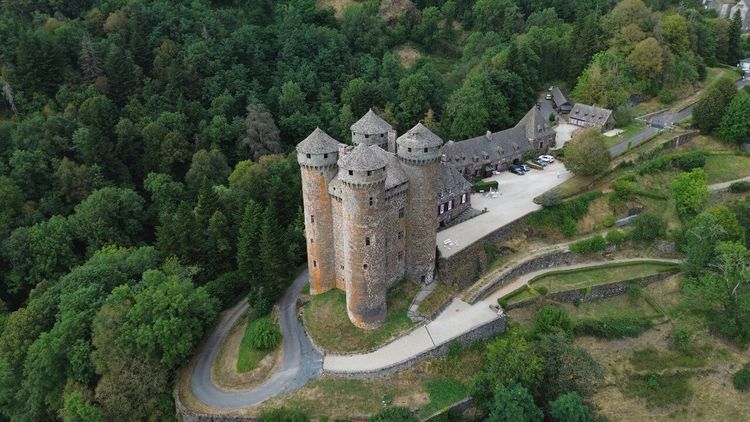
In Tournemire, in the gorges of the Doire, stands one of the best-preserved castles in the Massif Central. The château d'Anjony (Tournemire, 15340 Tournemire, rated 4.5/5 on Google from 1,033 reviews) has belonged to only one family since its construction in 1439: first the Turenne, then the Lecomte d'Anjony by marriage. This exceptional dynastic continuity explains the condition of its interior rooms, never vandalised, never expensively remodelled by owners eager for modernity.
The castle consists of four towers connected by residential wings, whose slender silhouette can be spotted from several kilometres away as you approach through the valley. What holds the attention inside are the frescoes on the first floor, dated to 1535. One cycle depicts the Nine Worthies — the nine greatest warriors in history according to medieval tradition — painted with a precision of detail that documents the clothing fashions and weaponry of the Renaissance. In the adjoining chapel, scenes from the life of Christ were painted with a realism remarkable for the period. The colours have never been restored. They have remained intact thanks to the regular humidity of the gorges and the darkness preserved by small, narrow windows.
The visit is guided. The current owner sometimes leads the explanations herself — a rare encounter not easily forgotten. To reach Anjony, allow 45 minutes from Aurillac along winding mountain roads. The castle is open from Easter to All Saints' Day.
Château de Polignac: the Basaltic Vertigo of Haute-Loire
Just 5 kilometres from Le Puy-en-Velay, the château de Polignac (Route du Château, 43000 Polignac, rated 4.6/5 on Google from 3,030 reviews) sits atop a basaltic pinnacle 80 metres high. This volcanic dyke, shaped by erosion over millions of years, was transformed by the lords of Polignac into a natural stronghold. The view from the summit is vertiginous: below, the village houses appear tiny; in the distance, the Velay plateau stretches to the first ridges of the Ardèche.
The Polignac family was one of the most influential in the French nobility. It gave Louis XVI his last favourite, the Duchess de Polignac, governess to the royal children and intimate friend of Marie-Antoinette. The castle is largely in ruins following the Wars of Religion, but the surviving remains — including the 11th-century keep and the 14th-century enclosure — retain an imposing presence. The climb from the village takes about ten minutes. Expect around 6 euros for adult admission, with reduced rates for children; the site is visited freely, brochure in hand, along a marked trail with around fifteen points of interest.
Château de la Roche: Suspended above the Gorges of the Loire
An hour's drive from Roanne, the Loire gorges carve between Belmont-de-la-Loire and Saint-Just-Saint-Rambert a landscape that few travellers know. It is in this setting that the château de la Roche (Saint-Priest-la-Roche, 42590 Saint-Priest-la-Roche, rated 4.6/5 on Google from 3,327 reviews) stands, in Saint-Priest-la-Roche: a 13th-century edifice perched directly above the river, accessible only by a suspension bridge when the waters are high.
The history of the castle is inseparable from that of the Loire. Built to monitor the passage of boats and collect toll rights, it has come close to disappearing several times. First during the Wars of Religion. Then when the filling of the lac de Villerest in 1984 flooded the foot of the cliff. Today, the castle emerges partially from the water depending on the lake's level, giving it, depending on the season, the appearance of an almost unreal lake castle. The spectacle is even more striking in autumn, when morning mist wraps the gorges in a low blanket of cotton.
The interior visit reveals soberly furnished rooms, but the mullioned windows frame the Loire like living paintings. The wall walk offers the best view over the gorges. Allow about an hour to explore the entire castle, plus time for the boat crossing if the lake level makes it necessary.
For visitors passing through Roanne, the Ryo audio guide of Roanne covers the city's textile and industrial heritage, a natural complement to the medieval dimension of these gorges and the castles that once guarded them.
Practical info: open from April to September. 5 euros adult admission, 3 euros for children.
Château de la Bâtie d'Urfé: the Renaissance on the Banks of the Lignon
Some 60 kilometres south of Roanne, the château de la Bâtie d'Urfé (Route de la Bâtie, 42130 Saint-Étienne-le-Molard, rated 4.5/5 on Google from 1,000 reviews) is a curiosity in a département known for its austere medieval fortresses. This edifice introduces the Italian forms of the Renaissance with a sophistication one would not expect here. Its grotto — an artificial cave adorned with shells, mosaics, and mythological figures — is one of the finest in France.
Claude d'Urfé, ambassador of François I to the Council of Trent, brought back from Italy not only art objects but a conception of architecture as a place of intellectual pleasure. His castle, begun around 1535, is a demonstration of this. The chapel contains Italian marbles, the entrance gallery is adorned with antique busts — some of them originals — and the formal French garden, reconstructed in the 20th century, engages elegantly with the surrounding wooded park.
Owned by the département of the Loire, the castle hosts temporary exhibitions in season. Open from March to November.
Château de Bouthéon: the Sentinel of the Forez Plain
A few kilometres north of Saint-Étienne, on a rocky spur dominating the Forez plain, the château de Bouthéon (Route du Château, 42160 Andrézieux-Bouthéon, rated 4.3/5 on Google from 781 reviews) has watched over the valley since the 11th century. It is not the best-known castle in the region, but its panorama over the Monts du Forez to the west and over the plain as far as the Pilat to the east is one of the most complete in the département.
Today owned by the Conseil Général de la Loire, the castle houses a hotel-restaurant within its 15th-century buildings — a rare opportunity to spend the night in an authentic medieval castle. The restaurant showcases Forez produce: local cheeses, regional charcuterie, and wines from the côtes du Forez. Saint-Étienne, a quarter of an hour away, deserves a stop for its industrial and creative heritage, which is far more nuanced than its reputation as a former mining city might suggest.
Château de Vizille: Where the French Revolution Began (Isère)
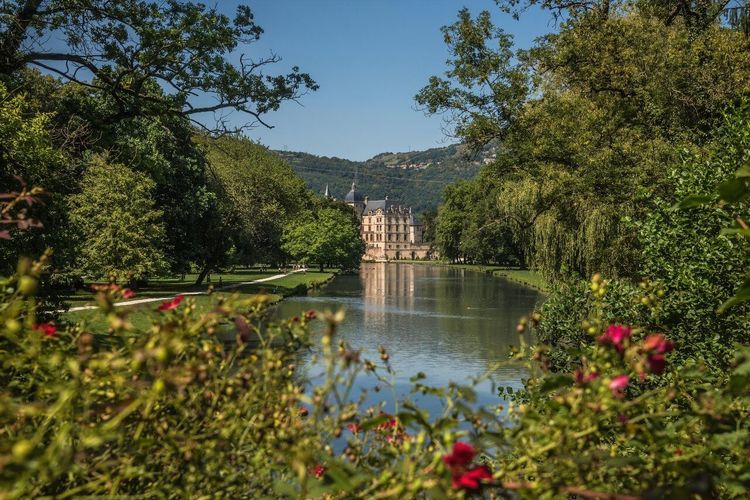
Most guides omit a crucial fact. The French Revolution did not begin in Paris in July 1789. It began in Vizille, in Isère, on 21 July 1788, when representatives of the three estates of the Dauphiné met illegally in this castle to sign the 'Declaration of the Dauphiné People'. The events in Paris a year later merely amplified a movement that had begun here, in the provinces, in a seigneurial residence in the Alps.
The castle itself is a 17th-century construction, less dramatically perched than the medieval fortresses in this guide, but of uncommon architectural scale. The keep of the constable de Lesdiguières has been preserved and integrated into the main building, whose classical façade overlooks a vast park — one of the largest public parks in Isère.
This park deserves particular attention. Home to deer, fallow deer, and mouflon roaming semi-freely, it extends over more than 100 hectares around the castle. Families with children spend entire afternoons here. In autumn, the rutting stags make the park particularly lively, with bellowing that echoes through the forest from dawn.
The Musée de la Révolution française, housed in the castle's rooms, is one of the most comprehensive collections on the period: period paintings, furniture from the Terror, revolutionary objects, satirical engravings. The museum visit alone takes a good two hours; with the park, allow a full half-day. Vizille is located 18 kilometres from Grenoble via the RN85, the Route Napoléon. Entry to the departmental museum is free, and the park also remains open and free all year round.
Château du Touvet: Suspended Terraces Facing Belledonne
Less well known than Vizille but more visually spectacular, the château du Touvet (Domaine du Touvet, 38660 Le Touvet, rated 4.3/5 on Google from 802 reviews) stands in Isère on the mid-slope of the Grésivaudan valley, with the Belledonne ridgeline as a permanent backdrop. Its main asset: Italian-style terraced gardens, carved into the hillside in the 18th century, descending towards the valley through a series of cascades, fountains, and geometric flowerbeds.
The castle is inhabited by its owners, descendants of the same family since the 18th century. This continuity is felt throughout the visit: the apartments retain their period furniture, the libraries their original books, and the portraits their original positions in the corridors. You have the feeling of entering a private home rather than a reconstructed museum.
The gardens can be visited separately from the castle: you can walk through them without visiting the interior. In spring, wisteria cascades over the balustrades. In summer, the fountain waters provide welcome coolness. In autumn, chestnut leaves carpet the terraces in gold. Open from April to October. The guided tour of the apartments lasts 45 minutes. Back in Lyon, the short version of our audio walking tour loops the two hills in 18 stops and 3.8 km.
Château de Menthon-Saint-Bernard: Sleeping Beauty Is Real (Haute-Savoie)
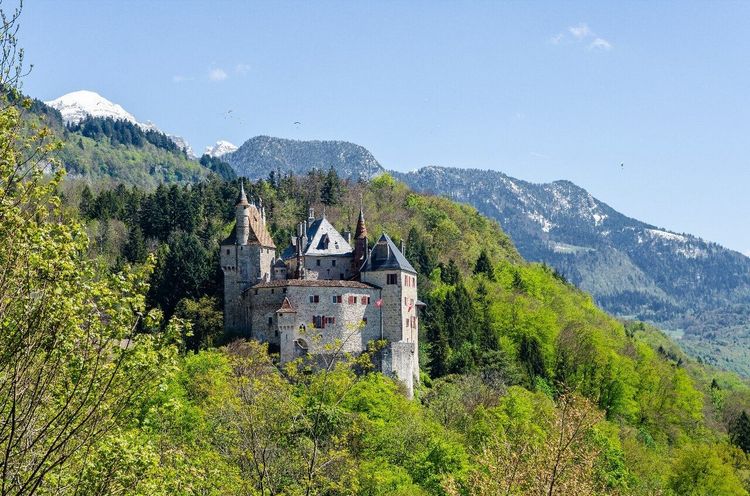
Dominating the lake of Annecy from its promontory 200 metres above the water, the château de Menthon-Saint-Bernard (Route du Château, 74290 Menthon-Saint-Bernard, rated 4.5/5 on Google from 5,937 reviews) is undoubtedly the most photographed castle in the French Alps. Its silhouette is the stuff of fairy tales: round towers topped with pepper-pot roofs, a Gothic façade opened by tall windows, reflections in the lake at dawn. Charles Perrault, who travelled in Savoy, is said to have found here the inspiration for his Sleeping Beauty. The de Menthon family claims this origin with quiet pride.
The castle's history is as romantic as its silhouette. The de Menthon family claims an uninterrupted presence within these walls since the Middle Ages, one of the longest family continuities in France. Saint Bernard de Menthon, founder of the famous Grand-Saint-Bernard hospices in the Alps, is said by tradition to have been born here around the year 1000. The ground-floor and first-floor apartments preserve medieval and Renaissance furnishings of rare quality: carved chests, Flemish tapestries, and armour in perfect condition.
The walk up from the village takes 20 to 30 minutes along a shaded forest path. By car, a narrow secondary road allows you to get close to a small car park. The view from the ramparts over the lake of Annecy, the Aravis and Bauges massifs is among the finest in Haute-Savoie. To explore Annecy and its surroundings on foot before or after visiting the castle, the Ryo audio guide La Venise des Alpes covers the 20 main points of interest in the old town centre in one hour of walking.
The castle is open from April to November. Expect 12 euros for adult admission, or 3 euros for the gardens and terraces only.
Château de Montrottier: the Essence of the Middle Ages Facing the Parmelan
Some 12 kilometres from Annecy towards Bonneville, the château de Montrottier (Lovagny, 74210 Lovagny, rated 4.5/5 on Google from 2,796 reviews) stands on a rocky promontory overlooking the gorges of the Fier. Less glamorous than Menthon but more austere in the best sense of the word: this is a medieval castle that never sought to charm, only to hold.
Built between the 12th and 15th centuries, it houses a collection of armour, medals, and Oriental objects assembled by its last private owner, Léon Marès, in the 19th century. The main tower, standing 36 metres tall, offers a panorama over the Parmelan, the Aravis, and on a clear day, Mont-Blanc. The gorges of the Fier lie directly below: a paid path allows you to cross them immediately after visiting the castle. Open from May to October.
Château de Crussol: the Ruins That Reign over the Rhône Valley (Ardèche)
On the right bank of the Rhône, two kilometres as the crow flies from Valence, the ruins of the château de Crussol (Saint-Péray, 07130 Saint-Péray, rated 4.7/5 on Google from 2,949 reviews) are silhouetted against the horizon from the city and from the A7 motorway. Perched on an almost vertical white limestone cliff some 200 metres above the Rhône valley, this 12th-century castle dominates the entire horizon with a presence that five centuries of abandonment have not diminished.
Access is from Saint-Péray, on the Ardèche bank. Allow 45 minutes on foot along a well-marked trail with 250 metres of elevation gain. At the top, the remains include the ruins of the seigneurial residence, the chapel, and the square keep. But it is the view that justifies the effort: from Valence to the north to the horizon of the Drôme to the south, the Rhône disappears and reappears between the meanders of peach and apricot orchards.
The climb is suitable for families with children aged 8–9 and above. Avoid summer afternoons due to the full westerly exposure and intense heat. Early morning or late in the day, the raking light on the ruins is perfect for photography. Access to the ruins is free and open all year round.
Château de Virieu: a Thousand Years of History in Bas-Dauphiné (Isère)
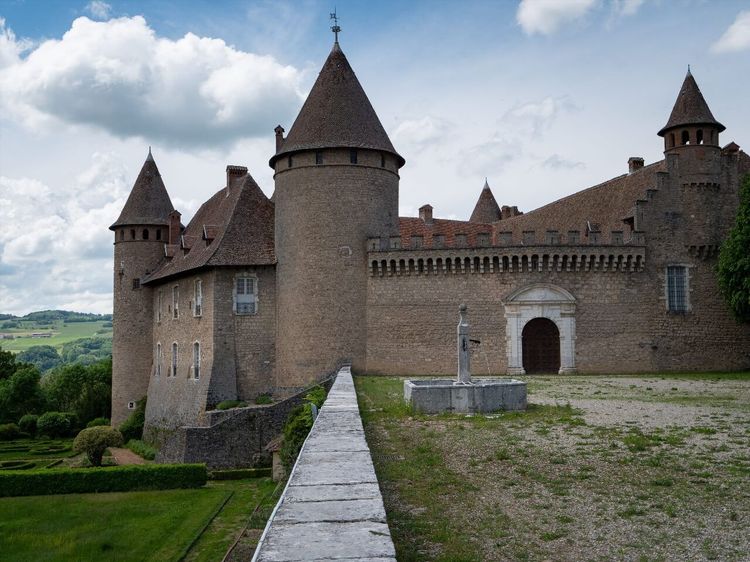
Halfway between Lyon and Grenoble, the château de Virieu (Virieu, 38730 Virieu, rated 4.6/5 on Google from 722 reviews) has risen from the Bas-Dauphiné plain since the 11th century. It is one of the rare castles in the region to display ten centuries of superimposed architecture within a single building, from the Romanesque keep to the 18th-century classical wing.
Visitable on a one-hour guided tour, from May to September. The guards' room, the Romanesque chapel, and the inner courtyard are the three most impressive spaces. Virieu is located 50 kilometres east of Lyon and 45 kilometres north of Grenoble, easily accessible by car from both cities.
Practical Tips for Visiting the Castles of Auvergne-Rhône-Alpes
When to go? The ideal season runs from April to October. Most castles close in winter or drastically reduce their opening hours. July and August guarantee that all sites in this guide are open, but also concentrate the most visitors. In May, June, and September, opening hours remain full and the experience is noticeably more pleasant.
How to plan your itinerary? The region is vast. Plan weekends by geographical cluster to avoid spending all your time on the motorway:
- Auvergne cluster: Murol, Anjony, Polignac, based in Clermont-Ferrand or Aurillac, 2 to 3 days
- Loire cluster: Bouthéon, Bâtie d'Urfé, château de la Roche, based in Roanne or Saint-Étienne, 2 days
- Isère cluster: Vizille, Touvet, Virieu, based in Grenoble, 2 days
- Savoie cluster: Menthon, Montrottier, based in Annecy, 1 day
- Château de Crussol: half a day from Valence, combinable with a visit to the city
Admission prices: expect between 5 and 12 euros per adult. Several castles offer free entry for young children. The ruins of Crussol are free to visit, and the museum of the French Revolution at Vizille has free admission.
With children: the château de Murol (costumed performances in summer) and the château de Vizille (Place du Château, 38220 Vizille, rated 4.7/5 on Google from 999 reviews) (park with deer and fallow deer roaming semi-freely) are particularly well suited to families with children under 10. Menthon-Saint-Bernard is suitable from age 7–8 for the walk up on foot. La Bâtie d'Urfé regularly offers children's workshops during school holidays.
Walking shoes: essential for Crussol, Polignac, and château de la Roche, accessible only on foot via steep paths. For other sites, comfortable walking shoes are sufficient.
Unique accommodation: if you wish to sleep in a castle, Bouthéon (Loire) is the most accessible option in this guide, with a hotel within its medieval buildings. Bed-and-breakfast rooms are also available in the outbuildings of several castles across the region.
Recommended pairings: the castles in this guide are often 30 to 60 minutes from the region's major cities. Combine a castle visit with a day of urban exploration to make the most of your journey: the Ryo audio guide of Saint-Étienne illuminates the Forez industrial heritage close to Bouthéon, while the Ryo audio guide of Valence ideally extends the ascent to Crussol, directly opposite on the other bank of the Rhône.
FAQ
What is the most beautiful castle in Auvergne-Rhône-Alpes?
The answer depends on what you are looking for. For the most spectacular natural setting, the château de Murol on its volcanic cone and Menthon-Saint-Bernard on the lake of Annecy vie for first place. For interior preservation and the quality of the artworks, the château d'Anjony in the Cantal has no equal in the region: its 16th-century frescoes are intact and accessible during the guided tour. For the most dramatic ruins, Crussol and Polignac dominate their respective valleys with a presence that five centuries of abandonment have not erased.
Which castles are best to visit with young children?
The château de Murol is the most suitable in summer, thanks to its historical costumed performances: actors in armour, archery, blacksmithing demonstrations, and falconry. The château de Vizille, with its large park inhabited by deer and fallow deer roaming semi-freely, appeals to young children from the age of 4–5. La Bâtie d'Urfé regularly offers children's workshops during school holidays. The ruins of Crussol, with free and open access, are ideal for families who enjoy exploring at their own pace.
Are there any free castles in Auvergne-Rhône-Alpes?
Yes, several. The château de Crussol (Ardèche) can be visited without an entrance ticket: the climb to the ruins from Saint-Péray is entirely free. At the château de Vizille (Isère), both the park and the departmental museum of the French Revolution are free to enter. The fortress of Polignac, however, charges a modest entrance fee (around 6 euros), even for a self-guided visit of the site.
Can you sleep in a castle in Auvergne-Rhône-Alpes?
Absolutely. The château de Bouthéon (Loire) has a hotel within its 15th-century medieval buildings. Other castles in the region offer bed-and-breakfast rooms or gîtes in their outbuildings. Specialist platforms list dozens of options across the region, from a B&B in a Renaissance château to a night in a restored keep.
Which castle offers the best panoramic view?
Crussol wins this title over the valleys and the Rhône: the view stretches from Valence to the far reaches of the Drôme. Menthon-Saint-Bernard offers the most picturesque setting, with the lake of Annecy in the foreground and the Alpine massifs behind. Polignac provides the best view over the Velay plateau. The château de la Roche, meanwhile, presents a unique panorama over the steep gorges of the Loire, depending on the water level of the lake of Villerest.
Do you need to book in advance to visit the castles?
For most castles in this guide, no. Advance booking is recommended only for guided tours with fixed dates and times (Anjony, Menthon-Saint-Bernard) and for the costumed performances at Murol in July and August. Vizille, Crussol, and Polignac welcome visitors without reservations. Check opening hours on official websites before you go: temporary closures for maintenance are common between November and March.
The Castles of Auvergne-Rhône-Alpes Are Worth the Trip
From the basaltic dykes of the Velay to the Ardèche limestone cliffs overlooking the Rhône, from the steep gorges of the Loire to the Savoyard alpine meadows above the lake of Annecy, the castles of Auvergne-Rhône-Alpes tell twelve centuries of history written in stone. Each edifice bears its geographical context like a fingerprint: one does not build in the same way in volcanic Auvergne as in glacial Haute-Savoie.
To continue exploring this region, our Ryo app offers audio-guided tours in the key cities close to these castles. The Lyon audio walking tour, with its 27 audio tracks over 7.9 kilometres, helps you understand how the regional capital was shaped by the same feudal power struggles that gave rise to the fortresses in this guide. Medieval heritage does not stop at the gates of castles: it still inhabits the streets and hillsides of every city in the region.
À lire également