© Shutterstock
 Votre guide Ryo
Visiting Nantes in 3 Days: Complete Itinerary 2026
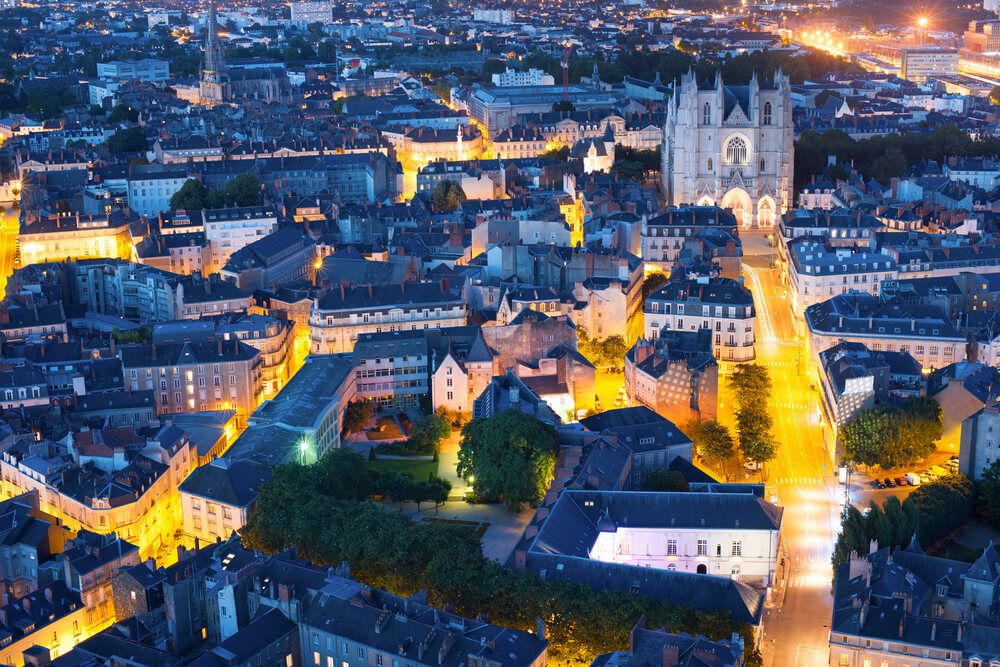
In Nantes, a twelve-meter wooden and steel elephant carries passengers above former shipyards, while just fifteen minutes away on foot, the half-timbered houses of the Bouffay tell an entirely different story. This dual identity — between preserved medieval heritage and reinvented industrial wasteland turned artistic stage — lends itself particularly well to a three-day stay: enough time to alternate between sightseeing and waterside breaks, without rushing from one point to the next. Visiting Nantes in 3 days lets you cover both faces of the city, from the historic center to the Île de Nantes, by way of the banks of the Erdre. The Ryo audio guide tour of Nantes follows this same thread, from the Grand Dukes to the Petit Lu biscuits, across thirty commented stops.
On the program for these three days: a château that served as a ducal residence, then a barracks, then a prison; a cathedral that remained under construction for 457 years; a memorial built at the edge of the Loire to acknowledge the city's slave-trading past; and a Japanese garden planted in the middle of a roundabout opposite the train station. Add to that Trentemoult, a fishing village with multicolored façades reachable in minutes by river bus, the major events of the Voyage à Nantes, a few ideas for exploring the city with children, and practical tips for getting around without a car — everything you need to build, day by day, an itinerary that holds up, whether you stay two, three, or four days.
Day 1 Morning: Old Nantes and the Château des ducs de Bretagne
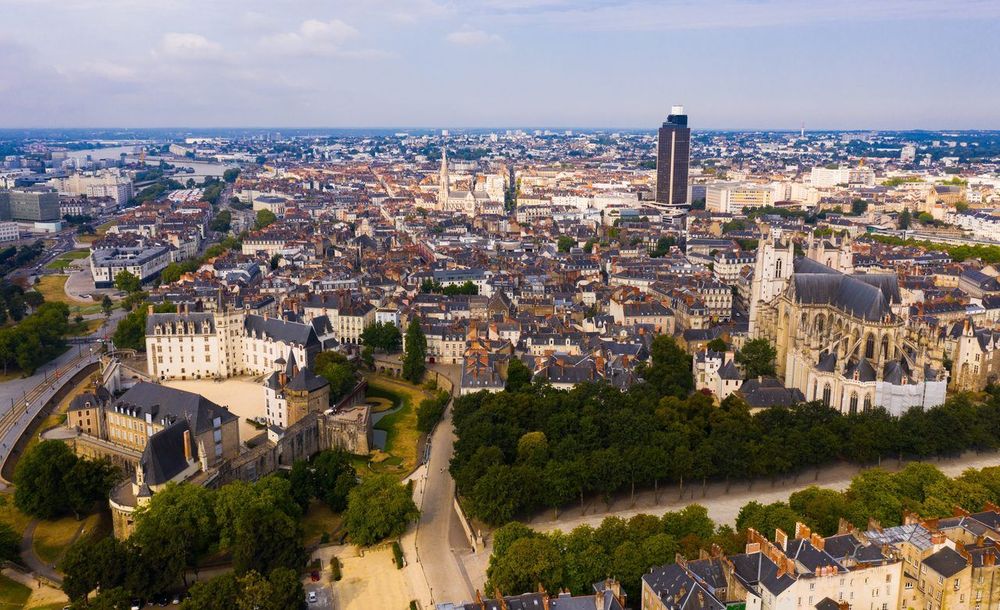
Drop your bags and start with the historic heart of the city: the triangle formed by the château, the cathedral, and the Bouffay neighborhood can be covered in a morning, provided you are willing to stop often. Allow around four hours, coffee breaks included.
If you arrive by train, everything is within less than ten minutes on foot. The south exit of the station leads directly to the Jardin des Plantes; the north exit connects to tram line 1, which drops you at the foot of the château in two stops. There is no need to take a taxi to reach the center.
Château des ducs de Bretagne: Ramparts and Water Wall
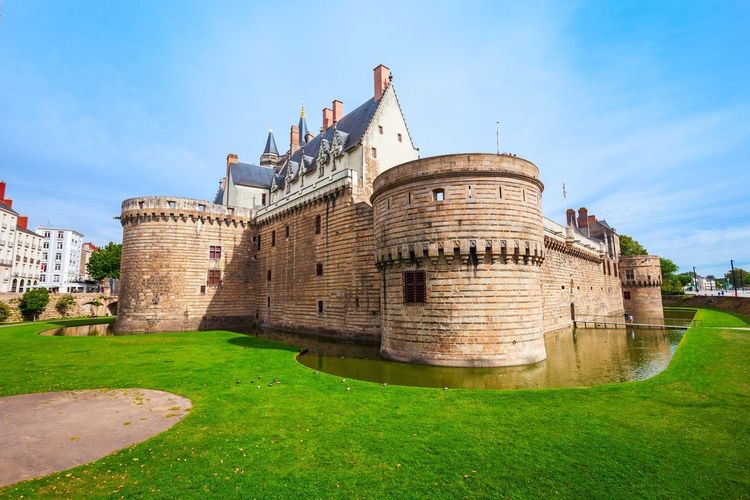
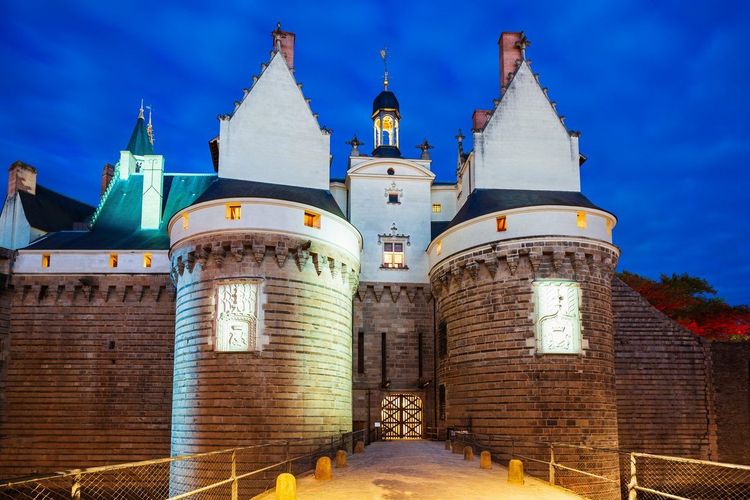
The château des ducs de Bretagne changed function almost every century: residence of the dukes of Brittany in the 15th century, military fortress under Louis XIV, then a barracks and prison until the early 20th century. It now houses the Nantes History Museum, spread across 32 rooms in the Renaissance buildings of the Grand Logis and the Grand Gouvernement.
Museum entry is paid, but the inner courtyard and the 500-meter wall walk along the ramparts remain freely accessible throughout the day. The water wall installed at the main entrance — a thin liquid sheet flowing down a glass panel — has become one of the favorite meeting spots for locals. Come early in the morning to enjoy the ramparts before tour groups arrive.
Inside, the permanent exhibition traces the city's history in sequences: ducal Brittany, the Atlantic port and the slave trade, industry and the shipyards, and then the contemporary reinvention. Allow a good two hours for the museum alone, one more if you add the walk around the moat and the climb onto the ramparts. Admission is around ten euros and remains free for under-18s, making it one of the best-value paid visits of the stay.
Cathédrale Saint-Pierre-et-Saint-Paul and Passage Pommeraye
Five minutes on foot away, the cathédrale Saint-Pierre-et-Saint-Paul displays an almost unreal whiteness inside, a striking contrast with its grey granite façade. Construction began in 1434 and stretched over 457 years until 1891, which explains the mix of Flamboyant Gothic and classical styles depending on which part of the building you are looking at. The tomb of François II, the last Duke of Brittany, adorns the south transept.
The cathedral has survived two major fires. The 1972 blaze destroyed the roof structure and triggered years of restoration; the fire of July 2020, which started at the great organ, relaunched a renovation project still ongoing. The cathedral remains open to visitors, but some sections may be closed depending on the progress of works: check the notices posted on the forecourt before entering, as they change regularly.
Heading back down toward the rue de la Fosse, the Passage Pommeraye deserves a ten-minute stop, even without any intention of shopping. This covered shopping arcade spread over three levels, inaugurated in 1843, unfolds a central staircase sculpted with cast-iron statues and a glazed roof listed as a historic monument. It is one of the few 19th-century arcades in France built on such a steeply sloping site.
The Bouffay Quarter and a Lunch Break
The Bouffay quarter, with its half-timbered houses and cobbled squares, concentrates the best-preserved medieval Nantes. Long the seat of judicial power, the name actually comes from the old Bouffay castle-prison, demolished in the 19th century. Today it gathers wine bars and lively terraces from lunchtime onward, interspersed with independent boutiques.
Look up along the rue de la Juiverie and the rue de la Bâclerie: a few timber-framed façades survived the bombings of September 1943, which destroyed a large part of the city center. Two streets further on, the buildings reconstructed in the 1950s tell the rest of the story, without transition. This collision of eras across three hundred meters sums up Nantes rather well.
For lunch, favor the small streets around the place du Bouffay and the rue de la Juiverie rather than the main tourist thoroughfares: prices are gentler and menus change with the market. If you are following the short version of the Nantes audio-guided tour, From the Grand Dukes to the Petit Lu, this is exactly where the morning loop ends.
Day 1 Afternoon: the Île de Nantes and the Grand Éléphant
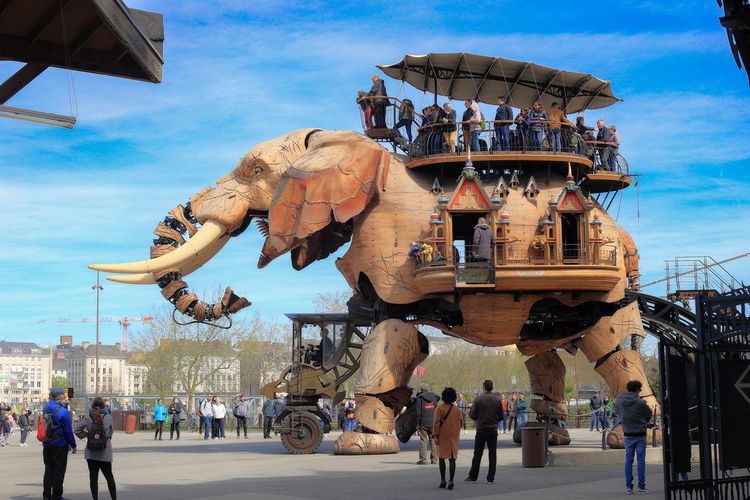
Cross the Loire via the pont Anne-de-Bretagne or take tram line 1 to the Chantiers Navals stop: the afternoon shifts into an entirely different Nantes, that of the former shipbuilding yards reinvented as an open-air artistic and technical park.
The Machines de l'île and the Grand Éléphant
It is impossible to spend three days in the city without encountering the Grand Éléphant, the centerpiece of the Machines de l'île. This 12-meter mechanical structure of wood and steel carries up to 50 passengers on a roughly thirty-minute ride around the site, spraying water from its trunk at bystanders who venture too close.
The site occupies part of the former Dubigeon shipyards, closed in 1987, and is divided into three spaces: the Galerie des Machines, where prototypes under construction are on display; the three-level Carrousel des Mondes Marins; and the Elephant itself. The whole complex was conceived as a tribute to the worlds of Jules Verne and Leonardo da Vinci, intertwined with the industrial memory of the site.
Right next door, the Musée des Hommes et des Techniques traces, through objects and testimonies, the working memory of the Dubigeon shipyards. A more intimate visit, often overlooked by visitors rushing toward the Elephant, but worthwhile for understanding what this neighborhood looked like before its transformation.
Book your Elephant tickets online the day before if you are visiting in high season: weekend slots sell out by mid-morning between June and September. For more detail on the visit, our article on the Machines de l'île covers seasonal opening hours and family pricing.
Musée Jules Verne and the Buren Rings
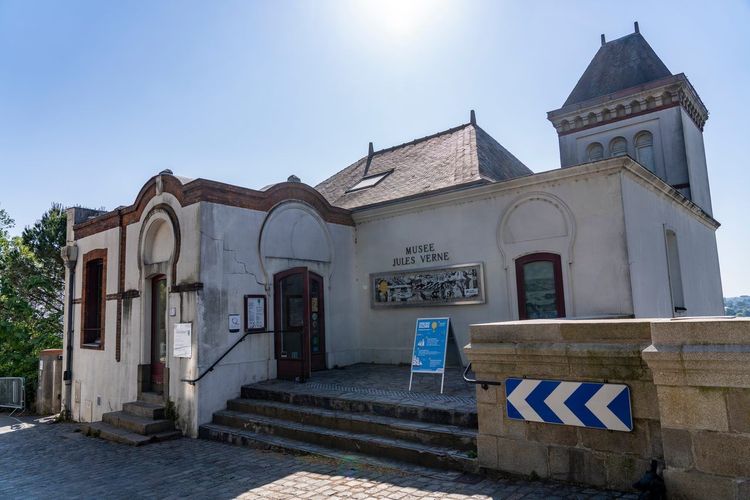
On the Butte Sainte-Anne, overlooking the Loire, the musée Jules Verne occupies a 19th-century bourgeois townhouse. The writer, born in Nantes in 1828, is celebrated here through manuscripts and models of his imaginary machines — submarines and dirigible balloons. The museum is modest in size; a full visit rarely takes more than an hour.
On your way back toward the Île de Nantes, stop on the quai des Antilles to see the Buren rings, an installation of eighteen steel rings lined up facing the Loire, created by artist Daniel Buren with Patrick Bouchain. The work is part of the Voyage à Nantes permanent trail and lends itself particularly well to a photograph at sunset.
After dark, the rings glow red, green, and blue, and the quay changes atmosphere entirely. The neighboring warehouses — former banana storage sheds converted into bars — take over until late: if your first day still has some energy left in it, this is where it naturally ends.
Mémorial de l'abolition de l'esclavage
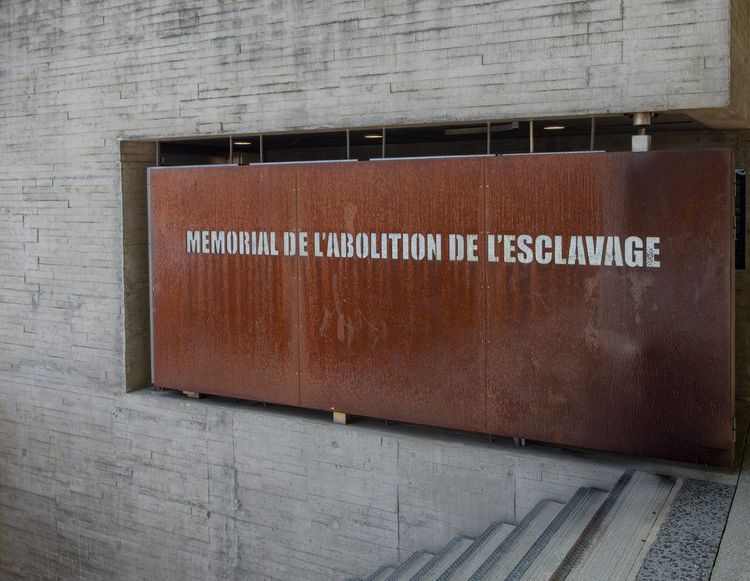
The Mémorial de l'abolition de l'esclavage (Quai de la Fosse, 44200 Nantes, rated 4.4/5 on Google from 2,108 reviews), on the quai de la Fosse, is discovered by walking through it: a suspended walkway above the water, then an underground gallery where the names of 1,800 slave ships belonging to Nantes shipowners are engraved. Nantes was France's leading slave-trading port in the 18th century, a past the city was slow to acknowledge officially — the memorial only opened in 2012.
Entry is free and accessible year-round, with open access from the quay. Allow twenty to thirty minutes to walk through the gallery and read the abolitionist quotations engraved along the route.
Day 2: Trentemoult, Chantenay, and the Outlying Neighborhoods
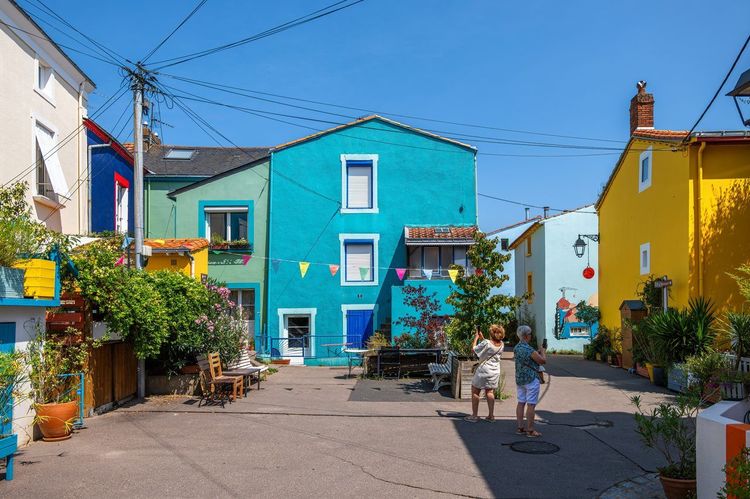
Change pace for this second day: head to the quieter banks of the Loire, a few minutes by river bus from the center. The navibus departs from the Gare Maritime at the far end of the quai de la Fosse and reaches Trentemoult in about ten minutes on a standard TAN ticket. A crossing that is worth the trip in itself, especially on a clear day.
Trentemoult: the Colorful Fishing Village
Trentemoult, a former fishing village attached to the municipality of Rezé, lines its pink, blue, and yellow façades along lanes too narrow for cars. The neighborhood long lived from fishing and deep-sea navigation before becoming, from the 2000s onward, a haunt for artists and independent businesses.
One detail amuses every visitor: locals say the houses were painted in bright colors so that sailors could spot their own from the river. Others see it simply as a practical use of leftover paint brought back from the shipyards. Both versions circulate, and no one here seems in any hurry to settle the question.
Take time to wander without a set route: ceramics shops, screen-printing studios, and cafés with river views reveal themselves at random down the lanes. Our article on the village of Trentemoult lists a few addresses for extending the walk on the Rezé side.
For lunch on the Loire riverbanks, several restaurants set up on the quay offer a direct view of the port cranes and, in the distance, the silhouette of the Île de Nantes. Book ahead if you come on a Sunday midday — a favorite outing for locals themselves.
The Chantenay Quarter and Its Workshops
Back on the north bank, explore Chantenay, a hilly neighborhood built on the hillside above the Loire. Long a working-class district tied to the shipyards and food industries, it has retained its suburban houses and steep lanes, now claimed by a new generation of ceramicists and coffee roasters.
Climb up to the Butte Sainte-Anne for one of the best free viewpoints over the Loire and the rooftops of Nantes. It was also historically the point from which river traffic was monitored. On the way back down, the Île de Nantes neighborhood is only about fifteen minutes on foot — handy if you want to move straight on to the end of the day.
A few hundred meters from the butte, the Jardin extraordinaire occupies the former Miséry quarry, a granite cliff opened to the public in 2019. Banana trees, tree ferns, and a cascade tumbling down the rock face create an almost tropical setting, freely and freely accessible. This is also the planned site of the Arbre aux hérons, the monumental project imagined by the designers of the Machines de l'île. The descent into the garden follows a long ramp — easy going down, slightly less so on the way back up at the end of the day.
Day 3: Gardens, the Erdre, and Museums Along the Water
Last day, last pace: calmer, greener, between parks and museums. It is also a chance to step slightly outside the historic center and discover the river Nantes, the one that takes shape around the Erdre rather than the Loire.
Jardin des Plantes and the Île de Versailles
The Jardin des Plantes, a seven-hectare botanical garden planted directly opposite the train station, combines tropical greenhouses, century-old magnolias, and ornamental ponds. Entry is free and the garden opens early in the morning — a good time to walk through before the afternoon heat in summer.
Children head straight for the monumental sculptures by Claude Ponti scattered along the paths since the Voyage à Nantes: a giant chick, an oversized watering can, an inhabited bench. The botanical collections are also worth exploring, starting with the camellias, for which the garden holds one of France's reference collections.
About twenty minutes on foot away, the Île de Versailles conceals a complete Japanese garden — wooden bridges, stone lanterns, and maple trees — set within a former trading port transformed into an island on the Erdre. The contrast with the traffic of the neighboring boulevard is immediate.
A Stroll Along the Banks of the Erdre
The Erdre, often called the most beautiful river in France by François I himself according to local legend, makes for a pleasant walk or cycle ride from the quai Ceineray. The landscaped quays, lined with 19th-century bourgeois townhouses, contrast sharply with the bustle of the city center.
The further north you go, the more the banks fill with "folies" — the pleasure houses that Nantes shipowners had built for themselves in the 18th century with the proceeds of maritime trade. Some can be visited; most are best admired from the water, which explains the enduring popularity of river cruises.
Commented boat trips do indeed depart from the quai de la Motte-Rouge, heading up the Erdre to the first pastoral meanders barely ten minutes after leaving the center. Allow one to two hours depending on the route chosen, and book in summer.
Musée d'Arts de Nantes and Le Lieu Unique
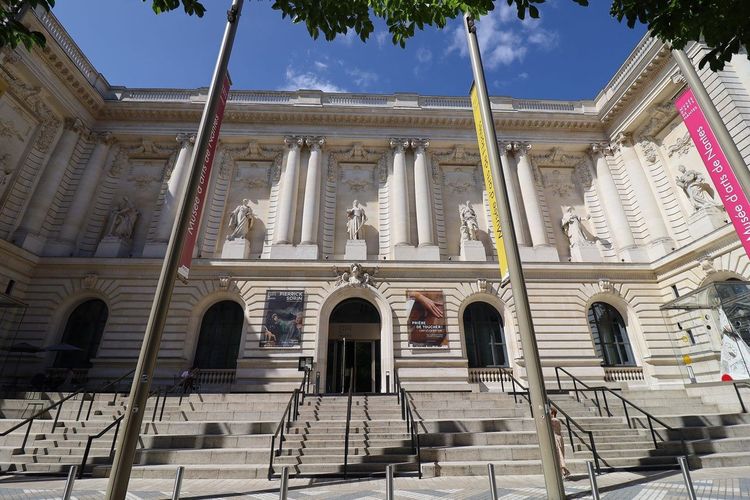
The musée d'arts de Nantes, reopened in 2017 after six years of renovation, holds a collection ranging from the 13th century to contemporary art, with a particularly refined display of the Kandinsky holdings. The Chapelle de l'Oratoire, attached to the museum, hosts the most ambitious temporary exhibitions. The contemporary extension, nicknamed the Cube and clad in translucent marble, glows from within at dusk — a detail you only notice when passing by in the evening.
End the day at Le Lieu Unique, housed in the former LU biscuit factory (Lefèvre-Utile), recognizable by its crenellated tower visible from several neighborhoods. Transformed into a national arts venue in 2000, the space combines a bookshop, a hammam, a bar, and a live arts program under a single industrial glass roof. The Loire and its quays — offering 200 kilometers of landscaped walkways in total around Nantes — are just five minutes on foot from here.
Following the Green Line of the Voyage à Nantes
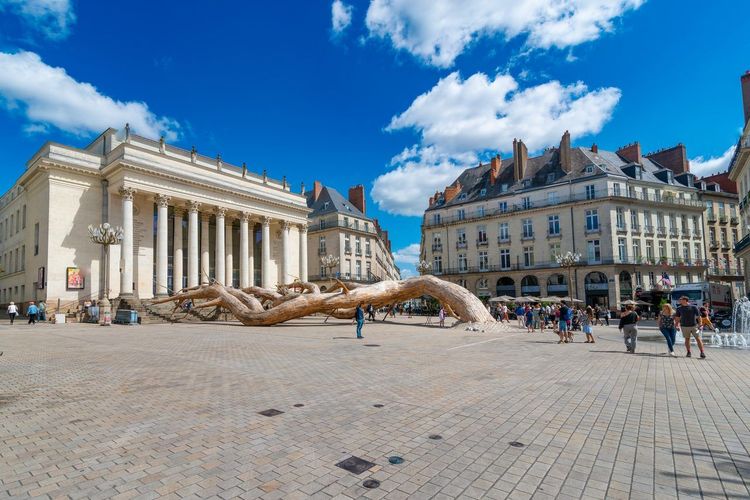
Since 2012, a green line painted on the ground connects the majority of artworks and sites belonging to the Voyage à Nantes, the cultural event that has become a permanent fixture. Roughly 12 kilometers long, it crosses the historic center, the Île de Nantes, and part of the quays, passing most of the places already mentioned in this itinerary: the château, the cathedral, the Machines de l'île, and the Buren rings.
The concept is simple: follow the line on the ground, without a map or app, and discover along the way permanent contemporary artworks — sculptures, sound installations, painted façades, and repurposed street furniture — scattered in corners you would never otherwise visit. Each summer, new temporary works are added to the route, generally from July to September.
A few pointers to avoid spreading yourself too thin: the most striking permanent pieces are concentrated in three areas — the quai des Antilles with the rings, the Jardin des Plantes with Claude Ponti's sculptures, and the Chantenay side with the Jardin extraordinaire. All are outdoors and free to access, which makes it easy to slot them between paid visits without straining the day's budget.
Should you follow the green line strictly for all three days? Not necessarily in full: the complete route takes an entire day just for the walking. That said, dipping in and out of it — between the château and the Île de Nantes, for instance — helps you spot artworks you would otherwise miss. Locals themselves tend to use it more as a visual landmark than as a step-by-step itinerary.
The tourist office, located opposite the château, distributes a free map of the route with the list of works on view during the year. Useful if you want to tick off the highlights without backtracking.
Nantes: a City of Festivals All Year Round

Beyond heritage and museums, Nantes structures its calendar around several events that have become unmissable for residents and visitors alike. The Folle Journée, a classical music festival created in 1995, takes over the Cité des Congrès in late January or early February with short concerts and accessible ticket prices — a formula designed to demystify classical music.
In late August or early September, the Rendez-vous de l'Erdre transforms the quays into a floating jazz stage, with free concerts performed from moored barges. Conversely, if you visit in June, the Hellfest draws more than 150,000 hard rock and metal fans each year to Clisson, about thirty minutes south of Nantes.
Summer remains the busiest period for the Voyage à Nantes, with its temporary artworks and free events on the quays from July to early September. If your stay coincides with any of these periods, book accommodation and restaurants a little further in advance than usual. Our article on events in Nantes lists exact dates edition by edition — useful for timing your stay. It is also a good time to explore Nantes at your own pace with Ryo's audio-guided tour, when the crowds thin out.
Day Trips from Nantes: Clisson and the Val de Loire
If your stay extends beyond three days, or if you are simply looking for a break outside the city, several day-trip options are on the table — and they have almost nothing in common with one another.
Clisson and Its Medieval-Italian Atmosphere
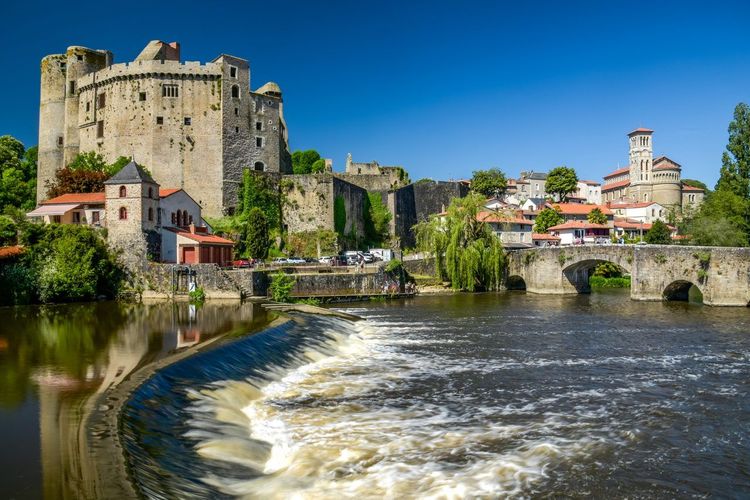
Clisson, a 30-minute drive or train ride south of Nantes, surprises with its Tuscan atmosphere: after the destruction wrought by the Wars of the Vendée, the town was rebuilt in the 19th century in a style directly inspired by Italy — ochre façades, bell towers, cypresses, and shaded lanes. The medieval château, partly ruined but impressive, still dominates the valley of the Sèvre Nantaise.
Clisson is also where the Hellfest is held each June, one of the largest metal festivals in Europe. For the rest of the year, the town is far quieter and well suited to a stroll through the parc de la Garenne Lemot, a romantic garden dotted with neo-antique follies. Our dedicated article on Clisson covers what to see in half a day.
Loire Châteaux and Surrounding Villages
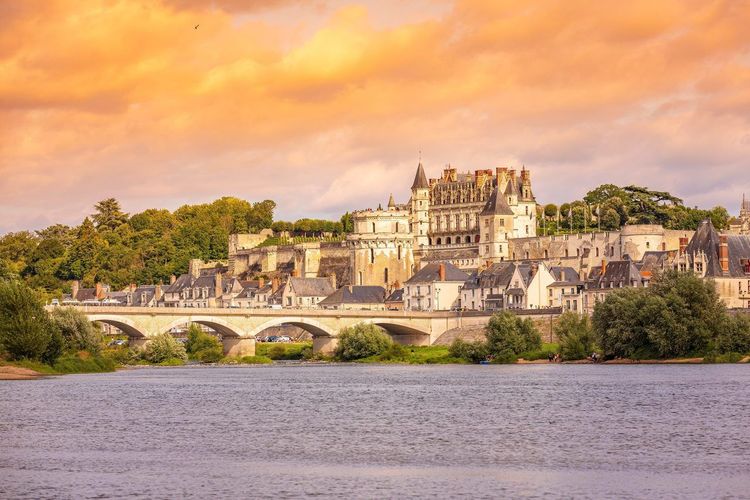
Nantes marks the western gateway to the Val de Loire, and several iconic châteaux are reachable by car or train. To organize this excursion, the road trip Châteaux de la Loire offers an audio-guided route designed to string together several sites without losing time on the road.
Around Nantes, several villages also make for worthwhile day trips, away from the crowds of the grand châteaux. Our selection of the most beautiful villages around Nantes lists five, some reachable without a car via the regional rail network. For cycling enthusiasts, the Loire à Vélo trail connects Nantes to several of these stops along an almost completely flat cycle path, and the estuary section toward Saint-Nazaire doubles as an open-air art route.
Another option if you are after the ocean: Pornic and the Côte de Jade are about an hour away, while Guérande, its ramparts, and its salt marshes are roughly an hour and a half. Nothing compulsory for a three-day stay, but a good card to keep in hand if the weather turns glorious.
Nantes with Kids: Things to Do with Children
If you are traveling with young children, the city requires little adjustment from the standard itinerary: the Machines de l'île, already on the program for day one, remains the top family attraction, with reduced pricing for under-18s and a family pass for larger groups.
For an afternoon snack break, the Jardin des Plantes has shaded play areas and a seasonal carousel — handy for a half-hour breather between visits. Several tea rooms in the Graslin quarter, five minutes on foot away, round off the stop with children's menus.
On the museum front, the Nantes history museum inside the château lends activity booklets to younger visitors, and the natural history museum, a short walk from the Butte Sainte-Anne, tends to win over children with its skeletons, taxidermied animals, and vivarium. The Île de Versailles, with its walkways and Japanese garden, is also a reliable option for a quieter end to the day, with no queues or set opening hours.
The Nantes tram network is stroller-friendly throughout, a real advantage when moving between several neighborhoods in a single day. And if rain moves in, the Carrousel des Mondes Marins and the Passage Pommeraye can easily save half a day indoors.
Where to Eat and Where to Stay in Nantes over 3 Days
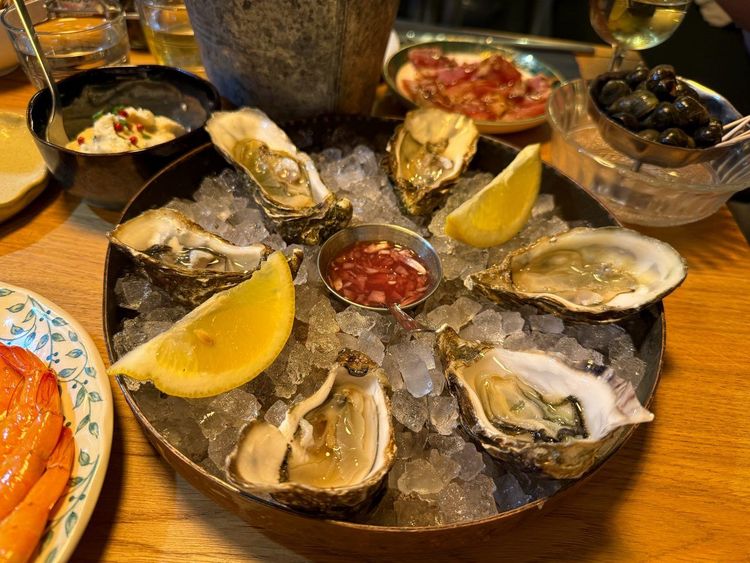
The best addresses in Nantes naturally group by neighborhood, which simplifies planning if you follow the day-by-day itinerary laid out above.
Good Addresses for Lunch and Dinner
In the Bouffay, the small tables on the rue de la Juiverie and the rue des Petites Écuries regularly update their menus according to what comes in from the Talensac market, ten minutes on foot away. Budget between 15 and 20 euros for a full lunch on a weekday.
On the rue du Maréchal Joffre in the Graslin quarter, several more refined addresses are better suited to dinner: bistronomy and revisited Breton cuisine, complemented by a handful of discreet natural wine cellars. It is also one of the few streets in the center where original historic façades survive intact between restaurants.
For outdoor aperitifs, head to the quays: the quai des Antilles on the Île de Nantes and the terraces near the château on the place du Bouffay are reliable evening spots from the first warm days onward. Trentemoult, discovered on day two, also keeps its waterside addresses for an aperitif with a view over the Loire.
For a deeper dive into local food, our article on the culinary specialties of Nantes details the dishes not to miss, from beurre blanc to curé nantais cheese.
Where to Stay: Neighborhoods and Accommodation Tips
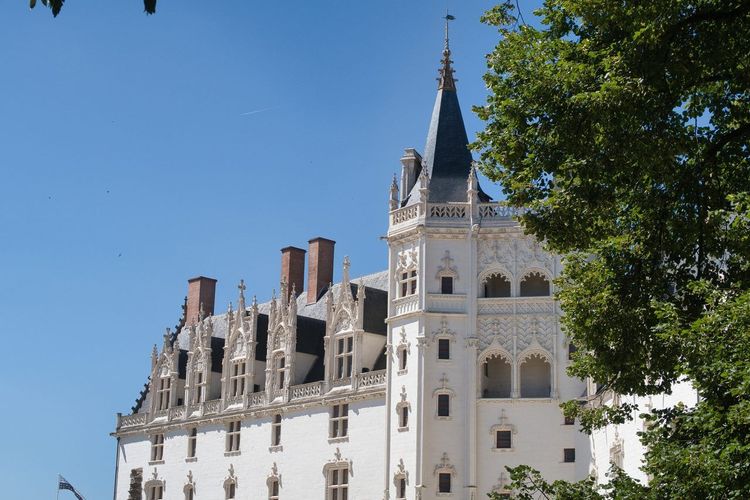
The city center, between the château and the cathedral, remains the most practical choice for a three-day stay on foot: most hotels in the area are within twenty minutes' walk of every major site.
Around the train station, the offer is denser in the mid-range and chain segment, with the advantage of direct access to tram lines toward the Île de Nantes and to the Jardin des Plantes five minutes on foot.
On the Île de Nantes itself, a handful of newer, often design-led properties capitalize on immediate proximity to the Machines de l'île and the Buren rings, at the cost of a slightly longer walk to the historic center in the evening.
Budget-wise, a three-star hotel in the city center runs roughly 80 to 120 euros per night outside festival periods, while hostels and short-stay studio rentals come in well below that. Book several weeks ahead if your visit coincides with the Hellfest in June or major summer weekends: prices rise quickly and central availability tightens fast.
Getting Around, Budget, and Best Season in Nantes
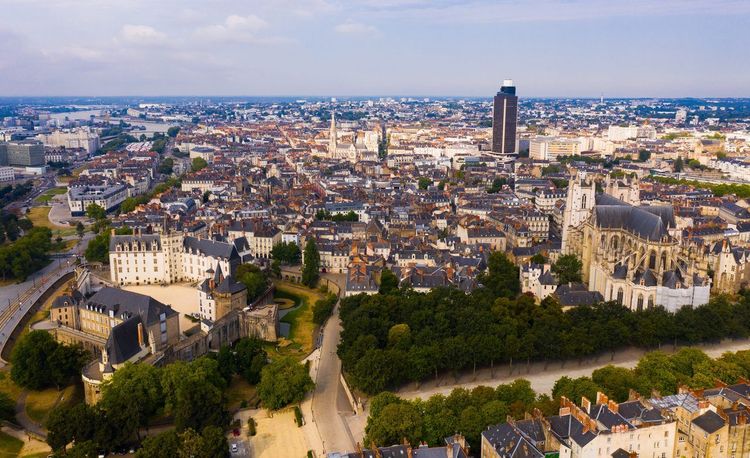
One final section before you set off: a few practical pointers to organize the rest of your stay without any unpleasant surprises.
Getting Around: Public Transport, Cycling, and Walking
Is Nantes easy to visit without a car? Without hesitation, yes. The TAN network (tram, bus, navibus) covers the city well, and the historic center is very walkable — most sites on day one are within fifteen minutes on foot of one another.
Three tram lines intersect in the center around the Commerce stop, and the same ticket is valid for bus, tram, and navibus alike, including the crossing to Trentemoult. A single ticket costs around two euros; a 24-hour pass becomes worthwhile from the third journey onward.
For exploring on foot, pack proper shoes: the cobblestones of the Bouffay and the slopes of Chantenay are unforgiving on thin soles. If you prefer cycling, the Bicloo bike-share scheme complements longer journeys well, particularly toward Trentemoult or the banks of the Erdre.
Arriving by car is possible but of limited use within the city itself: parking is expensive and restricted in the center, and a car only really comes into its own for excursions to Clisson, the coast, or the Loire châteaux mentioned earlier. Park-and-ride facilities on the outskirts, connected to the tram network, solve the question for the day.
City Pass, Budget, and Weather by Season
The Pass Nantes (local city pass) gives access to most museums, an Erdre river cruise, public transport, and a selection of partner discounts, valid for 24, 48, or 72 hours. For a three-day stay with several museums on the agenda, it pays for itself from the second or third paid visit, transport included.
Budget-wise, allow an average of 90 to 130 euros per person per day for a comfortable stay — mid-range accommodation and two meals included, before the Machines de l'île ticket, which is the single highest expense on the itinerary. Keeping costs down (Talensac market, free sites, gardens) makes it easy to stay well under 60 euros per day, since so many of the city's highlights are freely accessible.
On the weather front, be prepared: Nantes' oceanic climate means showers are possible at any time of year, including in summer. Spring (April to June) and early autumn (September) usually offer the best compromise between manageable crowds and pleasant conditions for walking from neighborhood to neighborhood. Pack a waterproof jacket whatever season you choose, and download the Ryo app before you leave if you plan to follow the Ryo audio guide of the historic center independently.
FAQ
How Much Time Do You Need to Visit Nantes?
Three days are enough to cover the essentials: the historic center, the Île de Nantes, and at least one outlying neighborhood such as Trentemoult. In a single day, focus on the château, the cathedral, and the Machines de l'île — the trio that packs the most discoveries per square meter. With a fourth day, you can add a trip to Clisson or the Loire châteaux without rushing the pace of the preceding days.
Is Nantes Easy to Visit without a Car?
Yes, very much so. The TAN tram and bus network serves the whole city well, and the historic center is entirely walkable. A car becomes useful mainly for excursions outside Nantes, toward Clisson, the coast, or the Val de Loire.
What Is the Best Season to Visit Nantes?
Spring and early autumn offer the best balance between mild weather and manageable crowds. Summer remains pleasant but busier, especially during the Voyage à Nantes and around the Hellfest in June at Clisson.
What Are the Must-See Attractions in Nantes?
The château des ducs de Bretagne, the Machines de l'île with the Grand Éléphant, the cathédrale Saint-Pierre-et-Saint-Paul, and the Passage Pommeraye form the core of any first visit. The Mémorial de l'abolition de l'esclavage, the Jardin extraordinaire, and the Trentemoult neighborhood are valuable additions to that foundation.
Should You Follow the Green Line of the Voyage à Nantes?
Not necessarily in its entirety: following the complete route takes a full day of walking. It remains useful on a case-by-case basis, between two sites already on your itinerary, to spot contemporary artworks you would otherwise miss.
Is Two Days in Nantes Enough?
It is possible if you focus on the historic center and the Île de Nantes — essentially the equivalent of day one of this itinerary spread over two days. You will, however, have to forgo Trentemoult, the gardens, and the museums from day three.
Can You Visit Nantes on Foot, or Do You Need a Car?
Nearly the entire itinerary described here can be done on foot or by public transport. Simply bring comfortable shoes for the cobblestones of the historic center and the slopes of Chantenay, and save the car for excursions outside the city.
Three days are therefore enough to experience Nantes in all its facets, from the medieval château to the reinvented Île de Nantes, without ever feeling rushed. Whether you follow this itinerary day by day or pick and choose according to your mood, leave some free time to wander through the Bouffay or stroll along the quays — two activities that appear on no list but sum up the spirit of the city rather well.
To continue exploring once you are there, the Ryo audio guide tour is the simplest way to connect all these places effortlessly: the app takes care of the narrative thread while you enjoy the scenery.