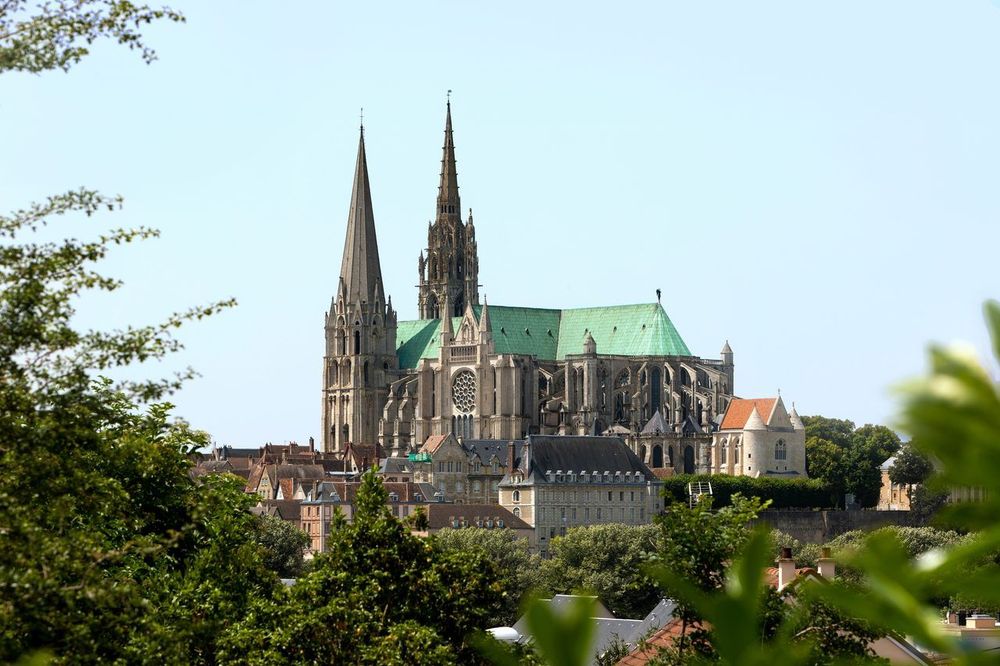
© Shutterstock
 Votre guide Ryo
Visiting Orléans Without a Car in 2026: Complete Itinerary on Foot, by Bike, and by Train
Visiting Orléans without a car starts the moment you step off the train: the station drops travelers a ten-minute walk from the place du Martroi, and barely more from the cathédrale Sainte-Croix. That detail changes everything. The city was built in an arc along the Loire within a comfortable walking radius, and the tram covers in ten minutes what would take a good half-hour by car on market day. The Ryo audio tour of Orléans follows this compact route, in the footsteps of Clovis, Jeanne d'Arc, and Attila, without ever needing to pull out a map at every junction.
Over two or three days, you can descend into a Romanesque crypt hidden beneath a church, listen to tales of the Underground City, cycle to a former boatmen's port at the end of the canal d'Orléans, board a flat-bottomed toue sablière to drift past the Loire's sandbars, or hop on a regional train that drops you at the foot of an 11th-century keep in under half an hour. This guide details the walking itinerary through the historic center, cycling and boat excursions, train and Rémi coach trips to the châteaux of the Val de Loire and the Sologne, through to calculating the Citypass and finding places to stay near the station.
Why Visit Orléans Without a Car
The distances speak for themselves: between the Orléans train station and the place du Martroi, the beating heart of the city, it is roughly 800 meters, or about ten minutes of relaxed walking along the rue de la République. The cathédrale Sainte-Croix, the Hôtel Groslot, and the half-timbered lanes cluster within a perimeter you can cross on foot in a quarter of an hour.
A car here creates more complications than it solves. Much of the city center is pedestrianized, several streets are one-way or restricted to residents, and parking is expensive and scarce on market days. By contrast, two tram lines (A and B) cross the urban area end to end, the Vélo+ bike-share fills in the gaps, and the station sits literally on the edge of the historic center.
You also gain access to places a car simply cannot reach easily: the Loire riverbanks laid out as a promenade, the towpath leading all the way to Combleux, or the port d'Orléans, whose quays were never designed for parking. Without a car, you discover Orléans through its real distances, not its car parks.
Day 1: Cathedral, Place du Martroi, and the Half-Timbered Old Town
Cathédrale Sainte-Croix, Campo Santo, and Hôtel Groslot
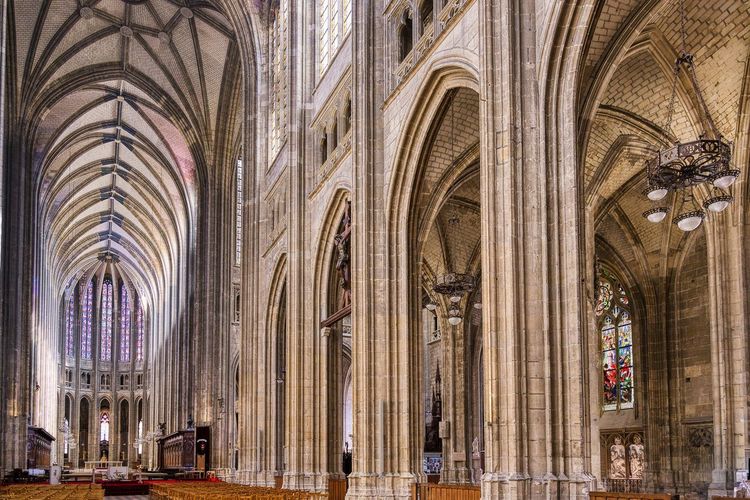
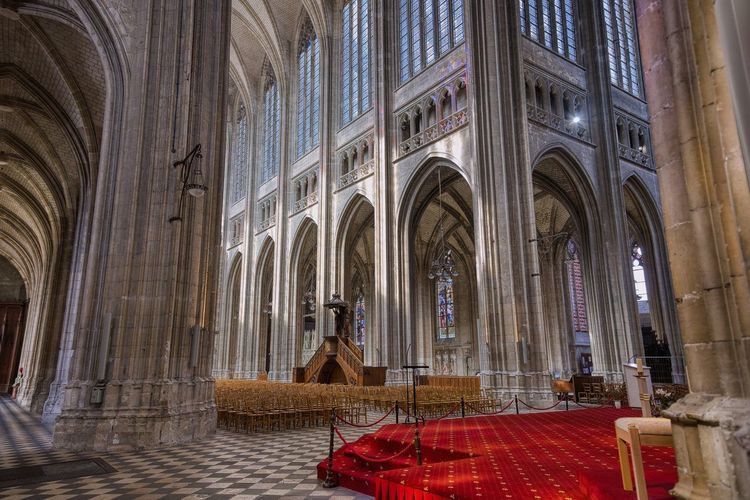
Start with the Cathédrale Sainte-Croix, a Gothic silhouette rebuilt after its partial destruction by Protestants in 1568, at the instigation of Henri IV, and completed only in the early 19th century with its twin towers dominating the city. In the nave, ten large stained-glass windows from the late 19th century tell the story of Jeanne d'Arc, from Domrémy to the stake in Rouen: few visitors take the time to read them in order, yet they form a genuine comic strip in glass.
Right next door, the Campo Santo occupies a former medieval cemetery surrounded by arcaded galleries: they now host exhibitions and events, in a calm that contrasts sharply with the bustle of the neighboring square. Behind the apse, the Jardin de l'Évêché (place Sainte-Croix, 45000 Orléans, rated 4.6/5 on Google from 39 reviews) offers a shaded bench for a breather before moving on, with a terrace view of the cathedral.
Crossing the square, the Hôtel Groslot surprises with its red and black brickwork and Renaissance façade: a former city hall, it is where the young king François II died in December 1560. The wedding hall and state rooms, still in use today, can be visited free of charge outside ceremony hours. The small garden at the rear, where remains of the Chapelle Saint-Jacques have been reassembled, is well worth a look.
Place du Martroi, Porte Bannier, and Half-Timbered Houses
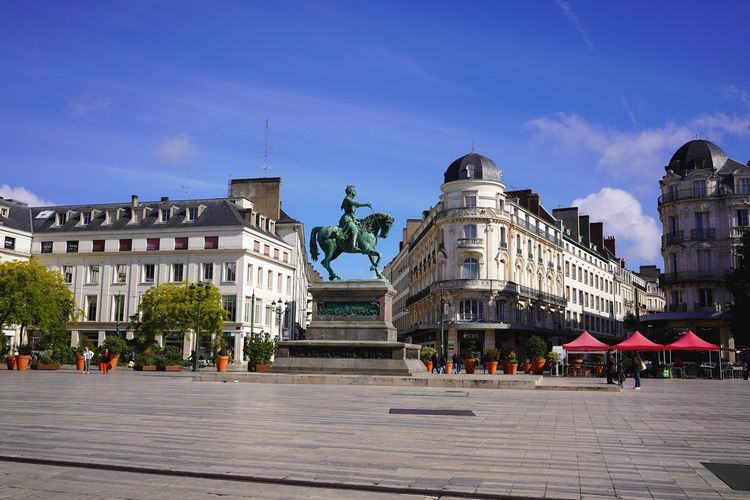
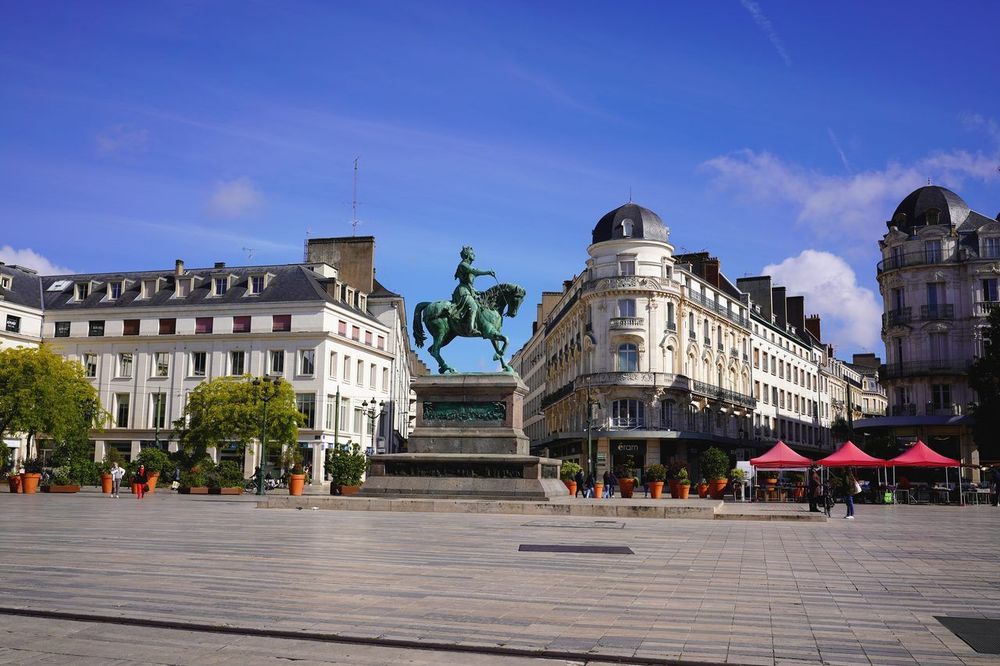
Five minutes on foot brings you to the place du Martroi, a wide esplanade dominated by the equestrian statue of Jeanne d'Arc and lined with cafés whose terraces fill up at the first sign of good weather. It is the city center's absolute landmark, the point from which almost every shopping street radiates.
Beneath your feet, the remains of the porte Bannier, one of the entrances to the medieval fortifications, were uncovered during the square's renovation and remain visible underground on guided tours organized by the Ville d'art et d'histoire service. Head down next to the rue de Bourgogne, the former Gallo-Roman decumanus, then toward the place du Châtelet and the rue de la Charpenterie: this is where Orléans' finest half-timbered houses hide, often dating from the 15th and 16th centuries, long concealed under plaster and rediscovered during recent restoration campaigns.
Two axes structure this loop. The rue Royale, cut through in the 18th century with its regular arcades, descends toward the pont George-V; partly destroyed in 1940, it was rebuilt to its original design. The rue Jeanne d'Arc, opened in the 19th century, offers a perfect perspective on the cathedral façade. For those who prefer a marked route, the discovery circuit of the Orléans city center offered by the tourist office follows much the same itinerary. You can also let the Ryo audio tour of Orléans guide you: its 23 audio stops, 1h50 of listening over 4.6 km, cover exactly the cathedral, the place du Martroi, and these lanes, without having to research the history of each façade yourself.
Day 2: Museums, the Blossières Quarter, and the Legends of Orléans
Musée des Beaux-Arts, Hôtel Cabu, and the Crypte Saint-Aignan
Founded in 1797, the Musée des Beaux-Arts ranks among France's oldest museums and deserves a good hour and a half: French, Flemish, and Italian paintings from the 15th to the 20th century, including a Saint Thomas by Velázquez, and a remarkable collection of 18th-century pastels. It stands opposite the cathedral, less than ten minutes on foot from the Martroi.
A few streets away, the Hôtel Cabu, a Renaissance mansion with the air of a small urban château, houses the Musée d'Histoire et d'Archéologie. Here you will find the Neuvy-en-Sullias treasure, a set of Gallo-Roman bronzes (including an almost life-size horse and a group of dancers) discovered in 1861 in a sand quarry in the Loiret. A combined ticket with the Musée des Beaux-Arts is generally available.
Heading east to the église Saint-Aignan, descend beneath the choir to discover the crypte Saint-Aignan (place Saint-Aignan, 45000 Orléans), an 11th-century Romanesque vestige that once housed the relics of the bishop who stood up to Attila in 451. Its sturdy columns and sculpted capitals can only be visited with tourist office guides: book ahead.
The Blossières Quarter, Street Art, and Orléans Legends
North of the center, the quartier des Blossières (avenue des Droits de l'Homme, 45100 Orléans, rated 4.7/5 on Google from 47 reviews) offers a completely different atmosphere: this working-class suburb, with its workers' housing and 20th-century blocks, is the subject of a discovery tour under the Ville d'art et d'histoire label, ideal for seeing a side of Orléans beyond its Renaissance façades. Allow twenty-five minutes on foot from the Martroi, or a few bus stops.
Orléans also nurtures a discreet but genuine street art scene: monumental murals punctuate the blank gable ends of the center and the outer districts, and the city's street art festival regularly adds new ones. You will likely come across one or two simply by turning down a different street.
Finally, the city loves to tell its legends, and the most intriguing remains that of the Underground City: a labyrinth of cellars, medieval storerooms, and galleries carved into the limestone beneath the historic center, some of which are said to have served as refuges during sieges. You cannot wander through them freely, but guided tours occasionally open a few doors. Several stops on the Ryo audio tour pause in front of these history-laden façades to recount their stories: a fine complement for those who want to dig deeper without carrying a paper guidebook.
Day 3: The Loire by Bike and by Boat
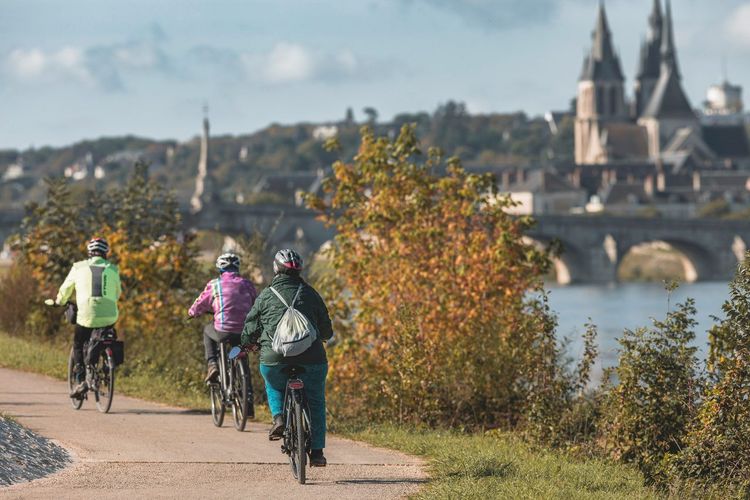
Cycling Along the Loire to Combleux
The Loire à Vélo, a cycling route of over 900 km, passes through the city along its quays. The tourist office rents hybrid bikes, and specialist hire shops offer electric-assist bicycles; if you plan to go further, the Pass Loire à Vélo (24, 48, or 72 hours) lets you cycle between Orléans and Tours and return by train. Head east: the path, flat and well signposted, follows the river for about 6 km to the village of Combleux (45800 Combleux), a former boatmen's port at the mouth of the canal d'Orléans, with its low houses and lock.
Allow about an hour there and back at a leisurely pace, photo stops included. The route skirts gravel banks where terns and grey herons nest, a welcome contrast after two days on cobblestones. Bring water: shade is scarce on this stretch.
Boat Trip and the Loire Riverbanks, Port d'Orléans
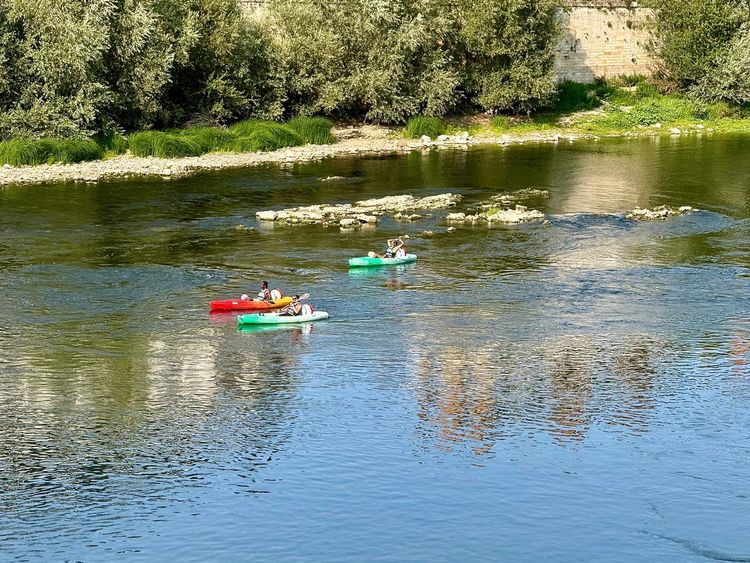
Back in the city, make for the port d'Orléans (quai du Fort Alleaume, 45000 Orléans, rated 4.6/5 on Google from 21 reviews), the historic boatmen's quarter where salt, wine, and sugar were once unloaded. Traditional flat-bottomed toues sablières offer guided trips of about an hour on the river, from the warmer months through early autumn depending on water levels. From Combleux, other "Loire escapades" set out to spot kingfishers, egrets, and, with luck, beavers.
This time on the water shifts your perspective: you can see the cathedral from the river, the quays where locals picnic in summer, and the sandbars that have shaped the Loire's reputation as a capricious river, often called the last wild river in Europe. On the cycling path, keep an earbud in: the Ryo audio tour also commentates on the bridges and the history of the port as seen from the quays.
Car-Free Day Trips: Loire Châteaux and the Sologne by Train or Coach
Châteaux Reachable by Train Along the Loire: Beaugency, Meung-sur-Loire, Gien
From Orléans station, TER trains on the Orléans–Blois–Tours line follow the Loire westward and serve several château towns, with roughly hourly departures during the day. The first stop, Meung-sur-Loire (about fifteen minutes by train): its château, formerly the residence of the bishops of Orléans, has two faces — a medieval fortress on one side and a classical manor on the other. The poet François Villon was imprisoned here in 1461 before being released by Louis XI.
One stop further, Beaugency (about 25 minutes) deserves a whole morning: a medieval town perched opposite one of the oldest bridges on the Loire, it retains an imposing 11th-century keep and a 15th-century château built by Dunois, companion of Jeanne d'Arc. The lanes, almost deserted on weekdays, give an accurate sense of what a small Loire town once looked like.
To the east, Gien cannot be reached by direct TER from Orléans: the Rémi coach, which follows the valley, is the simplest option (allow about 1h15). The château-musée de Gien, built in the late 15th century for Anne de Beaujeu, daughter of Louis XI, overlooks the river and houses the Musée de la Chasse. The town is also known for its faïencerie, and you can push on to Briare and its famous pont-canal.
The Sologne by Rémi Coach: Château de la Ferté-Saint-Aubin and ZooParc de Beauval
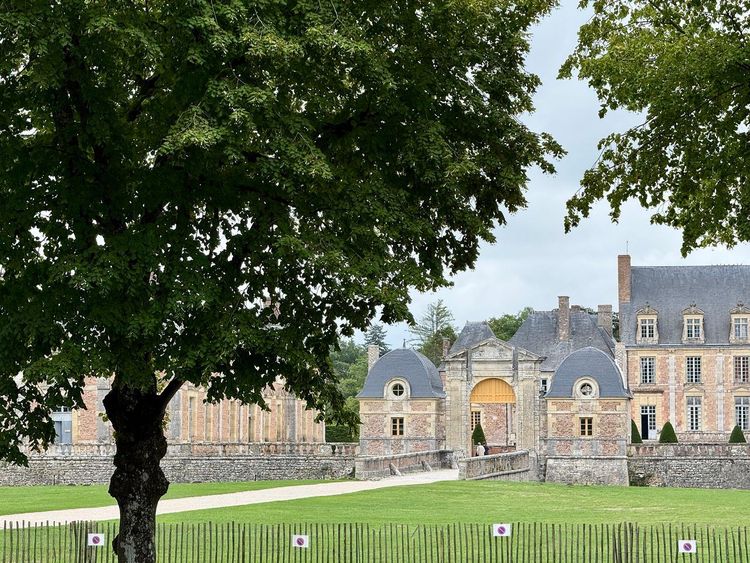
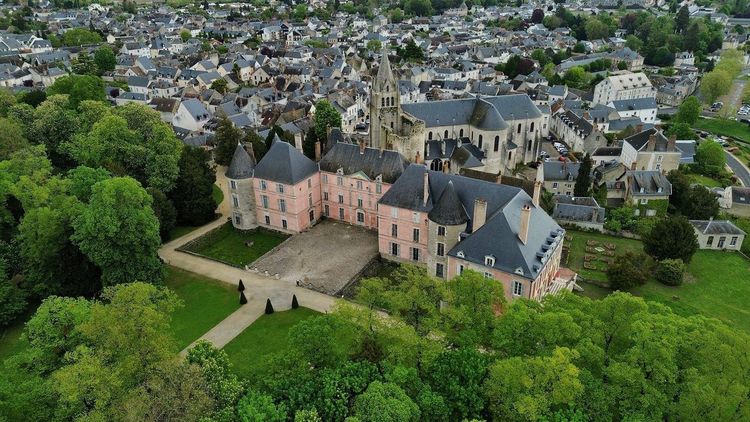
To the south, the Sologne and its ponds begin almost at the city's doorstep. The château de la Ferté-Saint-Aubin can be reached in about twenty minutes by TER on the Orléans–Vierzon line, then on foot from the station. With its pink brickwork and fully furnished outbuildings (kitchens, stables, bedrooms), it offers a more lived-in, less museum-like experience than the grand Loire châteaux, and is a great hit with children.
Further afield, the ZooParc de Beauval (avenue du Blanc, 41110 Saint-Aignan, rated 4.7/5 on Google from 100,438 reviews), one of the few French zoos to house giant pandas, requires more planning: take the train to Saint-Aignan-Noyers station (with a connection at Vierzon or Tours), then a shuttle or taxi. The visit takes a full day and should be planned in advance, as connections are less frequent on weekends.
To extend this type of day trip, the Ryo audio tour dedicated to the châteaux of the Loire slots easily into a train or coach journey: you listen to the history of each château just before you arrive, a real luxury when there is no one on board to narrate the landscape.
Nature and Fresh Air Without a Car: Forest, Parks, and Gardens
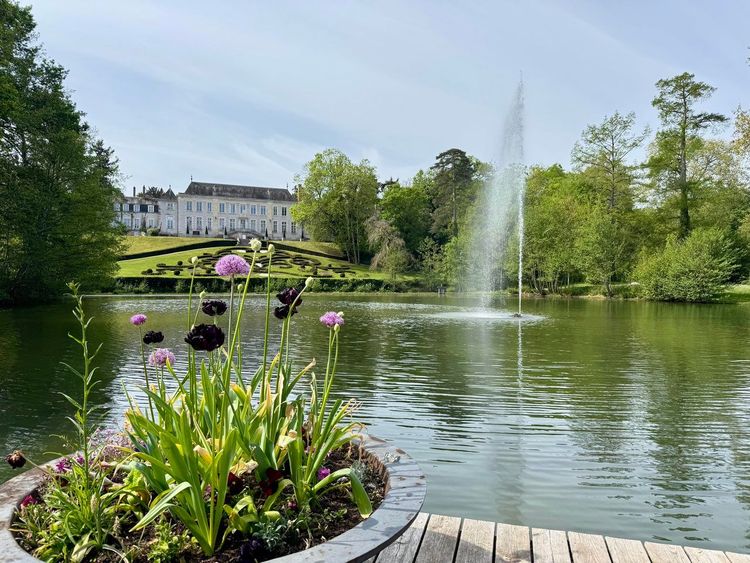
Forêt d'Orléans and Leisure Bases Accessible by Coach
At roughly 35,000 hectares, the forêt d'Orléans is the largest state forest in mainland France. Coaches serve several villages on its edge, notably Ingrannes, where the Arboretum des Grandes Bruyères is worth a detour for its collections of conifers and heathers. Marked trails can be explored on foot or by mountain bike hired in the city; with a little patience, you may spot the osprey, the forest's emblematic bird.
Closer in, the île Charlemagne, in Saint-Jean-le-Blanc, is the Orléanais' go-to leisure spot: a supervised swimming lake in summer, paths along the Loire, reachable by bus or bike from the center. You will also see, in Rémi brochures, the Bellebouche leisure base: it is located in the Brenne, in the Indre, and can only be reached in summer from Châteauroux, making it an impractical option from Orléans.
Parc Floral de la Source, Jardin des Plantes, and Parc Pasteur
Directly accessible by tram line A, the parc floral de la Source occupies the site where the Loiret springs from the ground, a resurgence of the Loire itself. Here you will find flamingos, a butterfly house, and seasonal bedding displays refreshed throughout the year. Allow half a day if you are travelling with children.
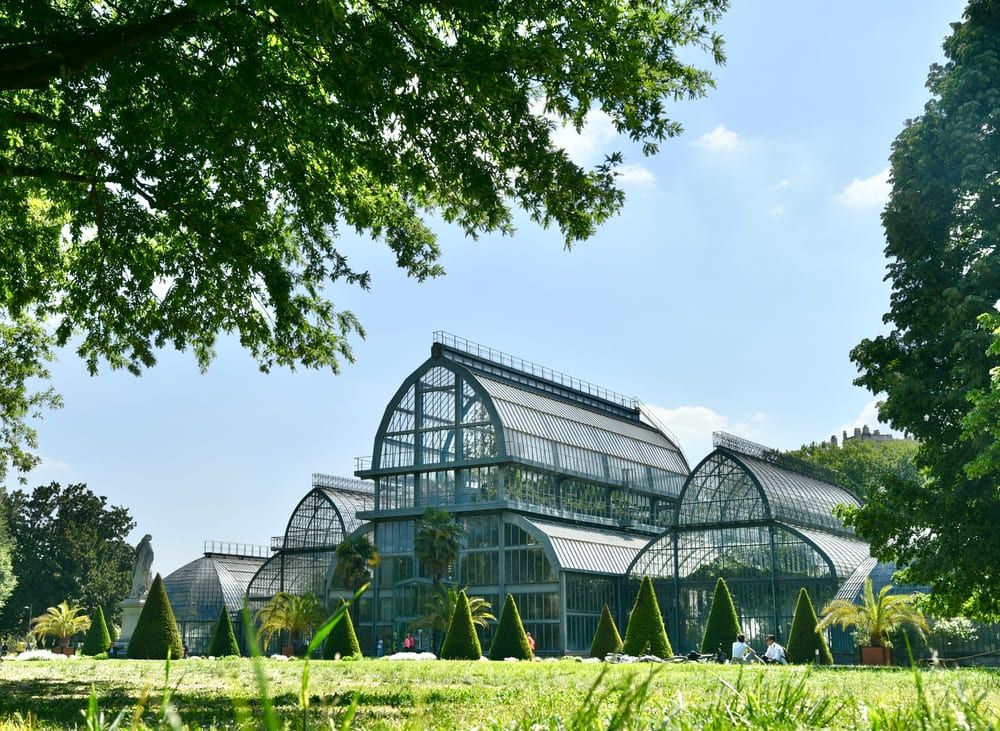
On the south bank, just past the bridge, the jardin des plantes offers a quiet pause with its 19th-century greenhouse and botanical beds. North of the center, parc Pasteur (boulevard Pierre-Ségelle, 45000 Orléans, rated 4.4/5 on Google from 2,911 reviews) adds playgrounds, tall trees, and a miniature train that delights the youngest visitors: for those who mostly want nature without leaving the city, these three addresses are more than sufficient.
In the Footsteps of Jeanne d'Arc in Orléans
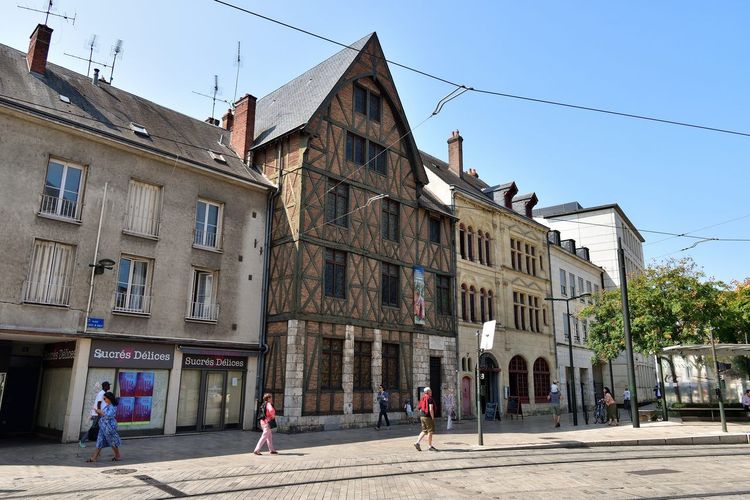
Orléans remains inseparable from Jeanne d'Arc, who lifted the city's siege on 8 May 1429 against the English forces. The event is celebrated every year from 29 April to 8 May during the Fêtes johanniques, with processions, a medieval market, and a son et lumière on the cathedral. If you can, time your visit to coincide with these dates. The maison de Jeanne d'Arc (3 place du Général-de-Gaulle, 45000 Orléans, rated 3.6/5 on Google from 1,854 reviews), a reconstruction of the home of Jacques Boucher where she lodged during the siege, features a scenographic display retracing those decisive days.
The equestrian statue on the place du Martroi, sculpted by Denis Foyatier and unveiled in 1855, extends this memory: it is impossible to cross the square without meeting her bronze gaze. Beyond Jeanne, Orléans witnessed the passage of many kings of France: a Capetian city from the outset, an appanage of the dukes of Orléans, it saw François II die at the Hôtel Groslot and hosted the Estates General of 1560.
An entire chapter of the Ryo audio tour tells the story of the siege of Orléans, pausing in front of the maison de Jeanne and then her statue, with anecdotes you generally do not have time to read on information panels.
Unusual and Off-the-Beaten-Path Visits in Orléans
Want to step off the classic circuit? Several playful formats are well worth it. The Detective Party turns a walk through the center into a full-scale investigation, with clues to track down in the urban landscape, like an outdoor escape game. A theatrical tour devoted to the secrets of medieval trades brings in costumed guides, a format that particularly appeals to children.
On the heritage side, the "Pause Patrimoine" tour offered by the Ville d'art et d'histoire label focuses on the contemporary stained-glass windows by Pierre Carron in the cathedral's chapels: their vivid colors enter into dialogue with the historic glazing, and the explanation of the artistic choices completely changes the way you read the building. In December, themed tours tell the story of Christmas in Orléans through the ages, alongside the Christmas market set up on the place du Martroi. These events vary from year to year: check the tourist office calendar before finalizing your dates.
A Brief History of Orléans: Between Legend and the Renaissance
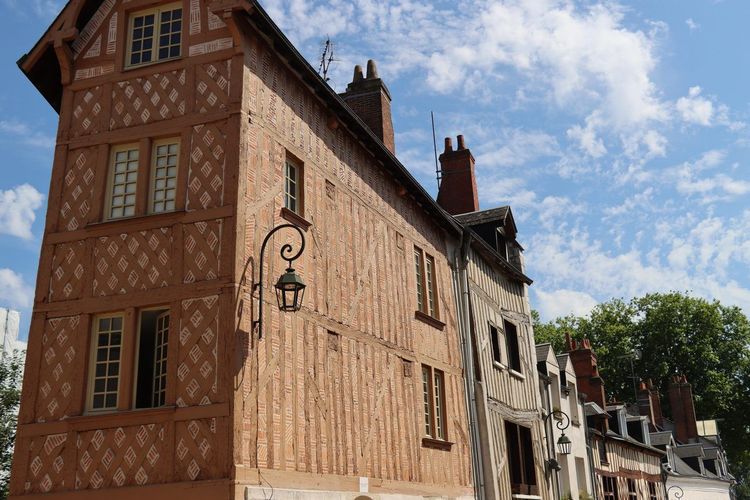
Gaulish Cenabum, then Roman Aurelianis, Orléans takes its name from the emperor Aurelian. Defended by Bishop Aignan against Attila in 451, it became under Clovis one of the key cities of the Frankish kingdom. In the Middle Ages and through the Renaissance, it flourished through its law university, recognized in 1306, which attracted the young Jean Calvin around 1528.
The city then enjoyed a less well-known prosperity in the 18th century, when its refineries transformed raw sugar from the West Indies, shipped up the Loire from Nantes, into sugar loaves sold across France: Orléans earned the nickname sugar capital, a wealth tied to colonial trade and slavery that guided tours now address without evasion.
The 20th century left darker marks: the bombings of June 1940 and again in 1944, before the city's liberation on 16 August 1944, destroyed part of the center, which was subsequently rebuilt. Among the city's notable women, Jeanne d'Arc often overshadows other figures — artists and resistance fighters alike — whom the Ville d'art et d'histoire label brings back into the light through themed tours. As for the strangest episode of the century, it is arguably the "rumeur d'Orléans" of 1969, studied by sociologist Edgar Morin and now a textbook case in the spread of rumors.
Orléans With Children, Without a Car
The city lends itself well to a family visit, as long as you pace the distances. The maison de Jeanne d'Arc and its scenographic display easily hold younger visitors' attention, as does the theatrical tour of medieval trades, which is designed to be participatory.
For outdoor time, parc Pasteur is a reliable choice for the very young, while the parc floral de la Source lets children run freely among the flowerbeds, with tram line A stopping right nearby. For older children, the cycle ride to Combleux — flat and largely traffic-free — works very well as a family outing, and the château de la Ferté-Saint-Aubin, twenty minutes by TER, tends to be a unanimous hit.
What to Do in Orléans When It Rains
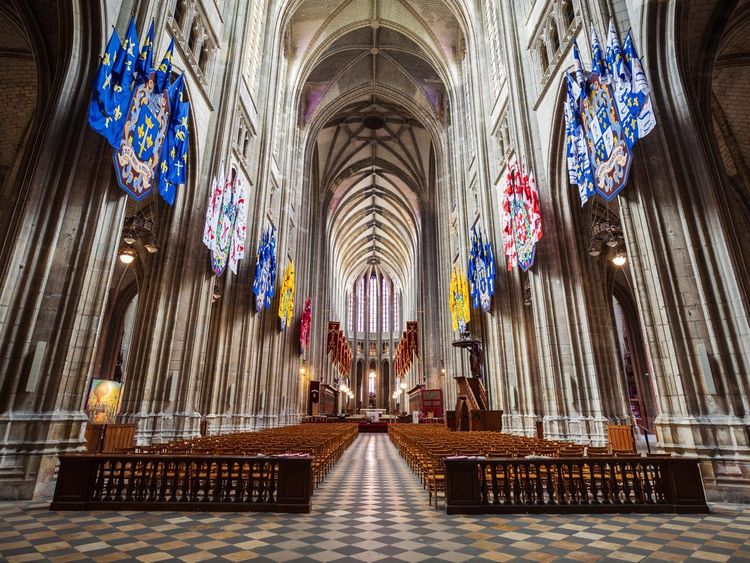
On rainy days, head for the indoor collections: the Musée des Beaux-Arts and the Hôtel Cabu together easily fill half a day, regardless of the weather. The cathedral remains freely accessible, and its vaults are even more impressive under a grey sky, when the light filtered through the stained glass becomes almost theatrical.
For contemporary art, the FRAC Centre-Val de Loire, housed in the Turbulences building and devoted to experimental architecture, rounds out the list nicely. All these venues can be reached on foot or by tram without ever needing an umbrella for more than ten minutes at a stretch.
Where to Eat in Orléans: Local Specialties and Good Addresses
Orléans has a few specialties you will not find elsewhere. Cotignac, a quince jelly set in small round wooden boxes, has been enjoyed as a confection since the late Middle Ages. More surprisingly, Orléans vinegar, produced by a slow fermentation process in oak barrels, made the city's reputation; the Maison Martin-Pouret has kept this method alive since the 18th century.
For the more food-oriented visitor: the halles Châtelet and the central markets are perfect for assembling a picnic to take to the Loire riverbanks. The restaurants around the cathedral and along the rue de Bourgogne cover a wide range, from traditional bistros to more creative tables, all accessible on foot from the station in under twenty minutes.
For wine lovers, the AOC Orléans and AOC Orléans-Cléry, little-known small vineyards, are making a comeback on local tables: a few wine merchants in the center offer tastings, a simple way to leave with a bottle without needing a car boot.
Getting Around Orléans Without a Car: Tram, Bike, and on Foot
The TAO network organizes mobility in Orléans around two tram lines. Line A connects Fleury-les-Aubrais in the north to La Source in the south, passing through the station and the center. Line B crosses the urban area from east to west, from Saint-Jean-de-Braye to La Chapelle-Saint-Mesmin, via the place du Martroi. A single ticket or a day pass covers the entire network, both tram and bus.
For short distances, walking is often the quickest option: allow about ten minutes between the station and the place du Martroi, the same again between the Martroi and the Musée des Beaux-Arts, and a quarter of an hour to reach the quays from the cathedral. The Vélo+ bike-share scheme complements the offer, with docking stations throughout the center and along the quays.
A practical tip: pick up the Orléans map at the tourist office on the place du Martroi, or download it before you set off. The historic center is fairly intuitive once you have identified the three or four main squares that define its layout.
Getting to Orléans Without a Car: Train, Coach, and Carpooling
From Paris, trains from Austerlitz station reach Orléans in about an hour, with frequent departures all day, including on weekends. Depending on the timetable, you will arrive at Orléans station (city center) or at Les Aubrais, connected to the center by a rail shuttle and by tram line A. This is by far the simplest option.
From Tours or Blois, the TER follows the Loire in one to one and a half hours; from other major cities, connections generally pass through Paris or Tours. The Rémi coach network, operated by the Centre-Val de Loire region, takes over for villages without a station. Carpooling remains a credible alternative from neighboring départements that are less well served by rail.
Where to Stay in Orléans Without a Car
Without a car, prioritize accommodation within the station–center–tram triangle rather than on the outskirts. Hotels near the station offer the logistical advantage of dropping your bags within minutes of stepping off the train, with direct tram access to explore from there.
The historic center, around the cathedral and the Martroi, concentrates more characterful addresses and guesthouses in old buildings, with the advantage of doing everything on foot in the evenings. More peripheral neighborhoods, such as La Source, make sense mainly if you plan to spend time in parks and gardens, as tram line A links them directly to the center.
When to Visit Orléans and How Long to Plan
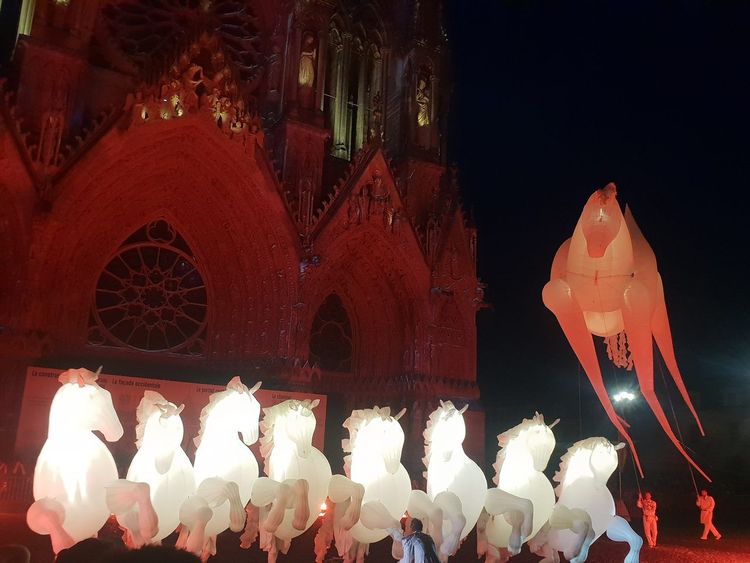
Spring, around the Fêtes johanniques at the end of April and early May, and early autumn offer the best compromise between mild weather and manageable crowds. In odd-numbered years, the Festival de Loire, a gathering of traditional boats on the quays in late September, is a reason to visit in its own right. Summer remains pleasant for river-based activities, provided you can handle the heat on the quays.
In terms of duration, one day covers the essentials of the historic center, cathedral and Martroi included, but leaves little room for spontaneity. Two days are enough to add museums and parks at a relaxed pace. To fit in a train trip to the châteaux or the cycling outing to Combleux, allow three full days: that is the format that makes the most of this guide's car-free logic.
Budget and the Orléans City Pass: a Good Deal Without a Car
Sold by the tourist office, the Citypass Orléans Val de Loire bundles public transport, museum admissions, and guided tours into a flat-rate ticket valid for one or more days (check the exact contents for the current year on the tourist office website). For car-free visitors who take the tram several times a day, the equation quickly becomes attractive: add up a tram day pass, entry to the Musée des Beaux-Arts, and entry to the Hôtel Cabu, and you are already approaching the price of the pass.
Over two or three days, the advantage grows if you add a guided tour. The calculation is still worth doing on a case-by-case basis: if you favour the Loire à Vélo and the parks, which are often free, you will find less direct value in it. Also bear in mind that many sites (cathedral, Hôtel Groslot, gardens) cost nothing.
FAQ
Can you visit Orléans without a car?
Yes, and it is actually the most comfortable option: the historic center is compact, largely pedestrianized, served by two tram lines, and the station is a ten-minute walk from the place du Martroi.
How much time should you plan to visit Orléans without a car?
One day covers the historic center, two days allow you to add museums and parks, and three full days also include a train trip to Beaugency or Meung-sur-Loire or a cycling outing along the Loire.
How do you get around Orléans without a car?
The TAO tram network (lines A and B) covers most of the urban area, complemented by Vélo+ bike-share and walking, as most historic sites are less than 20 minutes apart on foot.
How do you get to Orléans without a car from Paris?
Trains from Paris-Austerlitz reach Orléans in about one hour, with frequent departures throughout the day, including on weekends.
Is the Orléans City Pass really worth it?
The Citypass Orléans Val de Loire becomes worthwhile as soon as you combine several tram rides and at least two museum visits in a single day; for a trip focused on nature and cycling, the financial benefit is less clear.
What is the best time to visit Orléans?
Spring, particularly late April and early May around the Fêtes johanniques, and early autumn offer the best balance between pleasant weather and moderate crowds.
Where are the most beautiful half-timbered houses in Orléans?
They are concentrated around the rue de Bourgogne, the place du Châtelet, and the rue de la Charpenterie, between the cathedral and the Loire quays.
All in all, visiting Orléans without a car is no constraint at all: it is rather the ideal scale for this Loire city, designed for walking from its medieval heart to the riverbanks. Whether you stay for a day or push on to the nearby châteaux by train, the tram and your own two feet are more than enough. And if you prefer a voice that tells the story rather than a paper guide, the Ryo audio tour of Orléans connects all these places across 23 stops without ever losing the thread of history.
À lire également