© Shutterstock
 Votre guide Ryo
Christmas Markets in Vienna in 2026: Rathausplatz, Schönbrunn and 13 Other Austrian Gems
Cross Michaelerplatz on a December evening and you'll see that Vienna takes Christmas seriously: the smell of mulled wine and roasted chestnuts clings to the cobblestones until January. In this city, Christmas markets in Vienna number in the dozens, some taking over entire squares in front of imperial palaces, others tucked into a single cobbled lane. Our Ryo audio-guided tour of Vienna passes through several of these neighborhoods, making it easy to link the major markets without pulling out a map between two chalets.
The Christkindlmarkt at Rathausplatz lines up more than 150 chalets beside an illuminated ice rink, the Art Advent at Karlsplatz accepts only handmade pieces, and the Belvedere market serves Glühwein with the palace's baroque gardens spread out below. From grand monumental squares to quieter gardens and neighborhoods of cobbled lanes, this guide covers 15 Viennese Christmas markets, their 2026 dates, their特 features and everything you need to plan your December evenings without wasting time.
The Rathausplatz Christmas Market, Vienna's Largest and Most Iconic
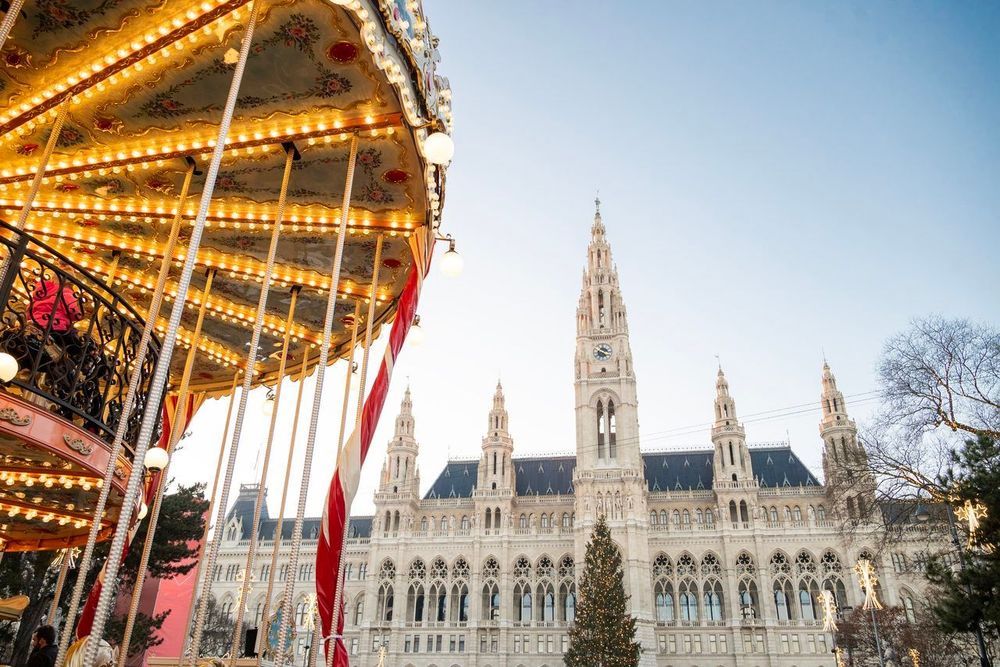
The Rathausplatz (Rathausplatz, 1010 Vienna, rated 4.7/5 on Google from 46,778 reviews), the vast square stretching in front of the neo-Gothic city hall, hosts Vienna's largest Christmas market each year, the Wiener Christkindlmarkt, part of the festive Wiener Weihnachtstraum, literally "the Viennese Christmas dream." In 2026, it opens on November 13 and closes on December 26, daily from 10am to 10pm (6:30pm on December 24). More than 150 wooden chalets set up shop here, selling mulled wine, hand-painted figurines and gingerbread beneath strings of lights stretched between the trees.
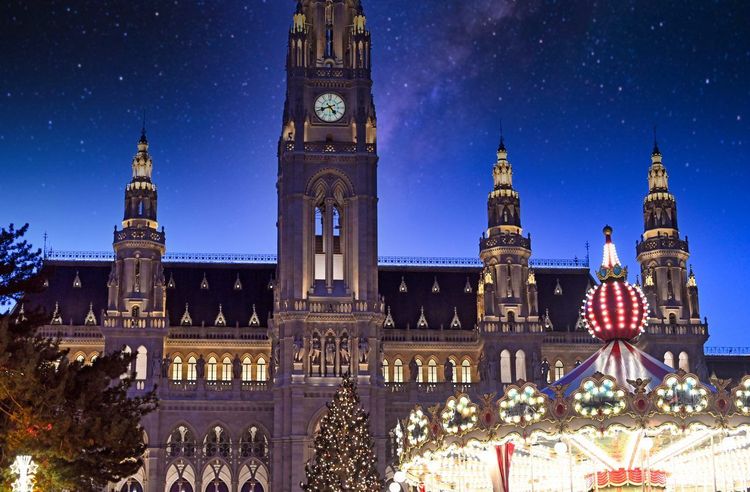
After dark, the illuminated façade of the city hall becomes the backdrop for every photo. Right next to it, the Eistraum ice rink winds between the trees of the Rathauspark and stays open until January 6: families mingle with groups of friends who have come simply to sip a Punsch between laps.
This market is about more than its size. In the city hall's Volkshalle, workshops let children bake Christmas cookies or make small decorations, which explains its reputation as a family gathering as much as a festive one.
Travel guides regularly rank it among Europe's most beautiful Christmas markets, alongside those of Strasbourg or Nuremberg. The setting contributes a great deal: the neo-Gothic city hall on one side, the Burgtheater on the other, and the University of Vienna just steps away, literally framing the scene.
If possible, avoid the weekend slot between 5pm and 8pm, when crowds make it hard to move between the chalets. A weekday visit in late morning lets you enjoy an almost empty market and take your time at every stall.
Our Ryo audio-guided tour of Vienna passes through this square: several stops comment on the neo-Gothic façade of the city hall and explain why this part of the Ring concentrates so many symbols of power, a clever way to pass the time before your turn at the mulled wine chalet.
The square is a short walk from the Rathaus metro station on line U2, in the heart of the Ring, the circular avenue that encircles Vienna's historic center.
The Christmas Market at Schönbrunn Palace
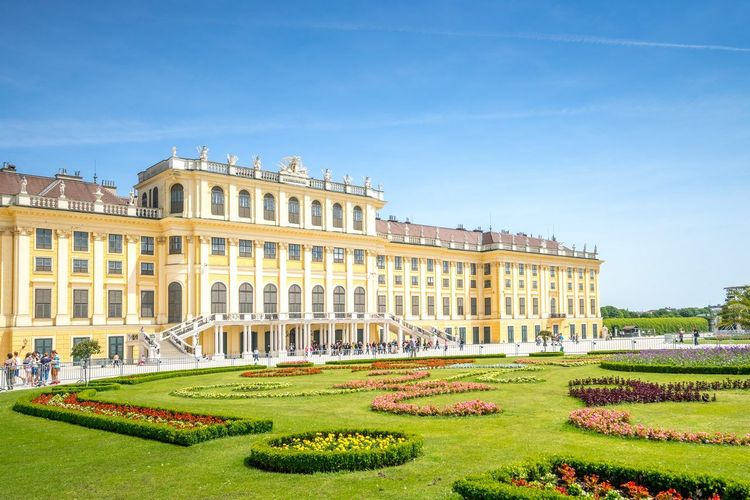
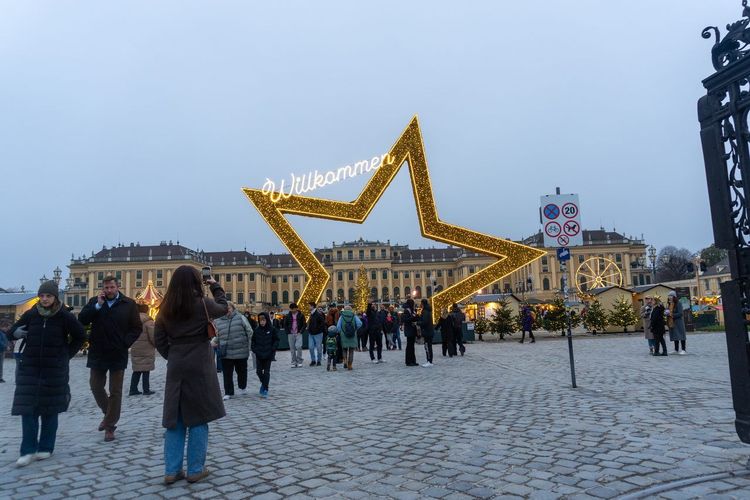
In front of the yellow façade of Schönbrunn Palace (Schönbrunner Schloßstraße 47, 1130 Vienna, rated 4.7/5 on Google from 186,942 reviews), the Habsburgs' UNESCO World Heritage summer residence, a more intimate Christmas market sets up each year in the main courtyard. It is also the longest of the season: from November 6, 2026 to January 6, 2027, from 10am to 9pm. The imperial setting radically changes the atmosphere: here, no Ferris wheel or giant ice rink, but rows of wooden chalets lined up facing the palace entrance.
You'll mostly find local crafts, blown-glass decorations and a children's area. The Tiergarten Schönbrunn, founded in 1752 and considered the oldest zoo in the world still in operation, is located in the adjoining park if you want to extend your outing during the day.
Allow a good hour on site if you combine the market with a stroll in the palace park, which is free to enter: the walk is worth the detour even without a ticket for the palace interior.
Unlike the markets in the city center, this one is visited more for the setting than for shopping: most of the appeal lies in the illuminated façade and the perspective that climbs toward the Gloriette, the pavilion overlooking the gardens.
Art Advent at Karlsplatz, the Artistic and Organic Market
On Karlsplatz (Karlsplatz, 1040 Vienna, rated 4.4/5 on Google from 1.2K reviews), facing the green dome of the Karlskirche, Art Advent stands out for one simple rule: no mass-produced items are tolerated. Ceramicists, glassmakers and jewelers sell only their own pieces, in chalets that look more like workshops than stalls.
On the food side, the market claims an almost entirely organic orientation: organic mulled wine, additive-free pastries, soups made with regional products. It's a selling point that few other markets in the city highlight as much.
If you're looking for an original gift rather than a tourist trinket, this is probably the most suitable Christmas market in Vienna: prices are higher than elsewhere, but every piece is unique.
The K&K Christmas Market at Belvedere Palace
In front of the Upper Belvedere, one of the two baroque buildings of Belvedere Palace (Prinz-Eugen-Straße 27, 1030 Vienna, rated 4.7/5 on Google from 91,702 reviews), the former summer residence of Prince Eugene of Savoy, the "K&K" market (Kaiserlich und Königlich, meaning "imperial and royal") enjoys one of the finest panoramas over Vienna. From the upper terrace, the whole city unfolds behind the French-style gardens.
The chalets, fewer in number than at Rathausplatz, focus on a more upscale selection: painted porcelain, silver jewelry, Austrian spirits. The atmosphere remains calm even in high season, far from the density of the historic center.
Come in the late afternoon to enjoy the fading light over the gardens before nightfall, then finish with a mulled wine with a view of the city.
The Altwiener Christkindlmarkt at Freyung, the Old-Fashioned Market
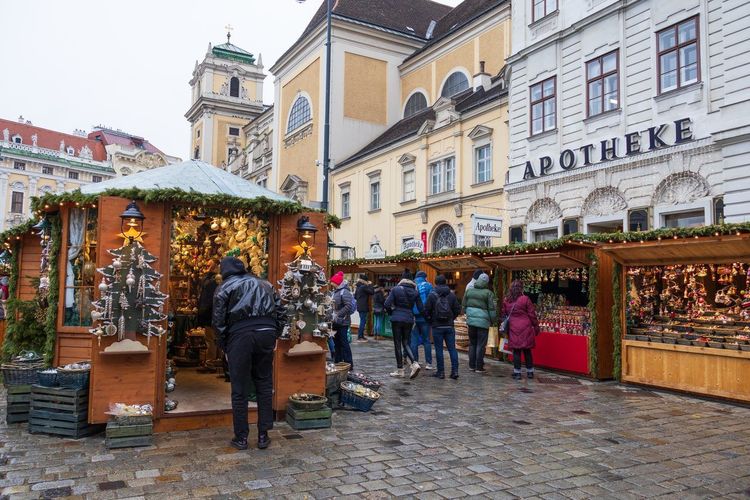
On the small square of Freyung (Freyung, 1010 Vienna), surrounded by baroque palaces, the Altwiener Christkindlmarkt claims the title of Vienna's most authentic Christmas market. The chalets mainly sell traditional handcrafted items: hand-carved nativity figurines, embroidered tablecloths, wooden toys.
The small size of the square limits the number of simultaneous visitors: it's one of the few markets in the city center where you can still wander without elbowing your way through the crowd.
The craftspeople are often there in person, which changes the nature of the exchanges. You chat about production techniques as much as you buy.
The Christmas Village at Stephansplatz, at the Foot of the Cathedral
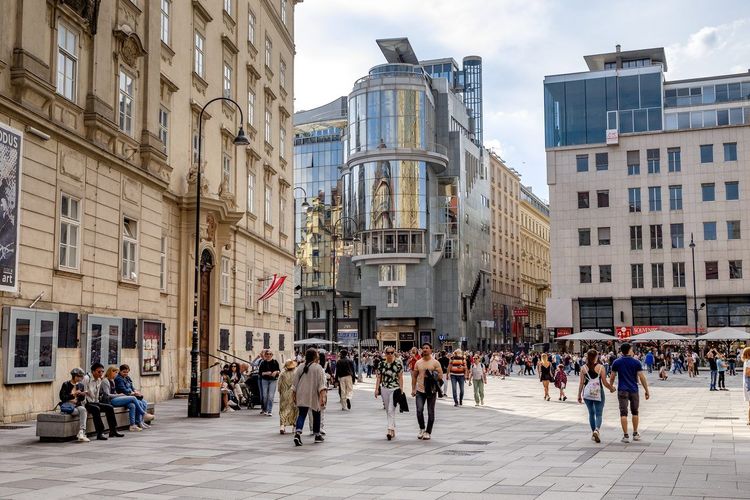
At the foot of St. Stephen's Cathedral, whose Gothic spire dominates the entire historic center, a small Christmas village occupies a portion of Stephansplatz (Stephansplatz, 1010 Vienna, rated 4.7/5 on Google from 60K reviews). Only a few dozen chalets, but a location that makes all the difference: it's impossible to visit the heart of Vienna without stumbling upon this market.
You'll mainly find light bites and a few souvenirs. Think of it as a stop along the way rather than a destination in itself.
The Ryo audio-guided tour The Empress of Austria, the short version of our Vienna audio guide, leads to the foot of this cathedral: a simple way to combine a visit to the market with the history of the monument towering above it.
The Spittelberg Christmas Market, the Most Original and Artisanal
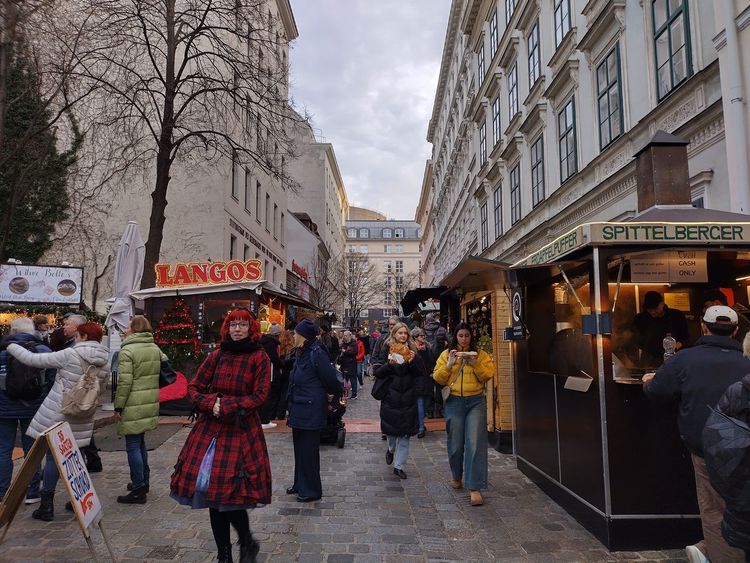
In the cobbled lanes of the Spittelberg neighborhood (Spittelberggasse, 1070 Vienna, rated 4.5/5 on Google from 3K reviews), lined with Biedermeier houses with colorful façades, the Christmas market literally slips in between the homes. There's no big square here: the chalets stretch along several pedestrian streets, giving a sense of strolling rather than a classic visit. Note that it closes earlier than the others, on December 23.
The offering is resolutely artisanal: ceramics, textiles, jewelry and original illustrations, far from standardized souvenirs. Many Viennese prefer it for this reason, even if it means giving up the grandeur of Rathausplatz.
Come on a weekday in the late afternoon (it opens at 2pm Monday to Friday): the narrow lanes quickly become overcrowded on weekends.
With the Ryo Vienna audio guide in your ears, these lanes take on another dimension: one stop tells the story of the neighborhood's Biedermeier houses, once inhabited by craftspeople, now turned into workshops and small restaurants.
Unusual Christmas Markets in the Center: MuseumsQuartier, Am Hof and Schwarzenberg Square
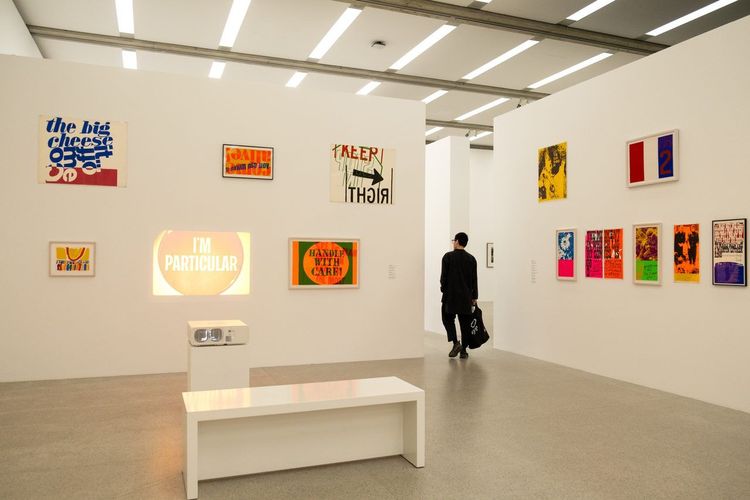
In the courtyard of the MuseumsQuartier, an immense cultural complex that brings together several modern art museums, the Christmas market takes on a resolutely contemporary tone. Pavilions with sleek design, light installations rather than classic garlands, sound performances on certain evenings: it's the Christmas market in Vienna furthest from the postcard image.
A few streets away, on the square of Am Hof (Am Hof, 1010 Vienna), one of Vienna's oldest, the market plays a totally different register: stalls of jewelry, glass decorations and religious objects, in a baroque setting that has remained almost intact for centuries.
On Schwarzenberg Square, further off toward the south of the center, the market relies on a calmer atmosphere: fewer chalets, more space between them, and the Hochstrahlbrunnen, an illuminated monumental fountain that serves as a landmark at night.
These three markets largely escape the crowds of the big tourist squares. If you've already visited Rathausplatz and are looking for a different atmosphere without leaving the city center, this trio makes the most logical itinerary for a second evening.
Several stops on our Ryo audio-guided tour of Vienna line these less-visited squares, with anecdotes about the architecture of the MuseumsQuartier and about the history of Am Hof square, one of the oldest in the Austrian capital.
Christmas Markets in Vienna's Parks and Gardens
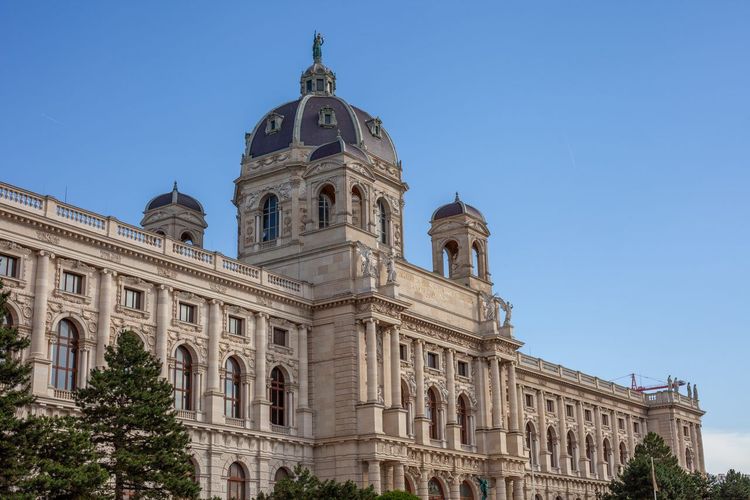
Between the two twin museums of Maria-Theresien-Platz, the Weihnachtsdorf ("Christmas village") stands out for its refinement: light-wood chalets, understated decoration, an atmosphere many consider the most elegant in the city. The statue of Empress Maria Theresa, at the center of the square, looks over the whole scene.
In the Prater park, at the foot of the Wiener Riesenrad Ferris wheel, the Wintermarkt enjoys a unique setting: you can ride the illuminated Ferris wheel and then head straight down to the chalets without leaving the park. The atmosphere is more funfair than heritage, ideal for a family outing, and the market stays open until January 6.
Farther from the center, in the 22nd district, the Hirschstetten flower gardens host a Christmas exhibition in greenhouses, along with a small market open Thursday to Sunday: tropical plants decorated with garlands, a rather striking contrast with the Viennese cold of December.
On the historic campus of the University of Vienna, in the former general hospital (Altes AKH), a Christmas village fills the large inner courtyard with Austrian craft stands and prices often gentler than in the center.
Farther northwest, the Türkenschanzpark (Türkenschanzpark, 1180 Vienna, rated 4.8/5 on Google from 7,195 reviews), a large landscaped park popular with Viennese, hosts a market of about twenty exhibitors, designed for local residents, with rides and workshops for children on weekends.
If you're staying more than two or three days in Vienna, these five off-the-beaten-path spots let you vary the atmospheres without visiting the same market twice.
Atmosphere and Traditions of the Viennese Christmas Markets
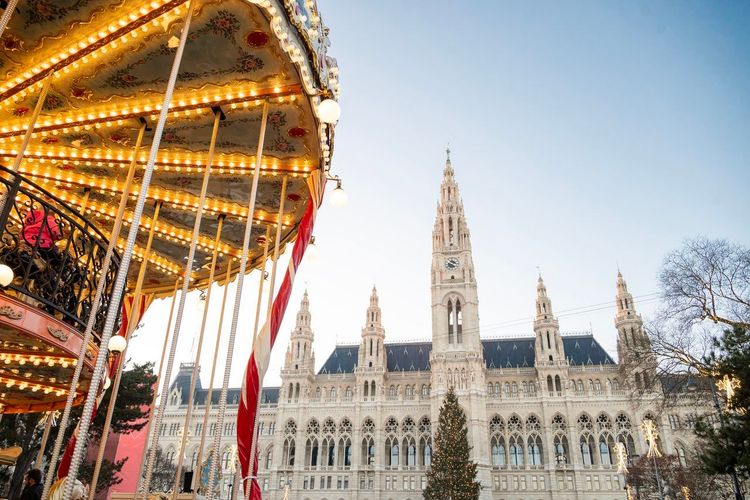
What sets Christmas markets in Vienna apart from those in other major European cities is less their size than their setting: most are set up in front of palaces or imperial monuments, giving the whole an almost solemn atmosphere despite the festive side. Mulled wine, called Glühwein or sometimes Punsch depending on the mix, is drunk from decorated mugs specific to each market, served against a deposit: return it or keep it as a souvenir.
December is also the season of Advent concerts. Several churches in the center, more than one just steps from the major markets, host classical music concerts in the evening, often free or modestly priced. The lights are not limited to the markets: the Graben and the Kärntner Straße, the two great shopping arteries of the center, are dressed each year in decorations hung above the street.
If the cold becomes too sharp, several historic cafés around Rathausplatz and Stephansplatz stay open late: warming up there with a hot chocolate is as much a part of the experience as the markets themselves.
Our Ryo article on winter in Austria details other ways to enjoy the cold season, from ice rinks to thermal baths and walks in the snow, for travelers staying longer than a weekend.
What to Eat and Buy at the Vienna Christmas Markets
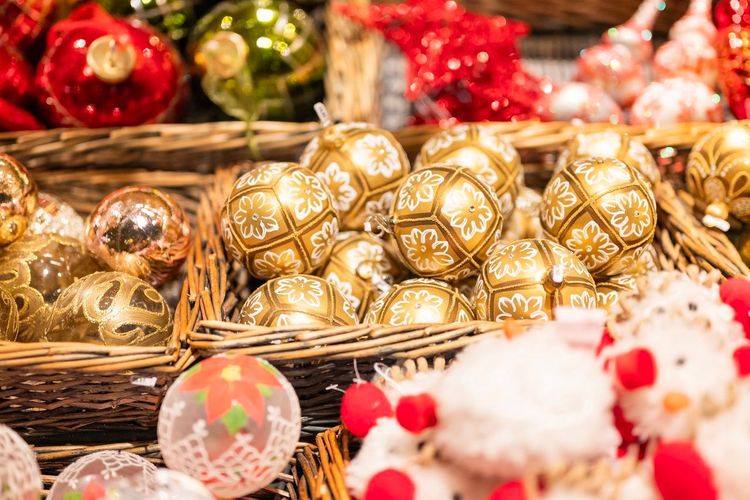
As for drinks, Glühwein (mulled wine) and Punsch (often higher in alcohol, sometimes with no wine at all) share the spotlight. Each market offers its own recipe, with some chalets even listing several variants depending on the spices used.
As for treats, gingerbread (Lebkuchen), Maroni (roasted chestnuts sold right on the street) and Kiachl, yeast-dough fritters served sweet with jam or savory with sauerkraut, are among the classics. The sweet-toothed will also look for Punschkrapfen, small pink-glazed cakes soaked in rum.
For gifts, handicrafts largely outweigh industrial production at most of the markets presented above: ceramics, candles, silver jewelry, blown-glass decorations. The Art Advent at Karlsplatz and the Altwiener Christkindlmarkt at Freyung remain the best places for this kind of purchase.
To go further, our Ryo article on Viennese culinary specialties details ten typical dishes to try in Vienna, well beyond the Christmas markets.
Practical Information: Dates, Hours, Access and Budget
Most Christmas markets in Vienna open between early and mid-November (from November 6, 2026 at Schönbrunn, and November 13 at Rathausplatz and Spittelberg) and close between December 23 and 26. Schönbrunn and the Prater Wintermarkt run into extra time until January 6. Usual hours run from 10am or 11am until 9pm or 10pm, with an early closing on December 24.
Entry to the markets is free everywhere, including at Rathausplatz or in front of the Belvedere: only the additional attractions (ice rink, Ferris wheel ride) are paid separately.
Expect to pay between 4 and 6 euros for a mulled wine depending on the market, plus a deposit of a few euros for the mug, and 3 to 5 euros for a quick bite. An evening across two or three markets, drinks and snacks included, generally comes to around 20 to 30 euros per person.
Vienna remains a highly sought-after destination in December, especially on weekends. Booking flights and accommodation six to eight weeks before departure spares you the price increases of the final weeks, which are particularly steep around the first Advent weekends.



FAQ
When do the Vienna Christmas markets open?
Most open between early and mid-November: on November 6, 2026 at Schönbrunn and on November 13 at Rathausplatz. They close between December 23 and January 6 depending on the location; Rathausplatz stays open until December 26.
What is the most beautiful Christmas market in Vienna?
It's hard to say: Rathausplatz remains the benchmark for its scale, but the Schönbrunn Palace market and the Belvedere Palace market offer settings that many visitors find more spectacular.
Is Vienna a good destination for Christmas markets?
Yes: the city has around fifteen distinct markets within a relatively compact area, with very different atmospheres from one neighborhood to the next, allowing you to vary your visits over several days without repeating yourself.
Do you need to book your trip to Vienna in advance?
It's recommended, especially for December weekends. Booking flights and accommodation six to eight weeks before departure generally helps you avoid the highest prices.
Are the Vienna Christmas markets free?
Entry to the markets is free everywhere. Only some additional attractions, such as the Rathausplatz ice rink or the Prater Ferris wheel ride, are paid separately, not to mention the deposit on the mulled wine mugs.
What should you buy at the Vienna Christmas markets?
Handicrafts dominate: ceramics, candles, silver jewelry and blown-glass decorations. The Art Advent at Karlsplatz and the Altwiener Christkindlmarkt at Freyung remain the most reliable places for this kind of purchase.
What specialties should you eat at a Viennese Christmas market?
Glühwein and Punsch are the must-have drinks. As for food, gingerbread, roasted chestnuts and Kiachl, Viennese fritters, are among the classics to try.
Vienna in December lives up to its reputation: between Rathausplatz and its 150 chalets, the Belvedere and its view over the city, and the lanes of Spittelberg where it's easy to get happily lost, there is plenty to fill several evenings without ever visiting the same market twice. The difficulty is not finding a Christmas market in Vienna, but choosing which one to visit first.
To link several of these neighborhoods without wasting time between two markets, our Ryo audio-guided tour of Vienna is the simplest solution: just walk, listen, and stop as soon as a mulled wine chalet appears along the way.
À lire également