© Shutterstock
 Votre guide Ryo
Visiting Athens in 2 Days: The Complete Itinerary, from the Acropolis to Mount Lycabettus (2026)
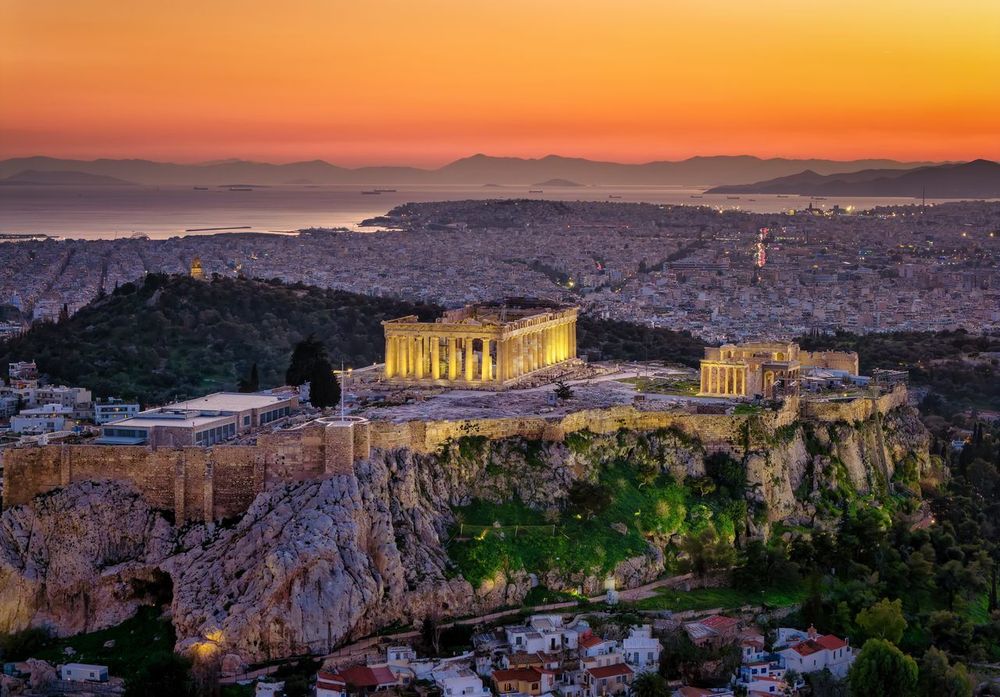
Twenty-four hours are never enough in Athens, but forty-eight well-organized hours allow you to travel through 2,500 years of history without rushing from one site to the next. To visit Athens in 2 days, everything happens within a few square kilometers: a UNESCO-listed ancient site, neoclassical lanes clinging to the slopes of the Acropolis, and a modern center where the presidential guard still parades in pleated skirts. This guide offers a chronological itinerary, half-day by half-day, from the Parthenon to sunset atop Mount Lycabettus, taking in the steep alleys of Anafiotika and the souvlaki aromas of Monastiraki along the way.
In 48 hours, you can climb the Acropolis before the 9 a.m. crowds arrive, have lunch at a Plaka taverna for around fifteen euros, watch the changing of the guard in front of Parliament on the hour, and end the day with the entire city lit up at your feet from 277 meters above sea level. If you prefer a voice in your ear to a paper guide, the Ryo Athens audio guide tour unfolds across 29 audio tracks over 3 hours 20 minutes and 8.2 km, from the Parthenon to the Agora, narrating the shift from Classical Greece to the Roman Empire. You will also find here 2026 prices, the best neighborhoods to stay, recommended restaurants, and an estimated budget. Here is how to organize these two days, neighborhood by neighborhood.
Day 1 (Morning): The Acropolis, the Parthenon, and the Ancient Agora
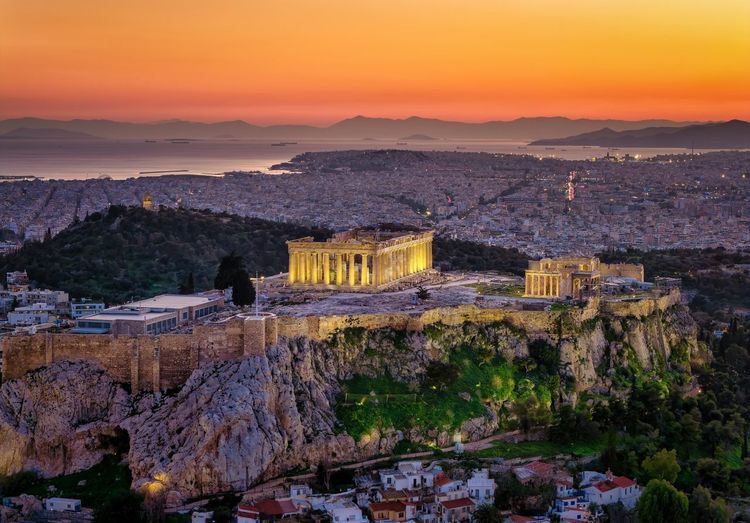
It takes about forty minutes to reach the top of the Acropolis from the main entrance, and it is the best time investment of the entire stay. Right at opening time, before tour groups flood the Propylaea, the raking light on the Pentelic marble gives the Parthenon an almost rosy hue. This first morning is devoted entirely to this sacred rock and its immediate surroundings: the temple, its dedicated museum, and the remains of the Agora where Socrates debated with his disciples.
The Acropolis and the Parthenon
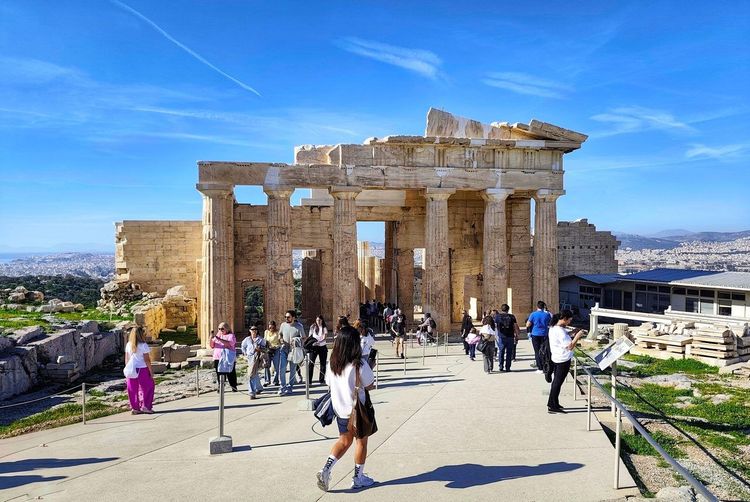
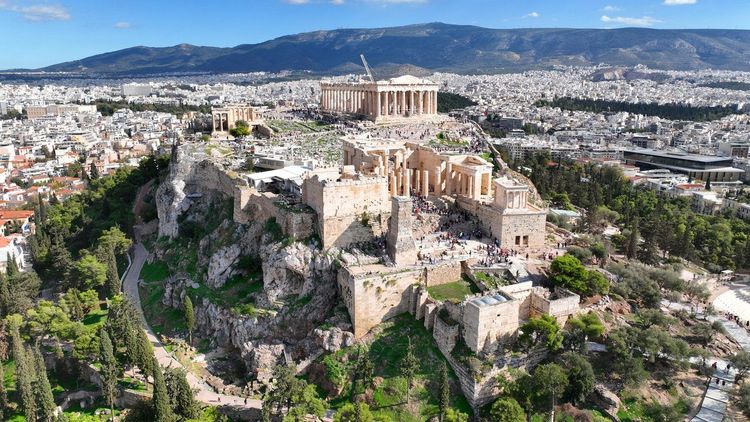
The Acropolis of Athens rises to about 150 meters above sea level and groups together several major monuments: the Parthenon, the Erechtheion with its Caryatids, the Propylaea, and the Temple of Athena Nike, with the Odeon of Herodes Atticus on the slope below. The site opens at 8 a.m. and takes 1.5 to 2 hours to visit depending on crowd levels. In summer, the heat builds quickly on this shadeless plateau: it is best to arrive at opening time or two hours before closing.
The Parthenon has dominated the site since 447 BCE. Built over roughly fifteen years under the supervision of Phidias, with architects Ictinus and Callicrates, it has served in turn as a temple to Athena, a Byzantine church, and an Ottoman mosque. In 1687, the Ottomans were storing gunpowder inside it: a Venetian cannonball fired during the siege of the city caused an explosion that tore off the roof and part of the frieze. The cranes that seem to permanently occupy one wing of the monument are not a forgotten construction project: they belong to a restoration program launched in 1975 that is still ongoing.
Book your skip-the-line ticket online with a time slot several days in advance from April to October. Since 2025, entry to the Acropolis and its slopes costs 30 euros, and the old multi-site combined ticket has been abolished: each site is now paid for separately. The ticket does, however, include the south slope, meaning the Theatre of Dionysus.
Before heading back down, make a detour to the Areopagus, the polished rock located just below the entrance. Access is free, the stone is slippery (grippy-soled shoes are recommended), and the view over the Agora and the rooftops of Plaka is just as beautiful as from the summit, without the crowds.
The Acropolis Museum
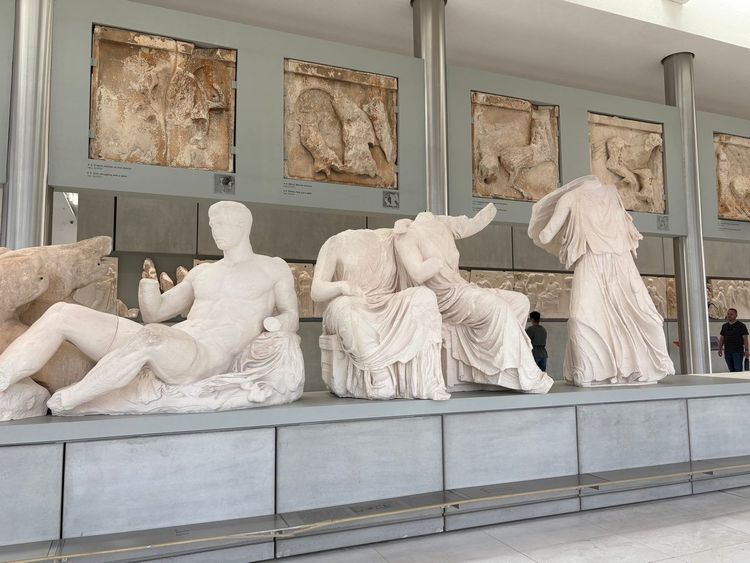
Head back down via the south slope to reach the Acropolis Museum (Dionysiou Areopagitou 15, Athens 117 42, rated 4.7/5 on Google based on 85,202 reviews), a few hundred meters away. Opened in 2009, the glass-and-concrete building designed by Bernard Tschumi lines up the Parthenon friezes on the top floor in exactly the same orientation as the original monument.
Allow 1.5 hours for the visit and 20 euros for full-price admission in high season. The glass floor at the entrance lets you look down at the excavations of an ancient neighborhood beneath your feet — a surprise for visitors in a hurry. You will also see five of the six original Caryatids from the Erechtheion: the sixth is at the British Museum, and those supporting the temple on the Acropolis are replicas.
The second-floor café-restaurant also offers one of the finest views of the Parthenon, drink in hand.
The Ancient Agora and the Roman Agora
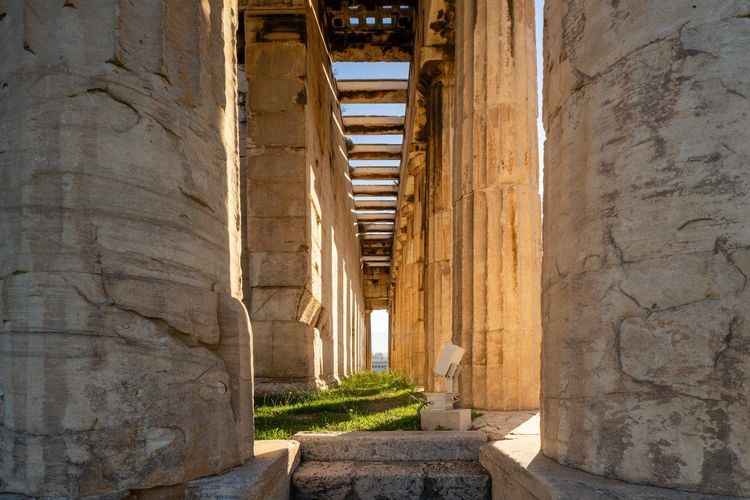
Leaving the museum, circle around the rock to the west to reach the Ancient Agora, the political and commercial heart of the city for centuries. This is where Socrates would engage passersby in conversation, while the people's assembly met on the nearby Pnyx. The Temple of Hephaestus, one of the best-preserved in all of Greece, has overlooked the site since the 5th century BCE, and the Stoa of Attalos, reconstructed in the 1950s, houses a small museum. Allow around 20 euros for admission.
Ten minutes' walk to the east, the Roman Agora tells a different story: that of Athens under Roman rule, when Julius Caesar and then Augustus funded a new marketplace. The Tower of the Winds, octagonal and decorated with reliefs depicting the eight winds, served simultaneously as a sundial, a weather vane, and a hydraulic clock. Allow around ten euros for this second site, less than 200 meters from the Plaka terraces where you will have lunch.
To prepare for this morning, our guide to visiting the Acropolis details time slots and access. On the ground, the Ryo Athens audio guide takes over: its 29 stops trace 2,500 years of history, from the Parthenon to the Agora, without you having to squint at a sign between flights of steps.
Day 1 (Afternoon): Plaka, Anafiotika, and Monastiraki
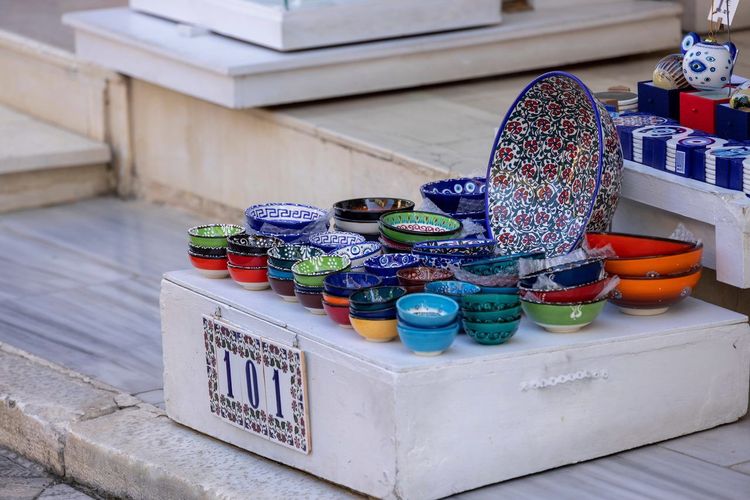
The afternoon shifts into a completely different Athens: one of cobbled lanes, bougainvillea, and shaded terraces. From the Roman Agora, a short walk east is all it takes to enter Plaka, the oldest continuously inhabited neighborhood in the Greek capital.
Plaka, the Historic Quarter with Cycladic Lanes
Plaka spreads across the north and east slopes of the Acropolis, a maze of largely pedestrianized lanes. Long neglected and overrun by nightclubs, the neighborhood underwent an extensive protection and restoration program from the 1970s and 1980s onwards, which restored its neoclassical village character.
Wander without a fixed route for an hour: it is the best way to discover Plaka. 19th-century houses sit alongside Byzantine churches, and some ceramics or handmade sandal shops have been run by the same family for several generations.
Avoid the tavernas planted on the most touristy streets, such as Adrianou and Kydathineon, where prices soar: the best spots are often tucked into the perpendicular lanes, barely 50 meters away.
Anafiotika, the Little Village Within the City
Climb another hundred meters or so beneath the north face of the Acropolis to reach Anafiotika, a tiny enclave unlike anything else in Athens. White houses, narrow staircases, and pots of geraniums are strongly reminiscent of the Cyclades — and that is no coincidence.
The neighborhood was born during the reign of King Otto, in the mid-19th century, when workers from the island of Anafi arrived to work on the royal palace construction site. They built their homes in the style of their native island, and legend has it that they would raise the walls in a single night, following an old custom that forbade demolishing a completed house before sunrise.
The lanes do not always have names and some end in dead ends: keep an offline map handy rather than relying on GPS. And keep your voice down — families still live behind those blue shutters.
Monastiraki and the Library of Hadrian
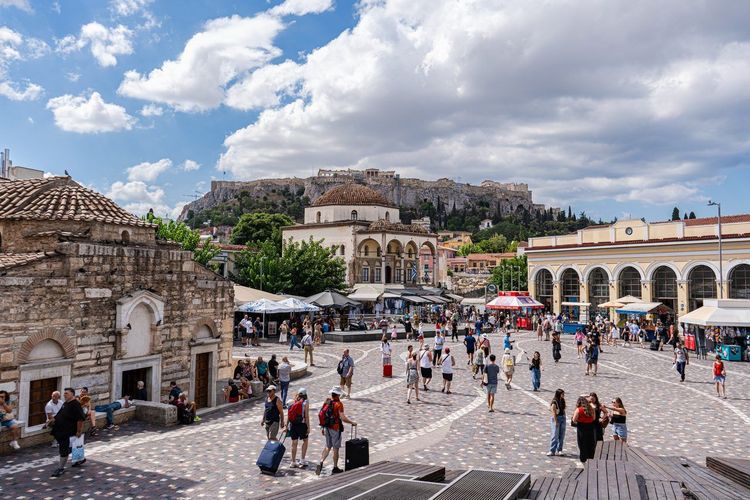
Heading back down to the northwest, Monastiraki shifts to a completely different rhythm. The square, buzzing from morning to night, takes its name from the church of Pantanassa, the remnant of an old monastery still visible on one side.
The flea market occupying the surrounding streets sells everything from genuine antiques to questionable souvenirs: bargaining is part of the game. Sunday mornings remain the liveliest time, when antique dealers set up their stalls around Avissynias Square.
Just north of the square, the Library of Hadrian (Areos 3, Athens 105 55, rated 4.4/5 on Google based on 7,653 reviews) is a reminder that Monastiraki was also a Roman intellectual center. Built around 132 CE, it housed papyrus scrolls around a large colonnaded courtyard, of which one of the most impressive façades in the city center survives. Admission is payable; allow around ten euros.
If the morning has worn you out, the short version of the Ryo audio guide tour focuses on the lanes between Plaka and Monastiraki, for a guided stroll without climbing back up to the Acropolis.
Day 1 (Evening): Sunset from Mount Lycabettus
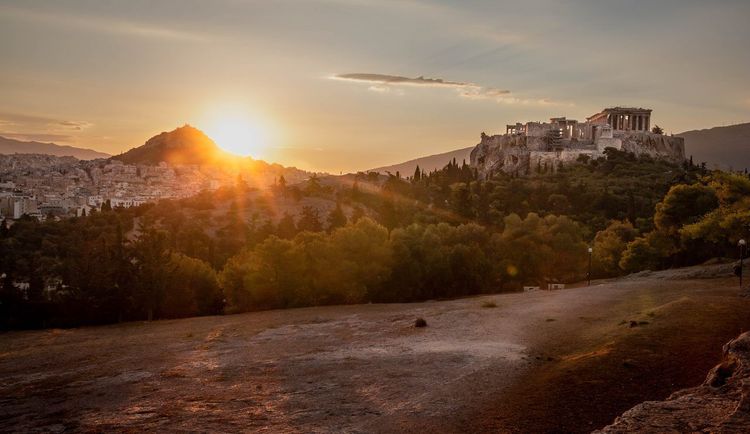
End the first day by gaining some altitude — literally. Mount Lycabettus (Athens 114 71, rated 4.8/5 on Google based on 6,344 reviews) peaks at 277 meters, the highest point in central Athens, well above the Acropolis rock.
A funicular departs from Aristippou Street in the upscale Kolonaki neighborhood and reaches the summit in a few minutes (allow around ten euros for a return ticket; it sometimes closes for maintenance, so check before you go). Walkers can also make the climb in 30 to 45 minutes along a pine-lined path, but set off at least an hour before sunset to enjoy the light on the way up.
From the Chapel of Saint George that crowns the summit, the view sweeps across the entire city to the Saronic Gulf, and on a clear day, all the way to the islands of Aegina and Salamis. In one glance you can pick out the Acropolis, the Panathenaic Stadium, and the port of Piraeus. The restaurant beneath the chapel serves cocktails at tourist prices, but nothing stops you from sitting on the rock with snacks bought at the bottom.
For dinner, walk back down toward Kolonaki, whose tavernas and wine bars draw mainly an Athenian crowd. The contrast between the morning ruins and this urban panorama sums up on its own the journey from city-state to a metropolis of 3.7 million people.
Day 2 (Morning): The Temple of Olympian Zeus, Hadrian's Arch, and the Metropolitan Cathedral
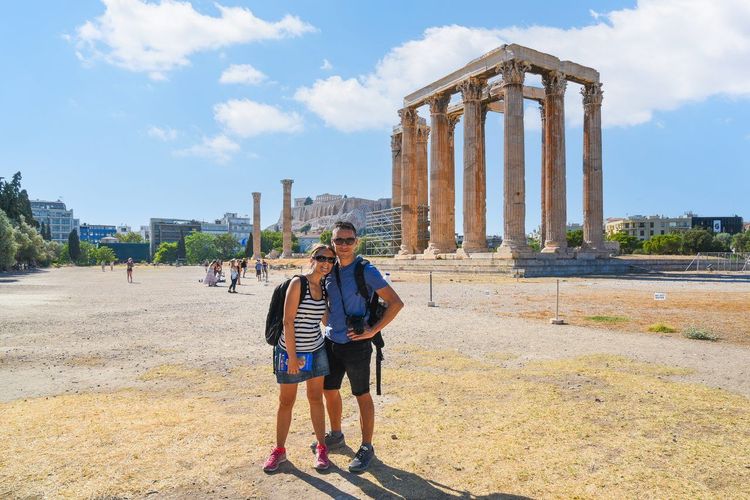
The second day begins in the southeast of the historic center, tracing a different Athens: the one where Roman emperors sought to leave their mark on the Greek city they so admired.
The Temple of Olympian Zeus
The Temple of Olympian Zeus took more than six centuries to complete. Begun in the 6th century BCE under the Pisistratid tyrants, it was only finished around 131 CE by Emperor Hadrian, a great admirer of Greek culture.
Of the original 104 Corinthian columns, each about 17 meters tall, fifteen still stand; a sixteenth has lain on the ground since a storm in 1852, its drums lined up like a stack of fallen coins. Admission costs around ten euros. Allow 30 to 45 minutes: the site is modest in area but striking in the scale of its remains.
Opening hours shorten in the low season: check them the evening before rather than arriving to find the gates closed.
Hadrian's Arch
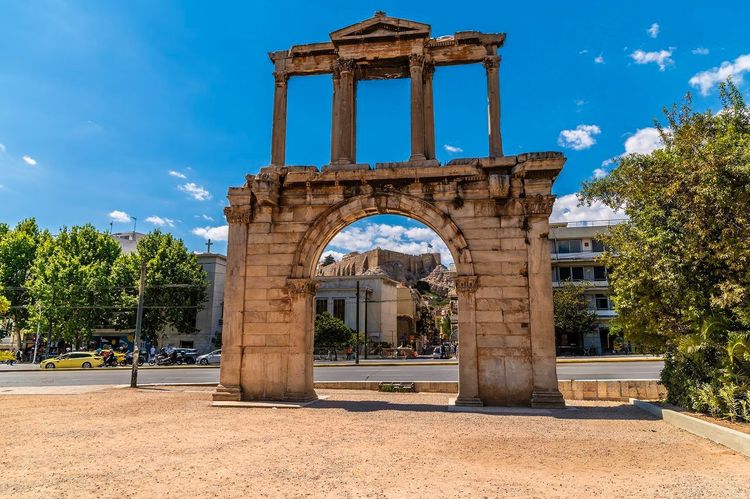
A few meters from the entrance to the temple stands Hadrian's Arch, an 18-meter-high arch that marked the symbolic boundary between the old Greek city and the new Roman Athens.
Two inscriptions carved on its faces summarize the situation with deliberate irony: on the side facing the old city, "This is Athens, the ancient city of Theseus"; on the side facing the new quarter, "This is the city of Hadrian, and not of Theseus." The arch can be seen freely from the pavement in just a few minutes.
The Metropolitan Cathedral of Athens
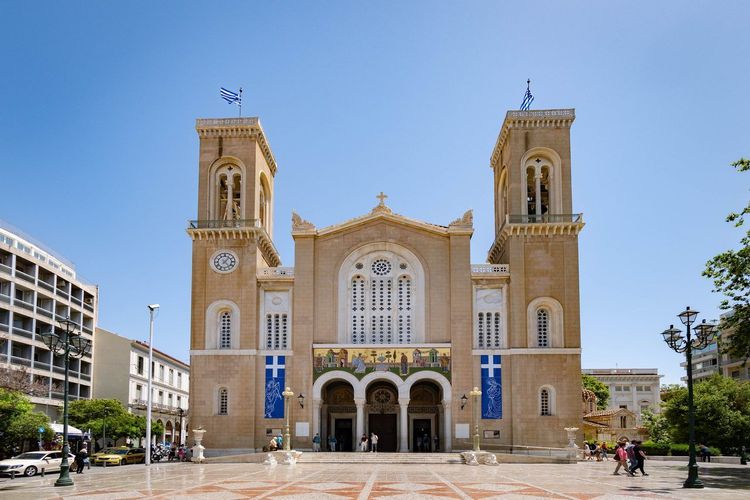
Head northwest toward Plaka to reach the Metropolitan Cathedral of Athens (Mitropoleos 21, Athens 105 56, rated 4.7/5 on Google based on 10,133 reviews), whose foundation stone was laid in 1842 by King Otto and Queen Amalia, and which was consecrated in 1862.
Its walls were built using marble taken from 72 churches demolished for the purpose — a long-debated decision. It houses the relics of Saint Philothei, martyred in 1589, and of Patriarch Gregory V, hanged in Constantinople in 1821. Right next door, the small 12th-century church of Agios Eleftherios looks tiny beside its neighbor: five minutes is enough to appreciate the contrast.
Entry is free, but cover your shoulders and knees, as in any Orthodox place of worship.
With headphones on, the Ryo audio guide links the Temple of Olympian Zeus and Hadrian's Arch in a single sequence: standing before the columns, you hear how the city shifted from Classical Greece to the Roman Empire.
Day 2 (Afternoon): Syntagma Square, the National Garden, and the Panathenaic Stadium
The afternoon of the second day moves away from Antiquity to 19th-century Athens, the Athens of the young Greek kingdom and its national symbols.
Syntagma Square and the Changing of the Guard
Syntagma Square, or Constitution Square, faces the Greek Parliament, which has been housed in the former royal palace since the mid-1930s.
In front of the Tomb of the Unknown Soldier, the changing of the guard takes place every hour, day and night, performed by the evzones in their fustanella (400 pleats, one for each year of Ottoman occupation according to tradition) and pompom shoes. The Sunday ceremony at 11 a.m. is the longest and most spectacular, with a full brass band and parade.
Arrive 10 minutes before the hour to secure a front-row spot: the crowd builds up quickly, especially in summer.
Before leaving the square, step down into Syntagma metro station, even without a ticket: the hall displays behind glass panels a stratigraphic cross-section and objects uncovered during the metro excavations, including ancient tombs and water pipes. It is a small, free, air-conditioned museum that shows just how charged every meter of the Athenian subsoil really is.
The National Garden, a Green Retreat
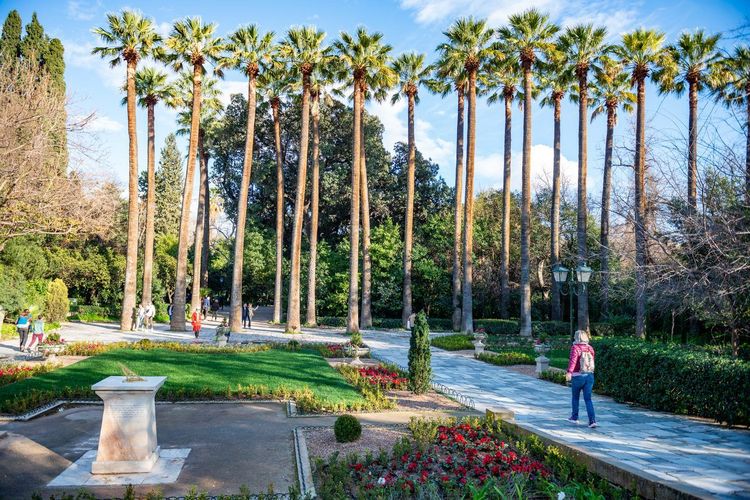
Just behind Parliament, the National Garden offers a welcome pocket of shade after a morning of marble and sunlight. Laid out from 1838 at the request of Queen Amalia, it brings together around 500 plant species.
A small free zoo, a few Roman remains, and turtles in the ponds make it a popular stop for families. Entry is free, from sunrise to sunset.
At the southern end of the garden, the Zappeion, a grand neoclassical palace inaugurated in 1888, hosted the fencing events at the 1896 Games. Its tree-lined paths and open-air café make a pleasant transition to the stadium, five minutes' walk away.
The Panathenaic Stadium
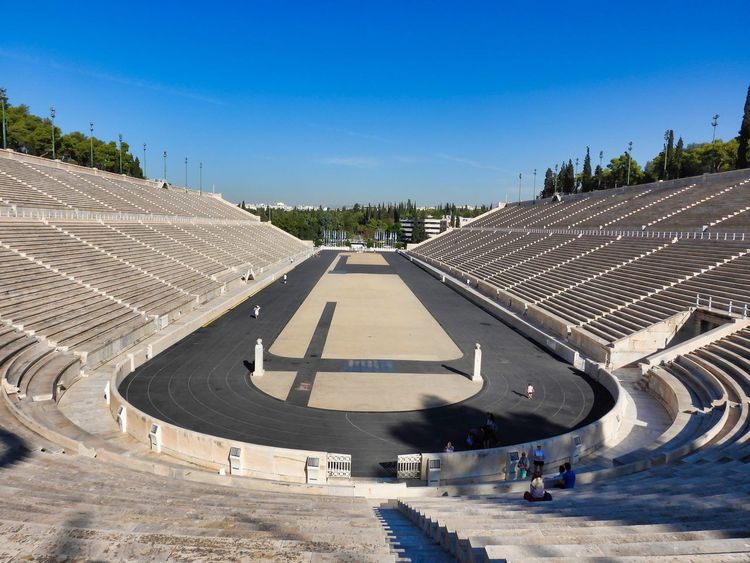
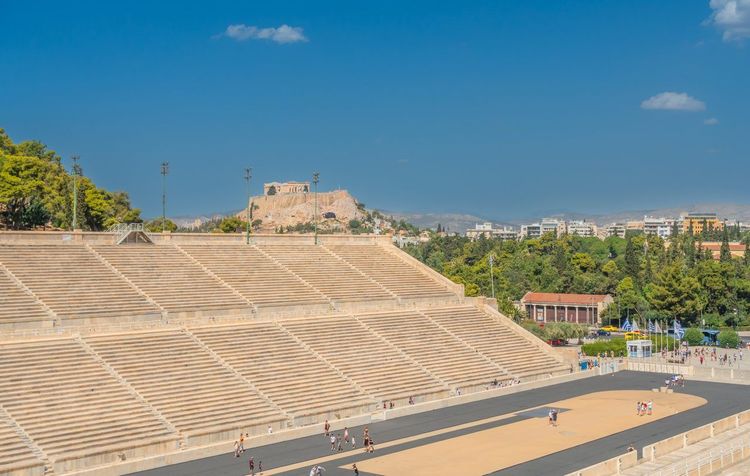
Exiting the garden from the southeast, the Panathenaic Stadium (Leoforos Vasileos Konstantinou, Athens 116 35, rated 4.7/5 on Google based on 46,246 reviews) closes the Olympic loop: this is where the first modern Olympic Games were held in 1896, in an arena entirely rebuilt in white Pentelic marble — a unique case in the world.
The original site dates to the 4th century BCE and hosted the Panathenaic Games in honor of Athena. Admission costs 12 euros and includes an audio guide as well as access to the track, where you can run a lap as the athletes of 1896 did, before stepping onto the podium for a photo.
Allow 45 minutes for the visit, less if you do not go down onto the track.
On the audio side, the final stops of the Ryo Athens tour pass through this modern center, from Syntagma to the Panathenaic Stadium, completing 3 hours 20 minutes of listening. For ideas to fill a free evening, our selection of activities in and around Athens offers further suggestions.
The National Archaeological Museum and Other Cultural Highlights in Athens
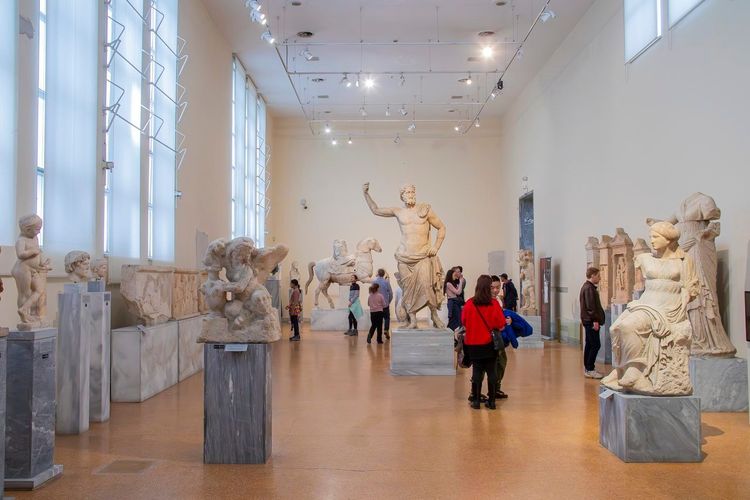
The program above covers the essentials, but two places deserve a spot if your pace allows, especially if you have a passion for Antiquity. The National Archaeological Museum, about twenty minutes from the historic center by metro (Victoria or Omonia stations), holds one of the richest collections of Greek antiquities in the world, with more than 11,000 objects on display, from the funeral mask known as the Mask of Agamemnon to the bronze Ephebe of Marathon.
Allow 2 to 3 hours for a thorough visit, or 1 hour for a quick pass focused on the Mycenaean hall and the bronzes. Do not miss the Antikythera Mechanism, a bronze astronomical calculator recovered from a shipwreck, often described as the oldest known "computer." Admission varies by season (budget between 12 and 20 euros), and the museum stays open late on certain summer evenings — useful for escaping the afternoon heat.
On the south slope of the Acropolis, the Theatre of Dionysus (Dionysiou Areopagitou, Athens 117 42, rated 4.7/5 on Google based on 6,748 reviews) is the birthplace of Western theatre: Aeschylus, Sophocles, and Euripides had their tragedies performed here in the 5th century BCE, and the tiers expanded in the 4th century could seat around 17,000 spectators. Access is included in the Acropolis and slopes ticket: if you are passing by on the first day, it would be a shame to skip it. For more detail, our article on the Theatre of Dionysus explains how ancient tragedies were staged there.
How to Get to Athens and Get Around the City
From the Airport to the City Center
Eleftherios Venizelos International Airport is about 27 km east of the city center. Three options connect the airport to the city: the metro (Line 3, blue), the express bus X95, and taxis.
The metro takes about forty minutes to Syntagma for around 9 euros one way. It runs roughly from 6:30 a.m. to 11:30 p.m., with a train every 30 minutes on the airport branch. The X95 bus costs 5.50 euros and runs 24 hours a day: slower (allow an hour, longer during peak times), it is useful when the metro is closed and drops you at Syntagma Square.
A taxi charges a fixed fare to the center: 40 euros by day and around 55 to 60 euros at night, luggage included. Confirm the flat rate before getting in: a few drivers still try to use the meter.
Metro, Tram, and Walking Around Athens
Once in the city, most of this itinerary is done on foot: the Acropolis, Plaka, Monastiraki, and Syntagma all fall within a radius of about 1.5 km, meaning 20 to 25 minutes' walk from one end to the other.
The Athens metro has three lines, more than sufficient for a 2-day stay: Line 1 (green), Line 2 (red), and Line 3 (blue). A single ticket costs 1.20 euros and is valid for 90 minutes across the entire urban network (metro, bus, tram, trolleybus). The 24-hour pass at 4.10 euros pays off from the fourth journey onwards. The tram runs from Syntagma along the southern coast, handy for a late-afternoon beach trip.
On the ticketing side, forget the old archaeological sites combined ticket: it no longer exists. Commercial passes such as the Athens Pass, sold online, bundle certain admissions and sometimes transport; compare their price against the sum of the individual tickets you actually plan to buy before deciding.
Avoid driving in the historic center: traffic is dense, parking is scarce, and most lanes in Plaka are closed to cars.
Where to Stay in Athens: the Best Neighborhoods for 2 Days
Plaka and Monastiraki to Be at the Heart of the Action
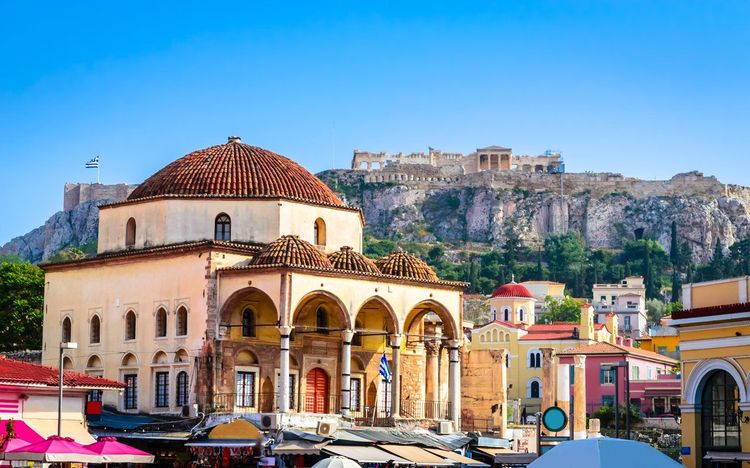
Staying in Plaka or Monastiraki puts all the Day 1 sites within less than 10 minutes on foot — a real advantage for such a short stay. Expect to pay roughly 90 to 180 euros per night for a well-located 3- or 4-star hotel, sometimes with a view of the Acropolis from the upper floors or the rooftop terrace, which alone justifies part of the price.
The downside: Monastiraki's nightlife, with its late-closing bars, can disrupt sleep on weekends. If you are sensitive to noise, request a courtyard-facing room or choose a quieter side street in Plaka, which settles down after 10 p.m.
Koukaki, a Quiet Alternative Close to the Acropolis
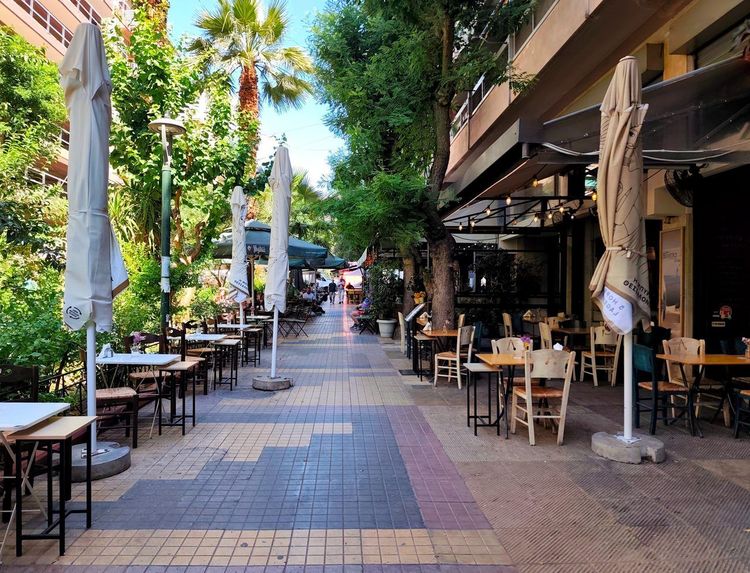
Koukaki, just south of the Acropolis, has established itself as the favorite neighborhood for travelers seeking a balance between residential calm and proximity to the sites. The Acropolis entrance and the museum are 10 to 15 minutes on foot, and boutique hotels with rooftop terraces have multiplied there in recent years.
Prices are generally a little gentler than in Plaka for comparable comfort, and the streets stay quiet in the evenings. The Syngrou-Fix station (Line 2) serves the neighborhood; for the airport, you will need to change at Syntagma for Line 3.
To compare neighborhoods according to your budget, our guide to the best neighborhoods to stay in Athens breaks down prices and atmosphere street by street.
Where to Eat in Athens: Addresses and Local Specialties

Souvlaki and Budget Street Food
Souvlaki, grilled pork or chicken skewers served in a pita with tomato, onion, and tzatziki, remains the quickest and most affordable meal in Athens: expect around 3 to 4 euros per pita at popular spots in the center — just enough to refuel between visits.
The busiest grills cluster around Monastiraki Square (Athens 105 55, rated 4.5/5 on Google based on 28,305 reviews), where the lunchtime queues speak for themselves. Do not judge solely by the most visible terraces: some of the best spots are nothing more than a narrow door and a few bar stools.
For dessert, try loukoumades, deep-fried doughnut balls drizzled with honey and cinnamon. And if you enjoy the atmosphere of a market hall, the Varvakios central market on Athinas Street, between Monastiraki and Omonia, overflows with fish, spices, and olives from Monday to Saturday mornings.
Traditional Tavernas in Plaka and Monastiraki
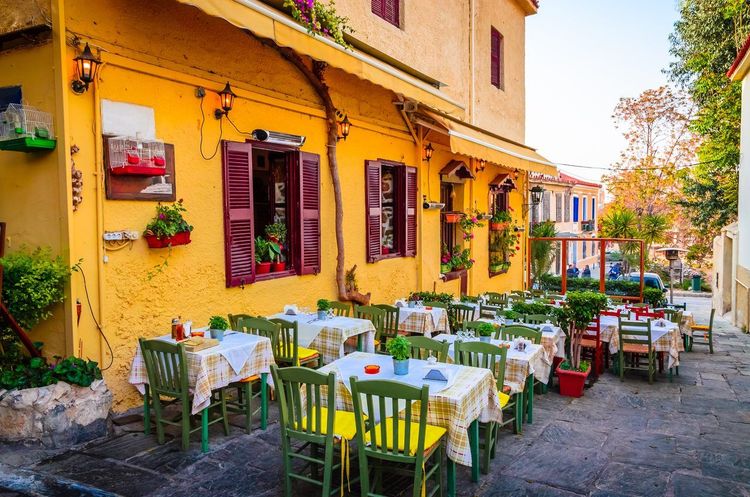
For a sit-down meal, traditional tavernas in Plaka serve moussaka, grilled octopus, and fava (yellow split pea purée) in a flower-filled courtyard or on a shaded terrace. Budget 15 to 25 euros per person for a full meal with house wine.
A simple rule for avoiding tourist traps: if a tout approaches you in the street, walk on by. Good restaurants generally do not need them, and Athenians tend to steer clear of overly pushy spots.
Dinner is served late, rarely before 9 p.m.: booking for 7 p.m. risks dining alone in an empty room.
For a more complete overview, our article on Athens' culinary specialties lists the dishes not to miss, from the counters of Monastiraki to the tavernas of Koukaki.
Budget, Safety, and Practical Tips for 2 Days in Athens
For two days in Athens, plan a budget of 150 to 220 euros per person excluding accommodation. Without a combined ticket, admissions now add up quickly: 30 euros for the Acropolis, around 20 euros for the Acropolis Museum and the same for the Ancient Agora, 12 euros for the Panathenaic Stadium — totaling 80 to 100 euros if you follow the full program. Add 40 to 70 euros for meals and around twenty euros for transport including the airport.
A tight budget can come down to around 90 euros by limiting paid admissions to the Acropolis, sticking to souvlaki and walking, and making the most of free attractions: the National Garden, Hadrian's Arch, the cathedral, the changing of the guard, and the Areopagus hill. On certain days of the year, such as 6 March, 18 April, or 28 October, entry to national sites is free, at the cost of larger crowds.
On the safety front, Athens is generally a safe city, including for solo travelers and families. The main risk is pickpocketing in busy areas: the metro during rush hour, the Monastiraki flea market on Sundays, and the surroundings of the Acropolis in high season. Wearing a bag across your front is usually enough to deter any problems.
For skip-the-line tickets, book everything online before departure through the official ticketing platform of the Greek Ministry of Culture: some third-party platforms add a sometimes significant commission for the same time slot.
As for the best time to visit Athens, aim for spring (April–May) or early autumn (September–October): 20 to 26 °C, soft light, and shorter queues. In July and August, temperatures often exceed 35 °C, and the Acropolis can close during the hottest hours in heatwaves. Winter, cooler and rainier, offers sites that are nearly deserted.
Finally, avoid Syntagma Square and the main boulevards on protest days, which are fairly frequent: they rarely target tourists but can block traffic and temporarily close certain metro stations.
Extending Your Stay: What to See with More Than 2 Days in Athens
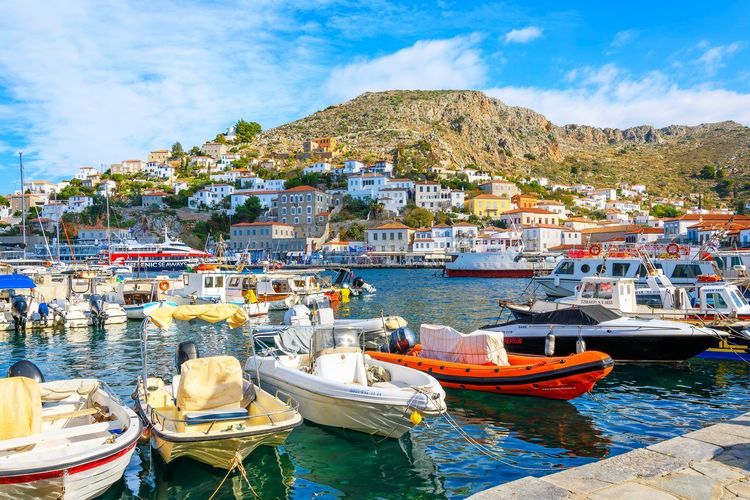
Two days cover the essentials, but Athens lends itself readily to a longer stay, especially if you plan to continue on to the islands. With a third day, head to Piraeus for a trip to the Saronic Islands: Aegina, Poros, or Hydra, all less than 2 hours away by fast ferry. Our guide to the Saronic Islands helps you choose the right one.
Another classic late-afternoon option: Cape Sounion, about 70 km to the southeast via the coastal road. The Temple of Poseidon, perched above the Aegean Sea, offers one of the most celebrated sunsets in Greece, and Lord Byron carved his name on one of its columns.
With four days or more, Delphi, about 180 km to the northwest, is well worth a day trip: perched on the slopes of Mount Parnassus, the sanctuary was home to the most famous oracle in the Greek world. Our guide to visiting Delphi explains how to organize the day from Athens.
For a relaxing break without leaving the mainland, several beaches line the southern coast from Glyfada to Vouliagmeni, less than an hour away by tram or bus. Our selection of the most beautiful beaches around Athens lists spots that are easy to reach without a car.



FAQ
How many days do you need to visit Athens?
Two days are enough to see the highlights: the Acropolis and its museum, Plaka, Monastiraki, and the major ancient sites in the city center. With three or four days, you can add a trip to the Saronic Islands, Cape Sounion, or Delphi. A week allows you to combine Athens with one or two of the Cyclades islands, reachable by ferry from Piraeus.
Should you book Acropolis tickets in advance?
Yes, it is strongly recommended between April and October. Admission costs 30 euros with a time slot to be chosen on the official ticketing platform of the Greek Ministry of Culture; the old combined ticket no longer exists. In July and August, morning slots often sell out several days in advance.
What is the best neighborhood to stay in Athens for a short visit?
Plaka and Monastiraki are the best options for 2 days: everything is within walking distance. Koukaki offers a quieter alternative, 10–15 minutes on foot from the Acropolis, with prices that are often a little gentler.
How do you get around Athens without a car?
The historic center is easily walkable, with the main sites falling within a radius of about 1.5 km. For longer journeys (airport, National Archaeological Museum), the metro is the fastest option, with a ticket costing 1.20 euros valid for 90 minutes on the urban network.
What budget should you plan for 2 days in Athens?
Budget between 150 and 220 euros per person excluding accommodation, including site admissions (80 to 100 euros since the end of the combined ticket), meals, and transport. A tight budget of around 90 euros is possible by limiting paid visits to the Acropolis.
When is the best time to visit Athens to avoid crowds and heat?
Spring (April–May) and early autumn (September–October) offer the best compromise: 20 to 26 °C and significantly smaller crowds than in July–August, when temperatures regularly exceed 35 °C at exposed sites like the Acropolis.
Two days in Athens force you to make choices, but this itinerary — from the Acropolis at dawn to sunset over Lycabettus — covers the essentials without racing through the city. Between ancient ruins, the Cycladic lanes of Anafiotika, and the changing of the guard in front of Parliament, the Greek capital more than delivers on its promises in 48 hours.
Want to go at your own pace, without depending on a group's schedule? The Ryo Athens audio guide tour launches from the app whenever you are ready: 29 audio tracks, 3 hours 20 minutes of listening, and 8.2 km to tell the story of the city that invented democracy.
À lire également