© Shutterstock
 Votre guide Ryo
Things to Do in Barcelona: 15 Must-Have Experiences in 2026
Wondering what to do in Barcelona often means choosing between the sea and the mountains. On a short weekend, it's hard to fit in the Barceloneta beach, the hills of Montjuïc, and the architectural extravagances of the Eixample — that grid of streets laid out in the 19th century where Antoni Gaudí scattered his most daring works, just steps from a Gothic quarter that has remained almost intact since the Middle Ages. The Ryo audio-guided tour of Barcelona draws a clear thread through these neighbourhoods packed with curiosities, without missing a single step along the way.
This selection of 15 experiences covers a basilica that has been under construction since 1882, a century-old market welcoming 20,000 visitors a day, a former military bunker now the best free viewpoint in the city, and a monastery perched at 725 metres above sea level accessible by rack railway. Enough to build a stay of 2, 3, or 5 days depending on the time available, between Gaudí's monuments, Roman lanes, and day trips to the surrounding area. Some of these experiences combine naturally into a half-day; others deserve to be savoured on their own, without rushing.
1. The Sagrada Família
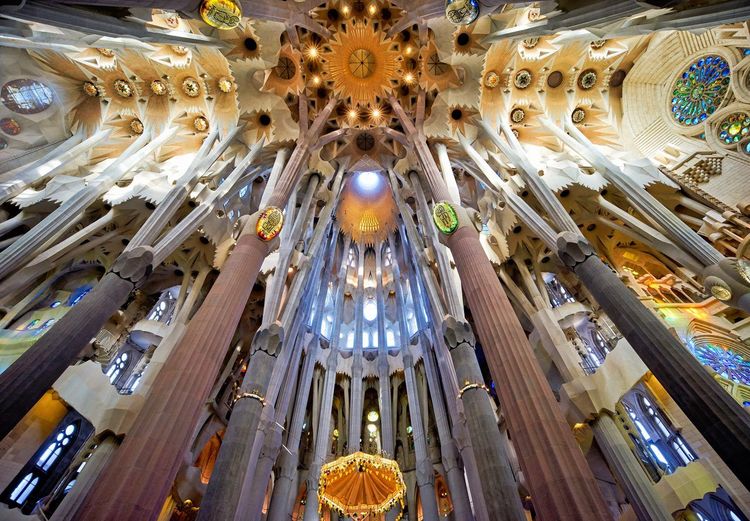
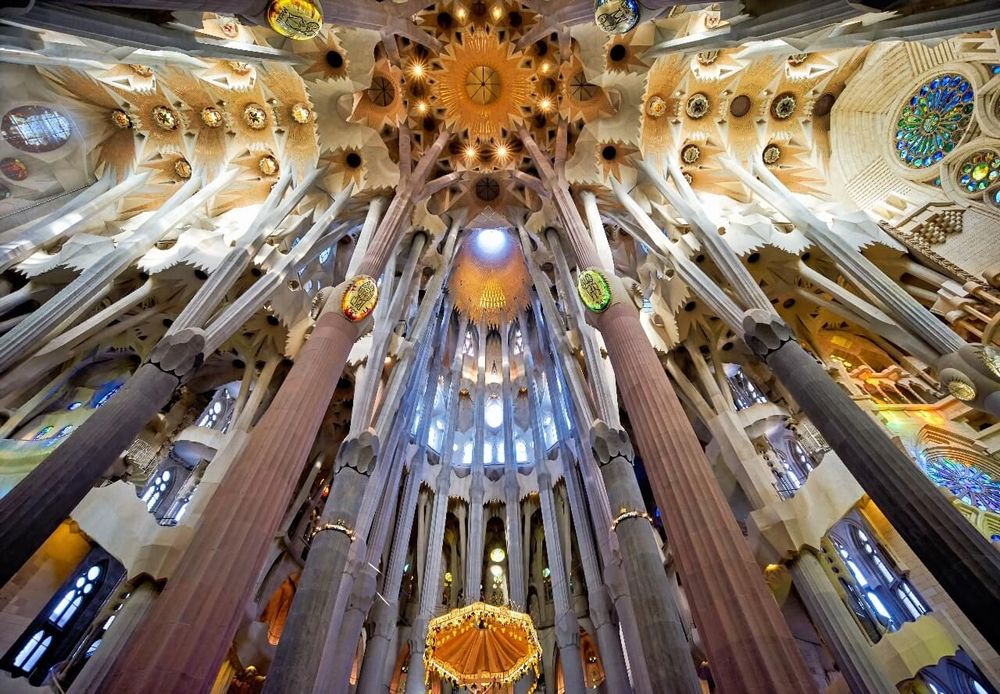
The Sagrada Família (Carrer de Mallorca 401, 08013 Barcelona, rated 4.8/5 on Google across 326,567 reviews) remains the longest-running religious construction project in Europe: begun in 1882, it still has no official completion date, although current teams are targeting 2034 for the central tower dedicated to Jesus Christ, which will reach 172.5 metres.
Gaudí took over the project in 1883 and devoted the last 15 years of his life to it, sometimes sleeping on-site. His signature is legible in every detail: the interior columns branch like tree trunks to support a vault 45 metres high, and light filters through the stained glass in a gradient from blue to red depending on orientation — blue and green on the east side, orange and red on the west. The Nativity facade, sculpted during the architect's lifetime, contrasts sharply with the more angular Passion facade, completed after his death by Josep Maria Subirachs.
The interior, often underestimated in photographs, rewards those who look up rather than straight ahead. Gaudí wanted to recreate a forest of stone: each column changes cross-section as it rises, star-shaped at the base and circular at the top, a technique that distributes the weight of the vault without the need for the flying buttresses of classic Gothic cathedrals. The interior feels surprisingly airy for such a massive structure, with a standing capacity of 9,000 people during major services.
Allow at least 1h30 on-site, longer if you go up one of the two towers open to the public — the Nativity Tower or the Passion Tower — accessible by lift and then on foot via a fairly narrow spiral staircase. Book your ticket online 3 to 4 weeks in advance during high season: time slots sometimes sell out within days in July and August, and the queue without a booking regularly exceeds 2 hours. Three options are available: standard entry, entry with tower access, and a small-group guided tour that includes the stained-glass workshop, which is closed to independent visitors. Children under 11 enter free, a detail that makes a real difference to the bill for a multi-day family stay.
One key tip: avoid Sunday mornings, when a mass is held and tourist access is restricted to worship hours. The rest of the week, the basilica opens from 9am to 6pm in winter and until 8pm in summer, with last entry 30 minutes before closing. Around the monument, Avinguda de Gaudí connects the basilica directly to the Hospital de Sant Pau, another UNESCO-listed Modernista complex, about 15 minutes on foot — a link that many hurried visitors skip despite it being a natural extension of the visit.
2. Parc Güell
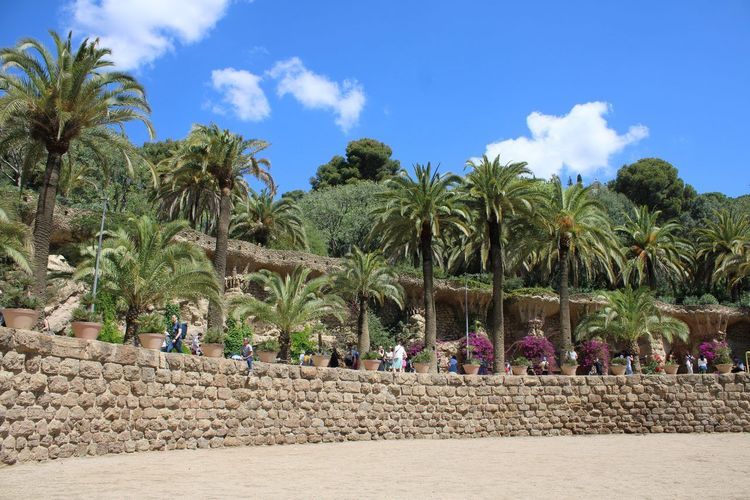
Originally conceived as a private residential estate for Barcelona's bourgeoisie, Parc Güell (Carrer d'Olot s/n, 08024 Barcelona, rated 4.4/5 on Google across 238,293 reviews) never found buyers: only two of the planned 60 houses were built, and the city eventually purchased the land in 1922 to turn it into a public park. The result, delivered by Gaudí between 1900 and 1914, looks like a fairytale setting: undulating benches covered in trencadís (broken ceramic mosaic), leaning Doric columns supporting an elevated plaza, and the famous multicoloured dragon at the top of the entrance staircase, now one of the city's most photographed landmarks.
Access is split into two distinct zones. The monumental zone, which requires a ticket, includes the dragon staircase, the hypostyle hall with its 86 columns, and the central plaza ringed by its long undulating bench — described by the site's official guides as the world's largest ceramic bench. The rest of the park, spreading across the hillside above the Gràcia neighbourhood, remains free to enter: you can climb to the top of the Turó del Calvari for an unobstructed view of the city and the sea, without buying a ticket.
It's worth booking your time slot online, as the monumental zone limits the number of entries per hour to protect the fragile mosaics. Arrive at opening time — generally 9:30am — when the raking light enhances the colours and organised groups have yet to arrive. The Gaudí House Museum, where the architect lived for nearly 20 years, requires a separate ticket and offers a chance to see his bespoke furniture — chairs and benches with curves as organic as his facades.
Allow 1h30 to 2 hours for a full visit including travel, as the park is some distance from the historic centre. Bus H6 or a gentle uphill walk from Vallcarca metro station are the most practical options.
3. Gaudí's Houses: Casa Batlló and La Pedrera
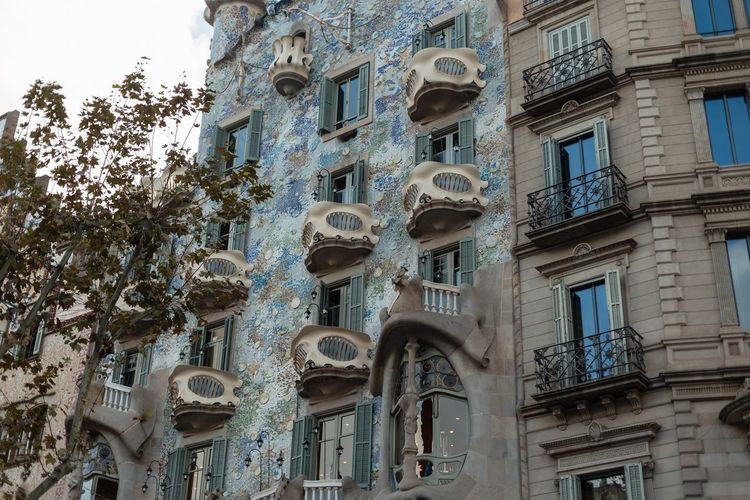
Along a 300-metre stretch of the Passeig de Gràcia, two of Gaudí's facades face each other without ever resembling one another. Casa Batlló (Passeig de Gràcia 43, 08007 Barcelona, rated 4.7/5 on Google across 213,200 reviews) displays an undulating facade covered in blue-green ceramic fragments and a roof of scales evoking a dragon's back — a symbolic reading tied to the legend of Sant Jordi, patron saint of Catalonia. A few numbers away, La Pedrera (Casa Milà, Passeig de Gràcia 92, 08008 Barcelona), built entirely in undulating limestone without a single right angle, resembles a sculpted quarry — hence its popular nickname.
Both houses can be visited with an audio guide included, but their highlights differ. Casa Batlló leans into an immersive scenography, with projections and light effects recreating the underwater atmosphere Gaudí envisioned for the inner courtyard, bathed in a gradient of blue ceramic. La Pedrera focuses on its rooftop terrace, where chimney stacks sculpted like helmeted warriors are said by several local guides to have inspired certain Star Wars set designs — an anecdote that circulates widely without official confirmation from Lucasfilm, but one guides love to tell.
If time is short, choose one of the two rather than rushing between both: each visit takes 1 to 1h30 including queues in season. To deepen your immersion in the architect's world, the Ryo audio-guided tour Through the Eyes of Gaudí connects several of his works in the Eixample with 22 commented audio tracks across 4h15 of walking — a format that helps you understand the links between his different projects without retracing your steps.
Budget-wise, both landmarks are among the most expensive in the city, but discounts are available for combined bookings with the Sagrada Família through certain tourist passes. In the evenings, Casa Batlló offers a low-lit night visit that completely transforms the atmosphere of the courtyard — a lesser-known option that tends to be far less crowded than daytime visits. Our audio-guided tour, Through Gaudí's Eyes, continues from here along Passeig de Gracia to Casa Milà.
4. The Barri Gòtic, the Medieval Heart
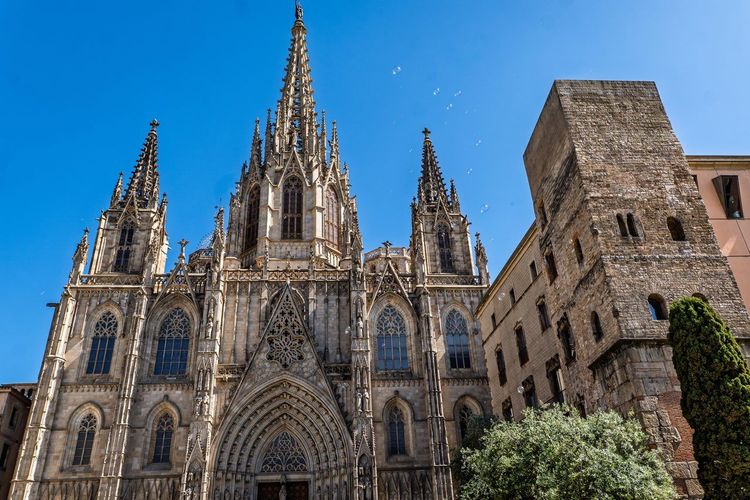
The Barri Gòtic preserves a street layout that pre-dates the Renaissance, built on the remains of the Roman city of Barcino, founded in the 1st century BC. Fragments of the Roman city wall, several metres high, still emerge at Plaça Nova, just in front of the cathedral. Nearby, four Corinthian columns from the Temple of Augustus survive in the inner courtyard of an unassuming building on Carrer del Paradís — a forgotten remnant of Roman Barcino that few hurried visitors notice in passing.
The Barcelona Cathedral (Pla de la Seu s/n, 08002 Barcelona, rated 4.6/5 on Google across 83,815 reviews), whose Neo-Gothic facade actually dates from the 19th century even though the body of the building goes back to the 13th, houses a cloister home to 13 white geese — a number said to correspond to the age of Saint Eulalia, martyred at that age according to local legend.
The Plaça Reial, with its 19th-century arcades and lampposts designed by a young Gaudí while still a student, stands in striking contrast to the rest of the neighbourhood, which is more organic and labyrinthine. You will also come across Plaça Sant Felip Neri, tiny and intimate, its walls pitted with shrapnel marks from a 1938 bombing during the Civil War — a jarring contrast with the present-day calm of the square.
Get deliberately lost in the lanes between the cathedral and La Rambla: that's where most of the craftsmen's workshops, candle shops, and small art galleries are hidden — the ones that give the neighbourhood its charm, far from the international chains that have gradually taken over the main thoroughfares.
On the hours front, the cathedral opens free of charge to worshippers early in the morning and late in the afternoon, while a tourist ticket is required during the day to access the choir, the rooftop terrace, and the cloister. The rooftop climb, often overlooked, offers a close-up view of the gargoyles and Neo-Gothic spires, just metres from the bell towers. Wear comfortable shoes: the medieval paving is slippery in wet weather and poorly suited to smooth soles, and most of the lanes can only be explored on foot, as car traffic is banned throughout most of the neighbourhood. Our audio-guided tour, The Beautiful Catalan Capital, winds through this same quarter, from Plaça Sant Felip Neri to Plaça Reial.
5. La Rambla and the Boqueria Market
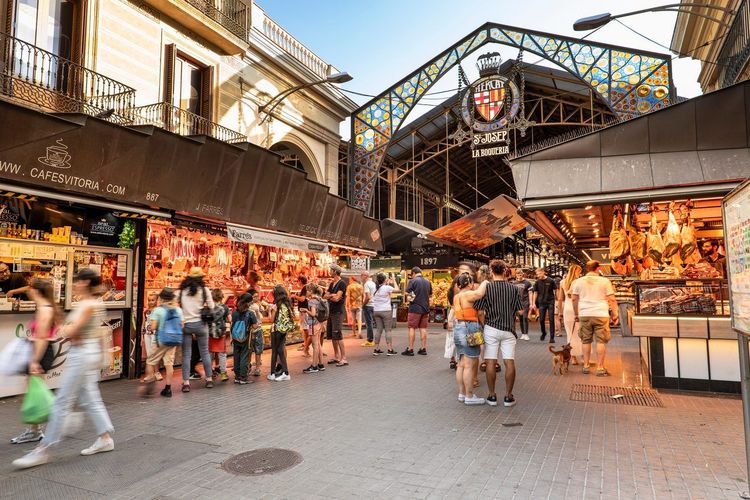
La Rambla runs 1.2 kilometres from Plaça de Catalunya to the waterfront, lined with plane trees and century-old newspaper kiosks. The boulevard remains the busiest thoroughfare in the city, with an estimated flow of more than 150,000 pedestrians daily in high season — which also makes it a classic hunting ground for pickpockets, especially around cash machines and the most touristy terraces.
At the very start of the boulevard, near Plaça de Catalunya, the Canaletes fountain keeps a persistent legend alive: drinking its water is said to guarantee that you will one day return to Barcelona. FC Barcelona supporters traditionally gather here to celebrate the club's titles, a tradition dating back to the early 20th century that endures to this day after every major victory.
Halfway along, the Mercat de la Boqueria (La Rambla 91, 08001 Barcelona) has been open since 1840 under a metal structure typical of 19th-century covered markets. More than 300 stalls offer exotic fruits pre-cut into portions, Iberian ham hanging from the ceiling, freshly pressed juices, and tapas counters where you can have lunch standing up, elbow to elbow with locals from the neighbourhood.
Come on a weekday before 10am to avoid the rush of cruise-ship groups, who arrive in large numbers late in the morning. The best prices are at the back of the market, away from the main aisles targeted by tourists, where vendors still charge prices closer to those paid by local residents. One stall in particular is worth seeking out: fresh coconut juice served directly in the shell, a local institution for over 30 years.
6. El Born and the Palau de la Música Catalana
A former neighbourhood of medieval craftsmen and traders, El Born has retained its network of narrow lanes while becoming one of the liveliest areas in the evening, with wine bars and independent designers' boutiques set up in old workshops.
The Basílica de Santa Maria del Mar, built in a remarkably short 54 years in the 14th century (from 1329 to 1383) thanks to port workers who carried the stones themselves from Montjuïc, stands out for its rare architectural purity: widely spaced octagonal columns, an almost total absence of heavy ornamentation, and a dizzying effect when you look up at the vault 33 metres above.
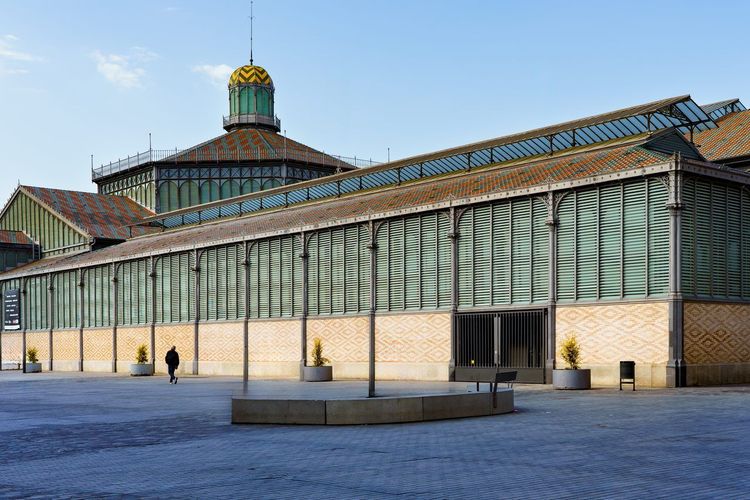
Nearby, the old Born covered market, now the Born Centre Cultural, conceals beneath its 19th-century iron roof archaeological remains uncovered during its renovation in 2013: entire streets of the neighbourhood destroyed in 1714 following the siege of the city, now freely accessible from a suspended walkway above the excavations.
Ten minutes on foot away, the Palau de la Música Catalana (Carrer Palau de la Música 4-6, 08003 Barcelona, rated 4.7/5 on Google across 54,988 reviews) illustrates the other side of Catalan Modernisme — that of Lluís Domènech i Montaner, Gaudí's architectural rival. Its central stained-glass skylight, shaped like an inverted sun, floods the concert hall with natural light, a remarkable feat for a building constructed between two party walls with no visible side facade.
If your budget doesn't stretch to a concert ticket, the 50-minute daytime guided tour gives access to the same rooms — less populated, but just as impressive in full daylight.
7. Montjuïc, the Hill of a Thousand Faces
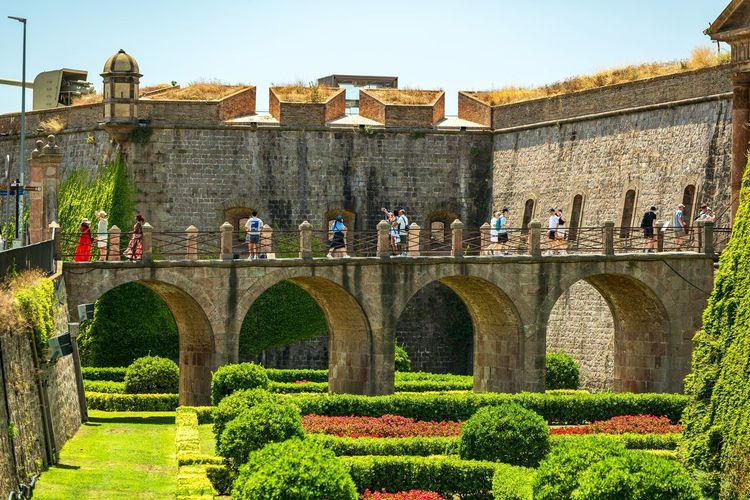
Montjuïc packs several centuries of the city's history onto a single 173-metre-high hill. The Montjuïc Castle, a 17th-century military fortress converted into a museum in 2008, overlooks the port and offers one of the most unobstructed views across the city, the sea, and the grid-aligned rooftops of the Eixample.
Lower down, the Fondació Joan Miró brings together more than 14,000 works by the Catalan painter, housed in a clean white building designed by Josep Lluís Sert, a personal friend of the artist. Nearby, the Poble Espanyol reconstructs 117 buildings representative of Spain's regional architecture at near full scale — a practical shortcut for those who don't have time to travel across the entire country.
In the evenings, the Font Màgica de Montjuïc (Plaça de Carles Buïgas 1, 08038 Barcelona, rated 4.6/5 on Google across 90,924 reviews) transforms the approach to the Palau Nacional into a free show: water jets synchronised with music and light displays, generally on Thursdays, Fridays, and Saturdays at nightfall depending on the season. Allow around an hour for several sessions of 20 to 25 minutes each.
To reach the summit without effort, the Montjuïc cable car (Telefèric de Montjuïc) climbs from Parc del Mirador in just a few minutes, with panoramic views throughout the journey. The 1992 Olympic stadium, still used for occasional sporting events, can be visited for free from the outside, its white stone stands contrasting with the futuristic communications tower designed by Santiago Calatrava right next door. Our dedicated article on this hill lays out a step-by-step itinerary from the Olympic stadium to the botanical gardens, designed for a full half-day: the Ryo audio guide to exploring Montjuïc covers the entire site with travel times between each point.
If you only have one time slot, go in the late afternoon: the golden light on the castle followed by the descent towards the magic fountain at nightfall makes for a natural sequence without having to climb the hill twice.
8. Barceloneta and the Waterfront
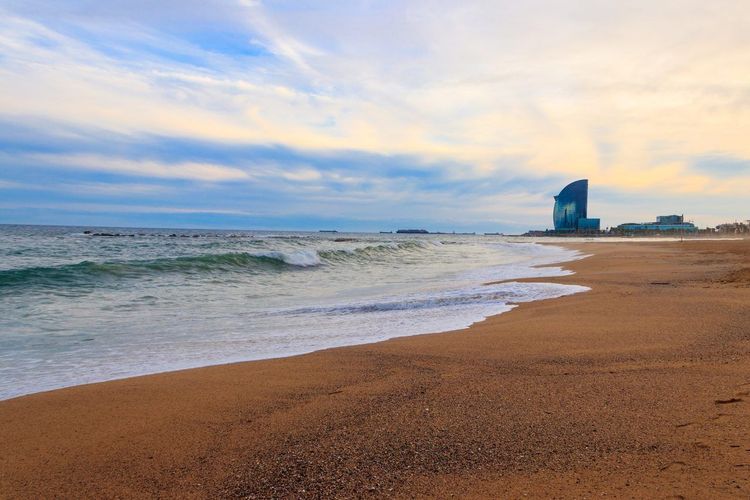
A former fishing neighbourhood rebuilt on a grid plan in the 18th century to house families displaced by the construction of the military citadel, Barceloneta has retained its working-class atmosphere despite the tourist pressure of recent decades. The beach of the same name stretches about 1.1 kilometres of sand, the most visited of the city's 7 urban beaches, with free showers and supervised lifeguard posts from April to October.
The side streets running perpendicular to the beach are packed with tapas bars where you can try calçots in season (January to April) or fideuà, a local take on paella made with vermicelli instead of rice. The covered Barceloneta market, more discreet than the Boqueria, is a reliable spot for a quick lunch away from the crowds of the centre.
A word of warning about waterfront restaurants: several establishments in the front row facing the beach charge noticeably higher prices than those a street or two back, sometimes with discreet extras for bread or the cover charge. It's better to venture one or two streets into the old fabric of Barceloneta to find tapas bars frequented by locals, where quality and price are far more balanced. For swimming, the water is pleasant from June to October, but the beach fills up very quickly at weekends: arriving before 11am is the best way to find a patch of sand without a struggle.
For water sports enthusiasts, several beach clubs hire out paddleboards, kayaks, and bodyboards by the hour — an activity that remains affordable compared to rates at other Mediterranean beach resorts. In the late afternoon, a stroll to Port Vell lets you walk along the moored yachts and reach the W Barcelona, the sail-shaped hotel that marks the eastern end of the waterfront. The port cable car (Telefèric del Port) crosses the bay to Montjuïc in a 7-minute aerial crossing that offers an unusual perspective on the entire coastline — best saved for a clear day.
9. Camp Nou, the Temple of Football
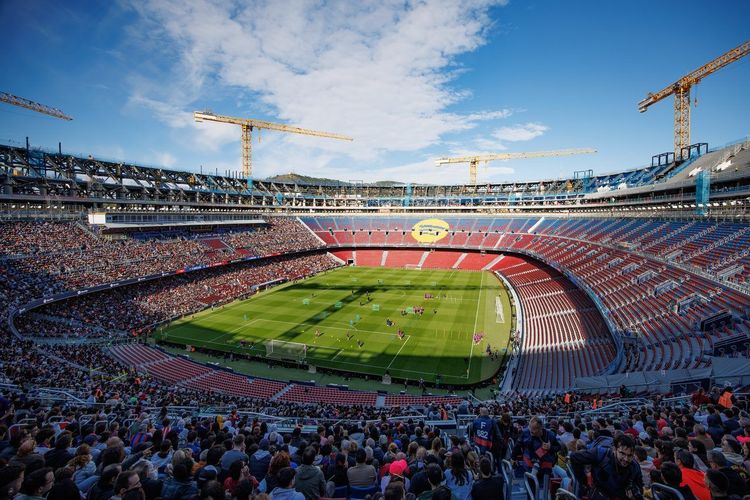
With an announced capacity of over 105,000 seats once renovation works are complete, Camp Nou (Carrer d'Arístides Maillol 12, 08028 Barcelona, rated 4.6/5 on Google across 168,719 reviews) remains the largest stadium in Europe and the beating heart of FC Barcelona since its inauguration in 1957.
The stadium is in the midst of a major transformation as part of the Espai Barça project, which regularly affects guided tour access: it's worth checking the status of the works before booking, as certain areas of the museum or the changing rooms may be temporarily closed depending on how construction is progressing. The standard visit, when offered in full, includes access to the changing rooms, the players' tunnel, and the club museum, where European trophies and historic shirts worn by the club's greatest players over the past century are on display.
To reach the stadium, metro lines L3 (Les Corts or Palau Reial stops) and L5 (Collblanc stop) serve the area in about fifteen minutes from the city centre. For as long as the Espai Barça works continue, the club periodically offers an alternative visit centred on the museum and the construction site surroundings, often at a reduced price compared to the pre-renovation full package. Check the announced total reopening date before booking: the schedule has already slipped several times, and part of the experience — including the walk down to the pitch — remains on hold depending on progress.
For football fans, attending a match remains the most memorable experience, but tickets often need to be booked several weeks in advance for the most high-profile league games, and several months ahead for a Clásico against Real Madrid. On non-match days, allow 1h30 for a full visit of the museum and stadium.
10. The Picasso Museum
Housed in five medieval palaces in El Born, the Picasso Museum (Carrer Montcada 15-23, 08003 Barcelona) holds the world's most important collection dedicated to the artist's early and formative years, before his definitive move to France.
The 4,251 works in the permanent collection cover Picasso's Barcelona period, between the ages of 14 and 23, and focus above all on his series of 58 reinterpretations of Velázquez's Las Meninas, painted in 1957 in a style that breaks radically with the original work. You won't find his most famous Cubist canvases here — those are exhibited elsewhere in the world — but rather the technical evolution of the young painter, still academic in his early work.
A few streets away, the café Els Quatre Gats, in the neighbouring Gothic quarter, hosted Picasso's very first solo exhibition in 1900, when he was barely 18 years old. The venue still operates as a restaurant today, decorated with reproductions of the works that hung on its walls at the time — a complementary stop for anyone wishing to extend their discovery of Barcelona's Picasso beyond the museum.
Allow around 1h30 to go through the whole collection at a comfortable pace, longer if crowds slow progress through the narrower rooms. The museum is located on Carrer Montcada, a medieval street lined with Gothic palaces that is worth a visit in its own right, and pairs easily with the Basílica de Santa Maria del Mar and the Born Centre Cultural, both less than five minutes on foot. A single afternoon is enough to take in all three El Born highlights without needing to use public transport.
Entry is free on the first Sunday of each month and on Thursday evenings — a great deal, provided you're prepared for a longer queue than usual. Book a timed entry slot online for other days, as visitor numbers regularly exceed the capacity of the historic building during peak season.
11. The Gothic Cathedral and the Bunkers del Carmel
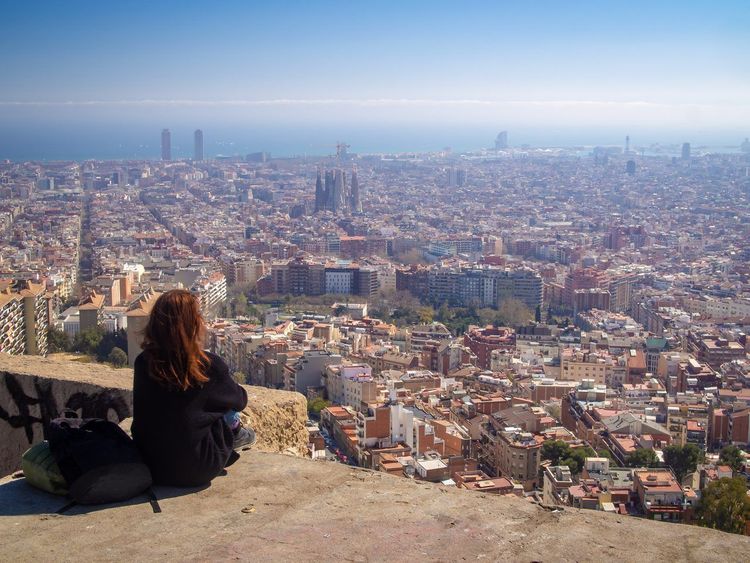
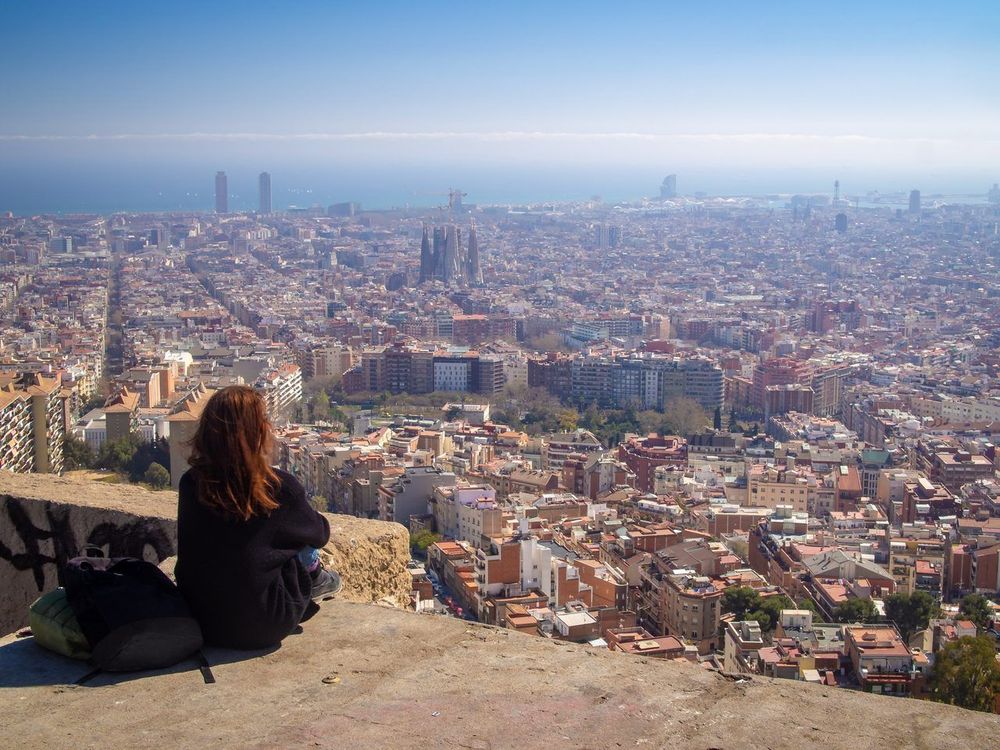
Let's head back up to the heights for a moment, but this time to the north side. The Bunkers del Carmel (Carrer de Marià Labèrnia, 08032 Barcelona, rated 4.6/5 on Google across 17,509 reviews), former anti-aircraft batteries built in 1937 during the Civil War to defend the city from bombing raids, today offer one of the most spectacular and entirely free 360-degree panoramas in Barcelona.
The site, long kept under the radar, has grown in popularity in recent years to the point where the city council has had to put up signs limiting noise after sunset, following complaints from nearby residents about rowdy gatherings. There is nothing to stop you going up during the day, when the view over the Sagrada Família, the port, and out to sea on clear days is just as striking — and with far fewer people than at sunset.
Getting there involves a short uphill walk from bus stop 119, or a taxi if you'd rather save your legs after an already full day. To connect this viewpoint with other lesser-known walking routes around the city, the Ryo app offers complementary itineraries: walks to discover Barcelona on foot lay out several alternative routes to the standard tourist circuits, neighbourhood by neighbourhood.
Head back down towards the historic centre afterwards to compare this 20th-century military architecture with the Gothic stonework of the Barri Gòtic described earlier: the contrast between the two faces of the city — one defensive and raw, the other ornate and religious — neatly captures Barcelona's architectural diversity within a single day.
12. Passeig de Gràcia and the Quadrat d'Or
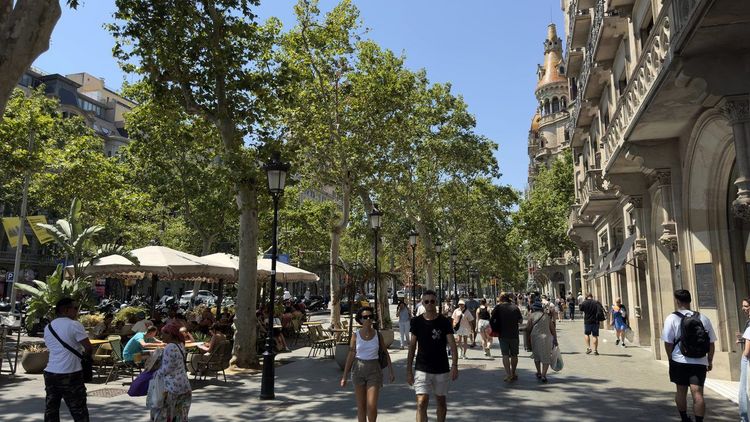
Beyond Gaudí's works already mentioned, the Passeig de Gràcia concentrates along a few hundred metres a unique collection of Modernista facades signed by several rival architects from the early 20th century. The Manzana de la Discordia (the "Block of Discord") brings together on a single city block Gaudí's Casa Batlló, Josep Puig i Cadafalch's Casa Amatller, and Domènech i Montaner's Casa Lleó Morera — three radically different visions of Catalan Modernisme, side by side.
A little further along the same avenue, the Fundació Antoni Tàpies, housed in a former publishing building topped by a metal sculpture shaped like a cloud of wire, exhibits the work of one of the most internationally recognised contemporary Catalan artists — a less-visited alternative to the museums dedicated to Gaudí and Picasso.
About ten minutes on foot away, in the Gràcia neighbourhood, Casa Vicens rounds out the Gaudí panorama: the architect's first major commission, completed in 1885, displays an Orientalist facade covered in green tiles and floral motifs that already hints at his passion for colour and nature. Long a private residence, it only opened to the public in 2017 and remains far less visited than Casa Batlló or La Pedrera, making it a restful visit for those who want to explore Gaudí's work in depth without the crowds of his best-known addresses.
The avenue itself rewards a slow stroll: its hexagonal paving tiles, originally designed by Gaudí, and its lamppost decorated with mosaic are as worth a look as the luxury boutiques that now occupy the ground floors. The best time to photograph the facades without reflections or crowds is early in the morning, before the shops open around 10am. Our audio-guided tour, Through Gaudí's Eyes, follows this same avenue, between Casa Batlló and Casa Vicens.
13. Parc de la Ciutadella
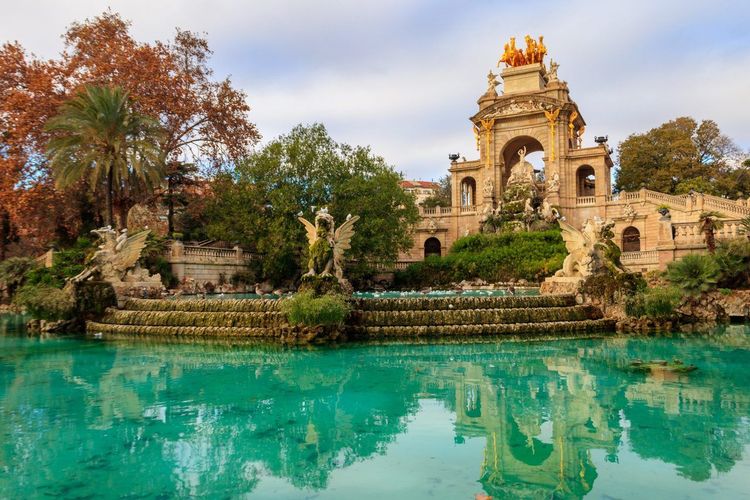
Once the site of a military citadel built to keep watch over the city after the 1714 siege, the Parc de la Ciutadella was transformed in 1888 for the Universal Exhibition and remains the main green lung of the city centre.
The monumental Cascada fountain at the park entrance is said to have benefited from the first sketches of a young Gaudí, still a student of architecture at the time. You can hire a rowing boat on the small artificial lake nearby — a simple activity that remains popular with families at weekends — or visit the Barcelona Zoo, located within the park grounds, free of charge.
The park is open every day, and access to its paths, the cascade, and the Arc de Triomf esplanade is entirely free — only the zoo requires a ticket. It is one of the rare large green spaces in the centre where you can picnic in the shade, take a break between visits, or watch the green parakeets that have colonised the palm trees. On Sunday mornings, groups of musicians and sardana dancers — performing the traditional Catalan circle dance — sometimes gather near the entrance, an impromptu and free show that gives a glimpse of local culture well away from the tourist circuit.
At the northern entrance to the park stands the Arc de Triomf, built in red brick for the Universal Exhibition of 1888, where it served as the main entrance gate. The palm-lined avenue leading up to it remains one of the favourite Sunday promenades for Barcelona residents, far from the tourist bustle of the centre. The building now housing the Parliament of Catalonia also stands within the park grounds — a former military arsenal that has changed purpose several times over the decades.
14. Tibidabo, the Magic Mountain
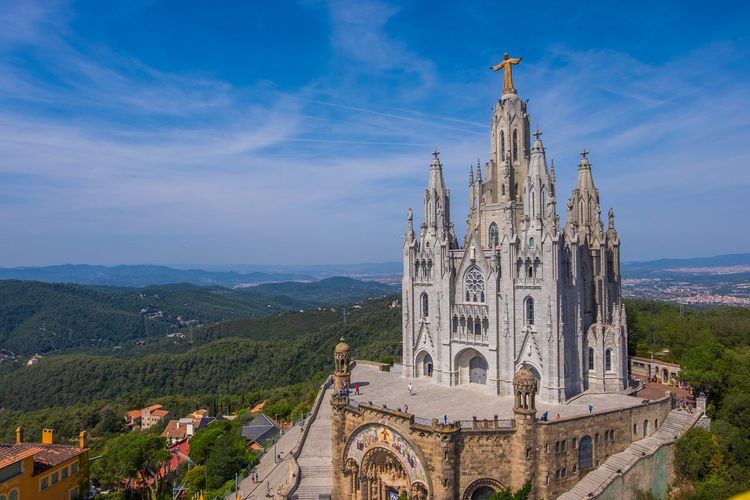
At 512 metres above sea level, Tibidabo commands the entire Barcelona metropolitan area and on clear days offers views stretching as far as the Pyrenees and the island of Mallorca.
The Parc d'Atraccions, open since 1899, has preserved several period rides still in operation, including the Avió — one of the world's first flight simulators, dating from 1928 — and a century-old carousel. The vintage atmosphere is deliberately at odds with modern thrill parks, a conscious choice by the city, which prefers to preserve the site's playful heritage rather than multiplying high-adrenaline attractions.
The amusement park does not open every day out of season: it's worth checking the online calendar before making the trip up, as it mainly operates on weekends and during school holidays from October to March. A standard entry ticket covers all the rides, but there is also a reduced "panoramic" rate limited to a handful of attractions and the viewing terrace, worth considering if you're going up primarily for the view rather than the thrills. The Sacred Heart church can be visited without a ticket, and the lift up to the base of the Christ statue — paid but inexpensive — offers the highest publicly accessible viewpoint across the entire metropolitan area.
Right next door, the Temple of the Sacred Heart, visible from across the city thanks to its Christ statue at the summit, is free to visit and offers from its terrace an alternative viewpoint to that of the park, with no entry ticket required. A panoramic restaurant just below the summit allows you to extend the visit over dinner with the city lights as a backdrop — an option worth booking in advance at weekends.
For the ascent, the journey combines several characterful modes of transport: the FGC train to Peu del Funicular, the funicular up to Parc del Tibidabo, then the Tramvia Blau — a historic wooden tram dating from 1901 that only runs on certain weekends depending on the season, with a replacement bus service otherwise. Allow half a day for the full trip including travel and visit.
15. Day Trips from Barcelona: Montserrat, Sitges, and the Costa Brava
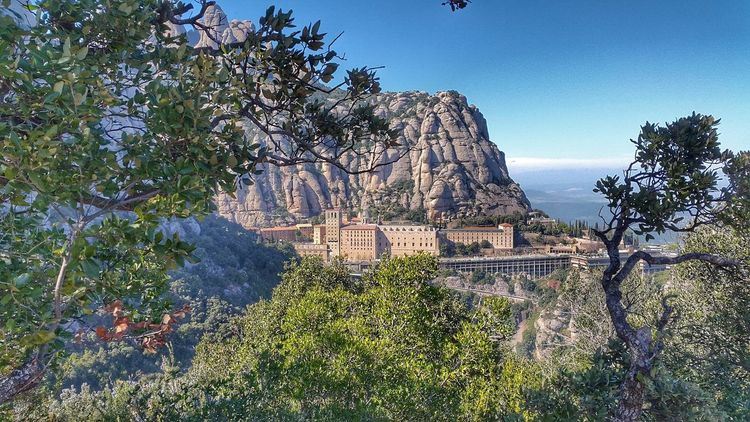
Beyond the city limits, several day trips naturally complement a stay of more than 3 days. The monastery of Montserrat, perched at 725 metres on a rocky massif with its distinctive rounded formations, can be reached by rack railway (Cremallera de Montserrat) from Aeri de Montserrat station — a 15-minute journey that climbs the mountainside with breathtaking views over the valley.
The Benedictine monastery is home to the Moreneta, a 12th-century Black Madonna venerated by Catalans, as well as the Escolania, one of the oldest boys' choral schools in Europe, whose young singers perform daily in the late morning in the basilica. Allow a full day for the round trip from Barcelona, including travel and the visit.
On the coast, Sitges, 35 minutes by train from Barcelona, has nine different beaches and a typically Mediterranean white historic centre, very popular for a day trip in summer. Further north, the Costa Brava strings together rocky coves and turquoise waters along more than 200 kilometres of coastline — a region many visitors discover too late in their stay, having not planned enough days. Our detailed selection of the most beautiful coves of the Costa Brava lists the most accessible coves within a half-day from the city, ideal for extending a 4-day or longer stay without retracing your steps.
Less well known among rushed visitors, Girona, 40 minutes away by high-speed train, offers a colourful medieval centre along the Onyar river and rampart walks with sweeping views over the old town — a less-visited alternative to Montserrat for those who have already ticked off the best-known sites. Several scenes from the Game of Thrones series were filmed here, a detail that now draws a portion of visitors who come specifically for that reason.
If you need to choose between these day trips and time is short, Montserrat remains the priority for its combined scenic and cultural interest, while Sitges and the Costa Brava are better suited to a summer stay focused on the beach, and Girona to a more urban and heritage-oriented traveller.



FAQ
How many days do you need to visit Barcelona?
Allow at least 3 days to cover the highlights: the Sagrada Família, Parc Güell, the Barri Gòtic, and Montjuïc. With 5 days, you can add a day trip to Montserrat or the Costa Brava without rushing, and keep half a day free to wander without a fixed itinerary.
What can you do in Barcelona for free?
The Bunkers del Carmel, the zoo in Parc de la Ciutadella, the exterior facades of Gaudí's works, the Barri Gòtic, and the Font Màgica de Montjuïc in the evening are all free. Several museums, including the Picasso Museum, also offer free entry one Sunday per month and on certain Thursday evenings.
What should you do in Barcelona in 1 day?
Focus on a single geographic area: the Sagrada Família in the morning, then the Barri Gòtic and La Rambla in the afternoon, or Parc Güell and Casa Batlló if Gaudí's architecture is your absolute priority. It's best to avoid travelling back and forth across the city in a single day.
What should you do in Barcelona with kids?
Parc de la Ciutadella with its zoo and rowboats, Tibidabo with its vintage rides, and the Barceloneta beach are particularly well-suited for children. The Sagrada Família remains free for children under 11, a detail that meaningfully reduces the budget for a family stay.
What should you do in Barcelona as a couple?
A sunset at the Bunkers del Carmel, a stroll along the Passeig de Gràcia, a tapas dinner in the lanes of El Born, or an evening at the Font Màgica de Montjuïc all offer a romantic setting with no reservation required and no particular budget needed.
Should you book the Sagrada Família in advance?
Yes, absolutely — 3 to 4 weeks ahead during high season (June to September). Without a booking, the queue regularly exceeds 2 hours, and tower time slots can sell out several days in advance, especially on weekends.
What is the best neighbourhood to stay in Barcelona?
The Eixample offers a good balance between proximity to Gaudí's sites and relative calm in the evening. The Barri Gòtic and El Born suit those looking for nightlife and restaurants, while Barceloneta appeals for its immediate access to the beach and waterfront.
Barcelona does not lend itself easily to a rushed visit: each neighbourhood, from the medieval Barri Gòtic to the heights of Montjuïc, deserves time in its own right rather than a brief stop between photos. Whether you have 2 days or a full week, it's better to choose 4 or 5 priority experiences from this list and explore them in depth rather than quickly ticking off every neighbourhood.
To plan your route neighbourhood by neighbourhood without retracing your steps, the audio-guided tour of Barcelona offers a complete audio-guided itinerary, with 27 audio tracks spread over 2h35 of walking — a solid foundation to build on with day trips or the less-visited neighbourhoods mentioned earlier in this article.
À lire également