
Créé par Emilie, le 17 nov. 2026
Votre guide Ryo
Cartagena, Colombia
La Heroica: The City of a Thousand Colours
Parcours audioguidé pour visiter Cartagena en 1 jour
This tour of Cartagena’s historic center invites you to step inside the walls of a legendary city, featuring colonial houses with flower-filled balconies, shaded squares, and churches with ochre domes. Throughout the route, discover the legacy of explorers and pirates, the strength of Spanish bastions, and the vibrant spots where the history of the Americas meets the magic and colors of the Caribbean coast. A simple and immersive way to explore the passionate soul of Cartagena at your own pace.
Quand partir à Cartagena ?
Jan.
27°
1
Feb.
27°
1
March
27°
1
April
28°
3
May
29°
11
June
29°
13
July
29°
13
Aug.
29°
15
Sept.
29°
17
Oct
28°
19
Nov.
28°
12
Dec.
28°
3
In Colombia, temperatures are high year-round and rarely drop below 27°C (81°F). At first glance, it might seem like you can travel at any time with no worries. However, there are two distinct seasons to consider: summer, or the dry season, from November to March, and winter, or the wet season, from April to October. While the cold is not a concern, the heavy rains and stifling humidity between May and November do not guarantee the best travel conditions. To optimize your visit, the months from January to April and December are the most recommended for planning your trip.
Départ conseillé
No need to worry about where to begin! Our tours are designed as a loop, so you can jump in wherever you are. The navigation system and audioguide will automatically adjust to your location. However, if you happen to be nearby, we do have a preferred starting point: next to the Heredia Bridge
Parking à proximité
Parqueadero : 9120 Cl. 29
À savoir
During our visit, you will pass through Parque Centenario. To avoid any last-minute surprises, please note that this site may have specific opening and closing hours. If the park is closed when you arrive, you will need to take the following route to continue the tour: 8b154 Cl. 29 (Avenida Blas de Lezo) -> 8b2 Cl. 30 (Calle de la Media Luna).
You will quickly notice that Cartagena has a serious shortage of public restrooms. To avoid any unpleasant urgent situations during the visit, we recommend planning your bathroom breaks at places where you can eat or drink.
Découvrez 22 lieux d'intérêt pour visiter Cartagena





What to see in Cartagena on your 2h15 tour?
This 5.1 km loop takes about 2 hours 15 minutes and links 20 sights across Cartagena de Indias. It starts at San Felipe de Barajas Castle, crosses the bohemian district of Getsemaní, passes through the Torre del Reloj into the walled old town, winds between colonial squares, church and cathedral, follows the ramparts facing the Caribbean, then closes the loop past the university and Parque Centenario. With the Ryo app in your ears, you dive into four centuries of colonial and Caribbean history.
Information checked in November 2026 and subject to change.
1 - San Felipe de Barajas Castle
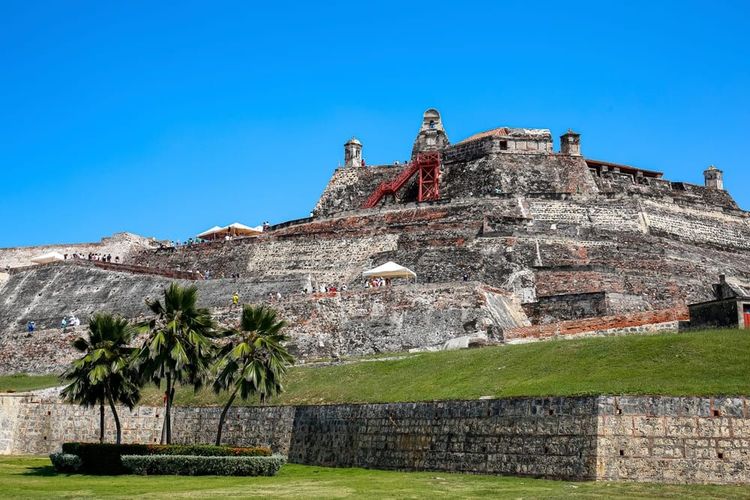
The walk begins at the foot of San Felipe de Barajas Castle, the largest Spanish colonial fortress ever built in the Americas. Founded in the 16th century on San Lázaro hill to fend off French and British fleets, it was the setting, in 1741, for a battle where a few thousand Spanish troops defeated nearly 30,000 attackers led by Admiral Vernon. Its original tunnels, batteries and turrets still tell this conquering, troubled story.
Paid entry
2 - Getsemaní District
The route then drops into Getsemaní, a long-overlooked district where, under Spanish rule, enslaved people sold at the nearby port came to settle. Turned craftspeople, these residents nurtured a spirit of emancipation that peaked on 11 November 1811, the day the city was finally freed. That rebellious past still fills its colourful streets, covered in street art murals and lit up at night by reggaeton beats drawing a bohemian crowd.
Free entry
3 - Viewpoint from the Marina
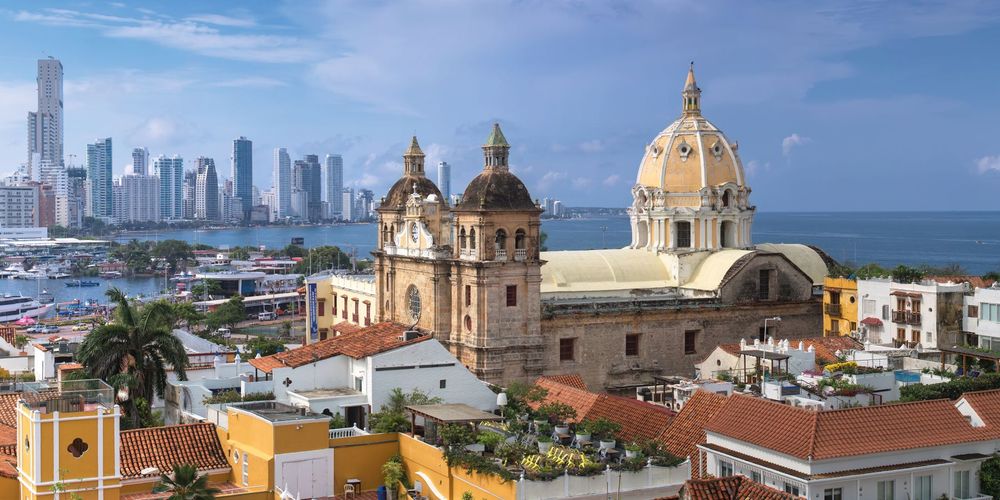
Before entering the old town, a detour by the marina offers a first overview. To the left rises the dome of San Pedro Claver church, the work of a French architect; opposite stands the sturdy silhouette of the Torre del Reloj. Between the two, the old town's ramparts close the view, recalling the sieges and raids they long tried to hold back.
Free entry
4 - La Torre del Reloj
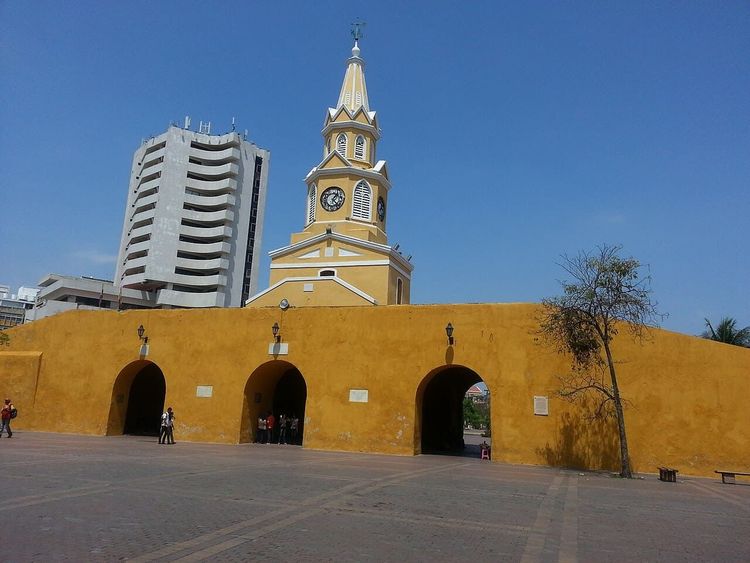
The route then passes through the Torre del Reloj, built in the 18th century where a drawbridge once guarded the fortified city's only entrance. Partly destroyed in 1704 and later remodelled into an octagonal tower, it received its first North American clock in 1874, replaced sixty-three years later by four Swiss dials, one per face, so no one entering the colonial centre would ever lose track of time.
Free entry
5 - Portal de los Dulces
Beneath the nearby arches stretches the Portal de los Dulces, once a passage for enslaved people and today a showcase of Caribbean sweets. Here you'll find coconut cocadas and cubanitos, tamarind balls or little milk-based sweet figures, specialities that scent the air and make it hard to settle on just one treat.
Free entry
6 - Plaza de la Aduana
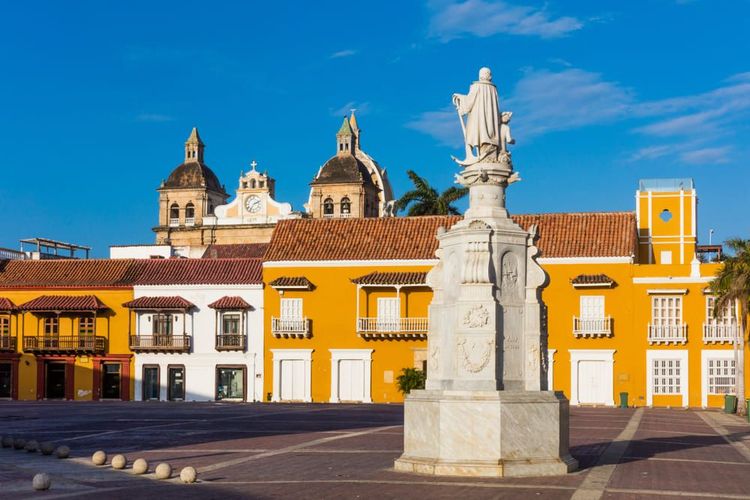
The route opens onto the Plaza de la Aduana, the largest square in the old town and once its administrative heart. The mansion of founder Pedro de Heredia, recognisable by its thirteen arches, still stands here, turned in 1790 into the customs office that gave the square its current name, before becoming city hall. A statue of Christopher Columbus, raised in 1894, watches over it all.
Free entry
7 - San Pedro Claver Church
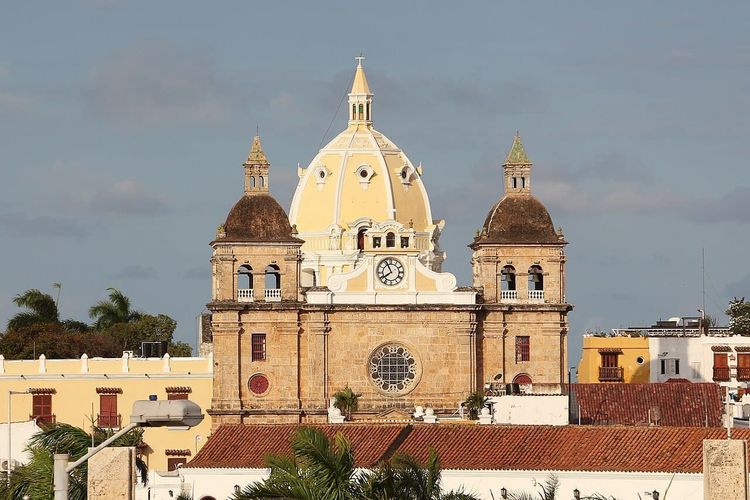
Standing apart from the colour around it, San Pedro Claver church keeps a strict simplicity. Built by Jesuits between 1700 and 1756, it honours the priest whose relics rest beneath the altar, remembered for defending the rights of enslaved Africans landed at the port. Expelled in 1767, the Jesuits saw the building used as a hospital and later a barracks, before reclaiming their mission in the 19th century.
8 - The Naval Museum of Cartagena
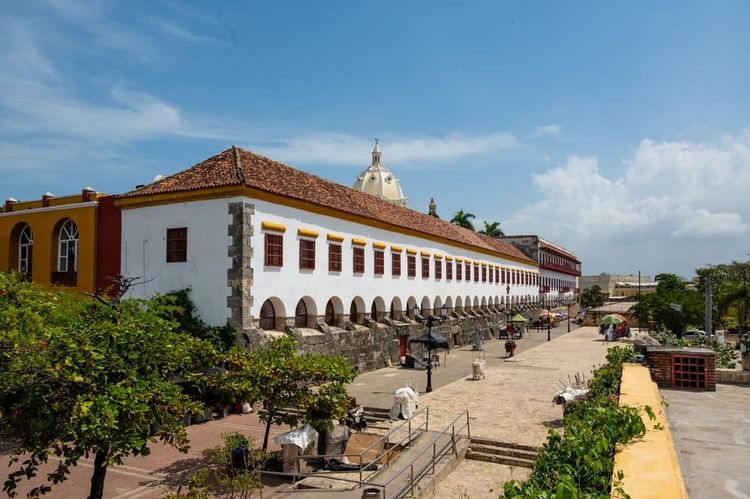
Nearby, the naval museum occupies a vast colonial complex of 3,500 square metres, built in 1612 for a Jesuit college before serving as a hospital, then as barracks for Colombian marine infantry. Turned into a museum since 1988, it tells the story of Cartagena's past as a strategic port through ship models and navigation instruments, not forgetting the galleon San José, sunk in 1708 with its gold cargo never recovered.
Paid entry
9 - The Palace of the Inquisition
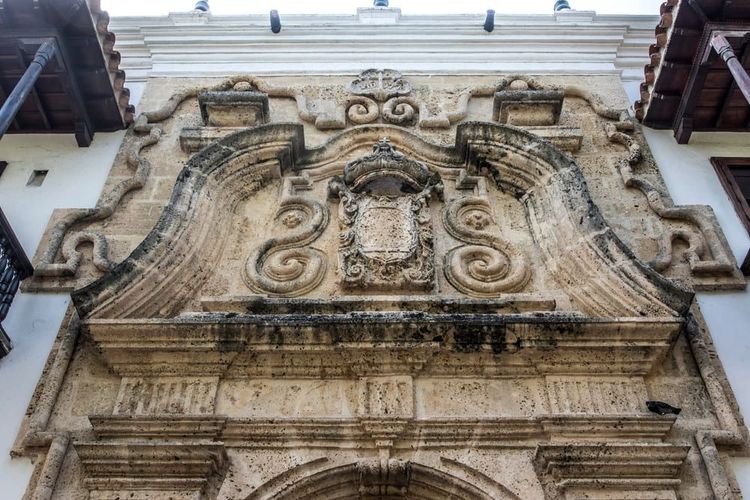
Behind its baroque coral-stone portal hides the Palace of the Inquisition, one of the city's finest buildings, yet also one of its darkest. Seat of the religious tribunal from 1610, it condemned thousands of people over three centuries, often accused of witchcraft. A museum since 1953, it now opens its former torture chambers and courtrooms to shed light on this painful period.
Paid entry
10 - Santa Catalina Cathedral
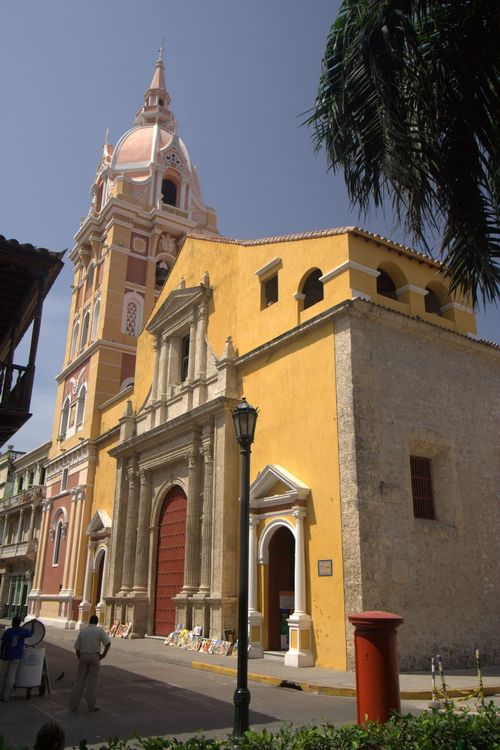
The colourful silhouette of Santa Catalina Cathedral has crowned the district since 1577, when it replaced a modest straw sanctuary, becoming one of South America's oldest cathedrals. Its construction, delayed by pirate Francis Drake's 1586 attack, was only finished in 1612; the tower and dome, inspired by Andalusian basilicas, were added only half a century later.
Free entry
11 - Plaza Santo Domingo
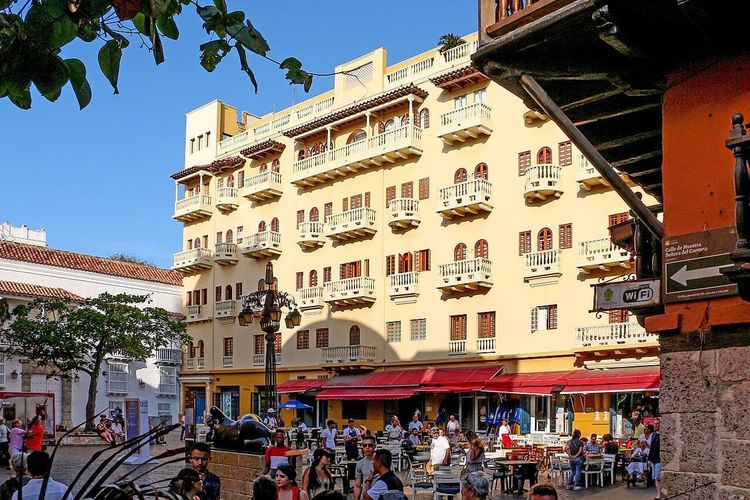
The walk opens onto Plaza Santo Domingo, one of the liveliest squares in the old town, where musicians and dancers keep its terraces buzzing late into the evening. Here stands the church whose leaning bell tower feeds a divine legend, but above all Botero's generous sculpture, whose curves, stroked by passers-by for years, are said to bring luck.
Free entry
12 - Viewpoint from the City Walls
Climbing onto the ramparts opens a wide panorama: the Caribbean Sea stretches on one flank, while the colourful rooftops of the old town rise on the other, crowned by the cathedral's bell tower. To the left, a few period cannons come into view, while on the horizon, in sharp contrast, the skyscrapers of the upscale Boca Grande district announce contemporary Cartagena.
Free entry
13 - City Walls
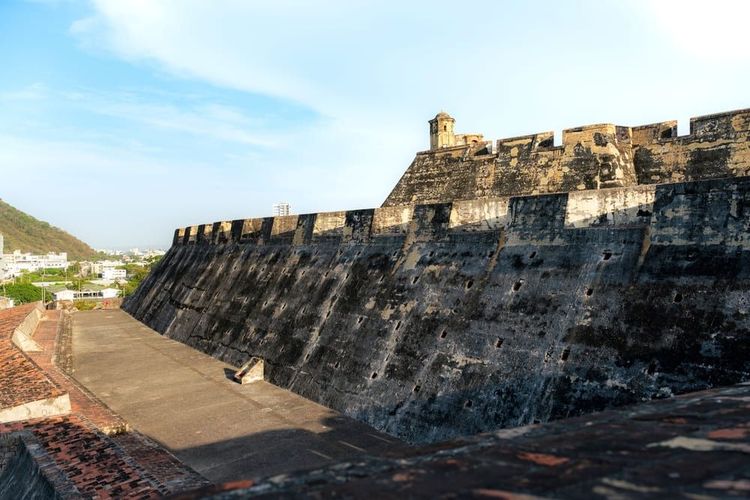
The route then follows the walls themselves, raised from the 16th century to protect the largest colonial port in the Americas from pirate raids and rival powers. Completed in 1796 after two centuries of work, they once held twenty-three bastions along eleven kilometres. Now listed as World Heritage, they remain the best-preserved fortifications on the continent.
Free entry
14 - Adolfo Mejia Theater
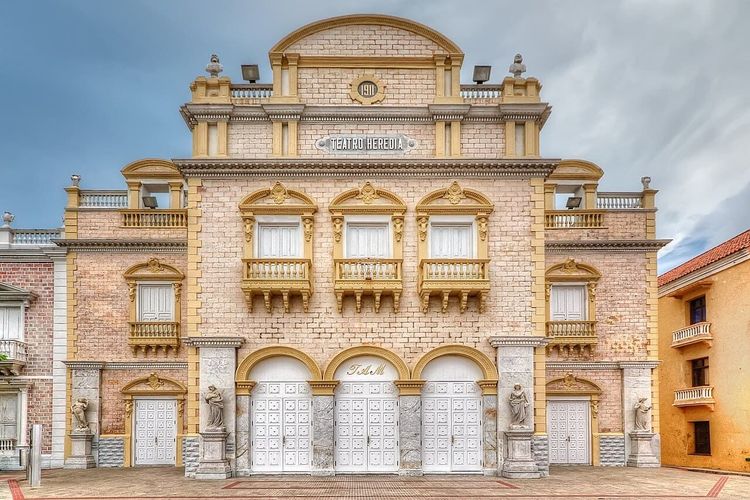
Nearby, the Adolfo Mejía theatre shows off its candy-pink façade, raised in 1911 for the centenary of independence. Inside, a horseshoe-shaped hall combines Italian marble, Portuguese wooden balconies and a ceiling fresco of the nine muses by Enrique Grau. Restored twice since, it still hosts concerts and shows in a setting worthy of the grandest stages.
Paid entry
15 - Las Bóvedas
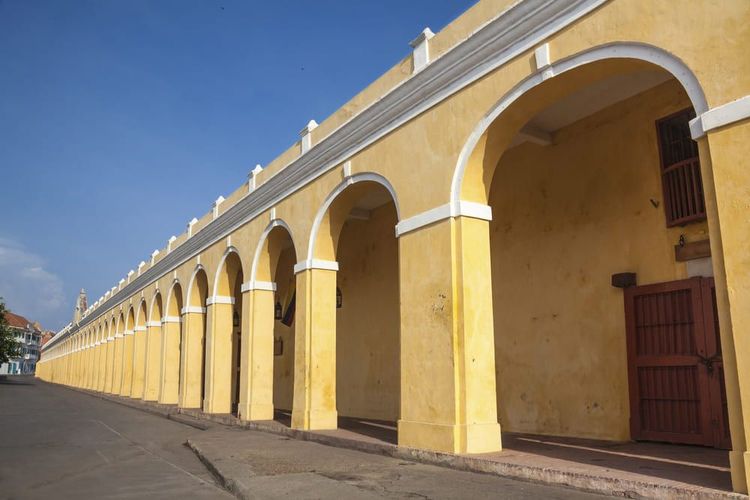
Backed against the ramparts, Las Bóvedas lines up forty-seven arches built between 1792 and 1796 to shelter Spanish troops and munitions. Turned in turn into barracks and then a prison, where seawater rose to prisoners' knees at high tide, it was restored in the 20th century and now hosts craft shops and art galleries beneath its colourful vaults.
Free entry
16 - Old Town
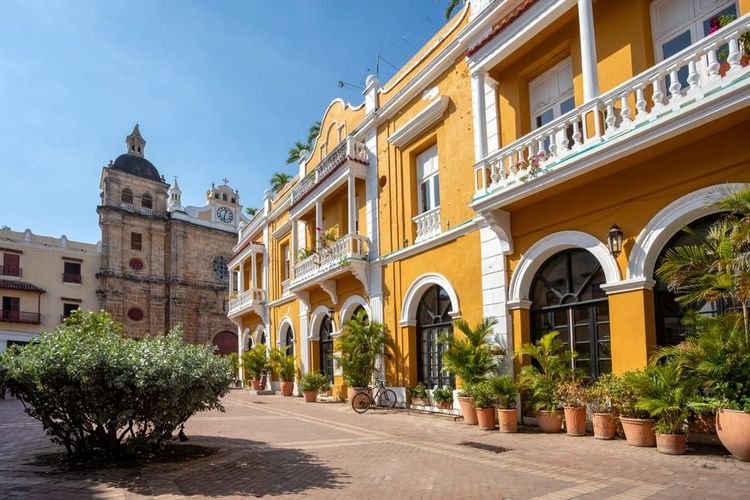
The walk continues through the maze of the old town, once the stronghold of the colonial bourgeoisie behind the ramparts. Colourful houses, balconies draped in bougainvillea and squares where locals love to linger make up this preserved setting, listed as World Heritage by UNESCO in 1984 against mounting tourist and real-estate pressure.
Free entry
17 - Casa de Simón Bolívar
The route then passes the house with the white studded door that was, in South America, Simón Bolívar's very first home. Nicknamed El Libertador, this Venezuelan general took part in the independence of six countries, riding on horseback roughly three times Napoleon's total distance to fight around a hundred battles, before seeing his dream of a pan-American confederation collapse.
18 - The University of Cartagena
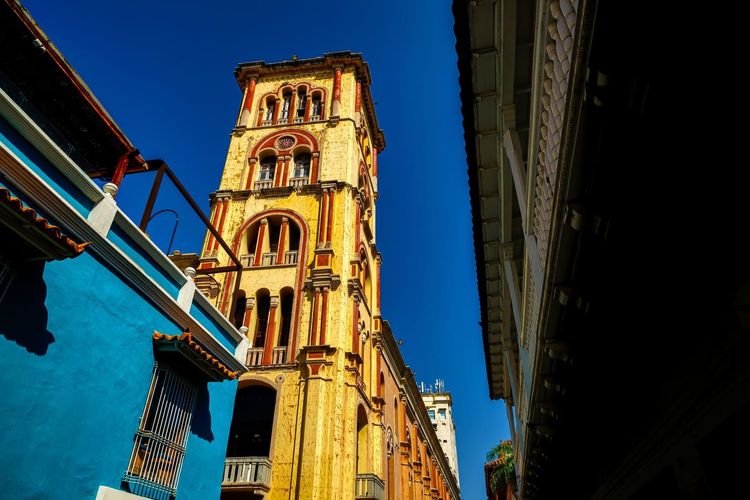
It's hard to resist photographing the University of Cartagena, housed since 1827 in a former Augustinian convent. Founded by Francisco de Paula Santander and Simón Bolívar, it originally taught only law and medicine, before widening its range of subjects from the 1950s onward. Northern Colombia's oldest academic institution, it was also the Caribbean's first university to earn the state's top quality rating.
Free to see from outside
19 - Plaza de los Coches
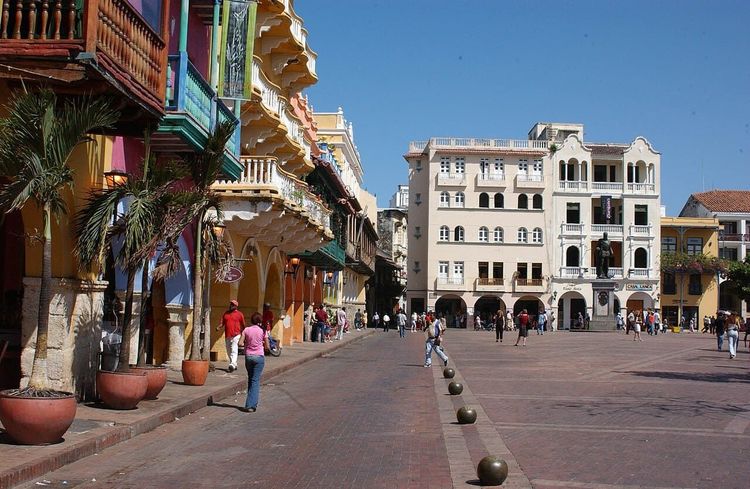
The loop returns to the Plaza de los Coches, framed by the Torre del Reloj and the Portal de los Dulces. Long named after a local lawyer, then for the sale of yerba leaves, it sadly became Cartagena's slave market in the 16th century, before taking its current name in the late 19th century, when the city allowed carriages to park there.
Free entry
20 - Parque Centenario
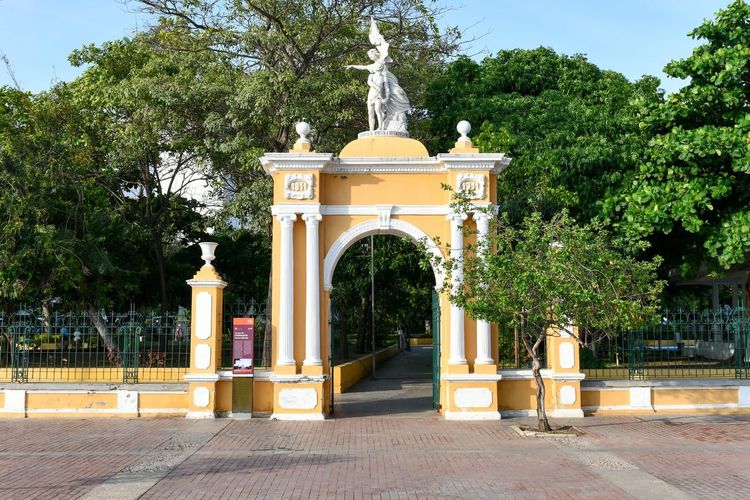
The walk ends at Parque Centenario, a green lung separating the old town from Getsemaní. Opened unfinished in 1911 to mark the centenary of independence, it now shelters a surprising free-roaming wildlife, sloths, squirrels, white-crested monkeys and iguanas, all former victims of animal trafficking that came to live out their days beneath its tall trees.
Free entry
Which neighbourhoods does the tour cross?
The loop begins outside the walls, crosses the fortified perimeter to wind through the colonial city, then returns to the edge of Getsemaní.
The start faces San Felipe de Barajas castle, seen from afar on San Lázaro hill. The route then heads into Getsemaní, where many enslaved people once settled, now a bohemian neighbourhood, then to a viewpoint from the marina, before passing through the Torre del Reloj, once the only way into the walled city, and entering the old town by the Portal de los Dulces (stops 1 to 5).
From there the route winds through the colonial squares, from Plaza de la Aduana to the San Pedro Claver church and the naval museum, before climbing back past the Palace of the Inquisition, the Santa Catalina cathedral and Plaza Santo Domingo, ending on the walls themselves, facing the Caribbean Sea (stops 6 to 13).
The last stretch runs past the Adolfo Mejía theatre and the arches of Las Bóvedas, set against the ramparts in the north of the old town, crosses the historic centre to the house of Simón Bolívar and the university, then passes Plaza de los Coches again before closing the loop at Parque Centenario, on the edge of Getsemaní (stops 14 to 20).
How much does it cost to visit Cartagena?
Of the 20 stops on the route, thirteen are freely accessible and one can only be seen from the street. Among the others, four require a ticket to go inside: the naval museum, the Palace of the Inquisition, the Adolfo Mejía theatre and San Felipe de Barajas castle, which the route shows from a distance.
Information checked in November 2026 and subject to change.
Where to stop for a bite along the tour?
One whole stop on the route is devoted to local sweets, under a colonial square's historic arcades.
Under arches once used for the slave trade, the Portal de los Dulces lines up traditional confectionery stalls mixing coconut, tropical fruit, cane sugar and tamarind; cubanitos, cocadas, little milk-fudge dolls and tamarind balls all compete for sweet-toothed visitors' attention.
A little further on, Plaza Santo Domingo takes over with its terraces and restaurants, at their liveliest in the evening to the sound of musicians.
What should you know before visiting Cartagena?
Three things are worth knowing before you set off: evening safety, a possible detour near the end of the route, and the best season to visit.
The French foreign ministry advises staying alert after dark in the historic centre, where violent robberies have been reported, and taking only taxis booked through an app, by phone or via a licensed company. Scopolamine attacks, a drug causing memory loss and leaving victims vulnerable to theft, are also reported in Colombia, notably through meetings arranged on dating apps: it's best to stay wary of any object, drink or cigarette offered by a stranger.
Parque Centenario, which closes the loop, keeps set opening hours: if it's already shut when you pass, a detour via Avenida Blas de Lezo and then Calle de la Media Luna gets you back on the route. As for timing, it is hot all year round, but the rain and stifling humidity from May to November make December and January to April the most recommended months.
Le plein d'inspirations
Explorez le monde en totale liberté, à pied au cœur des villes ou au fil des routes. Nos guides audios transforment chaque destination en une découverte culturelle immersive et unique.










FAQ for visiting Cartagena
When is the best time to visit Cartagena?
The best time to visit Cartagena runs from December to April, during the dry season. Temperatures remain pleasant all year round, generally hovering around 27-30°C, but it is the humidity that really makes the difference. Between January and March, you will enjoy sunny weather ideal for strolling through the colourful lanes of the historic centre. December is also excellent, with a special festive atmosphere. If possible, avoid the period from May to November, marked by frequent rains and stifling humidity that can make visits less pleasant. Transition months such as April remain fine, still with little rainfall.
How many days do you need to visit Cartagena?
Three to four days is the ideal length of time to properly discover Cartagena. This lets you calmly explore the fortified historic centre, soak up the unique atmosphere of its colonial neighbourhoods, and have time for a few getaways to the surroundings. Two days are enough to see the essentials if your time is limited, but you risk missing some of the city's hidden charms. With five days or more, you can really take your time, enjoy the beaches of the Rosario Islands, and let yourself be carried by the Caribbean rhythm without rushing. The Ryo audioguide accompanies you to optimise your discovery of the historic centre, whatever time you have available.
Which neighbourhoods should you visit in Cartagena?
The heart of Cartagena beats in its historic neighbourhoods within the walls. The Centro Histórico, with its colonial houses in multicoloured façades and its lively squares, is absolutely essential. Right next door, San Diego offers a more residential and authentic atmosphere, with charming flower-filled lanes. Getsemaní, once a working-class district, has become the city's trendy spot, blending street art, bohemian cafés and a festive atmosphere. Bocagrande, the modern seaside district, contrasts with its skyscrapers and urban beaches. For a complete immersion in colonial history, the Ryo audioguide takes you through the most beautiful corners of the fortified centre, revealing the secrets of every square and monument.
How do you get around in Cartagena?
The historic centre of Cartagena is ideally explored on foot, its cobbled lanes and short distances making walking very pleasant. To reach the more distant neighbourhoods such as Bocagrande or the airport, taxis are plentiful and relatively affordable, but always negotiate the price before getting in or ask for the meter to be used. Ride-hailing apps such as Uber also work well. Local buses exist but are rather complicated for visitors. For a typical experience, try the chivas, those festive colourful buses for tourist trips. The horse-drawn carriages travel through the historic centre but remain quite expensive. Bike rental can be nice early in the morning before the heat.
Where should you stay in Cartagena?
The choice of your accommodation will depend on your priorities. The Centro Histórico remains the most charming option, with its boutique hotels in former colonial residences, perfect for soaking up the atmosphere but generally more expensive. Getsemaní offers an excellent compromise, more affordable while remaining within the walls, with a young and dynamic atmosphere. San Diego suits those seeking quiet while staying close to the attractions. Bocagrande will appeal to lovers of the beach and modernity, with its large seafront hotels, but you will be further from the colonial charm. Hostels abound in Getsemaní for tight budgets, while luxury is concentrated in the Centro.
Is it safe to visit Cartagena?
Cartagena is generally considered one of the safest cities in Colombia for tourists, particularly in the tourist areas. The fortified historic centre and Bocagrande benefit from a strong police presence. As everywhere, stay vigilant with your valuables and avoid displaying them. Pickpockets can operate in very crowded areas. At night, favour taxis for your travels, especially outside the historic centre. Avoid the outlying, less touristy neighbourhoods. Street vendors can be insistent but remain harmless, a polite no is generally enough. Overall, by applying the usual travel precautions, you should have a calm and pleasant stay.
What can you see around Cartagena?
The surroundings of Cartagena are full of natural and cultural wonders. The Rosario Islands, accessible by boat in less than an hour, offer paradisiacal beaches and crystal-clear waters perfect for snorkelling. Playa Blanca on Barú island is renowned for its immaculate white sand. The El Totumo mud volcano offers a unique experience of bathing in mud with therapeutic properties. La Boquilla, a fishing village, lets you discover local life and the mangroves by canoe. San Basilio de Palenque, the first village of free slaves in the Americas, offers a fascinating cultural immersion. These excursions are generally done as a day trip and perfectly complement your urban discovery with the Ryo audioguide.
Where can you go out at night in Cartagena?
Cartagena's nights vibrate to the rhythm of salsa and reggaeton. Getsemaní stands out as the festive neighbourhood par excellence, with its bohemian bars and the famous Plaza de la Trinidad where locals and travellers gather. Café Havana remains an institution for dancing to live music. In the Centro Histórico, the rooftops offer spectacular views for sipping cocktails at sunset. Calle del Arsenal concentrates several nightclubs buzzing until the early hours. For a more sophisticated atmosphere, head to the cocktail bars around Plaza Santo Domingo. The chivas rumberas offer typically Colombian festive nighttime tours. The atmosphere generally remains relaxed and welcoming in all the venues.
Which monuments and museums are unmissable in Cartagena?
The walled old town holds most of what matters. You usually enter through the Torre del Reloj, the old clock gate, before reaching Plaza Bolívar with its palm trees and wooden balconies. All around, the Palace of the Inquisition retraces a dark chapter of colonial history, the Gold Museum displays Zenú goldwork and the church of San Pedro Claver keeps alive the memory of slavery in the port. The ramparts themselves can be walked, especially at the end of the day as the sun drops towards the sea. Beyond the walls, the castle of San Felipe de Barajas dominates the city with its mass of stone and its underground galleries. The Ryo audio guide offers a dedicated Cartagena route that links these places through the lanes.
What food should you try in Cartagena?
Cartagena's cooking blends Caribbean, African and Spanish legacies. For a quick bite, people snack on fried arepas de huevo, patacones of crushed plantain and empanadas bought straight from a street stall. At the table, posta cartagenera, a cut of beef simmered in a sweet and savoury sauce, cazuela de mariscos and lightly sweetened coconut rice turn up on almost every menu, often alongside a whole fried fish. As for drinks, tropical fruit juices come in endless varieties, from lulo to corozo, and coconut lemonade does a great deal to make the heat bearable. The fruit sellers in their brightly coloured dresses, the palenqueras, have long been part of the scenery of the historic centre.
Vos commentaires, idées et suggestions
Aucun avis pour le moment