© Shutterstock
 Votre guide Ryo
Auvergne: 15 Must-See Things to Do in 2026
Auvergne boasts staggering figures: 80 volcanoes lying dormant along 125 kilometres, 5 PDO cheeses recognised worldwide, and a Chaîne des Puys inscribed on the UNESCO World Heritage List since 2018. Yet this region remains one of the least visited in metropolitan France. This guide gathers the must-see things in Auvergne to see and do — and it is precisely because the region still escapes mass tourism that these sites remain accessible without queues or overcrowding.
Start from Clermont-Ferrand, whose black basalt streets can be explored with the Ryo audio-guided tour of Clermont-Ferrand in a morning, before heading towards the Puy de Dôme and the Chaîne des Puys. To the east, Vichy unfolds its Belle Époque spa architecture and its Napoleonic parks. To the south, the Cantal reveals the region's most sweeping landscapes around the Puy Mary. Allow a minimum of 5 days to cover the essentials, and ten days to travel through all of Auvergne's territories.
This guide details the volcanoes, Romanesque abbeys, caldera lakes, medieval villages and cheese specialities that make up the region's unique identity. Whether you are planning a road trip, a week of hiking or a gastronomic stay, you will find a rigorous selection of must-see things in Auvergne to build your itinerary.
The Chaîne des Puys and the Puy de Dôme
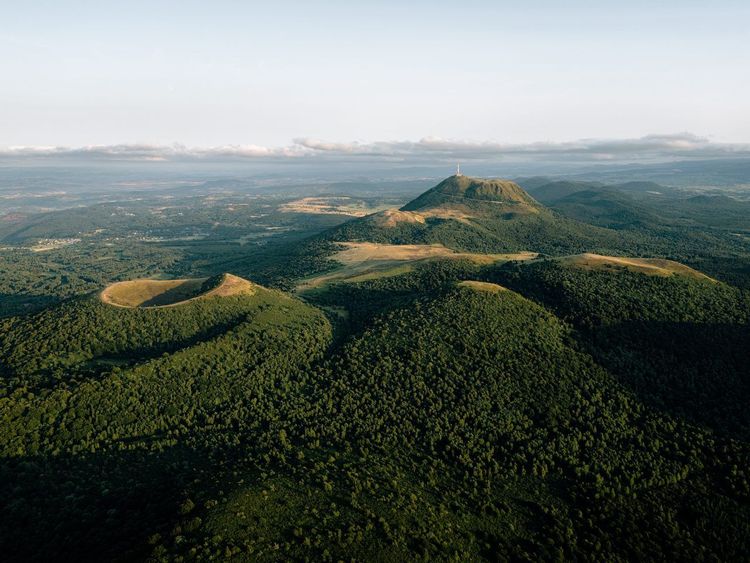
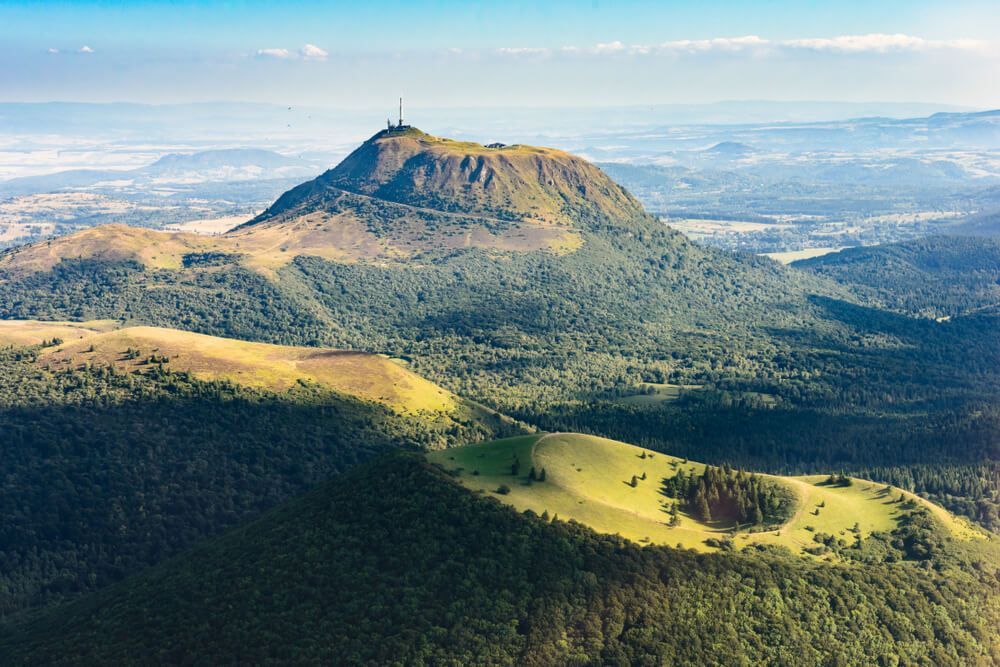
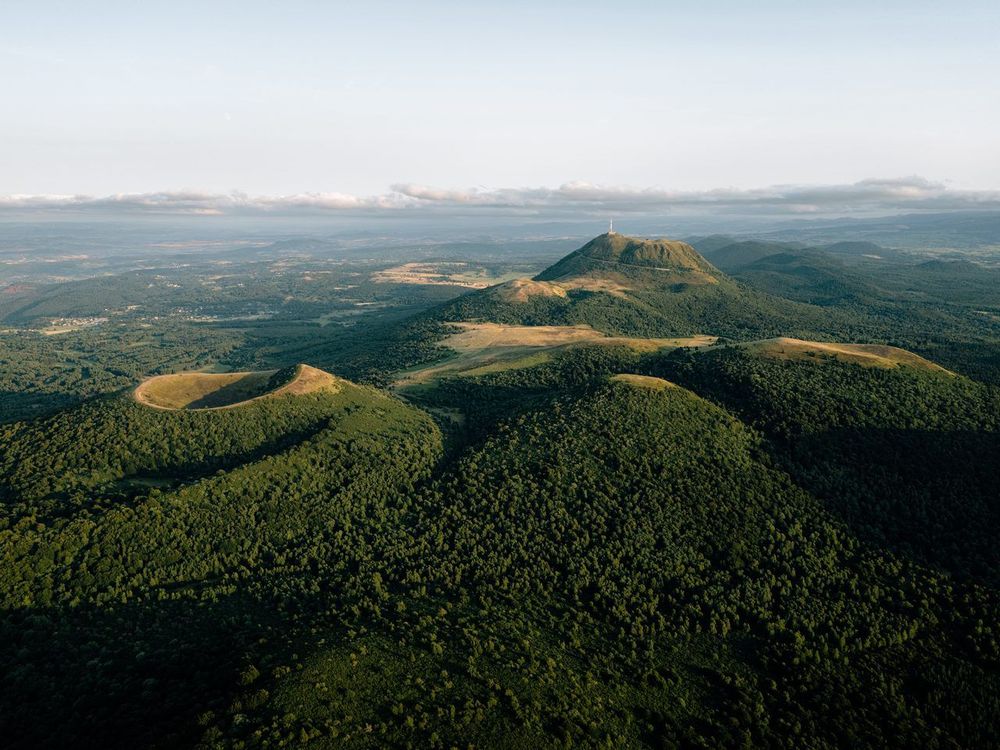
The Chaîne des Puys is Auvergne's number-one attraction and the very first of its must-see highlights. Yet few visitors truly understand what they are looking at when they arrive: it is not a single volcano, but an alignment of 80 volcanic structures stretching 125 kilometres long and about ten kilometres wide, formed between 95,000 and 8,500 years ago. The last eruption dates to 4,000 BC. Since 2018, the entire range has been listed as a UNESCO World Heritage Site under the category of "evolving cultural and natural landscapes".
The chain's highest point is the Puy de Dôme (Route du Puy de Dôme, 63870 Orcines, rated 4.8/5 on Google with 45K reviews), at 1,465 metres above sea level. From the summit, the view takes in the entire chain: you can make out the Puy de Côme with its near-perfect crater, the Puy de la Vache with its fossilised lava flows, and the Grand Sarcoui with its dome of white trachyte. On a clear day, the gaze extends as far as the Alps.
Two options are available for the ascent. The first: the Panoramique des Dômes, a rack railway connecting the Laschamps car park to the summit in 15 minutes. The second: the Chemin des Muletiers, a 3-kilometre footpath climbing 400 metres of elevation from the Col de Ceyssat (allow 1h30 of walking). Both options lead to the ruins of a Roman temple of Mercury that occupied the summit in the 2nd century AD, partially excavated and visible from the observation platform.
The Chaîne des Puys can also be explored over several days via the GR 441, which completes a full loop of approximately 100 kilometres. This route passes through villages of black lava, high-altitude beech forests and ever-changing panoramas depending on the time of day. You can walk day-long segments departing from Clermont-Ferrand.
The Puy de la Vache deserves special mention. This volcano can be explored on foot from the Quatre-Routes car park in a 2-hour round trip. Its double crater, open to the north, clearly reveals the two eruption phases that produced the great Beaunit lava flow, visible to the naked eye in the valley below. It is the most instructive volcano in the chain — less visited than the Puy de Dôme but equally spectacular.
For families, Vulcania (the European volcanology park in Saint-Ours-les-Roches) makes an excellent introduction to volcanic geology before climbing the cones themselves. The park descends 15 metres underground to simulate a magma surge and features interactive exhibitions on the formation of Auvergne's volcanoes. Allow half a day on site.
The Chaîne des Puys is accessible year-round, but the Panoramique des Dômes may close occasionally in the event of black ice or severe storms. In summer, between July and mid-August, visitor numbers peak: prefer a weekday morning to avoid crowds. For further reading, our selection of must-see volcanoes in Auvergne details the region's most remarkable sites.
Clermont-Ferrand: the City of Black Lava
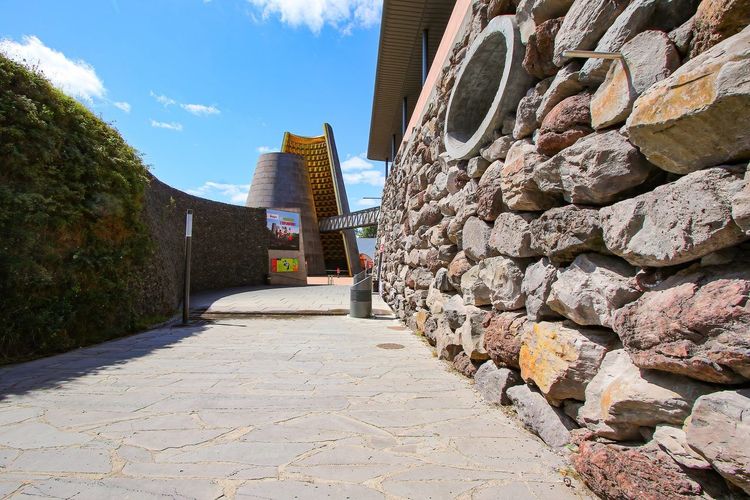
Clermont-Ferrand surprises. The capital of Auvergne is built largely from Volvic lava, a dark volcanic rock quarried since the Middle Ages from mines north of the city. This stone gives the historic centre a colour that is almost unique in Europe — a stark contrast with the white limestone towns found elsewhere in France. Walking through old Clermont feels like stepping into a black-and-white film.
The centrepiece is the Cathédrale Notre-Dame-de-l'Assomption, built entirely from Volvic lava beginning in the 13th century. Its two neo-Gothic towers stand 96 metres tall and dominate the city. Inside, the 13th-century stained-glass windows — among the oldest in France — filter coloured light that creates a striking contrast with the blackness of the walls. The cathedral also holds major historical significance: it was here that Pope Urban II preached the First Crusade in 1095.
A ten-minute walk downhill, the Basilique Notre-Dame-du-Port belongs to another world entirely. Romanesque and 12th-century, it has been a UNESCO World Heritage Site since 1998 as part of the Routes of Santiago de Compostela. Its vaulted crypt and ambulatory choir are models of Auvergne Romanesque architecture: sober, taut, with a geometric rigour that contrasts sharply with the Gothic ornamentation of the neighbouring cathedral.
The Vieux Clermont deserves a full morning. The Place de Jaude, the city's commercial heart, is dominated by the equestrian statue of Vercingétorix: this Auvergnat Gallic chieftain who resisted Caesar in 52 BC remains a central figure of local identity. From the Place de Jaude, head up via the Rue du Port and the Place de la Victoire to reach the cathedral forecourt. The Musée d'Archéologie Bargoin, along this same axis, houses the most important Gallo-Roman collections in the Massif Central, including an exceptional set of wooden statuettes from the spring at Chamalières that is remarkable on a European scale.
Clermont is also a vibrant university city: 40,000 students for 140,000 inhabitants. The neighbourhoods around the university and the Vieux-Marché buzz with bistros and markets at weekends. The Marché Saint-Pierre, covered and historic, is the ideal place to buy farmhouse Saint-Nectaire, Cantal charcuterie or bottles of Côte d'Auvergne wine.
The Ryo Clermont-Ferrand audio tour covers the city in 21 audio tracks over 5.3 kilometres and 2h10 of guided walking. The route details the city's volcanic history, the secrets of building in Volvic lava and its architectural heritage from the Middle Ages to the Michelin era. It is the best starting point for understanding Clermont before venturing into the wider region.
For further reading, the must-do activities in Clermont-Ferrand and the culinary specialities of Clermont-Ferrand usefully complement this overview.
Vichy: the Thermal Elegance of Napoleon III
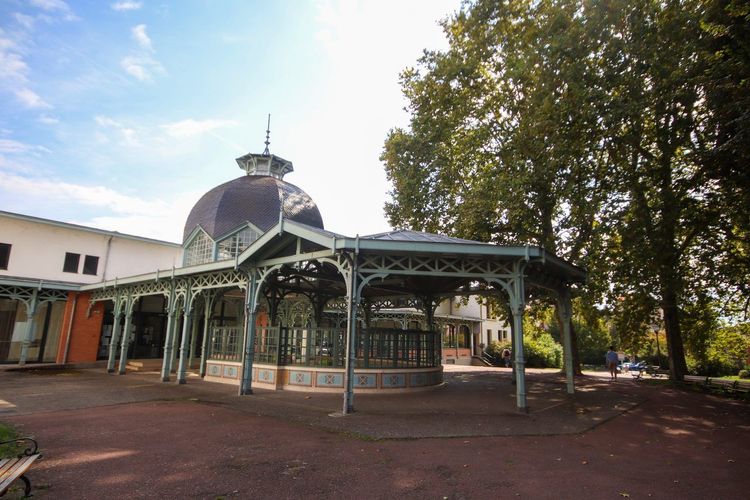
If Clermont is the city of lava, Vichy is the city of water. France's most famous spa town reached its peak under the Second Empire, when Napoleon III established his summer court there and had an entire city built: an opera house, casinos, parks and monumental cure hotels. In just two decades, Vichy transformed from a provincial market town into the summer capital of the French bourgeoisie.
The Parc des Sources is the heart of this Napoleonic Vichy. This avenue of century-old chestnut trees, closed to traffic, leads to the various free mineral water springs you can taste directly at the fountain — each with its own flavour, some sparkling, others sulphurous. The Grand Kiosque des Sources, a metal gallery built in 1865 in the same spirit as Victorian glasshouses, shelters the most frequented fountains.
The Opéra de Vichy (1 Rue du Casino, 03200 Vichy, rated 4.7/5 on Google with 1,390 reviews), built in 1901, is one of the finest Belle Époque buildings in France. Its coloured ceramic facade and double-gallery interior make it a remarkable performance venue. Guided tours are organised out of season; in summer, the programme includes opera, concerts and theatre. The hall is immaculately maintained, making a visit fully worthwhile even without a show scheduled.
The Halles de Vichy, a covered market dating from 1897, host one of the region's most lively markets every Tuesday and Friday morning. You will find Pastilles de Vichy (mint sweets produced here since 1825), farmhouse Saint-Nectaire, Val d'Allier vegetables and local specialities. It is also the best place to observe the daily life of a city that is far from being a museum piece.
The city holds a complex memory linked to the Vichy regime (1940–1944), when Pétain's government established its seat here. This period is addressed with care at the Musée de l'Allier, which also covers the region's archaeological history and regional painting collections.
To explore Vichy at your own pace, the Ryo audio-guided tour La fièvre de l'eau retraces the city's thermal and architectural history in 27 audio tracks over 3.6 kilometres and 1h35 of walking. The surroundings of Vichy hold many surprises: our article on what to see around Vichy and on activities in and around Vichy provides the practical details.
The Cantal and the Puy Mary: Volcanic Immensity
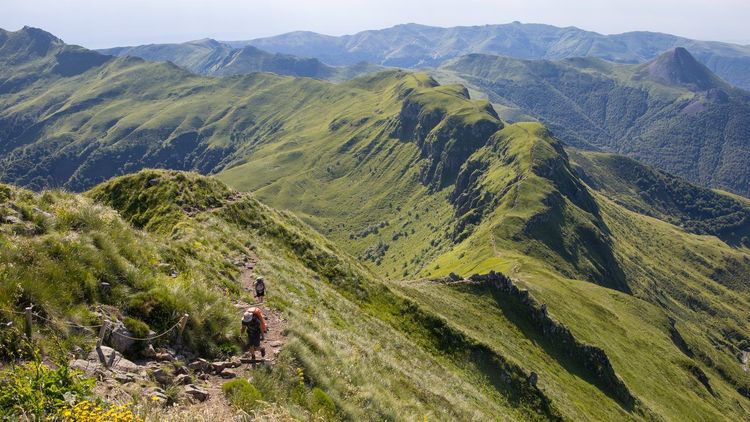
The Cantal is the least densely populated département in metropolitan France: around 10 inhabitants per square kilometre. That statistic says everything about what you will find there. Landscapes of exceptional scale, a high-altitude light that landscape photographers know well, and a mountain silence that is becoming increasingly rare across the rest of France. The massif is among the must-see things in Auvergne for anyone seeking wide open spaces.
The Cantal massif is geologically the largest ancient volcano in Europe. At its maximum, around 10 million years ago, it rose to over 3,000 metres and covered an area comparable to Corsica. Glacial erosion carved it into a series of radiating valleys — the "planèzes" — that give the Cantal landscape its distinctive silhouette: long, regular slopes, a crown of jagged summits, and sunken green valleys.
The unmissable stop is the Puy Mary (Col de Pas de Peyrol, 15400 Mandailles-Saint-Julien, rated 4.7/5 on Google with 284 reviews), at 1,787 metres. Accessible from the Col de Pas de Peyrol (1,588 m, the highest paved road in the Massif Central), the summit is reached on foot in 30 minutes via a well-marked trail. From the top, the star-shaped view across the Cantal valleys is breathtaking: photographs barely convey the panorama's sweeping horizontality.
The Puy Mary is closed to vehicles from around 1 November to 15 May (dates vary depending on conditions). In July and August, shuttles depart from several valley points to avoid congestion at the pass. The hike from the Vallée de la Jordanne (starting from Mandailles-Saint-Julien) offers a more challenging and far quieter alternative: allow 4 hours return.
Around the Puy Mary, ridge roads lead to timeless summer-pasture villages: Dienne, Condat, Riom-ès-Montagnes. These grey-stone towns have barely changed since the 19th century. The ridge road between the Col de Pas de Peyrol and the Col d'Eylac (towards Saint-Flour) is one of the most spectacular drives in all of France, especially in June when blue gentians cover the slopes.
Salers and the Cheeses of the Cantal
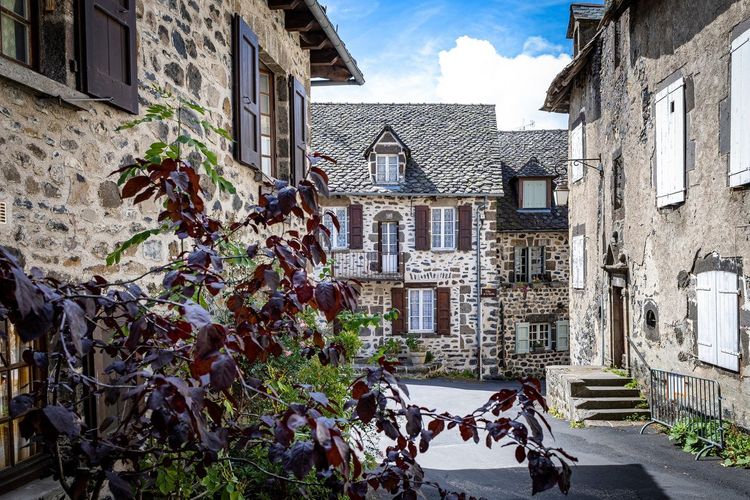
Salers appears on the list of the "Most Beautiful Villages in France" and fully merits this distinction. This medieval village of 300 inhabitants perched at 950 metres above sea level in the Cantal mountains is built from dark trachyte, punctuated with towers, Renaissance houses and a 15th-century church overlooking the plain. It features prominently among the must-see things in Auvergne.
Salers is also the epicentre of two distinct cheese-making traditions. Salers cheese (PDO) is produced only from May to October, exclusively from the milk of Salers-breed cows on summer pasture and only in wooden gerles: traditional vats that harbour the bacteria specific to the terroir. It is probably the cheese in France whose production is subject to the strictest conditions.
The better-known Cantal (PDO) comes in three versions: young (mild, aged 1 to 2 months), medium (6 to 18 months) and old (over 18 months, strong and dry). It is one of the oldest cheeses in France: written records of its production date back to the 14th century. In the village of Salers (Place Tyssandier d'Escous, 15140 Salers, rated 4.7/5 on Google with 2K reviews), several artisan cheese shops offer tastings directly to visitors.
If you wish to continue discovering Auvergne's villages, our articles on the most beautiful villages of the Puy-de-Dôme and the 7 most beautiful villages around Clermont-Ferrand complement this selection.
Orcival, Issoire and the Romanesque Basilicas
Auvergne concentrates some of the finest expressions of Romanesque art in France. Five great basilicas form the heart of Auvergne Romanesque architecture: Notre-Dame-du-Port in Clermont-Ferrand, Saint-Austremoine in Issoire, Notre-Dame-d'Orcival, Saint-Nectaire and the cathedral in Brioude. This body of 11th- and 12th-century architecture is distinguished by its volumetric rigour, its chevets with radiating absidioles and its historiated capitals carved with remarkable precision.
The Basilique Notre-Dame-d'Orcival (Place de l'Église, 63210 Orcival, rated 4.6/5 on Google with 1,546 reviews) is the one that impresses most by its setting. Built in the 12th century in a wooded valley at 840 metres above sea level, it seems to emerge from the forest. The interior houses a gilded wooden Virgin in Majesty from the 12th century, one of the finest in France and still venerated on pilgrimage on Ascension Day. The votive chains suspended in the nave for centuries add a striking ritual dimension that few other buildings possess.
In Issoire, the Abbaye Saint-Austremoine represents the most accomplished example of Auvergne Romanesque. The polychromy of its chevet — a play of white tufa, black basalt and red lava — is visible from the market square. Inside, the choir capitals depict scenes from the Apocalypse with a narrative vigour unmatched in the region.
Plan to include at least three of these five basilicas in your itinerary. These sanctuaries are among the must-see things in Auvergne for lovers of Romanesque art. Visits are free and open to all (Orcival welcomes donations). Our article on museums and historic sites linked to Auvergne's volcanoes complements this selection with other heritage sites in the region.
Thiers, France's Cutlery Capital
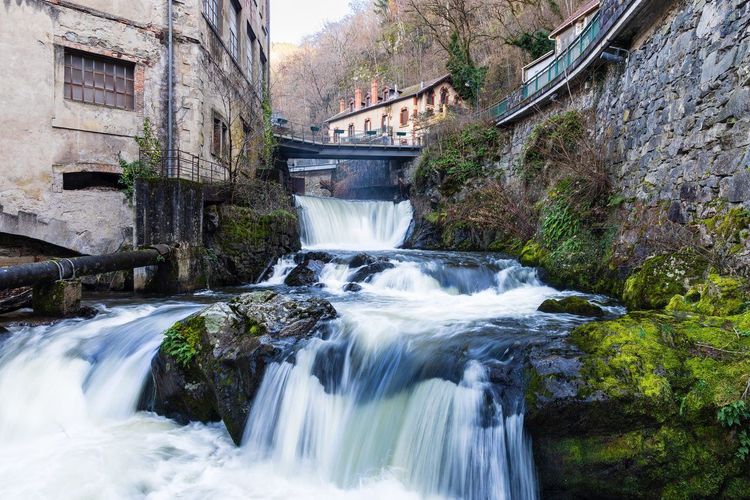
The town of Thiers, clinging to a clifftop above the Vallée des Usines (or Vallée des Rouets), produces 70% of all knives made in France. This industrial specialisation dates back to the 14th century: the valley's streams turned the grindstones of the knife-sharpeners, who worked lying flat above the water to cool the blades. This posture earned them the nickname "pleutres" — those who lie down.
The upper town deserves exploration on foot. Its half-timbered houses from the 15th and 16th centuries, its sloping cobbled lanes and its craftsmen's workshops visible from the street paint the picture of a relatively well-preserved medieval industrial town. The Musée de la Coutellerie traces the history of this craft with sharpening demonstrations by working cutlers: far more lively than a conventional museum display. For knife enthusiasts, the artisan shops in the centre offer pieces at prices well below those charged by Parisian retailers.
If you walk down into the Vallée des Usines (20 minutes from the centre via a marked path), you will still see the old factory buildings along the Durolle, some converted, others abandoned. The atmosphere is particular — somewhere between industrial heritage and the romanticism of a ruin.
The Volcanic Lakes of Auvergne
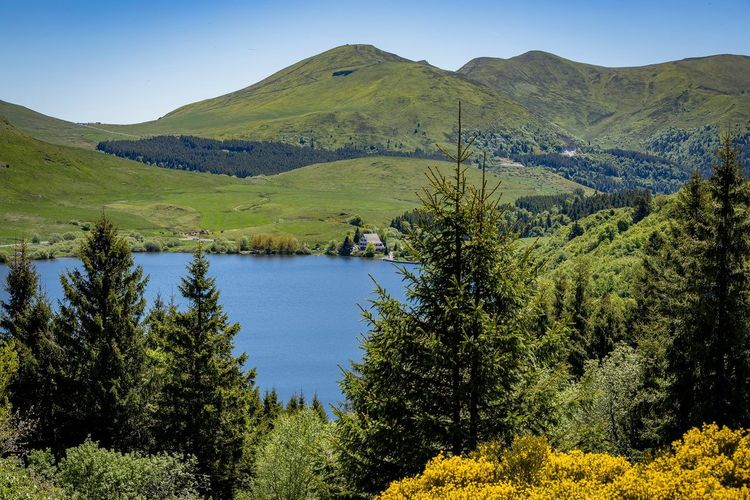
Auvergne boasts several volcanic lakes among the most singular in France, formed in craters or behind solidified lava dams. Their cold waters and deep blue-green hues make them instantly recognisable. They rank among the must-see things in Auvergne during the warmer months.
Lac Pavin (Lac Pavin, 63610 Besse-et-Saint-Anastaise, rated 4.8/5 on Google with 2,278 reviews) is the most fascinating from a scientific standpoint. Its last eruption occurred just 6,700 years ago — yesterday on a geological timescale. The lake occupies a near-perfectly circular crater 750 metres in diameter. Its waters reach 92 metres in depth and are stratified: the lower portion, anoxic and saturated with CO2, never mixes with the surface. The one-hour circular hike around the lake from the Vassivière car park is one of the most accessible walks in the region.
Lac d'Aydat, 20 kilometres south-west of Clermont-Ferrand, is the largest natural lake in Auvergne. It formed behind a lava flow from the Puy de la Vache that dammed the Veyre valley around 8,500 years ago. It is the region's main swimming lake, with a developed beach and water sports activities in summer.
Lac Chambon, in the Couze Chambon valley beneath the Sancy massif, is a popular base for hikers exploring the high plateaux. For the finest reflections, Lac de Guéry (at 1,244 metres above sea level) offers mirror-like waters framed by the Roc Sandoux and the Roc d'Aigle, well away from summer crowds. Access from the Mont-Dore road is free and open year-round, and Clermont-Ferrand makes an easy base on either side of the trip, its black lava streets told over 22 stops of audio-guided walking.
The Gorges and the Garabit Viaduct
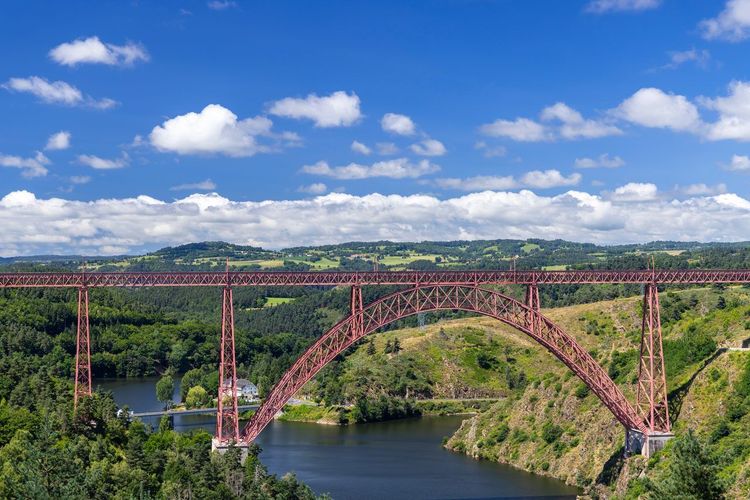
The south of Auvergne is carved by deep gorges that rivers have cut into the volcanic plateau. The most spectacular are the Gorges de la Truyère, whose meanders extend over more than 100 kilometres between the Haute-Loire and the Cantal. Much of the canyon has been submerged since the construction of EDF dams in the 1950s and 1960s, forming the Garabit and Lanau lakes.
Against this backdrop of gorges stands the Garabit Viaduct (D909, 15110 Ruynes-en-Margeride, rated 4.7/5 on Google with 1,656 reviews), a masterpiece by Gustave Eiffel built between 1880 and 1884 — five years before the Eiffel Tower. With its 122 metres above the Truyère and its metal arch spanning 165 metres, it was the tallest bridge in the world at its inauguration. It still carries the Paris–Millau railway line today.
The best viewpoint is from the Route de la Plaine (D13), at the designated observation area. Boat cruises depart from the Garabit embarcadère to pass beneath the structure and explore the lake's meanders: one hour of navigation that gives the full measure of the viaduct's scale seen from below.
The Gorges de la Sioule, east of the Chaîne des Puys, offer a via ferrata and a canyoning route accessible to beginners. The Gorges de l'Allier, in the Haute-Loire, are renowned for kayaking and rafting on one of the Massif Central's wildest rivers.
Moulins and the Bourbonnais
Moulins, capital of the Allier, is Auvergne's least known city among travellers. And one of the most historically rich: the former capital of the Duchy of Bourbon in the 15th century, it preserves an exceptional heritage that mass tourism has yet to discover.
The Cathédrale Notre-Dame-de-l'Annonciation (Place de l'Ancien Régime, 03000 Moulins, rated 4.6/5 on Google with 720 reviews) houses the Triptych of the Master of Moulins, a masterpiece of late Gothic painting created around 1498–1499 and considered one of the finest medieval paintings in France. The central panel depicts a Virgin in Glory surrounded by angels, remarkable for its delicacy of line and richness of colour.
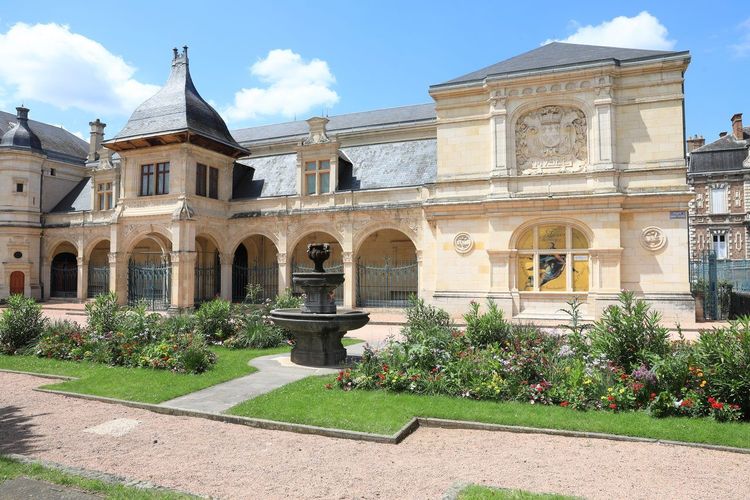
The Musée Anne de Beaujeu (the former ducal residence) presents the city's archaeological and medieval collections. A few streets away, the Vieilles Maisons quarter groups half-timbered buildings from the 15th and 16th centuries in a remarkably well-preserved state. Moulins works ideally as an entry or exit point for Auvergne for travellers coming from Paris via the A71 motorway or from Burgundy.
Hiking, Skiing and Outdoor Activities
Auvergne is one of France's best-endowed regions for outdoor activities, across all four seasons. It brings together several distinct massifs with varying difficulty levels, making it a destination for both beginners and seasoned hikers alike.
Hiking
The Massif du Sancy, which peaks at 1,886 metres at the Puy de Sancy (the highest point in the Massif Central), offers the region's most extensive trail network. The ascent of the Puy de Sancy from Super-Besse by gondola, followed by a return on foot to the Lac de Guéry (4 hours, 550 m elevation gain), is one of the most rewarding routes for intermediate walkers.
For more experienced hikers, the Haute Route Volcanique (HRV) crosses the Chaîne des Puys, the Massif du Sancy and the Cantal over 250 kilometres in 12 to 15 days, with nights in refuges or B&Bs. The cumulative elevation gain exceeds 12,000 metres. Our article on the most beautiful hikes in the Puy-de-Dôme details routes by level, with durations and starting points.
Downhill and Cross-Country Skiing
Auvergne has several human-scale ski resorts, far from the crowds of the major Alpine domains. Super-Besse and Le Mont-Dore in the Puy-de-Dôme, and Lioran in the Cantal offer ski areas with 30 to 70 runs at altitudes between 1,300 and 1,850 metres. The season generally runs from December to March depending on snowfall.
Cross-country skiing is particularly well suited to Auvergne's geography: the plateaux of the Cantal, Sancy and Aubrac are ideal terrain for Nordic touring skis, with several hundred kilometres of marked trails.
Canyoning and White-Water Sports
Auvergne's gorges offer exceptional terrain for white-water sports. Canyoning in the Gorges de la Jordanne (Cantal) is accessible from beginner level, with natural slides and crystal-clear pools. The Gorges de la Sioule offer a more demanding route for experienced practitioners.
For rafting and kayaking, the wild Allier between Langeac and Brioude is the national benchmark: its class III to IV rapids draw practitioners from across Europe. Our article on canyoning in Auvergne lists sites by difficulty level and recommended providers.
Mountain Biking and Cycling
The Massif du Cantal has several certified mountain biking centres, including Lioran with its bike park descents and cross-country routes. For road cycling, the cols of the Cantal are classics of sport cycling: the Col de Pas de Peyrol, the Col de la Croix-Saint-Robert (1,451 m) and the Col de Font de Cère (1,294 m) feature in several regional events. These roads see little traffic outside the season, making them ideal terrain for cycle touring.
Auvergne Gastronomy
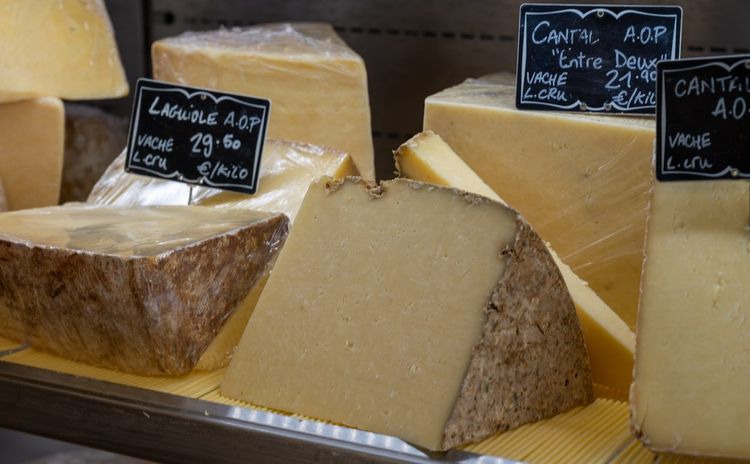
Auvergne's cheese reputation rests on solid foundations. With 5 active PDO cheeses — Cantal, Saint-Nectaire, Fourme d'Ambert, Bleu d'Auvergne and Salers — the region has the highest density of protected cheese appellations per unit area in France. Local cuisine is a must-see thing in Auvergne on a par with its volcanoes.
Saint-Nectaire is probably the most refined of them all. Ripened on rye straw for 5 to 8 weeks, it develops a grey, bloomy rind beneath which lies a melting paste with notes of hazelnut and mushroom. Farmhouse Saint-Nectaire — to be distinguished from the dairy-produced variety — bears an oval green label and offers a markedly superior aromatic complexity. Producing farms open their doors to visitors in the Sancy massif between May and November.
Fourme d'Ambert is the mildest blue cheese in France. Its ripening in high-altitude galleries gives it a creamy texture and a discreet blue veining, without the bitterness of gorgonzola or roquefort. It is produced within a limited geographical area around Ambert and Montbrison.
Auvergne cuisine is built around straightforward, hearty mountain dishes. Truffade — pan-fried potatoes melted with young Cantal or fresh tome cheese — is the emblematic recipe of the Cantal. Potée auvergnate, a slow-cooked stew of pork and winter vegetables, is found in the region's inns from October to April. Soupe au fromage, gratinated with fresh tome, warms you effectively after a day of high-altitude hiking.
The green lentils of Le Puy (PDO), grown in the Haute-Loire, are well worth seeking out for their firm texture and nutty flavour. Cantal charcuterie — dried sausage, smoked ham, pounti — rounds out a quality local hamper. For wines, the Côte d'Auvergne (PDO) produces reds from Pinot Noir and Gamay grapes around Clermont-Ferrand: a vineyard of 600 hectares, one of France's smallest PDOs, yet one that yields fresh, mineral wines you will rarely find outside the region.
Our article on the culinary specialities of Vichy details the gourmet addresses of the spa town.
Planning Your Stay in Auvergne
How Long Should You Allow?
A weekend (2 days) will let you cover Clermont-Ferrand and the Chaîne des Puys. Five days give access to Clermont, Vichy, the Puy de Dôme, the Massif du Sancy and the Romanesque basilicas. To also take in the Cantal, the Gorges de la Truyère and the Bourbonnais, allow ten full days.
When Should You Go?
Spring (May–June) is the ideal season. Summer (July–August) is high season, with queues at the Puy de Dôme and peak visitor numbers at the most popular sites. Prefer early-morning or weekday visits. High-altitude lakes and water sports are at their best during this period.
Autumn (September–October) is arguably the most beautiful season for photographing the region. The beech forests of the Cantal and Sancy turn gold and russet, the herds of Salers cows descend from the summer pastures in a ritual known as the désalpe, and the golden late-afternoon light lends photographic depth to every landscape.
Winter should not be overlooked if you enjoy skiing or snowshoeing. The resorts of the Sancy and Cantal are far less crowded than the major Alpine domains, giving them a peaceful charm that is hard to find elsewhere.
How Do You Get Around?
A car is essential to explore Auvergne at your own pace: inter-urban public transport is limited. Clermont-Ferrand is accessible by Intercités train from Paris Gare de Bercy in around 3h15. From Clermont station, regional lines serve Vichy (50 min), Issoire (30 min) and Le Mont-Dore (1h50 with a connection). Renting a car at Clermont-Ferrand station remains the simplest solution for travellers without their own vehicle.
Where Should You Stay?
For a full exploration of the region, several bases are worth considering: Clermont-Ferrand for the northern part (Chaîne des Puys, Vichy, Thiers), Saint-Flour or Aurillac for the Cantal, and Moulins for the Bourbonnais. Our article on accommodation in Auvergne's volcanic region offers options organised by type of stay, and our selection of unusual weekends in Auvergne details packages for original getaways.
FAQ
What Is the Best Time to Visit Auvergne?
Spring (May–June) and autumn (September–October) offer the best conditions for discovering the must-see things in Auvergne. In spring, vegetation returns to the volcanoes and waterfalls run at full flow after the snowmelt. In autumn, the beech forests of the Cantal and Sancy put on a remarkable display of colour, and the descent of the Salers cows from the summer pastures is a visually unique event in the region. Summer is ideal for lake swimming and outdoor sports, but the Puy de Dôme can be very crowded in July and August. Winter, quieter, lends itself to skiing and snowshoeing at the resorts of the Sancy and Cantal.
How Many Days Do You Need to Visit Auvergne?
A weekend is enough to discover Clermont-Ferrand and the Chaîne des Puys. Five days allow you to add Vichy, the Massif du Sancy and the Romanesque basilicas. To travel through the entire region — from the Puy-de-Dôme to the Cantal via the Allier and the Haute-Loire — allow between 8 and 12 days. The Cantal alone can easily fill 3 days between the Puy Mary, Salers and the Gorges de la Truyère.
How Do You Get Around Auvergne Without a Car?
Clermont-Ferrand is connected to Paris in around 3h15 by Intercités train and to Vichy in 50 minutes by regional train. For natural sites (Chaîne des Puys, volcanic lakes, Cantal massif), a car remains virtually essential. Summer shuttles serve the Puy de Dôme from Clermont and the Puy Mary from several valley points in the Cantal, between June and September. Local agencies offer guided excursions departing from Clermont for travellers without a vehicle.
Which Cheeses Should You Absolutely Try in Auvergne?
Auvergne has five PDO cheeses: Cantal (young, medium or old), Saint-Nectaire (preferably farmhouse, recognisable by its oval green label), Fourme d'Ambert (creamy and mild blue), Bleu d'Auvergne and Salers (produced only from May to October). If you can only choose one cheese, farmhouse Saint-Nectaire tasted in autumn is often cited as the region's finest. Favour producers' markets and affineur cellars over supermarkets to find the best pieces.
Is the Chaîne des Puys Accessible All Year Round?
The summit of the Puy de Dôme is accessible year-round, but the Panoramique des Dômes (rack railway) may close occasionally in the event of black ice or severe storms. The Col de Pas de Peyrol (access to the Puy Mary in the Cantal) is closed to vehicles from November to May, depending on winter conditions. Hikes along the Chaîne des Puys remain feasible in winter with appropriate footwear; certain trails may be snow-covered from December to March.
What Is the Best Base for Exploring Auvergne?
Clermont-Ferrand is the most logical starting point. The city is directly served by Intercités trains from Paris, has a good car-rental network and is less than an hour from the main attractions (Puy de Dôme, Chaîne des Puys, Orcival, Issoire). For an exploration focused on the Cantal, Saint-Flour or Aurillac are more central bases. Vichy is better suited to a stay centred on the north-eastern part of Auvergne and the Bourbonnais bocage.
Is Auvergne a Good Destination for Families?
Yes, and often more so than people expect. The region offers activities well suited to children: the Vulcania park (volcanoes and interactive science), the ascent of the Puy de Dôme by rack railway, developed swimming lakes (Aydat, Chambon), family ski resorts (La Bourboule, Super-Besse) and many hiking trails accessible from age 6. Most Romanesque basilicas and medieval villages can be visited in under an hour. Camping or rural gîtes work particularly well for families who want to explore the region at their own pace.
Conclusion
Auvergne rewards those who take the time to truly travel through it. Its must-see highlights are earned at the pace of the road, not the stopwatch: not merely the time to climb the Puy de Dôme and leave again, but to descend into the gorges of the Cantal, to sit in the nave of a deserted Romanesque basilica at lunchtime, or to dine on truffade in a mountain inn in October.
To begin your exploration, the Ryo audio-guided tour of Clermont-Ferrand grounds you in the history and geography of the region before you hit the road. And if you head towards Vichy, the Ryo audio guide La fièvre de l'eau transforms the thermal promenade into a genuine historical narrative.
À lire également