© Shutterstock
 Votre guide Ryo
Visit Marseille in 2 Days: Complete Itinerary, Calanques and Top Tips (2026)
Marseille refuses to be explored like an ordinary city. Here, the quays of the Vieux-Port coexist with wild calanques reachable in under thirty minutes by bus, and France's second-largest city can be crossed almost entirely on foot or by metro. Visiting Marseille in 2 days therefore calls for a real guiding thread: one day for the historic heart and the heights, another for nature and the creative neighbourhoods. The Ryo audio-guided tour of Marseille maps out exactly this kind of itinerary, with 24 tracks spread across 3 hours of walking between the Vieux-Port and Notre-Dame de la Garde.
In two days, you will climb up to the Bonne Mère for a 360-degree panorama over the bay, plunge into the turquoise water of a calanque, and stroll past the murals of the Cours Julien before ending the day over a bouillabaisse at the Vallon des Auffes. This guide breaks down that programme hour by hour, with solutions for those travelling without a car and the best times to avoid the crowds.
Quick Overview: Marseille in 2 Days at a Glance
If you are looking for a programme outline for a weekend in the Phocaean city without going into detail just yet, here is the structure this guide follows. Day 1 stays focused on the historic centre and the heights, an area almost entirely walkable from the Vieux-Port. Day 2 opens up towards the sea and the more contemporary neighbourhoods, with a trip to the Calanques that can, depending on the hike you choose, fill the entire morning.
| Time | Day 1 | Day 2 | |---|---|---| | Morning | Vieux-Port, forts and Palais de la Bourse | Calanques (hike or boat) | | Midday | Lunch in Le Panier | Return to the Vieux-Port | | Afternoon | Mucem, J4 esplanade, Notre-Dame de la Garde | Château d'If, Frioul or Cours Julien | | Evening | Corniche Kennedy, Vallon des Auffes | Canebière and Prado |
Two practical points before you set off. Most municipal museums are closed on Mondays, and the Mucem on Tuesdays: plan your indoor visits accordingly. And the maritime shuttles to the Château d'If or the Frioul depend on the weather, since the mistral can be strong enough to cancel sailings for half a day at a time.
This structure is not set in stone: if you are travelling as a couple for a romantic weekend in Marseille, you can easily swap the two days around or slow down the pace of day 1 to spend more time in Le Panier. The Phocaean city lends itself well to improvisation, as long as you keep in mind that the Calanques require a full half-day, while the audio-guided tour stays focused on the Vieux Port and the Palais de la Bourse.
Day 1: The Vieux-Port, Le Panier and Notre-Dame de la Garde
The Vieux-Port and Its Forts
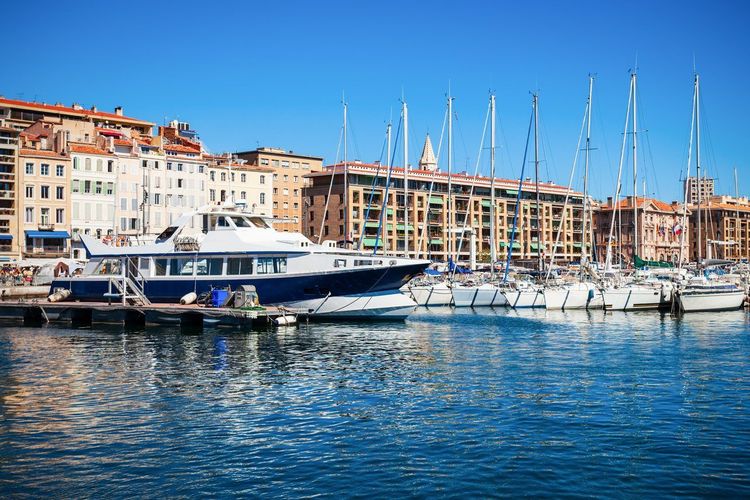
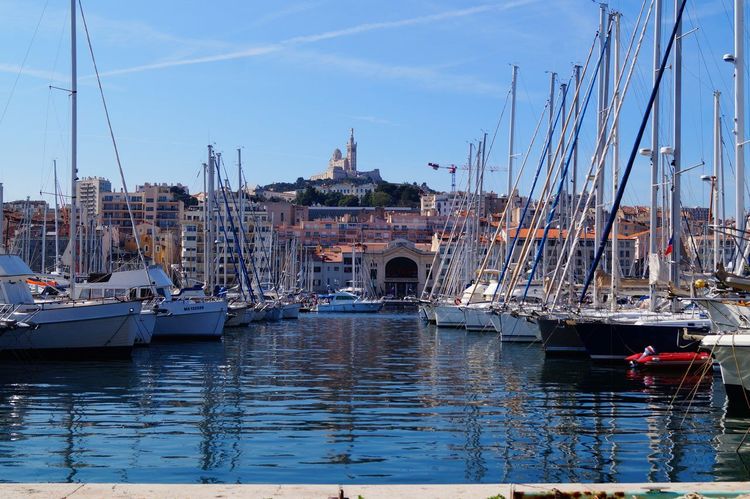
The Vieux-Port eases you gently into the day. From 8 a.m. onwards, fishermen set up their stalls on the Quai des Belges to sell the morning catch, a near-daily scene that has played out since Marseille came into existence. Sailboats and pointus crowd both banks, and the square forms a rectangle of water lined with café terraces where it is a pleasure to have a coffee before starting your walk. Look up at the ombrière installed in 2013 facing the quay: this vast steel mirror resting on eight slender legs reflects an inverted image of passers-by and the port below, and it has become the city's first instinctive photo opportunity.
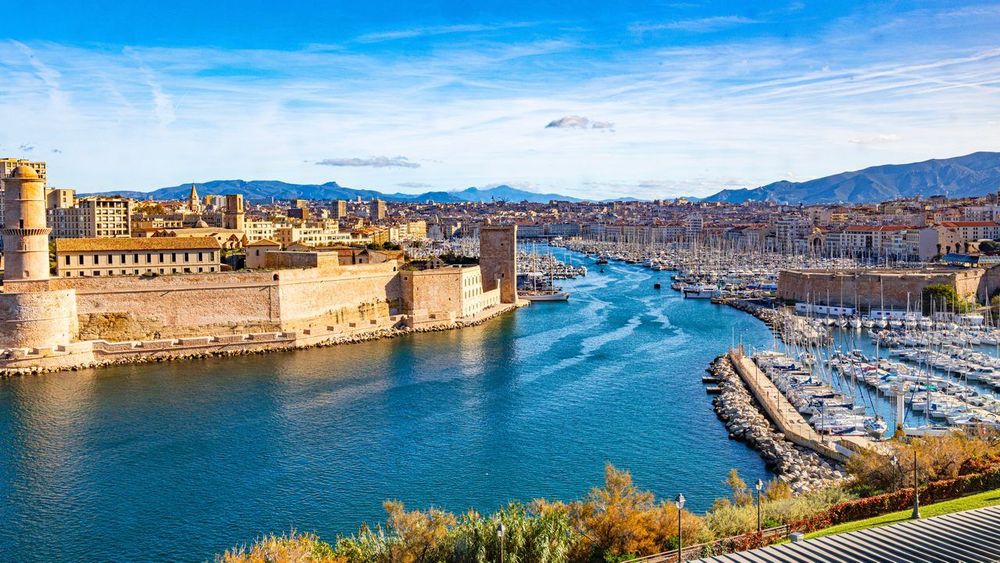
At the entrance to the port, two fortresses have faced each other since the 17th century. Fort Saint-Jean, on the north side, has guarded the entrance since the time of Louis XIV, who had both forts built as much to keep watch over the city as to defend it: the cannons pointed towards the Marseillais, not out to sea. Today it is connected to the Mucem by a suspension footbridge over the water, and a second bridge links it to the Le Panier neighbourhood. Opposite, Fort Saint-Nicolas occupies the south bank; long military and closed to the public, it has opened in recent years thanks to the association restoring it, with free-access visiting slots on part of the site and an unobstructed view over the port entrance.
Heading back up towards La Canebière, the Palais de la Bourse closes this first loop. Built in the mid-19th century to house Marseille's chamber of commerce, founded in 1599 and considered the oldest in France, it presents a monumental façade carved with allegorical figures of maritime trade. Inside, the grand concourse and the Museum of Marine and Economic History tell the story of the city's port. Do not confuse it with the Musée d'Histoire de Marseille, located a little further away in the Centre Bourse. Allow about an hour for this opening sequence, strolling at an unhurried pace.
Le Panier and the Cathédrale de la Major
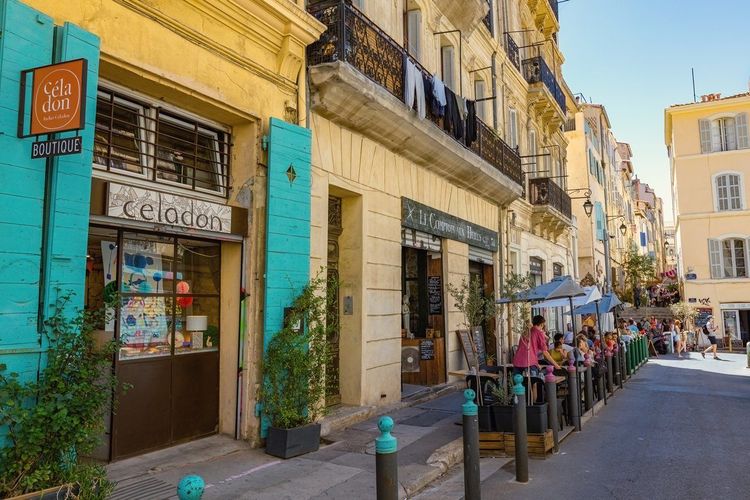
The Le Panier neighbourhood is the oldest in Marseille, a labyrinth of steep lanes, colourful façades and artists' studios that climbs up from the Vieux-Port. Here you will find the Vieille Charité, a former almshouse with arcaded courtyards built in the 17th century to designs by Pierre Puget and converted into a cultural centre, with its oval chapel and its museums of Mediterranean archaeology and African arts. Continue up to the Place des Moulins, tiny and shaded, where some fifteen windmills once stood. Our Ryo article on the Le Panier neighbourhood details the streets not to miss if you want to explore beyond the main thoroughfare.
Leaving Le Panier on the sea side, the Cathédrale de la Major imposes its striped silhouette of green Florentine stone and white limestone in a neo-Byzantine style. Construction began in 1852 and was completed in 1893, making it one of the largest cathedrals built in France in the 19th century, with a nave said to hold several thousand worshippers.
At the far end of the Vieux-Port, a few steps from the Quai des Belges, the small Église des Augustins, also known as Saint-Ferréol, is worth the five-minute detour: its neo-Gothic façade opens directly onto the boats, and its much older interior contrasts with the bustle of the quays. It is a useful landmark for walking to the Mucem.
The Mucem and the J4 Esplanade
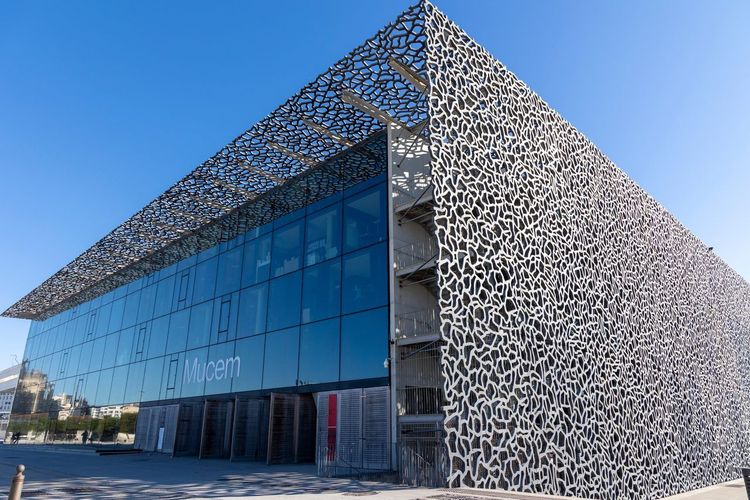
The Mucem, the Museum of European and Mediterranean Civilisations, occupies a latticed concrete cube set over the water, designed by Rudy Ricciotti and inaugurated in 2013, the year Marseille was European Capital of Culture. The architecture alone justifies the stop: the concrete lacework filters light like lace, and you can walk around the building along the exterior walkways, then cross the footbridge to Fort Saint-Jean and its gardens, without buying a ticket. The ticket only becomes necessary for the exhibitions, at around ten euros, and the museum is closed on Tuesdays. To prepare your visit, our Ryo guide to the Mucem lists opening hours and tips for avoiding the queue.
Just in front, the J4 esplanade stretches out to the water's edge and offers one of the best free viewpoints over the port entrance. In the late afternoon, the low light on the fort and the sea makes it one of the most photographed spots in the city. This is also where you will find the Grotte Cosquer Méditerranée, the 2022 recreation of the painted cave discovered submerged off Cap Morgiou, a visit of about an hour if the Mucem queue puts you off.
Notre-Dame de la Garde, the Bonne Mère
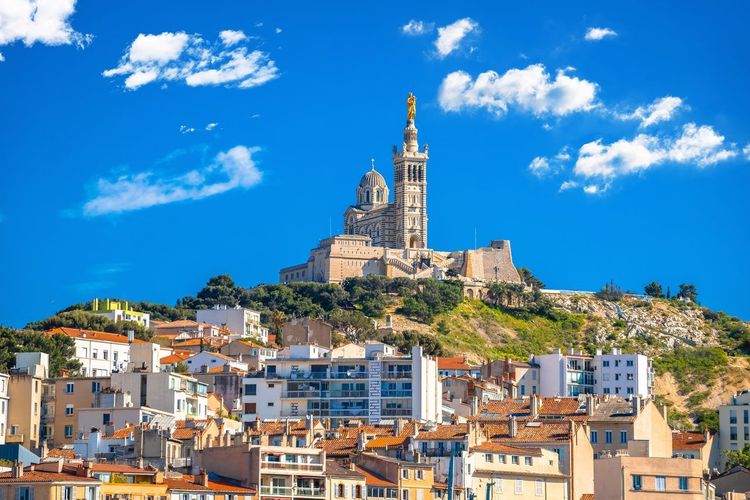
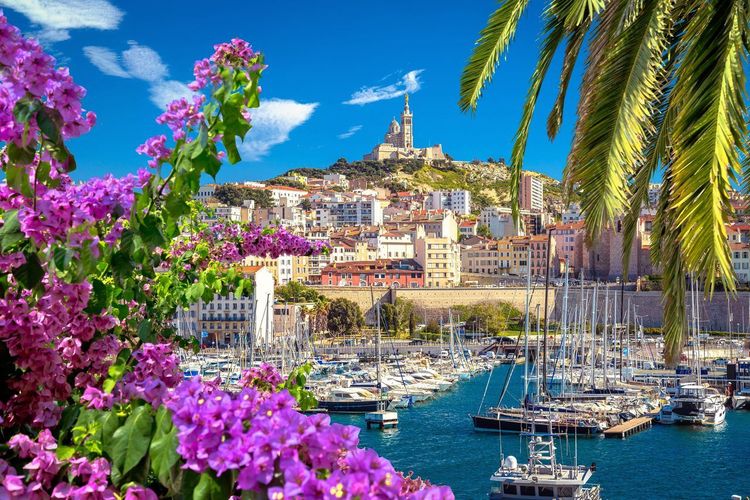
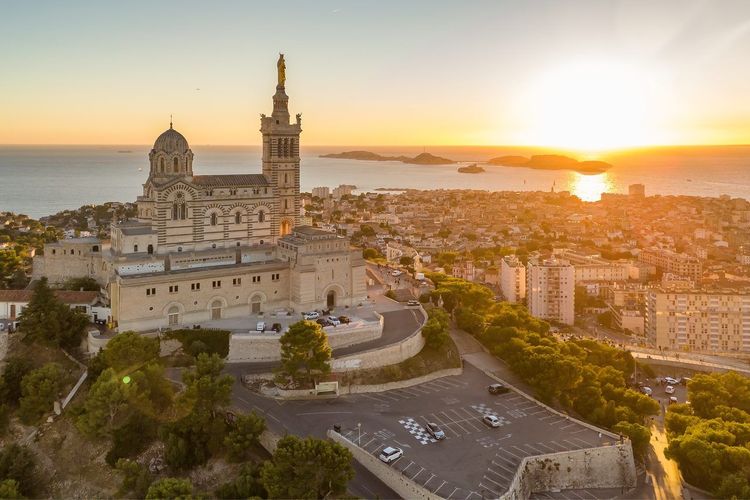
You cannot spend two days here without climbing up to the Basilique Notre-Dame de la Garde, which everyone calls the Bonne Mère. Perched at nearly 150 metres above sea level on a limestone outcrop, it has dominated the city since 1864 and its gilded statue of the Virgin, about ten metres tall, serves as a landmark for sailors and Marseillais alike. Inside, the walls disappear beneath ex-votos: model boats, marble plaques and naive paintings offered by fishing families after a narrowly avoided shipwreck. Admission is free.
You can walk up from the Vieux-Port in about 25 minutes, via a succession of steep streets and staircases, or take bus 60, which drops you just below the forecourt. Once at the top, take time to walk around the outside: the panorama over the Frioul islands, the Corniche and the distant Calanques is worth the climb on its own. Aim to arrive late in the morning, when the light still illuminates the port.
Corniche Kennedy and the Vallon des Auffes
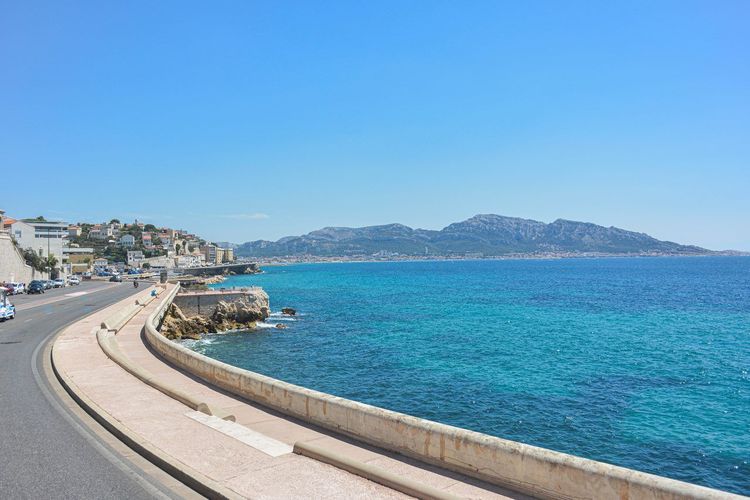
The descent southwards follows the Corniche Kennedy (Corniche du Président John Fitzgerald Kennedy, 13007 Marseille, rated 4.6/5 on Google with 2.7K reviews), a coastal road of nearly five kilometres open to the Mediterranean, linking the city centre to the Prado beaches. On the sea side it is bordered by what the Marseillais proudly describe as the longest bench in the world, several hundred metres of stone facing the open sea. Along the way, stop at the Jardin du Pharo, a terraced park laid out around the palace that Napoleon III had built for Empress Eugénie, offering one of the finest free views over the Vieux-Port and Fort Saint-Jean.
A little further on, the Vallon des Auffes hides below the road, beneath a bridge you cross without noticing it: a tiny fishing harbour squeezed between two cliffs, with its colourful boats, its cabanons and a handful of restaurants that have been serving bouillabaisse for decades. Its name comes from the alfa-fibre ropes that were once made here for boats. It is the perfect place to close the first day, between the sunset over the water and the smell of grilled fish rising from the kitchens.
Day 2: Calanques, Islands and Cultural Neighbourhoods
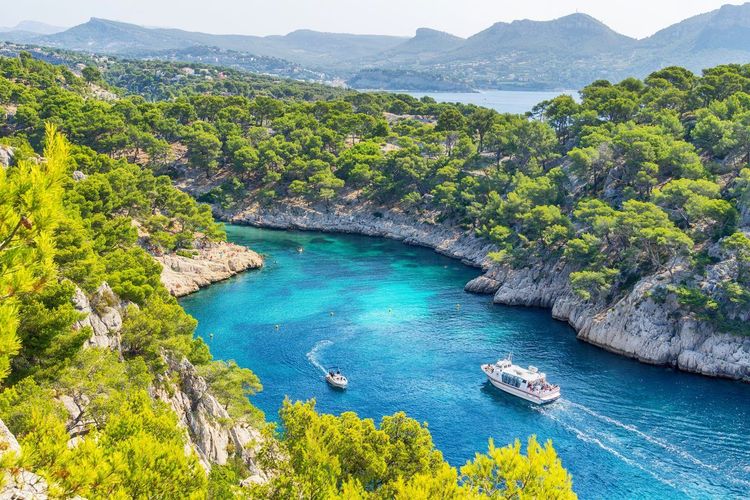
The Parc National des Calanques: a Full-Day Excursion
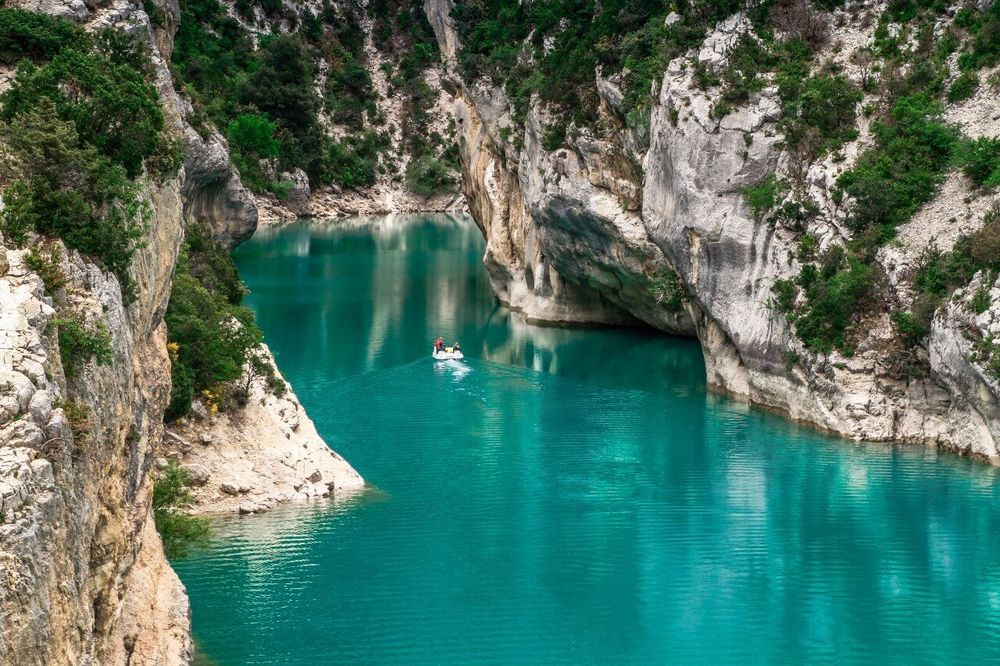
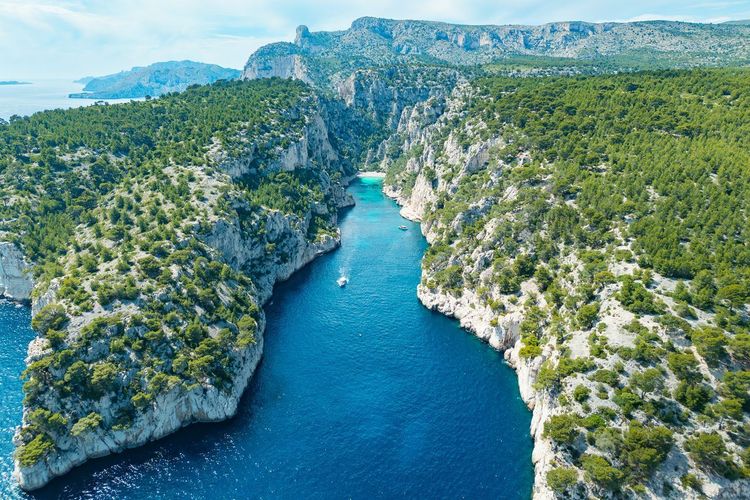
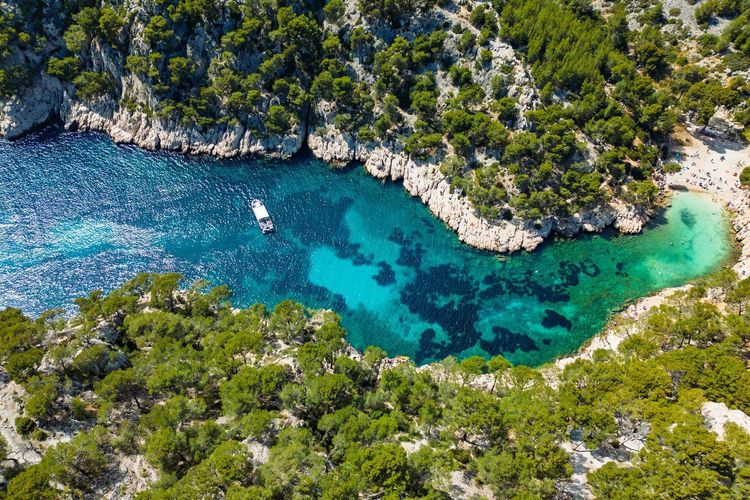
The Parc National des Calanques, created in 2012, is the first peri-urban national park in Europe: it begins at the southern edge of the city, in the 8th and 9th arrondissements, and stretches all the way to Cassis, both on land and at sea. These inlets tucked between limestone cliffs and turquoise water are the reason many travellers add Marseille to their itinerary. Let us be clear from the outset: a proper excursion into the Calanques can easily fill an entire morning, or more if you set off on foot.
Two options are available to you. The first, hiking, starts from the village of Les Goudes or Callelongue, reachable by bus (line 19 then 20 from the Castellane or Rond-Point du Prado metro stations), to reach the calanques of Sormiou or Morgiou on foot, about 1 hour 30 minutes of walking there and back depending on the path chosen. The second, faster option is to take a boat from the Vieux-Port to cruise the coastline and glimpse Sugiton or En-Vau with ease; expect to pay around twenty euros for a two-to-three-hour cruise.
Three precautions are worth repeating. In summer, access to the massifs is regulated according to fire risk: the prefecture publishes a map of authorised access points each afternoon for the following day, and a morning can go from open to closed overnight. The calanque of Sugiton, a victim of its own popularity, requires a free online booking during the peak summer season to limit the daily number of visitors. Finally, there is neither water nor shade on most paths: closed shoes, two litres of water per person and an early morning start are the rule.
Château d'If and the Frioul Islands
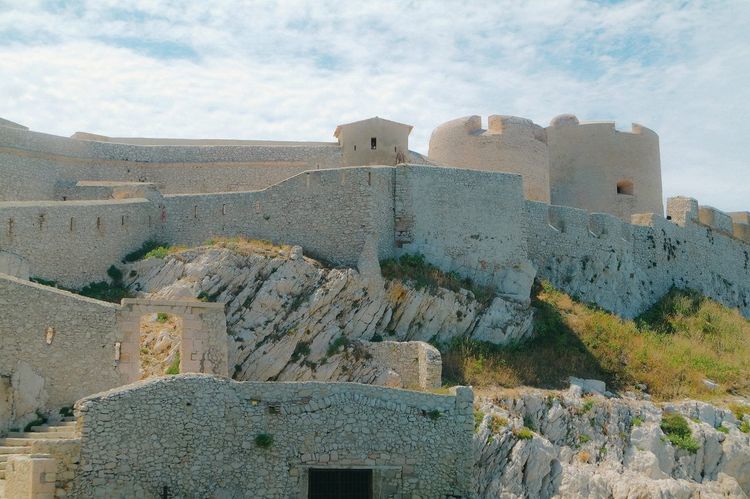
From the Quai de la Fraternité, a shuttle reaches the Château d'If in about twenty minutes, the fortress made famous by Alexandre Dumas in The Count of Monte-Cristo. Built on the orders of François I in the 16th century to defend the entrance to the bay, it never withstood a siege but served as a state prison for nearly three centuries: Protestants, republicans and political opponents were held here long before Dumas's hero. Admission to the monument remains under ten euros and the site closes on certain Mondays in the low season.
The same shuttle often allows you to continue to the Frioul islands, the neighbouring archipelago where Ratonneau and Pomègues are linked by a dyke built in the 19th century. Here you will find coves far quieter than on the mainland, the ruins of the Hôpital Caroline, a former lazaretto built to quarantine crews suspected of yellow fever, and wind-swept hiking trails. Our Ryo selection for the Frioul islands lists the best swimming spots and the shuttle timetables you need to know before you go.
Cours Julien and Its Street Art Murals
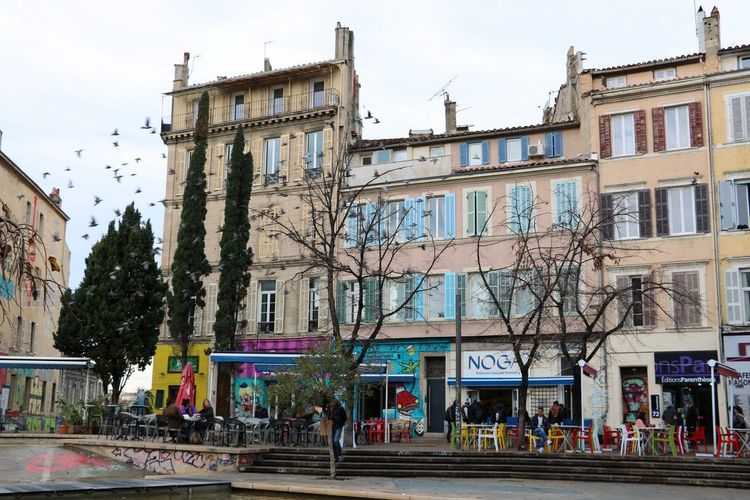
Back on the mainland, head to Cours Julien, a bohemian neighbourhood a few minutes' walk from La Canebière (La Canebière, 13001 Marseille, rated 4/5 on Google with 414 reviews). The façades here change regularly as murals cover almost every available wall, from giant portraits to political messages; the painted staircase climbing from Cours Lieutaud, repainted several times a year, sums up the spirit of the area on its own. It is also one of the liveliest neighbourhoods in the city for a drink on a terrace, with its concept stores, independent record shops and, on the neighbouring Place Jean Jaurès — which everyone calls la Plaine — a market several mornings a week.
Palais Longchamp and Its Park
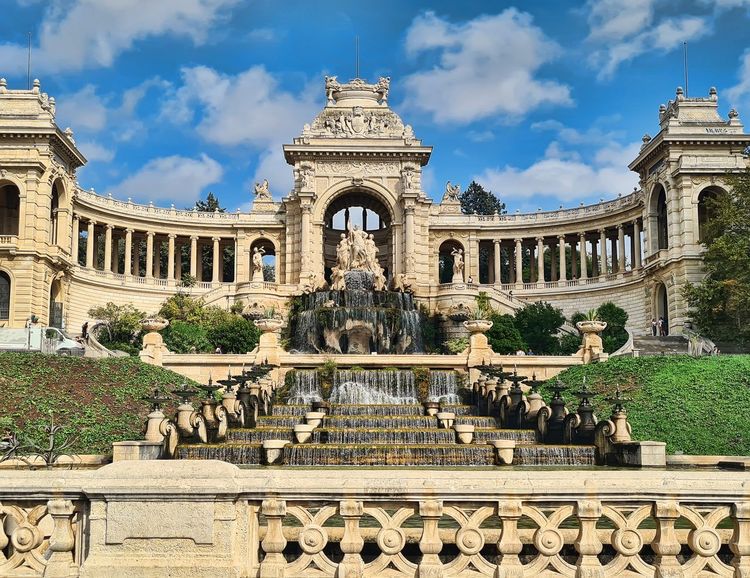
About twenty minutes' walk away, the Palais Longchamp closes the afternoon's cultural loop. This 19th-century monument, designed by Henry Espérandieu, the architect of Notre-Dame de la Garde, celebrates the arrival in the city of Durance water via the Canal de Marseille, which put an end to centuries of shortage and epidemic. Its hemicycle colonnade frames a monumental waterfall and houses two museums, the Fine Arts Museum on one side and the Natural History Museum on the other. The surrounding park, shaded and free to enter, provides a welcome break after the morning's hike in the Calanques.
The Prado Beaches and La Canebière
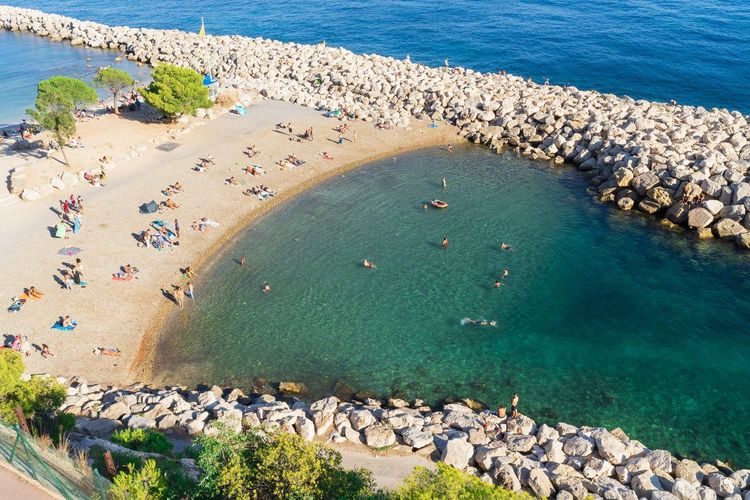
To end the day with your feet in the water, head to the Prado beaches, a long strip of sand and pebbles reclaimed from the sea in the mid-1970s using spoil from the metro construction. You will find a marble replica of Michelangelo's David planted in the middle of a roundabout, and just behind it the Parc Borély, its château and its rose garden, ideal if swimming does not appeal. Our Ryo guide to the most beautiful beaches in Marseille compares the different coves if you prefer to avoid the crowds at the Prado.
Heading back towards the centre, Place Castellane serves as the gateway to the Prado neighbourhood and a convenient metro hub, with its obelisk and the Fontaine Cantini. From there, La Canebière runs in a straight line back down to the Vieux-Port: the historic avenue, whose name comes from the hemp of the rope-making workshops that once occupied the area, long embodied the commerce and bustle of Marseille, and its Haussmann-era buildings still bear traces of their former splendour.
Other Hidden Gems Not to Miss if You Have a Little More Time
Few guides group these secondary sites into a separate section, yet they are all accessible if you add an hour or two to your stay, without disrupting the two-day programme.
On the Heights: Abbaye Saint-Victor and the Jardin de la Colline Puget
The Abbaye Saint-Victor, founded in the 5th century around the tomb of a martyr, is one of the oldest Christian sanctuaries in the Western world. Its crypt, hewn from the rock, preserves early-Christian sarcophagi that can be visited for a few euros. Every year on 2 February, Candlemas gives rise to a procession of the Black Virgin and a blessing of the navettes followed by thousands of Marseillais, a tradition rarely mentioned in tourist guides.
Just above, the Jardin de la Colline Puget climbs in successive terraces to a belvedere. Far less visited than Notre-Dame de la Garde, this stepped garden planted with pines and agaves offers an equally open view over the port and the islands, provided you are willing to tackle a somewhat steeper climb.
In the Centre: Opéra de Marseille, Palais de la Bourse and Théâtre La Criée
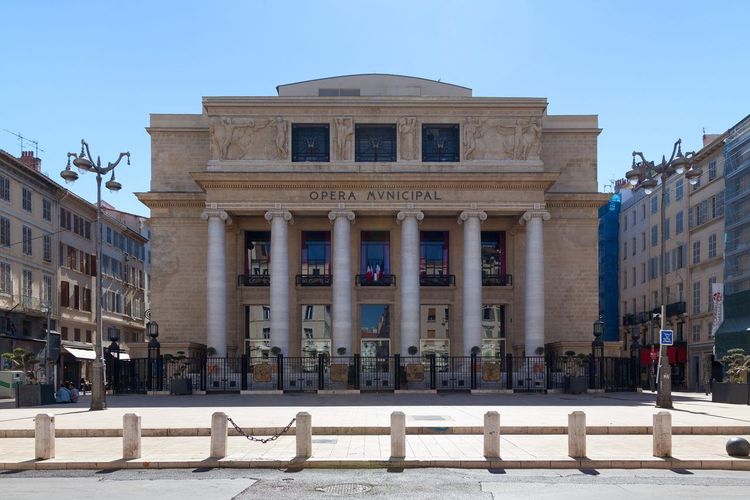
Not far from the Palais de la Bourse already visited on day one, the Opéra de Marseille hides behind its columns an Art Deco auditorium entirely rebuilt after the fire that destroyed the building in 1919. The programme remains accessible even outside the opera season, with ticket prices that are often gentler than those of the great Parisian houses.
On the Quai de Rive-Neuve, the Théâtre La Criée, set up in the former fish market decommissioned in the late 1970s, has become one of the most active national stages in the south of France. Nearby, the Jardin des Vestiges (Centre Bourse, 13001 Marseille, rated 4.5/5 on Google with 1,362 reviews), laid out at the foot of the Centre Bourse, displays the foundations of the ancient Greek port unearthed during excavations in the late 1960s: a basin, ramparts and a paved road are visible from the Musée d'Histoire de Marseille alongside.
If you want to locate all these sites, bear in mind that the city has 16 arrondissements arranged in a spiral around the Vieux-Port: the 1st and 2nd cover the historic centre (Le Panier, Mucem, La Canebière), the 6th and 7th climb towards the Bonne Mère and the Corniche, and the 8th extends over the Prado and its beaches. A map of the arrondissements in your pocket saves many unnecessary detours, especially since the numbering does not follow geographical order.
Where to Stay in Marseille for a Weekend
The choice of neighbourhood depends mainly on the pace you want to set for your stay. Around the Vieux-Port, hotels are pricier but everything is within walking distance: the Mucem, Le Panier and the island shuttle pier are just minutes away. It is the most practical option for a packed two-day stay, even if it means sacrificing a little charm. Expect to pay from around 90 to 100 euros a night for a decent double room outside the high season.
Le Panier, just above, offers the most characterful atmosphere, with its guesthouses in old buildings and its quiet lanes once night falls. The downside: the steep, cobbled streets are not suited to all luggage types, and you need to head back down to the port for most evening restaurants.
For a stay more oriented towards the beach, the Prado neighbourhood offers quieter addresses, a short walk from the sand and the Parc Borély, but a good fifteen minutes by metro from the historic centre. It is the ideal compromise if your day 2 starts with a swim before moving on to sightseeing. Another option often overlooked: the Joliette area, between the Docks and the Terrasses du Port, where newer hotels offer gentler rates and remain ten minutes' walk from the Mucem. Our Ryo article on the most beautiful neighbourhoods in Marseille details the atmosphere of each area if you are still undecided.
In summary: Vieux-Port for efficiency, Le Panier for charm, Prado for tranquillity and the beach, Joliette for value for money. Book as far in advance as possible in summer — the city fills up from July onwards in the mid-range category.
Where to Eat: Marseille's Gastronomy in 2 Days

Marseille is almost as much a city to eat as it is to explore. Around the Vieux-Port, bouillabaisse remains the emblematic dish: a rock-fish soup served in two stages, first the saffron broth and then the fish carved at the table, accompanied by rouille and garlic-rubbed croutons. Budget at least 60 to 80 euros per person at a serious restaurant, a price explained by the variety of fish required by the Marseille bouillabaisse charter, drawn up in the early 1980s by a group of restaurateurs to combat the cut-price versions served to tourists.
In Le Panier or while walking along the quays, panisses are eaten standing up: fried chickpea-flour sticks, crispy on the outside and soft in the middle, sold for a few euros a portion. They are the perfect snack between two visits on day 1, much lighter than a full meal. In the same vein, look out for the chichis fregi near l'Estaque, long sweet fritters that traditionally accompany a Sunday afternoon stroll.
For something sweet, navettes, small dry biscuits flavoured with orange blossom and shaped like a boat, are traditionally enjoyed at Candlemas but are available year-round in bakeries in the centre. The oldest maker, established in the Rue Sainte near the Abbaye Saint-Victor since the late 18th century, guards its recipe as an almost-kept secret.
On the evening of day one, the Vallon des Auffes is home to several restaurants specialising in grilled fish and bouillabaisse with a sea view; book ahead, as tables are few. On the second evening, closer to the Cours Julien or la Plaine, you will find a more eclectic cuisine that reflects the North African, Italian and Comorian influences that have run through the city for generations. And if you only have time for one indulgence, have a pastis on a terrace at sunset: it is a local institution in its own right. For more, our Ryo top of Marseille specialities lists eleven dishes to try at least once, from pieds paquets to Friday aïoli.
How to Get Around Marseille During Your Stay
The historic centre is entirely walkable: between the Vieux-Port, Le Panier, the Mucem and La Canebière, you will rarely need more than 20 minutes on foot from one point to another. To cover Marseille in one day on foot, you simply need to accept a good climb up to the Bonne Mère, or take bus 60, which makes the journey in a few minutes from the bottom of La Canebière.
For the rest, two metro lines, three tram lines and a dense bus network cover most of the city. From the Vieux-Port station, line 1 reaches Castellane, where a connection to line 2 drops you at the Rond-Point du Prado in just a few minutes: this is the standard journey for day 2. A single ticket costs just over 2 euros, and a 24-hour pass for under 6 euros pays for itself after three trips. A small almost-free pleasure: the ferry boat crosses the Vieux-Port from one bank to the other for a handful of cents, a three-minute crossing immortalised by Marcel Pagnol.
If you are wondering how to manage 3 days without a car, rest assured that the Calanques and the islands remain accessible by public transport or by boat: buses 19 and 20 serve la Madrague de Montredon, Callelongue and Les Goudes, and the maritime shuttles leave from the Vieux-Port for the Frioul and the Château d'If. A car therefore adds little value in the city centre, where parking is expensive and difficult, unless you plan to push on to Cassis or Aix-en-Provence. One last useful tip: download the RTM network app, as the bus timetables for the Calanques are more reliable there than on the stop signs.
What Budget to Plan for a 2-Day Weekend in the Phocaean City
For two days without skimping, budget broadly between 150 and 250 euros per person per day, accommodation included. Accommodation weighs most heavily on the bill: a decent double room around the Vieux-Port starts at 90–100 euros a night in the low season, and can easily double in July and August.
For local transport, a 24-hour pass for under 6 euros covers most needs; add around ten euros for the maritime shuttle to the Château d'If or the Frioul, plus the monument entrance on top, or around twenty euros for a boat trip into the Calanques if you prefer not to hike. Food costs vary considerably: a simple meal (panisses, sandwich, pizza) runs to around 10–15 euros, compared with 60–80 euros for a proper bouillabaisse.
Good news for tighter budgets: a large part of the programme costs nothing. Notre-Dame de la Garde, Fort Saint-Jean, the J4 esplanade, the Jardin du Pharo and the Jardin de la Colline Puget, the beaches and the national park trails are all free to access. For a romantic weekend, however, allow extra for a dinner by the sea at the Vallon des Auffes or a restaurant with a view from the heights: this type of address starts at around 45–55 euros per person excluding drinks. With friends, the budget comes down quickly by focusing on the free viewpoints and snack-style meals.
When to Go: the Best Time for a Weekend in Marseille
The best time depends largely on what you are looking for. For swimming in the Calanques, May to September remains the logical window, with a peak in footfall in July and August that means booking some access points online in advance and dealing with trail closures when fire risk is high.
If your focus is more on heritage (Le Panier, the Mucem, the Bonne Mère), spring and autumn offer pleasant weather, around 18 to 22 degrees during the day, without the heat or the crowds of high summer. These months also reduce the risk of unpleasant surprises from the mistral, the northerly wind that can blow for several days in a row and cancel shuttles to the Frioul or the Château d'If.
Marseille's winter remains mild compared to the rest of France, with generous sunshine even in January, making it a good option for a short city-focused weekend rather than one centred on swimming. Accommodation prices are noticeably lower than in peak season, and the main sites can be visited without queuing. Two dates worth noting if you enjoy living traditions: the Candlemas on 2 February at Saint-Victor, and the santons fair that sets up on the Vieux-Port at the end of the year.
If You Stay an Extra Day: Extending Your Trip to 3 Days
If your schedule allows, adding a third day changes things considerably: you can devote an entire morning to the Calanques without sacrificing another visit, or push on to Cassis to discover its more secluded calanques from a fishing village, less than an hour by bus from Place Castellane.
Many travellers who plan their stay with a printed guide end up adding this extra day once they are there, realising that the city has more layers — in the literal sense — than expected. Aix-en-Provence, less than an hour by train or coach, offers a complete architectural contrast with Marseille's historic centre: private mansions, fountains and shaded courtyards. Our Ryo selection of day trips around Marseille details several full-day options, from secret calanques to hilltop villages and wine estates.
No car is needed for this third day: Cassis and Aix-en-Provence are just as accessible by train or coach from the Gare Saint-Charles, which seamlessly extends the car-free approach tested over the first two days. Another option, more rooted in Marseille itself: devote this day to the neighbourhoods that the basic programme leaves aside, l'Estaque and its cabanons painted by Cézanne, or the Docks and the Joliette to the north of the Vieux-Port.



FAQ
How many days do you really need to discover Marseille?
Two days are enough to cover the historic centre, Notre-Dame de la Garde and a trip to the Calanques or the Frioul islands. For a more relaxed pace, or to add Cassis and Aix-en-Provence, plan for three days instead.
Can you visit Marseille in 2 days without a car?
Yes, easily. The centre is walkable, the metro and bus cover the Prado and access to the Calanques via lines 19 and 20, and the maritime shuttles serve the Château d'If and the Frioul directly from the Vieux-Port.
What is the best neighbourhood to stay in for a weekend?
The Vieux-Port is the most practical for a short, packed stay. Le Panier wins for its charm, the Prado is better if you prioritise the beach and quiet, and la Joliette offers the best value for money.
Is it possible to see the Calanques in just 2 days?
Yes, by setting aside a full half-day, ideally the morning of day 2. A short hike from Callelongue or a boat trip from the Vieux-Port both allow you to discover several calanques without dedicating the entire day to it.
What budget should you plan for a two-day Marseille weekend?
Budget between 150 and 250 euros per person per day, accommodation included, with a higher margin in summer and for a traditional bouillabaisse meal.
What is the best time of year for a two-day stay?
Spring and autumn offer the best weather and crowd compromise. Summer is better if swimming in the Calanques is your priority, despite the crowds and access restrictions in the massifs.
Two days are enough to understand why Marseille fascinates as much as it bewilders at first glance: that permanent split between a millennia-old heritage and wild nature reachable by bus. Between the Vieux-Port quays at dawn, the Bonne Mère late in the morning and a calanque at the end of the day, you will leave with a far more complete picture than the usual postcard.
To prepare your visit in detail, place by place and neighbourhood by neighbourhood, the Ryo audio-guided tour of Marseille remains the best starting point: 24 audio tracks, 3 hours of content and an itinerary designed to fit exactly this two-day programme.
À lire également