






Créé par Romane, le 17 nov. 2026
Votre guide Ryo
Fira, Greece
The Hilltop Jewel of Santorini
Parcours audioguidé pour visiter Fira en 1 jour
Perched on the cliffs of Santorini, Fira offers spectacular views over the caldera and the Aegean Sea. With its whitewashed streets, chapels, and lively atmosphere, it embodies the vibrant and sunlit heart of the island.
Quand partir à Fira ?
Jan.
13°
8
Feb.
13°
7
March
15°
6
April
18°
4
May
22°
3
June
26°
1
July
28°
0
Aug.
28°
0
Sept.
26°
1
Oct.
22°
3
Nov.
18°
6
Dec.
15°
8
Fira is best enjoyed in spring (April–June) and autumn (September–October), when the climate is mild, the days are sunny, and the crowds more manageable. Summer (July–August) is the peak season, perfect for lively atmosphere but with crowded streets and higher prices. Winter (November–March) is much quieter, with some hotels and restaurants closed, but it offers a peaceful charm and lower rates.
Départ conseillé
No need to worry about where to begin! Our tours are designed as a loop, so you can jump in wherever you are. The navigation system and audioguide will automatically adjust to your location. However, if you happen to be nearby, we do have a preferred starting point: on Theotokopoulos Square
Parking à proximité
Parking O Mesaria
Parking in Fira can be tricky during the high season, but there are several options. Free public car parks are available at the southern entrance, near the high school, or along the main road, just a few minutes’ walk from the center. For more convenience, there is a large parking area near the cable car and the main square. When these fill up, you can also choose a private paid option such as Fira Central Parking. Finally, a few spots can be found in the side streets, mostly suitable for scooters and ATVs.
À savoir
In Santorini, the official currency is the euro.
Découvrez 17 lieux d'intérêt pour visiter Fira







What to see in Fira on your 1h tour?
This 1.3 km loop takes about 1 hour and links 15 sights. It starts at Theotokopoulos Square, the heart of Fira, crosses the museums and churches of the historic center to the Three Bells and the cable car suspended above the caldera, follows Agiou Mina Street and the Orthodox cathedral, then heads back down past the prehistoric museum and the Fabrica Shopping Center. With the app in your ears, every square, church or viewpoint tells the volcanic, cosmopolitan story of Santorini.
Information checked in November 2026 and subject to change.
1 - Theotokopoulos Square
This square, the heart of Fira, is named after El Greco, a painter and sculptor born in Crete in the 16th century who later developed, in Spain, a style known for its elongated figures. At its center stands a donkey statue nicknamed Marcos, celebrating the animals that once carried loads and riders up the island's steep slopes. Since the 1956 earthquake, this open space has served as a gathering point for locals, and it remains the lively center of Santorini's capital, framed by white façades.
Free entry
2 - Monument to the Pontic Greek Genocide
This modest monument honors the Pontic Greeks, a community settled since antiquity along the Black Sea, who between 1914 and 1923 suffered deportations, massacres and organized famines carried out by the Ottoman Empire, killing roughly 350,000 people. This tragedy was part of a wider persecution that also struck Armenians and Assyrians. The memorial stands so far from Pontus because surviving refugees scattered across all of Greece. Every May 19, ceremonies here recall this painful past and the resilience of a displaced people.
Free entry
3 - Gastronomy
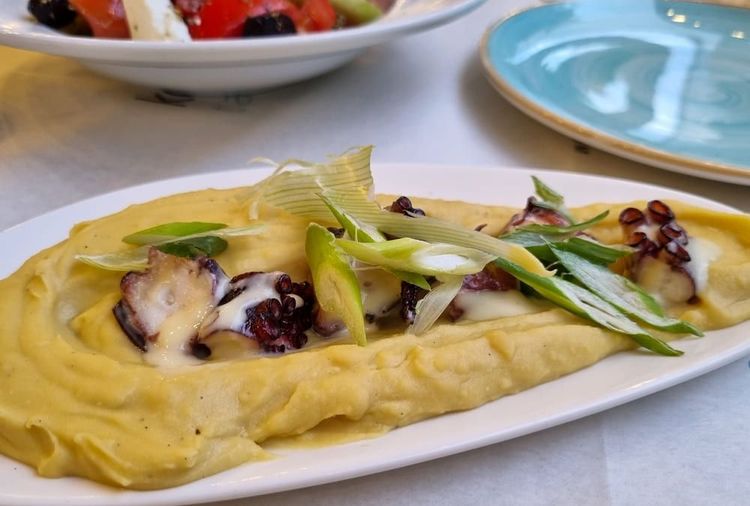
Fira's cuisine tells the story of the island's volcanic soil: fava, a purée of yellow peas grown here for three thousand years, tomatokeftedes, sweet cherry-tomato fritters, and moussaka made with the island's gentler white eggplants. Tavernas also fill their tables with shareable mezze, a local salad with chloro cheese, smoky eggplant dip or refreshing tzatziki, before serving squid and freshly caught fish, simply grilled over wood, down at the old port or in Amoudi.
Free entry
4 - Archaeological Museum
This small archaeological museum, often overshadowed by its prehistoric neighbor, traces Santorini's history from the Archaic to the Roman period through pieces from ancient Thera, once perched on Mount Mesa Vouno: a kouros, a statue of a nude young man of timeless beauty, a vase decorated with ships, and the Rock of Eumastas, proudly inscribed by a man who managed to lift it. The very first museum, founded in 1902, was destroyed in the 1956 earthquake; the current building, completed in 1960, carries on its mission.
5 - Megaro Gyzi Cultural Center
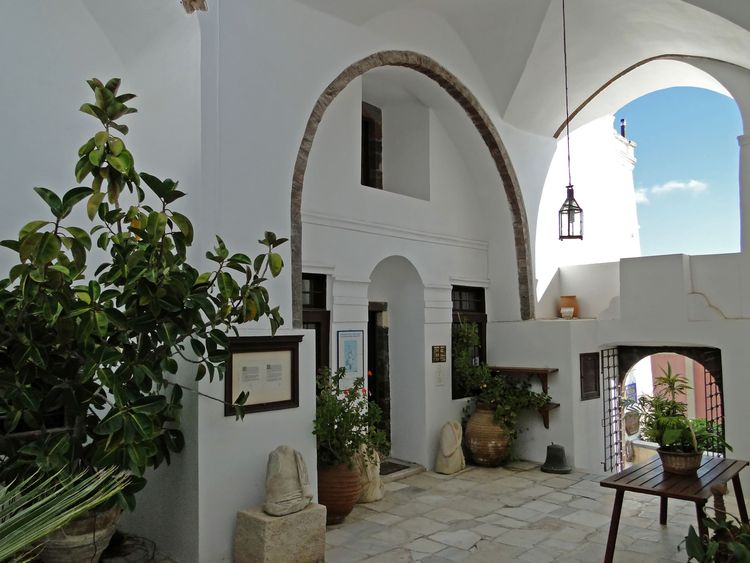
A rare survivor of the great earthquake, this 17th-century mansion once belonged to the Gyzi family, who left their coat of arms on its façade, before the Catholic diocese gave it a new life as a cultural venue. Since 1980 it has welcomed concerts and exhibitions around an eclectic range of collections: old maps of the Cyclades, manuscripts, 19th-century paintings, vintage snapshots and layers of volcanic rock tracing how the island was formed. Each August, a festival gathers Greek and foreign artists here, keeping that memory alive.
Free entry
6 - St. John the Baptist Cathedral
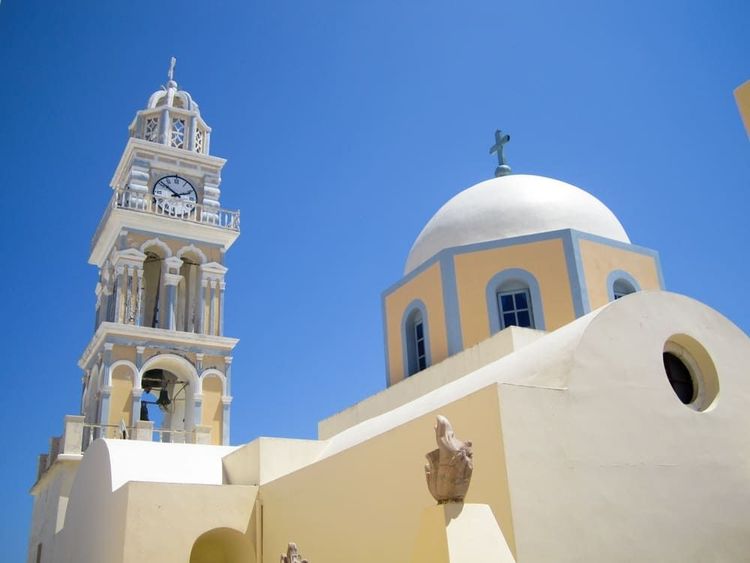
Unlike the blue Orthodox domes that dominate the island, this Catholic cathedral shows off an Italian Baroque style in soft grey and beige tones. Founded by the Jesuits in the 17th century, the present building dates from 1823, suffered heavy damage in the 1956 quake and reopened only in 1975, after another church had served as a temporary cathedral for nearly twenty years. It remains the spiritual home of Santorini's roughly five hundred Catholics, where Mass is celebrated every Sunday in several languages.
Free entry
7 - Three Bells of Fira
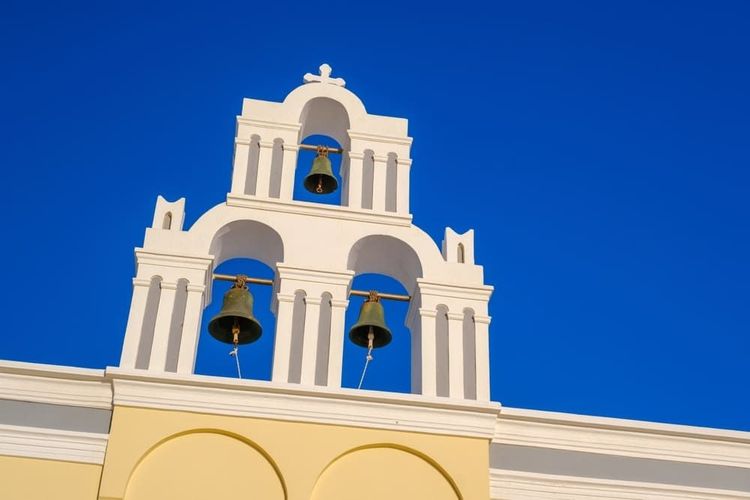
Officially dedicated to the Dormition and built in 1757, this Catholic church succeeded small cave chapels carved into the cliff in the 17th century and later lost to erosion. Damaged by the 1956 earthquake, it was carefully rebuilt. Legend has it that the three bells came as a gift from a shipowner who was miraculously saved from a storm at sea. Still active, it draws worshippers for its August 15 feast day, but above all visitors for its unmatched view of the caldera, especially at sunset.
Free entry
8 - Cable Car
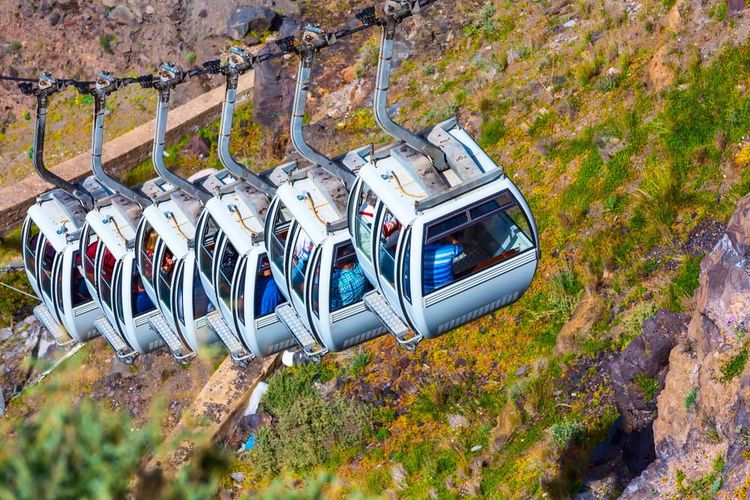
Instead of tackling six hundred steps carved into the cliff, or trusting your bag to a donkey, visitors can now cover, in just a few minutes, the climb between the town, set more than 200 meters above the water, and the port below. A gift from the Nomikos foundation around the late 1970s, this system began running in 1982: each small cabin carries six riders, with a flow topping a thousand people every hour. The harbor underneath, nicknamed Gialos, now mostly welcomes cruise passengers and shuttles bound for the volcano.
Paid entry
9 - Panoramic Viewpoint
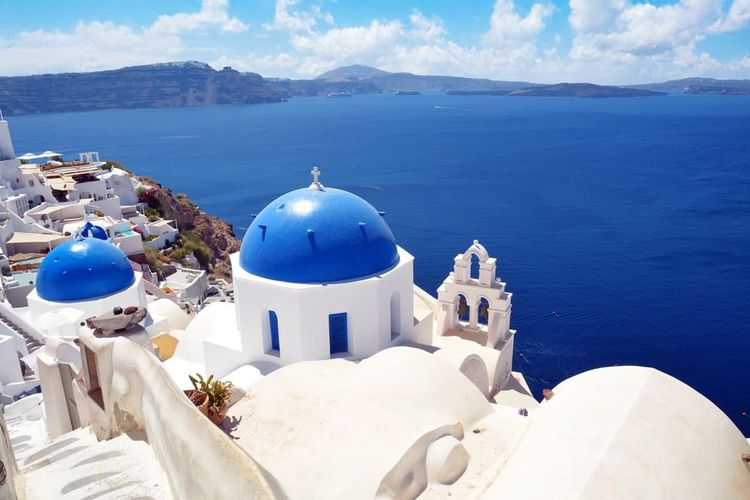
This viewpoint reveals the caldera in its full scale, born from a cataclysmic eruption more than 3,600 years ago that caused the island's heart to collapse into the sea. At its center sit two dark islets, Nea Kameni and its smaller neighbor Palea Kameni, both active volcanoes you can reach by boat from the old port to walk across solidified lava. The Aegean stretches endlessly beyond, and while the view already impresses in daylight, it becomes unforgettable at sunset, when the cliffs glow orange.
Free entry
10 - Santozeum
Hanging over the edge of the caldera, this unusual cultural venue first showcased, from 2011, faithful 3D replicas of the Minoan frescoes unearthed at Akrotiri, three thousand years old. It has since turned toward present-day creation: sound installations, residencies for artists from abroad, temporary shows. The structure itself, drawn up in the 1950s, pairs rooms hollowed straight out of rock with wide openings facing the sea. Its activity has been uncertain since the health crisis, yet this bridge between ancient memory and today's art keeps its meaning.
11 - Agiou Mina
This picturesque lane runs along the cliff, revealing the caldera at every turn between white façades and flower-filled terraces. Along the way stands one of the town's oldest parishes, dedicated to its local patron and raised between the 16th and 17th centuries, marked by a pale dome topped with three small bells. Once a year, on November 11, its doors open wide to show off its icons and carved wooden altarpiece. Further on, straight ahead, you'll spot the cable car and other major landmarks of Fira.
Free entry
12 - Holy Metropolitan Church
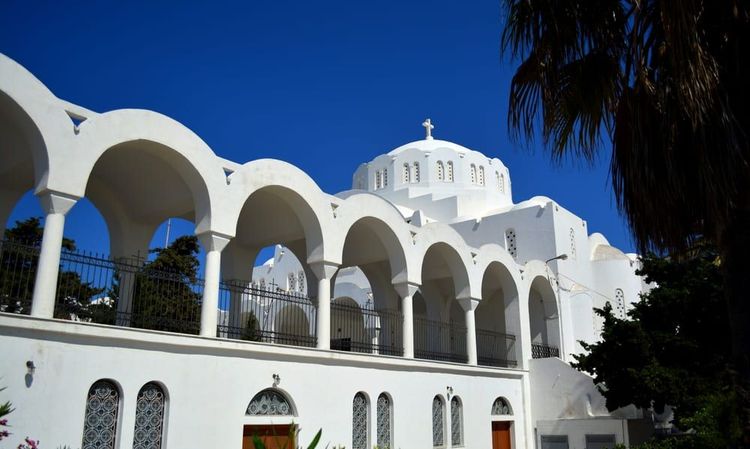
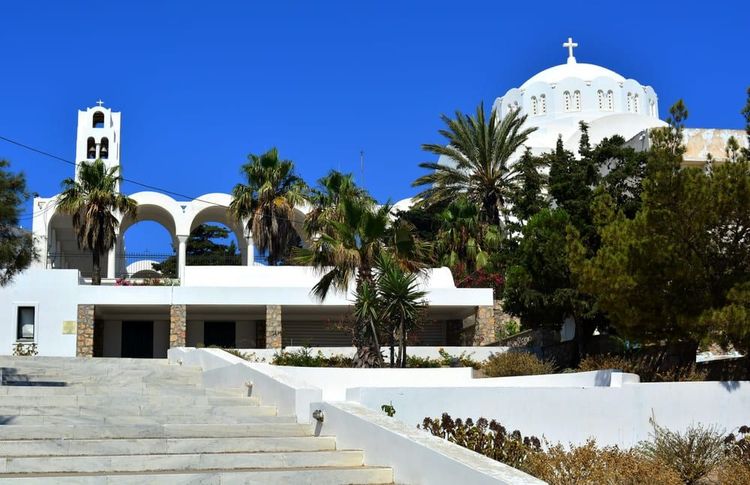
The island's great Orthodox cathedral, raised in 1827 and devoted to the Presentation of Christ, was badly damaged by the 1956 earthquake before being fully restored. Its blue dome and colorful mosaics decorate the exterior; inside, marble floors, a gilded iconostasis and monumental chandeliers create a solemn atmosphere. The frescoes by local artist Christoforos Asimis, painted over seven years, culminate in a Christ Pantocrator dominating the dome. From the esplanade, the view over the caldera and volcanic islets remains one of Fira's finest, especially at sunset.
Free entry
13 - Prehistoric Museum of Thera
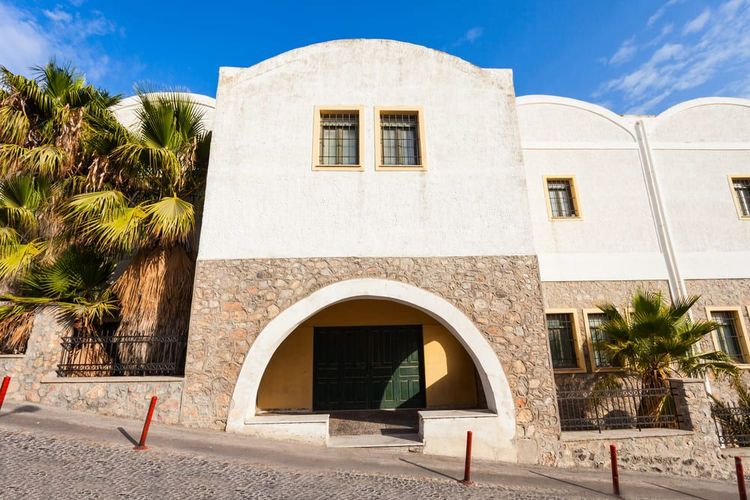
Opened in 2000, this museum gathers the treasures unearthed at Akrotiri, a Bronze Age city nicknamed the Pompeii of the Aegean, about ten kilometers south of Fira. Its holdings range from Neolithic times through the Minoan age, roughly 1600 BC, starring the Spring Fresco and the Blue Monkeys Fresco, whose colors have stayed vivid after three thousand years. Visitors also find storage jars decorated with swallows, delicate gold jewelry, a miraculously preserved ibex statuette, and obsidian tools carved from the island's own volcanic rock.
14 - War Memorial
Modest as it looks, this memorial on Dekigala Street carries a heavy memory: that of the people of Fira who gave their lives, in April 1944, during the two days of fighting that ended German occupation. Despite its isolation, the island had seen a determined resistance rise up, at great cost. People still gather here today on major Greek national dates, laying flowers in memory of the victims, a precious yet often ignored testimony to a recent chapter of Santorini.
Free entry
15 - Fabrica Shopping Center
It was here, in 1892, that the island's first mechanical mill was built, shaping the local economy for more than seventy years under the nickname Fabrica, which has stuck ever since. The old workshop has given way to Santorini's one real shopping center, spread over several open-air floors of shops, art galleries and cafés, each level offering a clear outlook onto the caldera. This shift also recalls the windmills brought by the Venetians in the 1500s to harness the Aegean's winds.
Free entry
Which neighbourhoods does the tour cross?
Over a single loop, the route crosses the districts that make up Fira's historic heart, from the main square to the cliffs above the caldera.
It all begins on Theotokopoulos Square, the beating heart of Santorini's capital, before passing the small park around the Monument to the Pontic Greek Genocide and a stop devoted to local food (stops 1 to 3).
The trail then climbs into the historic centre, between museums and churches: the Archaeological Museum, the Megaro Gyzi Cultural Centre, St. John the Baptist Cathedral and the Three Bells of Fira, before the cable car, the panoramic viewpoint and the Santozeum, all perched above the caldera (stops 4 to 10).
Agiou Mina street follows the cliff edge to the Holy Metropolitan Church, then the route heads back down to the Prehistoric Museum of Thera, the war memorial and the Fabrica Shopping Center (stops 11 to 15).
How much does it cost to visit Fira?
Of the route's 15 stops, 11 can be visited without a ticket: squares, churches, the viewpoint and monuments are all open freely, as is the Megaro Gyzi Cultural Centre.
Fira's cable car, meanwhile, requires a ticket to reach the old port in a few minutes. The route's three museums, the Archaeological, the Prehistoric and the Santozeum, each have their own entry conditions: check on site, and see their opening hours below.
Information checked in November 2026 and subject to change.
Where to stop for a bite along the tour?
The route devotes a whole stop to local food (stop 3): in Fira, cooking is part of the journey.
Try Santorini fava, a purée of yellow split peas served with olive oil, raw onion and capers, or tomatokeftedes, fritters of cherry tomatoes still warm from the pan. Moussaka here is made with the island's white aubergines, and mezze spreads bring together Santorini salad with chloro cheese, melitzanosalata and tzatziki. For fish, head to the taverns of the old port or Amoudi, where squid and octopus are grilled over wood fire.
What should you know before visiting Fira?
Santorini uses the euro. The low season (November to March) brings a calm atmosphere and better prices, though several hotels and restaurants close; spring and autumn remain the most pleasant times, with mild weather and reasonable crowds.
Three stops on the route keep their own schedules. The Megaro Gyzi Cultural Centre (stop 5), free to enter, only opens from May to October, and is closed the rest of the year. The Archaeological Museum (stop 4) opens from 8:30 am to 3 pm, closed on Mondays, and the Prehistoric Museum of Thera (stop 13) opens from 8:30 am to 3:30 pm from November to March, closed on Tuesdays.
The Santozeum (stop 10), meanwhile, has had an uncertain status since the pandemic and does not appear on Santorini's official list of museums: it's worth checking it's open before heading over.
Santorini sits in a monitored volcanic zone; in case of an alert, follow local authorities' instructions, relayed through the GR-Alert system.
What to see around Fira?
Two natural extensions await beyond the Fira loop. By boat from the old port, you can reach the still-active volcanic islets of Nea Kameni and Palea Kameni, where you can walk on solidified lava.
To the south of the island, about 10 km from Fira, the archaeological site of Akrotiri, a Bronze Age city sometimes called the Pompeii of the Aegean, yielded the frescoes now on display at the Prehistoric Museum of Thera, on the route.
Le plein d'inspirations
Explorez le monde en totale liberté, à pied au cœur des villes ou au fil des routes. Nos guides audios transforment chaque destination en une découverte culturelle immersive et unique.
FAQ for visiting Fira
When is the best time to visit Fira?
The ideal time to discover Fira runs from April to June and from September to October. You will then enjoy a perfect Mediterranean climate with mild temperatures, generous sunshine and fewer people in the lanes. Summer is still wonderful for its festive atmosphere, but expect large crowds and higher prices. If you are looking for peace and gentle prices, winter offers a more authentic experience, even if some establishments close their doors. Spring is particularly enchanting, when the bougainvillea blooms and colours the white façades.
How long do you need to visit Fira?
A full day will let you discover the essentials of Fira without rushing. Allow about three to four hours to explore the historic centre, wander the picturesque lanes and admire the views over the caldera. If you want to go down to the old port, visit the museums and enjoy a lunch with a view, plan on a full day instead. Many visitors devote two days to Fira to really soak up the atmosphere, shop in the local boutiques and savour a sunset from one of the many viewpoints. The Ryo audioguide accompanies you for the best discovery in just a few hours of walking.
How do you get around Fira and Santorini?
The centre of Fira is explored exclusively on foot, its narrow lanes and stairways making car traffic impossible. To explore the rest of Santorini, several options are available. Local buses regularly serve the main destinations from Fira's central bus station. Renting a car or a quad bike is handy for discovering the island at your own pace, notably the beaches and outlying villages. Taxis are available but can be pricey in high season. For the sportier travellers, renting an electric bike is an eco-friendly alternative for medium distances, even though the slopes call for good physical condition.
Where can you park in Fira?
Parking in Fira can prove tricky, especially in high season. You will find several public car parks at the entrance to the town, generally paying according to duration. The main car park is located near the bus station, a few minutes' walk from the centre. Free spaces exist along some peripheral roads, but they fill up quickly from the morning onwards. If your accommodation has a car park, that is the most convenient option. Otherwise, arrive early in the morning or in the late afternoon to have a better chance of finding a spot. Some hotels offer a valet service or arrangements with private car parks.
How do you get to the old port of Fira?
Three options are available to reach the old port from Fira, located about 300 metres below. The cable car is the fastest and most comfortable way, with a journey of a few minutes offering spectacular views. The braver visitors will take the traditional staircase of nearly 600 zigzagging steps, an authentic but gruelling experience on the way back up. The third option, picturesque but controversial, involves going down on the back of a donkey or a mule. For ethical reasons, favour the cable car or your own legs. Bring good shoes if you opt for the stairs and avoid the hottest hours.
Is Fira suitable for families?
Fira can suit families with a few precautions. The many steps and slopes make a pushchair impractical, so prefer a baby carrier for the little ones. Teenagers will appreciate the lively atmosphere, the shops and the spectacular viewpoints. Beware, however, of the steep cliffs, which require constant vigilance with young children. Restaurants generally offer suitable menus and the Greek welcome remains warm towards families. Favour morning visits to avoid the crowds and the heat. The prehistoric museum may interest the more curious. Plan regular breaks and plenty of water, especially in summer.
What are the must-see sights in Fira?
Fira is full of wonders to discover during your visit. The Orthodox cathedral with its colourful frescoes is worth the detour, as is the Catholic church, which offers a breathtaking view. The archaeological museum presents treasures from ancient Thera, while the prehistoric museum displays the finds from Akrotiri. Do not miss the walk along the caldera, from the Firostefani district to Imerovigli, for stunning panoramas. The shopping lanes hide charming little squares and secret terraces. The Ryo audioguide takes you through a carefully designed route so you miss none of these gems while telling you their story.
How can you avoid the crowds in Fira?
To enjoy Fira without the tourist crush, adopt a few simple strategies. Visit early in the morning, before nine o'clock, when the lanes are still peaceful and the light is perfect for photos. Lunchtime also sees fewer people, as many are at the restaurant. Absolutely avoid the arrival times of the cruise ships, generally between ten in the morning and four in the afternoon. Explore the lesser-known outlying districts, which are just as charming. The months of April, May, September and October offer the best compromise between good weather and reasonable crowds. In the evening, while everyone converges on the sunset spots, quietly discover the other districts.
Which museums are worth visiting in Fira?
Fira brings together Santorini's main museums, which makes it a natural stop on windy days or when the heat becomes too much. The Museum of Prehistoric Thera gathers the finds from the site of Akrotiri, the village frozen in time by the eruption: frescoes, pottery and furniture tell the story of a surprisingly sophisticated civilisation. The archaeological museum covers later periods, from the Geometric era to Roman rule, with fine pieces of sculpture. Smaller collections devoted to island life, folklore and the history of local wine complete the picture. Allow a morning to see two of them without rushing, and check the opening days, which vary with the season.
How do you reach Oia from Fira along the caldera path?
The path starts at the northern edge of Fira and follows the cliff through Firostefani and Imerovigli before reaching Oia. The walk takes several hours depending on your pace and your photo stops, with uphill sections and uneven ground over the second half, so sturdy shoes and plenty of water are essential. Set off early in the morning to avoid the heat, or in the late afternoon if you are after evening light, knowing that the return trip is easy by bus. Before you head off, take the time to explore Fira itself: the Ryo audio guide devotes a route to it that tells the story of its lanes and viewpoints.
Vos commentaires, idées et suggestions
Aucun avis pour le moment
