© Shutterstock
 Votre guide Ryo
Free Split: 16 Experiences to Enjoy Without Spending a Penny in 2026
In Split, visitors literally sleep inside history: the entire old town fits within the walls of a 4th-century Roman palace, and no one will ask you for a ticket to get in. Looking for free things to do in Split is therefore less about saving money than about discovering the city the way it is really lived, among stone lanes, squares open to the sea and wooded hills. The Ryo audio-guided tour of Split follows this very principle: it takes you into Diocletian's Palace and along the waterfront at your own pace, with your headphones as your only guide.
The facts speak for the city: granite columns brought from Egypt have stood on the same square for 1,700 years, a vaulted hall turns any voice into an a cappella choir, and a bronze statue is said to bring luck to anyone who rubs its toe. Add a street so narrow that two people cannot pass each other, a pine-covered hill where locals swim at sunset, and a morning market where fruit is still haggled over out loud. Sixteen experiences, no entrance ticket needed for most of them, and a few paid exceptions honestly flagged: here is how to visit Split without emptying your wallet.
1. Get Lost for Free in Diocletian's Palace
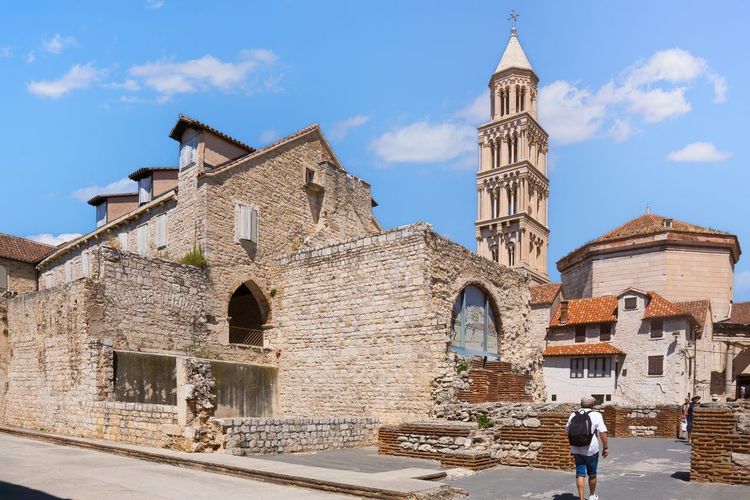
The Diocletian's Palace (Dioklecijanova 1, 21000 Split, rated 4.7/5 on Google from 93,726 reviews) is not a museum you visit at fixed hours: it is the entire historic centre of Split, built at the turn of the 3rd and 4th centuries (construction began around 295–298 and ended around 305) for the Roman emperor who wanted to spend his retirement there. A UNESCO World Heritage Site since 1979, it covers about 30,000 m² and still shelters shops, restaurants and some three thousand residents behind its white limestone walls. Unlike most ancient sites, you can enter at any hour of the day or night, through any of its four gates, with no ticket office or barrier.
The rule to remember is simple: the open-air streets, squares and facades cost nothing, while two specific things remain paid, the vaulted cellars beneath the Peristyle and the climb up the cathedral bell tower (more on that below). For the rest, you can walk for hours among Corinthian columns, peek from the alley toward the former Temple of Jupiter, converted into a baptistery in the Middle Ages, or simply drift through the maze without any ticket desk stopping you.
The best time to explore the palace remains early in the morning, before 9am, when the white stone has not yet absorbed the heat and the cruise ship groups have not yet disembarked. You will mostly hear your own footsteps on slabs polished by seventeen centuries of passers-by, and you can photograph the arcades without a single head in the frame. In the evening, around 10pm, the same walls take on an almost unreal whiteness under the streetlamps; the terraces come alive, but the lanes of the north-east quarter become surprisingly quiet again.
A detail few visitors notice: look for the medieval houses literally wedged between two Roman columns, or the paired windows typical of Adriatic architecture, added centuries after the imperial construction. The palace reads like a mille-feuille where Rome, Byzantium, Venice and Austria each left their layer. Rather than a two-hour express stop, give yourself at least half a day: it is by walking through the same lane twice, at different times, that you end up spotting these layers.
Would you rather have someone tell you what you are looking at? The Ryo audio guide for Split starts precisely with an entry into the palace and comments, step by step, on the Roman remains you pass along the way, with no booking or set schedule.
2. Admire the Peristyle and the Vestibule, the City's Most Beautiful Square
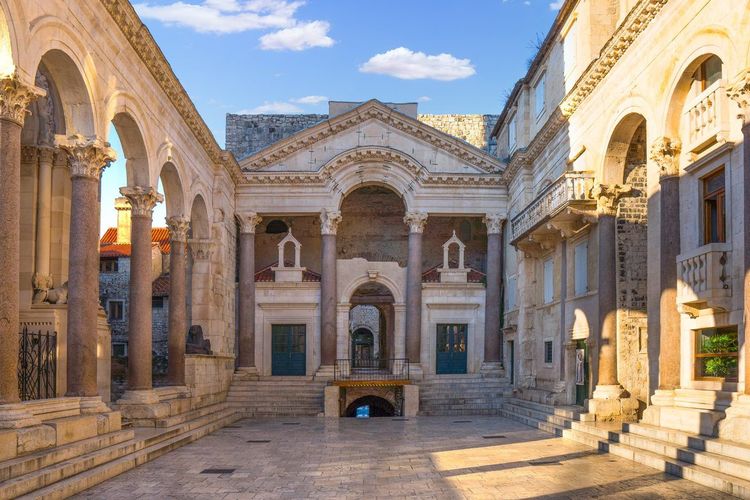
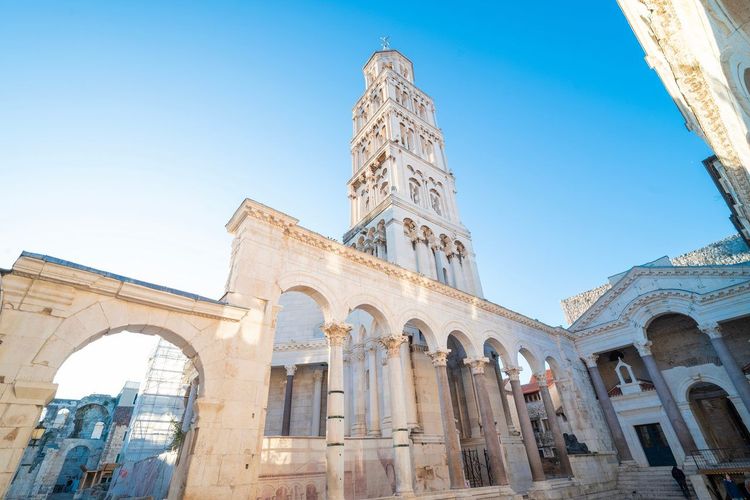
At the centre of the palace, the Peristyle serves as a grand reception hall: a rectangular square lined with granite and marble columns, opening onto the entrance of the former imperial mausoleum, now a cathedral. Access is free at any hour, and many visitors consider it the most beautiful square in Split. Look to the right of the steps: a black granite sphinx, carved in Egypt about 3,500 years ago during the reign of Thutmose III, then brought back by Diocletian to decorate his palace, still watches over the square. It is one of three Egyptian sphinxes that survive in Split.
At nightfall, it is not unusual for klapa singers, the traditional Dalmatian vocal ensembles inscribed on UNESCO's intangible heritage list, to strike up an a cappella song in the neighbouring Vestibule (Kraj Svetog Ivana 1, 21000 Split, rated 4.8/5 on Google from 486 reviews). This round hall, which served as an antechamber to the imperial apartments, has lost its dome but retains astonishing acoustics: the slightest chord resounds as in a church. Entry costs nothing; only access to the adjoining cellars requires a ticket. If a group is singing, stay until the end and drop a coin in the hat, as is customary.
In the late afternoon, settle on the steps covered with red cushions from the neighbouring cafés, or simply on the stone, for a quarter of an hour: between tourists photographing the columns and locals crossing on their way home, you have one of the best vantage points for watching daily life inside the palace. In summer, extras dressed as Roman legionaries sometimes re-enact a changing of the guard at noon, a small free show that children love.
3. Explore the Palace's Gates and Hidden Remains
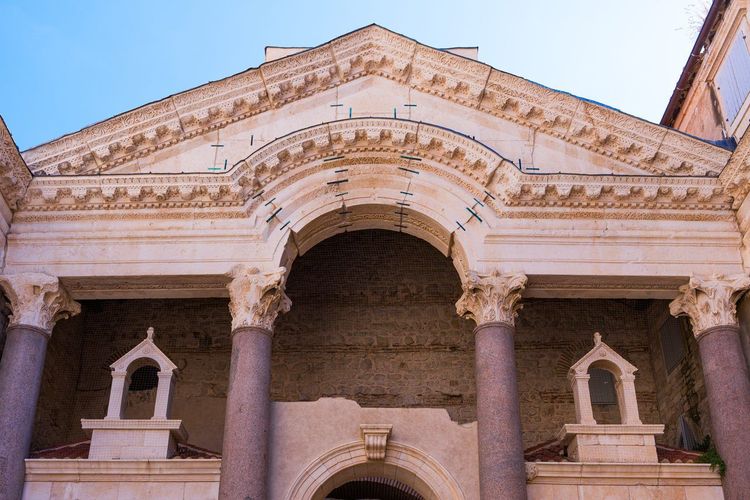
Beyond the Peristyle, the palace hides half a dozen curiosities that would be a shame to miss. Start with the four gates, each with its own character. The Golden Gate, to the north, was the ceremonial entrance towards Salona and remains the most imposing, with its niches and arcades still largely intact. In the former walkway above it hides the tiny Church of St. Martin, often cited among the narrowest in Europe. The Silver Gate, to the east, opens onto the market; the Bronze Gate, to the south, once opened directly onto the sea and today leads to the Riva through the cellars. Finally, to the west, the Iron Gate (Željezna vrata) gives onto the People's Square and bears above its arch a small 11th-century Romanesque bell tower, one of the oldest in Dalmatia.
Between two gates, go in search of the alley called Pusti me proć, literally the “let me pass” street: at its narrowest point, it is barely more than half a metre wide, so two people cannot pass each other without one stepping into a recess. It is a classic for souvenir photos, and you may have to wait a few minutes to have it to yourself. A few steps away, the Venetian tower, a 15th-century defensive remnant built during Venice's rule over Dalmatia, still overlooks the Radić Brothers Square.
For lovers of medieval history, one last detour lies farther on, along the promenade that runs along the south of Marjan: the Museum of Croatian Archaeological Monuments (Šetalište Ivana Meštrovića 18, 21000 Split, rated 4.7/5 on Google from 1,492 reviews), housed since 1976 in a modern building, displays the stone interlace and inscriptions of the first Croatian rulers. The collections are paid, but the outside can be seen in passing, on the way to the beaches of Kašjuni or to the Meštrović Gallery mentioned later.
4. Touch the Toe of the Statue of Gregory of Nin
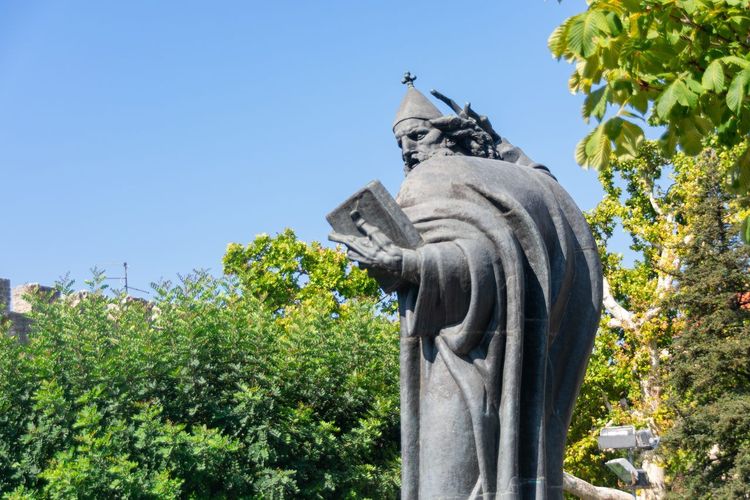
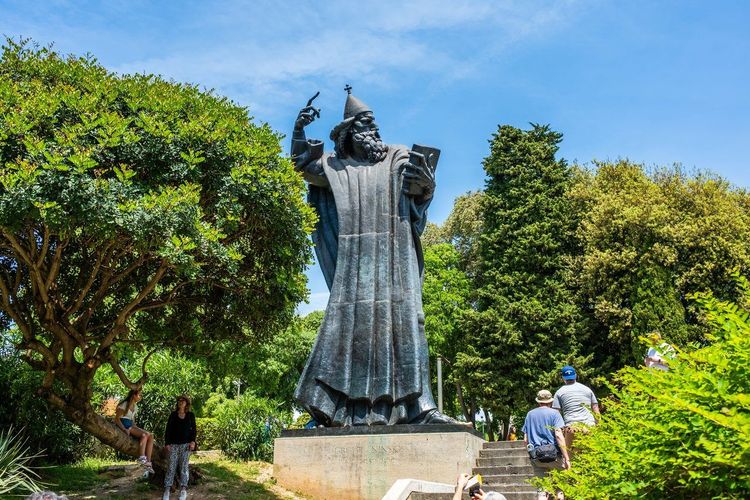
Right in front of the Golden Gate stands one of the most photographed statues in Croatia: the statue of Gregory of Nin (Zlatna vrata, 21000 Split, rated 4.7/5 on Google from 1,402 reviews) (Grgur Ninski in Croatian), a monumental work by the sculptor Ivan Meštrović, more than four metres high. It depicts the 10th-century Croatian bishop who defended the use of the Slavic language in the liturgy against Rome, a figure of cultural resistance still very present in local identity. First installed on the Peristyle in 1929, it was moved outside the walls after the Second World War.
Tradition has it that you rub the statue's left big toe while making a wish: the bronze there is a shining gold, polished by generations of hands, while the rest of the sculpture has kept its dark patina. For a photo without a queue, come before 8am or after 10pm; in the middle of the day, groups follow one another every two minutes. And take the time to walk around it: from behind, the silhouette of the bishop pointing his index finger to the sky nicely cuts against the north wall of the palace.
5. Stroll Through People's Square and Radić Brothers Square
Walk through the Iron Gate and you are on People's Square, which the people of Split simply call Pjaca. It has been the civic centre of the city since the Middle Ages, when Split began to spill beyond the walls of the Roman palace. The former Gothic town hall, with its three-arched loggia, still marks one of its sides, and its ground floor regularly hosts free temporary exhibitions. The white marble paving, worn smooth by passing feet, becomes so shiny in the evening that it looks wet.
Two minutes' walk away, the Radić Brothers Square (Trg braće Radića, 21000 Split, rated 4.7/5 on Google from 593 reviews), nicknamed “Voćni trg” or Fruit Square in memory of its former market, is home to the statue of Marko Marulić, considered the father of Croatian literature, also by Meštrović. The Venetian tower mentioned earlier overlooks it. The place is much calmer than the Peristyle: if you are looking for a shaded bench to watch neighbourhood life, this is where to stop.
From Pjaca, the pedestrian street Marmontova, cut through in the 19th century and lined with shops, heads straight towards the sea and the Prokurative: a handy shortcut to reach the waterfront without going back through the Peristyle crowds. These squares, where all municipal life was once told, take on another depth with the Ryo audio guide to Split: it walks through them slipping anecdotes about daily life in the medieval city straight into your headphones as you walk.
6. Discover Trg Republike and the Bell Tower of St. Domnius Cathedral
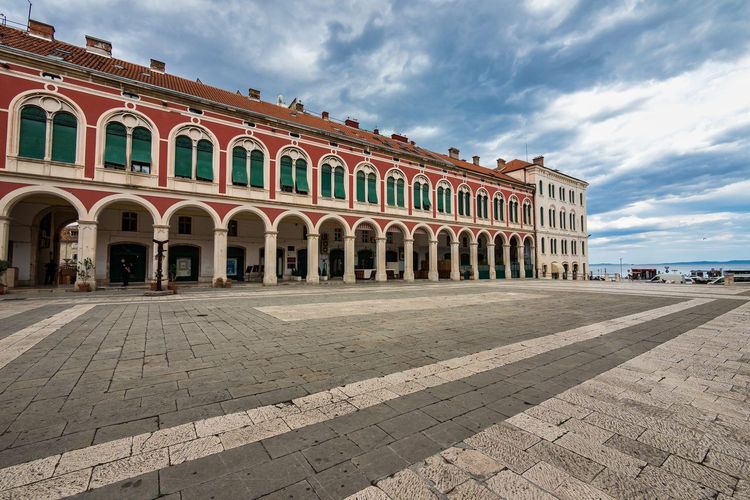
Towards the sea, the square Trg Republike, which everyone calls the Prokurative in reference to St. Mark's Square in Venice, unfolds its 19th-century neo-Renaissance arcades on three sides, the fourth opening onto the Riva. During the day it seems almost empty; it comes alive in summer, when it hosts numerous open-air concerts, some of them free. Stop by at the end of the day, when the light grazes the ochre colonnades and locals gather there after work.
Back to the heart of the palace: the bell tower of St. Domnius Cathedral (Kraj Svetog Duje 5, 21000 Split, rated 4.6/5 on Google from 7,590 reviews) towers over the whole old town at 57 metres. Built from the 13th to the 16th century and then heavily restored at the turn of the 20th, it blends Romanesque and Gothic in a silhouette that serves as a landmark from any street. The square around it, like the facade of the cathedral set in Diocletian's former mausoleum, can be admired at no cost. Go up close to the heavy carved wooden doors from the 13th century, by Andrija Buvina, which tell the life of Christ in twenty-eight panels. Only the climb inside the bell tower is paid: we detail below whether the exception is worth it.
7. Hike Marjan Hill at Sunset
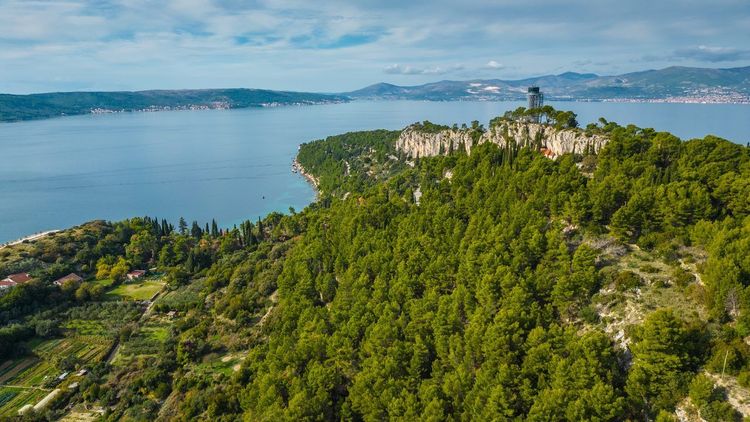
Split has the rare luck of having a true urban forest ten minutes' walk from its historic centre. The Marjan hill (Marjan, 21000 Split, rated 4.8/5 on Google from 340 reviews), protected as a forest park since 1964, spreads over about 3.5 km² of Aleppo pines, Mediterranean scrubland and marked trails freely accessible from morning until nightfall.
The most direct path starts from the Varoš district via a long stone staircase. After ten minutes of climbing, you reach the Vidilica viewpoint, the first panoramic terrace over the palace rooftops, the port and the islands; there is a café there, but the view itself is free. Right next to it, the former Jewish cemetery, one of the oldest still preserved in Europe, climbs the slope.
From there, the main trail climbs in half an hour to the highest point, Telegrin, at 178 metres above sea level, from which the eye takes in the old town, the islands of Brač and Šolta and, on a clear day, the peaks of the Dinaric Alps. Along the way and on the south slope, several old chapels punctuate the walk: St. Nicholas, whose origins go back to the 13th century, Our Lady of Bethlehem, and St. Jerome, set against a cliff hollowed with former hermitages. All can be admired from the outside with no entrance fee.
Prefer the sea to altitude? The lower trails run along a series of rocky coves where locals swim from the first fine days, well before tourists arrive at the better-known beaches. On the same slope, the Meštrović Gallery, a villa the sculptor had built in the 1930s, gives a glimpse from the road of its garden filled with bronzes. Allow about two hours for a relaxed round trip to the summit with a swimming stop, three hours if you link several viewpoints. Bring water: beyond Vidilica, refreshment points are scarce.
Sporty visitors will enjoy the forest road closed to cars that circles the peninsula: joggers and cyclists meet there from 7am, in the shade of the pines, with the sea below at every bend. Bike rental shops near the park entrance let you ride around it without undue effort if you have not brought your own.
Sunset remains the most sought-after moment, and for good reason: from the west-facing viewpoints, the sun dives directly behind the islands, tinting Split's white stone orange and then pink. Arrive about 45 minutes before the announced time to find a good spot on the flat rocks that serve as natural bleachers, especially in July and August when the place fills quickly. The Ryo audio-guided tour in Split extends this atmosphere at the foot of the hill, with commentary on the viewpoints and the history of the coast, enough to turn a simple walk into a real guided visit without a human guide.
8. Enjoy the Calm of Sustipan Park
Less well known than Marjan, Sustipan Park (Sustipanski put, 21000 Split, rated 4.9/5 on Google from 322 reviews) occupies a small promontory between the port and the foot of the hill. The place has had several lives: a Benedictine monastery in the Middle Ages, then, in the 19th century, one of the most beautiful cemeteries in Croatia, where Split's leading families were buried. In the 20th century, the communist authorities had the graves removed to turn the site into a public park. Only a neoclassical pavilion with columns, set at the edge of the cliff, recalls this past today, amid the pines.
It is the place to choose if Marjan seems too crowded: the view of the port, the manoeuvring ferries and the islands is comparable, access is just as free, but you will mostly meet locals who come to read, walk their dogs or picnic at the end of the day. To get there, follow the harbour promenade westward, beyond the yacht club: the park is about fifteen minutes' walk from the Riva. In the evening, the pavilion facing the setting sun offers one of the most peaceful settings in the city, without the crowds of the Marjan viewpoints.
9. Walk Along the Riva, Split's Waterfront
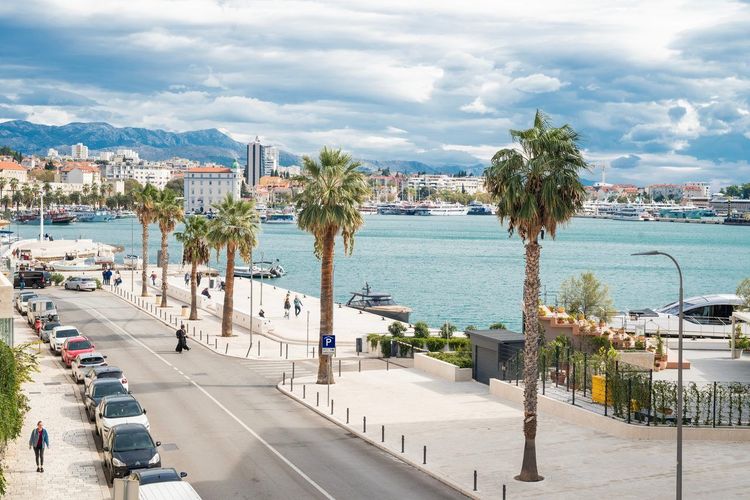
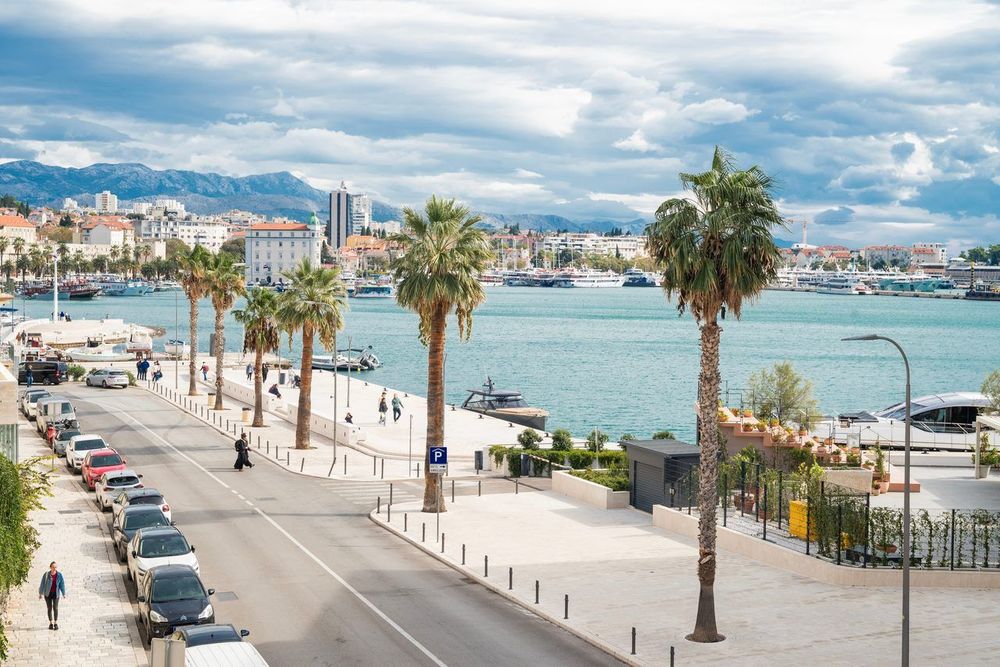
The Riva, a palm-lined promenade that runs along the entire seafront of the palace, concentrates most of Split's social life. Fishing boats, island ferries and yachts pass just metres from the café terraces, and you can enjoy the spectacle simply by walking from one end to the other, without buying anything. The white benches facing the sea are taken by storm from 6pm, so keep one in mind if you plan to wait there until night.
The best time is late afternoon, when the low light illuminates the south facade of the palace and the heat subsides. Locals call this evening ritual the korzo, the daily stroll where people come as much to see as to be seen. Then continue west to Matejuška, the small fishermen's harbour of the Veli Varoš district: wooden boats are moored just metres from children diving off the quay, and the atmosphere is anything but touristy. You will also regularly come across street musicians on the Riva (Obala Hrvatskog narodnog preporoda, 21000 Split, rated 4.7/5 on Google from 25,447 reviews).
Finally, the Riva serves as the great stage for the city's festivals. On 7 May, Sudamja, the feast of St. Domnius, patron saint of Split, sets up a big popular fair with craft stalls, processions and concerts open to all. From mid-July to mid-August, the Split Summer Festival enlivens the palace and its surroundings; some of the shows take place outdoors and can be watched from the square, without booking.
10. Breathe in the Scents of the Green Market (Pazar)
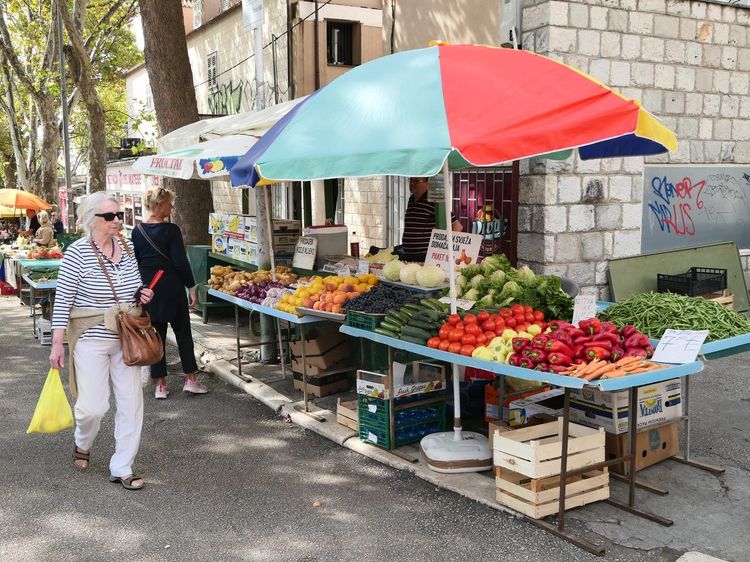
Just east of the palace, at the foot of the Silver Gate, the Pazar market (Hrvojeva, 21000 Split, rated 4.3/5 on Google from 24 reviews) (Green Market) opens at dawn and empties in early afternoon. Fruit, vegetables, dried herbs, Hvar lavender, cheeses and handmade souvenirs are sold there at prices well below those of the shops in the centre.
Walking around costs nothing and is well worth the detour for the atmosphere: Dalmatian vendors still haggle out loud, and it is not unusual to be handed a slice of peach or a handful of cherries to taste. A few euros are enough for a bag of seasonal figs or apricots that will advantageously replace an 8-euro terrace snack. Arrive before 10am to see the market at its liveliest, before the heat makes the stalls fold up.
Then continue to the Peskarija, the covered fish market located west of the old town, near Marmontova street. It is said that the nearby sulphur springs keep flies away, which would explain the surprising absence of insects above the stalls. The sight of fishermen praising sardines, octopus and sea bream caught that very morning can be enjoyed without buying anything.
11. Swim at Split's Public Beaches
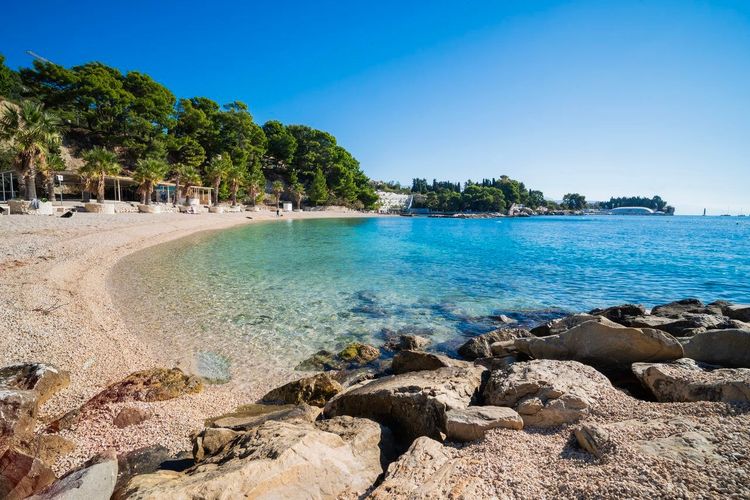
Unlike many Mediterranean destinations, Split charges no access fee for its public beaches; only sunbeds and umbrellas are for rent, for those who prefer comfort. Four of them deserve a mention, each with its own atmosphere.
Bačvice, ten minutes' walk from the centre, remains the best known: a bay of shallow sand where picigin is played, a local sport invented here in the early 20th century, which consists of keeping a small ball out of the water by slapping it with the palm, with spectacular dives. A tournament is even held there every year. It is the liveliest beach, perfect in the late afternoon for atmosphere, less so for tranquillity.
Kašjuni, at the foot of Marjan on the south side, offers a wider pebble cove, with a few beach bars and an open view of the islands. It is generally the choice of families who want to avoid the Bačvice crowds; a city bus serves the area if you do not want to walk.
More discreet, Ovčice, a small pebble beach just east of Bačvice, and Plaža Kaštelet (Kaštelet, 21000 Split, rated 4.5/5 on Google from 535 reviews), nestled below the Meštrović promenade, require a bit more walking but reward you with clearer water and far fewer people, especially outside August. On the north side of Marjan, the beach at Bene, shaded by pines, appeals to locals for its sports courts and picnic spots.
To the east, finally, the long pebble beach of Žnjan, lined with a recent promenade, offers the space that the coves in the centre sometimes lack: this is where you will find room even on an August Sunday. To compare with the great beaches of the rest of the coast, the Ryo article on the most beautiful beaches in Croatia gives you ideas beyond Split. And if you want to reach the coves without pulling out your phone in the full sun, the Ryo audio guide follows part of the coastline and points out the access routes along the way.
12. Join a Free Walking Tour
Several organisations offer free walking tours in Split, generally starting from the statue of Grgur Ninski or the Peristyle, in mid-morning and sometimes in the late afternoon. The principle is the same everywhere in the world: the tour officially costs nothing, with the guide living solely on the tip each person leaves at the end, according to their appreciation and budget.
Allow an hour and a half to two hours, most often in English, sometimes in French in high season, for an overview of the palace and the surrounding squares, with anecdotes that an information panel never tells: the life of Diocletian, TV series shoots, the quarrels between Split and Venice. Times vary by season; check the exact meeting point the day before on the organiser's website, as slots may be cancelled if the group is too small. A tip of 8 to 10 euros per person remains the implicit norm, even though nothing obliges you to give it.
If you are torn between several organisers, look at the announced maximum group size: under twenty people, the tour stays truly interactive. And if group schedules do not suit you, nothing stops you from putting together your own guided walk: by following the order of the sections in this article, from the palace gates to the market and then the Riva, you cover most of the programme of a classic walking tour.
13. What's Worth It Among the Normally Paid Visits
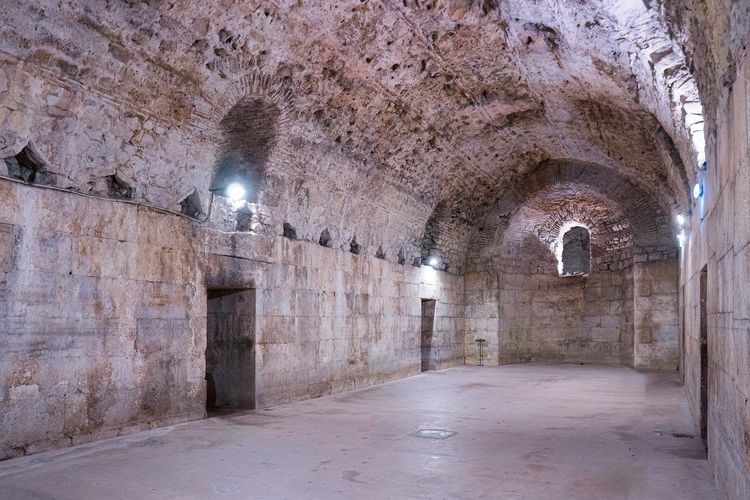
Split can be discovered almost entirely for free, but three exceptions are worth taking out your wallet for. The palace cellars, beneath the Peristyle, gather immense vaulted halls nearly eight metres high, which compensated for the slope of the terrain and supported the imperial apartments. They gained fame after serving as a set for Game of Thrones, where Daenerys locked up her dragons, and are worth the ticket for the atmosphere as much as for the architecture. Good news: the central corridor, which links the Riva to the Peristyle and serves as a shopping arcade, can be crossed without a ticket.
The climb up the cathedral bell tower goes through a narrow stone and then metal staircase, sometimes dizzying, but rewards you with the best panoramic view of the palace's red roofs, impossible to get from the ground. Finally, the collections of the Museum of Croatian Archaeological Monuments or the city museum usefully complement the walk if Roman and medieval history fascinates you. Plan on about ten euros per site in 2026 (combined tickets exist for the cathedral complex); prices change each season, so check them on site.
14. Eat and Drink in Split Without Breaking the Bank
Beyond the Pazar market already mentioned, a few habits let you eat well in Split without blowing your budget. Tap water is drinkable throughout the city, and several public fountains dot the centre: fill a water bottle in the morning rather than buying bottles all day in the middle of summer.
As for meals, bakeries (pekara) and small stalls selling burek (a cheese or meat pastry) or ćevapi (small grilled minced-meat sausages) in the side streets cost two to three times less than restaurants with a view of the Peristyle. The same dish, a few streets away, can go from 15 to 5 euros. For a picnic, the convenience stores of Croatian chains such as Konzum, Studenac or Tommy, present in every neighbourhood, offer bread, Pag cheese, Dalmatian ham and fruit at prices that bear no comparison with those of the terraces.
For a sit-down meal, aim for the Varoš district, just at the foot of Marjan, where konobas, those family-run Dalmatian taverns, welcome a mostly local clientele. Look for those that advertise a marenda: this mid-morning meal, inherited from the port workers, offers a simmered dish of the day (pašticada, fish stew, black risotto) at a gentle price, generally served between 10am and noon. Finally, for an aperitif, buy a bottle of Dalmatian wine at a convenience store and settle on the rocks of Marjan at sunset: the best terrace in the city doesn't charge for service.
15. Cheap Day Trips and Road Trips from Split
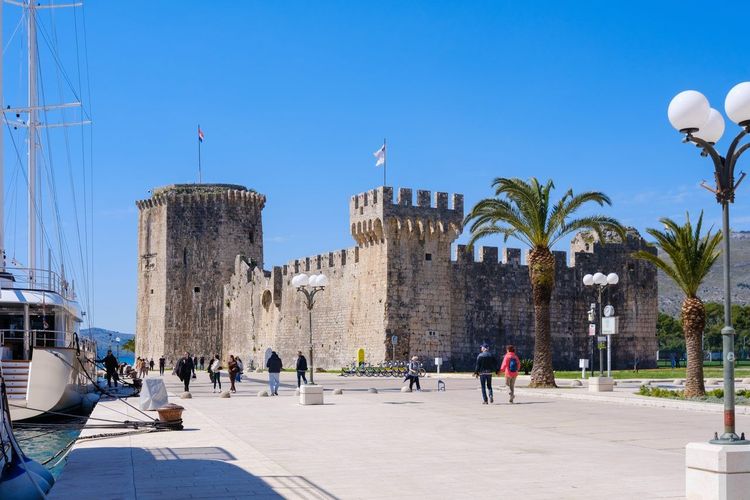
Split is an ideal base for low-budget day trips, provided you favour public transport. Trogir, a medieval UNESCO-listed town on its islet, can be reached in about forty minutes by public bus for a few euros, compared with double or triple that on an organised excursion. Once there, walking through its lanes and along its waterfront costs nothing.
The Klis Fortress, perched on a rocky outcrop above the city and turned into Meereen in Game of Thrones, can be reached by a city bus line; the entry ticket to the site is much cheaper than a group guided tour. Even closer, the ancient ruins of Salona, in Solin, former capital of the Roman province of Dalmatia and the supposed birthplace of Diocletian, can be reached by bus in twenty minutes: you will walk among the amphitheatre and early Christian basilicas for a modest fee.
For the islands, public ferries to Brač, Hvar or Šolta remain very affordable compared with the private boat excursions sold on the Riva, especially if you leave early and return the same evening. Tickets are bought at the port terminal, a stone's throw from the bus station; in July and August, buy them the day before, as the first departures fill up quickly. To prepare these stops in more detail, the Ryo articles on the road trip in Croatia and the Croatian islands detail the routes and the best seasons for each.
16. Daily Budget and Practical Info for Visiting Split on the Cheap
By following most of this list, a daily budget of 25 to 35 euros per person, accommodation not included, is enough in Split: zero euros for the palace, the squares, Marjan, the Riva and the beaches, with most of the spending going on food (10 to 15 euros) and a possible local bus ride (2 to 3 euros).
A few time markers to organise your days. The palace's lanes and squares are accessible around the clock, day and night. The Pazar market operates mainly in the morning, until 1–2pm depending on the season, including Sunday, when it is calmer. For free walking tours, book your spot online the day before, as groups are limited. The historic centre, the Riva, Sustipan and the foot of Marjan can all be covered entirely on foot: there is no need to pay for a taxi or bus for most of the stops on this list.
Spring (April–June) and early autumn (September) remain the best times to enjoy these free activities in Split without the heat or crowds of high summer, with accommodation prices much lower than in July–August. In winter, the city empties of its cruise passengers: the terraces partly close, but the palace regains a rare authenticity.



FAQ
Is Diocletian's Palace free to visit?
Mostly, yes: the streets, squares and facades can be explored freely at any hour. Only two things cost money, the vaulted cellars beneath the Peristyle and the climb up the bell tower of St. Domnius Cathedral, each with a separate ticket of around ten euros.
How many days do you need to see the essentials of Split without paying admission?
Two full days let you cover the palace, the historic squares, Marjan, the Riva, the Pazar market and a beach without rushing. One day is enough for a condensed overview, at the cost of sacrificing the hike up the hill or a trip to Trogir.
Where can you swim for free in Split?
All of the city's public beaches are free to access, apart from paid sunbeds. Bačvice is best for atmosphere, Kašjuni for families, and Ovčice and Plaža Kaštelet for peace and quiet and clearer water, a few extra minutes' walk from the centre.
Are free walking tours really free?
Signing up and taking the tour cost nothing, but the guide lives on the tip left at the end of the walk. An amount of 8 to 10 euros per person is the implicit norm, with no obligation to pay a specific amount.
What daily budget should you plan for in Split when travelling frugally?
Plan on roughly 25 to 35 euros per day per person, excluding accommodation, by combining the discoveries in this list with simple meals at local eateries rather than in the restaurants of the historic centre.
What is the best time to visit Split without spending too much?
Spring and early autumn offer pleasant temperatures for walking and swimming, fewer crowds at the sights, and accommodation prices well below those of high season (July–August).
Are there free festivals or concerts in Split?
Yes. Sudamja, on 7 May, turns the Riva into a big popular fair, and the summer festival, from mid-July to mid-August, offers some of its shows outdoors around the palace. The klapa singers in the Vestibule and the concerts on Trg Republike round out the programme.
Split, a City Best Earned on Foot
In the end, Split can be visited without a single entrance ticket being truly essential, as long as you know the right landmarks: the palace gates rather than queues, the Marjan trails rather than organised excursions, the Pazar market rather than tourist terraces. These free activities in Split have one thing in common: they are experienced on foot, at the pace of the city.
To link them without a map or group schedule, download the Ryo audio-guided walk in Split: it links most of these stops on foot, in the order that suits you. And if you are staying longer, the Ryo article on visiting Split in 3 days details a complete itinerary, with a few paid extras for those with a little more time.
À lire également