© Shutterstock
 Votre guide Ryo
The Largest Aquariums in France: Complete 2026 Guide (Nausicaá, Océanopolis, La Rochelle…)
There's a persistent misconception about French aquariums: that they're oversized fish tanks for school trips, pleasant but lacking depth. The reality is quite different. France is home to one of the three largest aquariums in the world, an oceanographic centre covering nearly four hectares under glass, and a dozen institutions that hold their own against the best European establishments. From the hammerhead sharks of Boulogne-sur-Mer to the piranhas of Lyon, from the nuclear submarine of Cherbourg to the giant octopuses of Brest, France's largest aquariums hold surprises that few visitors anticipate. This guide reviews twelve venues, from the northern giant that welcomes nearly 600,000 visitors a year to the lesser-known addresses well worth seeking out. And since none of these cities can be reduced to their shark tank, each visit pairs naturally with a Ryo audio guide of La Rochelle or one of the other coastal cities. Practical information, prices, visiting tips and what you won't find anywhere else: it's all here.
1. Nausicaá: Boulogne-sur-Mer, the Largest Aquarium in Europe
Nausicaá (Boulevard Sainte-Beuve, 62200 Boulogne-sur-Mer, rated 4.4/5 on Google from 45,385 reviews) does not present itself as a simple aquarium. Its official name, Centre National de la Mer, sets the tone: it is a fully-fledged museum facility dedicated to understanding the oceans as much as to contemplating them. Opened in 1991 and radically expanded in 2018, it now claims the title of largest aquarium in Europe with 10,000 m² of exhibition space, 58,000 animals and 69 tanks.
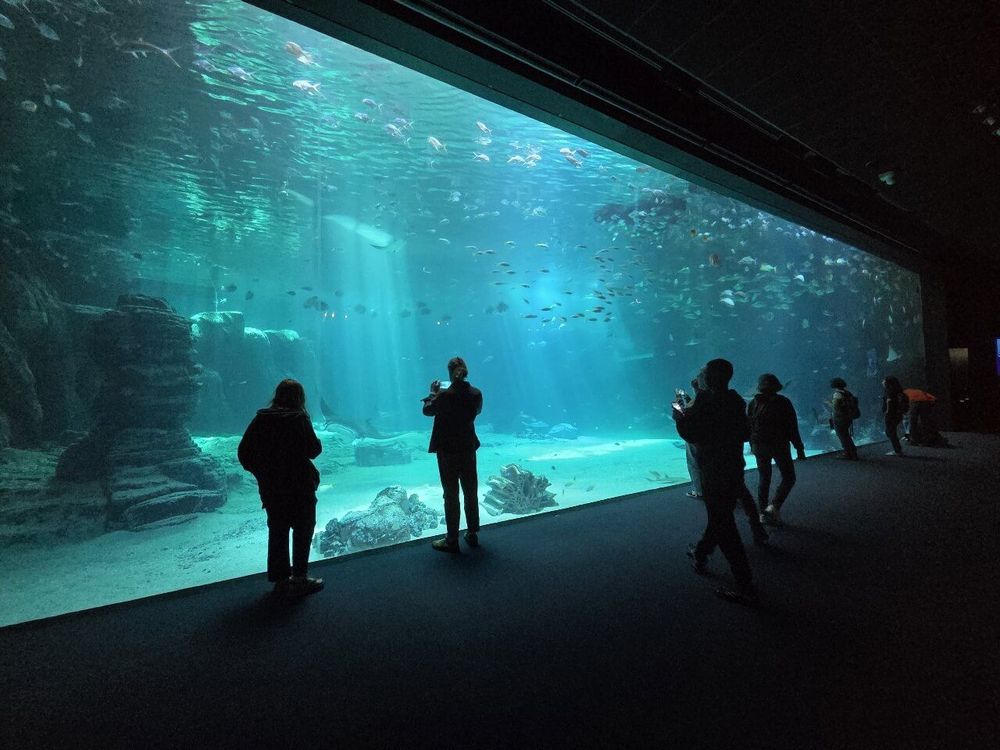
The 2018 restructuring doubled the floor area and introduced a brand-new pavilion: 'La Planète Océan'. This new wing immerses visitors in an immersive scenography, featuring a 30-metre underwater tunnel and an open tank of 2 million litres populated by manta rays, reef sharks and sea turtles. It is one of the rare places in France where you can observe hammerhead sharks gliding just a few dozen centimetres away, separated only by glass.
Boulogne-sur-Mer is a port city in the Pas-de-Calais, often overlooked by classic tourist itineraries. Yet Nausicaá makes it one of the most visited family destinations in northern France. The site attracts 600,000 visitors a year, more than many Parisian national museums. Allow a minimum of 3 hours to explore it properly. Adult admission ranges from €30 to €31.50 depending on the season (2026 prices), with reduced rates for children aged 3 to 12 and groups; free for under-3s.
What truly sets Nausicaá apart from its competitors: its commitment to marine research. The venue hosts active scientific programmes on the reproduction of manta rays in captivity, and its teams participate in international species protection protocols. This is therefore not purely a spectacle — the visit also addresses conservation challenges, explained accessibly in the 'Engagés pour demain' space.
Practically speaking, Nausicaá is accessible from Calais in 30 minutes by car or direct bus from the train station. In summer, queues can be long: booking online is strongly advised. The panoramic restaurant offers views over the English Channel and themed menus, a way to extend the maritime experience.
If you're exploring the northern coastline after your visit, the Ryo audio guide of Calais takes you on a journey through a city that carries far more history than it is often credited with, from the English ghosts of the Middle Ages to the brasseries of postwar reconstruction.
2. Océanopolis: Brest, the Temple of Marine Biodiversity
Océanopolis (Port de Plaisance du Moulin Blanc, 29200 Brest, rated 4.1/5 on Google from 19,710 reviews), in Brest, champions a different philosophy from Nausicaá: less showmanship, more science. Opened in 1990 and renovated several times since, it is organised around three themed pavilions — Brittany, Tropical and Austral (polar) — offering a panorama of global marine biodiversity across approximately 9,000 m² of exhibition space. Good to know: in 2026, the Tropical and Austral pavilions are gradually reopening after a major renovation — the Tropical for summer and the Austral in autumn.
The Austral pavilion is often cited as the most impressive. It houses a reconstruction of the Antarctic environment with penguins, sea otters and seals, in spaces designed with animal welfare in mind — a subject to which Océanopolis pays particular attention. The tanks are deep, the animals visibly active. The contrast with the old-style fishbowl aquariums of the 1980s is striking.
Océanopolis's geographic position is no coincidence. Brest is Brittany's capital of marine sciences: Ifremer, Shom and several university laboratories are based on the Plouzané peninsula, just a few kilometres away. This scientific concentration directly benefits the aquarium, which co-develops exhibitions with research teams and regularly organises public lectures.
Budget €25 to €30 per adult for full access; during the 2026 pavilion reopening phase, a reduced rate of around €14 per adult applies — check opening status before you go. A full day is needed to cover all three pavilions. One tip that often goes unmentioned: avoid Wednesday mornings during the school term, as Océanopolis is very popular with school groups and they can crowd the smaller spaces.
Brest is worth one or two nights. Ryo's audio-guided tour of Brest covers 3.5 hours of walking through the city, from the medieval citadel to the postwar reconstruction quays — a city that lost everything in 1944 and reinvented itself as an Atlantic capital.
3. Aquarium de La Rochelle, the Atlantic Institution
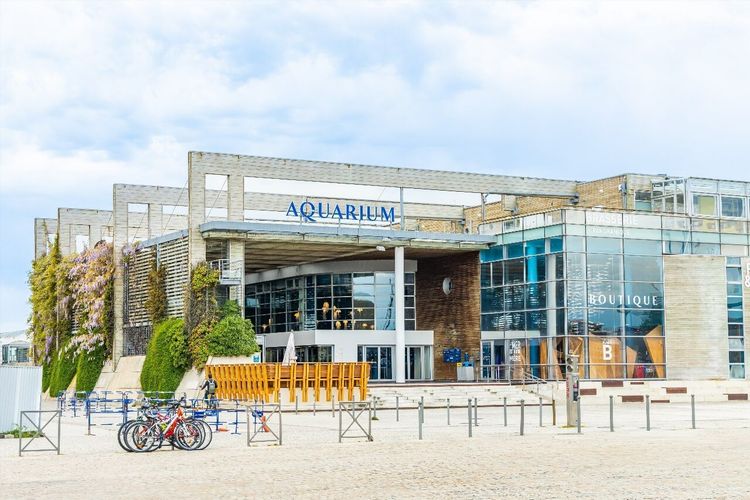
The Aquarium de La Rochelle holds a special place in the French landscape. Founded in 1990 in the heart of the Vieux-Port, it is one of the most visited in France with around 700,000 annual visitors. Its reputation rests on an exceptional collection of Atlantic species and a scenography that favours closeness over gigantism.
The star attraction is the 3-million-litre tropical tank, the largest in France accessible to the public in the form of a 360° tunnel. Reef sharks mingle with schools of golden trevally and leopard rays in a permanent ballet. The visit is organised around twenty or so themes, from mangrove to deep sea, making the route easy to follow even for the youngest visitors.
What makes La Rochelle unique: the aquarium is entirely privately run, with no public subsidy. To survive, it has had to innovate constantly. The permanent exhibition now incorporates interactive elements developed in-house: touch sensors on contact tanks, augmented reality in the 'depths' section. The result is a venue that reinvents itself regularly — each visit brings something new.
Prices: around €19.50 for adults (2026 prices), free for under-3s. The aquarium is open 365 days a year, including 25 December — useful information for year-end stays. Allow at least 2 hours for your visit, more with children.
La Rochelle lends itself perfectly to a full weekend. The ramparts, medieval towers and Wednesday market form a natural programme around the aquatic visit. The Ryo audio guide of La Rochelle takes you across 6 km and 26 listening points through the White City — Protestant, maritime, independently minded since the 16th century.
4. La Cité de la Mer: Cherbourg, Submarines and the Deep
La Cité de la Mer (Gare Maritime Transatlantique, 50100 Cherbourg-en-Cotentin, rated 4.5/5 on Google from 11,957 reviews) in Cherbourg-en-Cotentin is a special case in this ranking. It is not strictly an aquarium, but a museum complex centred on the conquest of the ocean depths, and it is impossible to overlook when surveying France's finest oceanic experiences.
Its main attraction is the Redoutable, France's first ballistic nuclear submarine, fully open for visits along its 128 metres of length. Stepping inside a submarine of the Force océanique stratégique and understanding life on board for a crew of 135 men during 70-day patrols is an experience you will find nowhere else in France.
The aquarium proper occupies the upper part of the building, housed in a superb Art Deco edifice built in 1933 as a transatlantic terminal. The abyssal tank presents deep-sea species — giant sea anemones, spider crabs, anglerfish — under lighting that evokes the darkness of the ocean floor. The section devoted to the wreck of the Titanic, which departed from Cherbourg on its maiden voyage in 1912, is particularly well documented.
Prices: approximately €20 per adult for full access (submarine + aquarium). Allow 3 hours. Cherbourg has no audio-guided tour of its own, but it is 1.5 hours from Caen, and the Ryo audio guide of Caen offers an immersion into the history of medieval Normandy and the Second World War that ideally complements a visit to La Cité de la Mer.
5. Le Grand Aquarium de Saint-Malo, Sharks and Shipwrecks
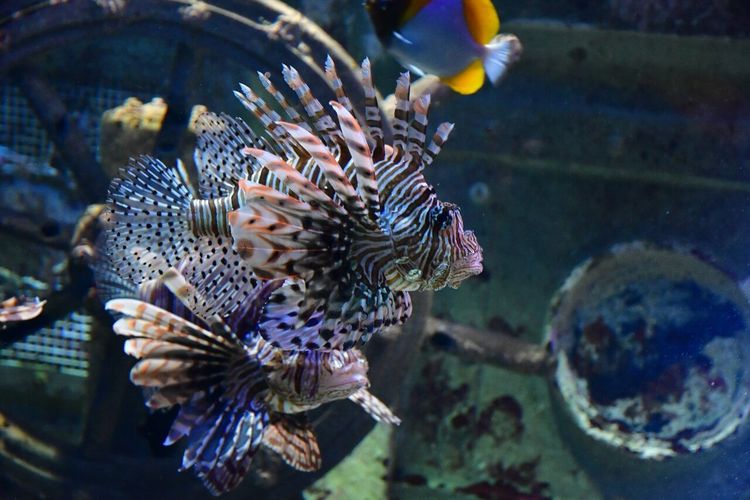
The Grand Aquarium de Saint-Malo (Avenue du Général Patton, 35400 Saint-Malo, rated 4.1/5 on Google from 20,807 reviews) plays the cinematic immersion card. Opened in 1996 and thoroughly renovated since, it offers a thematic journey through the world's seas and underwater shipwrecks — a narrative angle that gives it a distinct identity among the country's major establishments.
Its centrepiece is the Shark Ring, a circular 3-million-litre tank into which a transparent gondola slowly descends, allowing 360° observation of around ten species of sharks and rays gliding just centimetres away. The effect is spectacular — especially for children, and for adults who thought they knew what aquariums were about.
The route explores around fifty tanks spread across two levels, with clearly delineated thematic zones: the deep sea, the English Channel, tropical seas, and the freshwaters of the Amazon. The section dedicated to jellyfish is particularly well executed, with coloured lighting that transforms these translucent creatures into living sculptures.
Prices: around €16.50 for adults, €12 for children aged 4–12 (2026 prices). Open year-round. In high season (July–August), queues are long: arriving at opening time or booking online is essential.
Saint-Malo obviously deserves more than half a day. The corsair city, its ramparts, its islands accessible at low tide — all make for ideal stops before or after the aquarium. Ryo's audio walking tour of Saint-Malo offers 29 listening points in the old town and its surroundings to understand the history of the privateers and shipowners who built the city's fortune.
6. L'Océarium du Croisic, Underwater Immersion in Loire-Atlantique
The Océarium du Croisic (Avenue de Saint-Goustan, 44490 Le Croisic, rated 4.4/5 on Google from 12,374 reviews) is often underestimated in national rankings, which makes it one of the pleasant surprises of this guide. Located on the Croisic peninsula in Loire-Atlantique, it offers a collection of around 800 species in a more modest space than the northern giants, but the quality of its museography more than compensates for the size.
The house speciality: local North Atlantic species. Lobsters, conger eels, cuttlefish, seahorses and gilt-head bream are presented in faithful reconstructions of their natural habitats — Breton rocky bottoms, estuaries, seagrass meadows. For visitors weary of exotic sharks and tropical fish, it offers a refreshing perspective.
The 10-metre underwater tunnel and the touch pool, where children can handle rays and starfish, make it a perfect destination for families with young children. Prices: approximately €14 per adult, €10 per child. Best combined with a day on the Guérande peninsula; the visit takes 1.5 to 2 hours.
If you're in the area, Ryo's audio-guided tour of Nantes is 1h15 away by road. The city of the Machines de l'Île — 30 audio stops and 2.5 hours of walking — is a logical step in a Loire Valley stay.
7. Planet Ocean Montpellier, Spectacle and Science
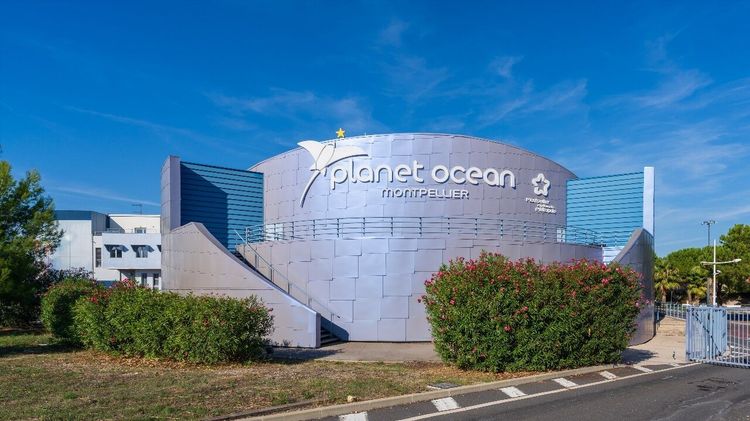
Planet Ocean (1 Promenade du Large, 34000 Montpellier, rated 4.4/5 on Google from 12,844 reviews) is the reference aquarium of the Mediterranean coastline. Opened in Montpellier in 2012, it held a unique position on the map of French aquariums: the only major aquarium on the Mediterranean façade reachable without a car from a regional metropolis.
Its vocation is clearly spectacular. The IMAX dome, the first installation of this kind in a French aquarium, screens immersive films on coral reefs and cetacean migrations. The central tank of 2 million litres houses sharks, rays and barracudas in a tropical reef reconstruction. The overall experience targets families and casual visitors rather than dedicated marine science enthusiasts.
Prices: around €21 per adult for full access (aquarium + IMAX dome). The aquarium alone is slightly cheaper. Note: Planet Ocean closes for certain periods of the year for maintenance — check dates before planning your visit.
Montpellier is a dynamic university city that merits several days. The Ryo audio guide of Montpellier covers the Écusson, the medieval historic centre, and the grand Haussmann-era boulevards that transformed the city in the 19th century, with 19 listening points in 1.5 hours.
8. Le Seaquarium du Grau-du-Roi, the Mediterranean on a Grand Scale
The Seaquarium du Grau-du-Roi (Avenue du Palais de la Mer, 30240 Le Grau-du-Roi, rated 4.3/5 on Google from 20,594 reviews) (Gard) is one of the most under-the-radar aquariums in this ranking, and one of the most endearing. Located in a seaside resort on the Languedoc coastline, it focuses almost exclusively on Mediterranean species, with a scientific honesty that sets it apart from more commercially oriented aquariums.
The collection comprises around 250 species — groupers, sea bass, octopuses, bottom-dwelling rays — presented in naturally lit tanks that replicate the light conditions of the coastal Mediterranean. The Mediterranean shark tank, featuring thresher sharks, catsharks and smoothhounds, is a useful reminder that the Big Blue is not populated solely by harmless fish.
Prices: approximately €13 per adult, €9 per child. Open April to November. Ideal as a companion to a beach day or a stop during a Languedoc stay. Allow 1.5 to 2 hours for the visit.
If you continue eastward, the city of Nîmes, 30 km away, offers a striking contrast: intact Roman monuments, bullfighting culture, and the Ryo audio guide of Nîmes to help you understand its remarkable heritage.
9. L'Aquarium de Lyon, a Surprising Find in the Heart of the Alps
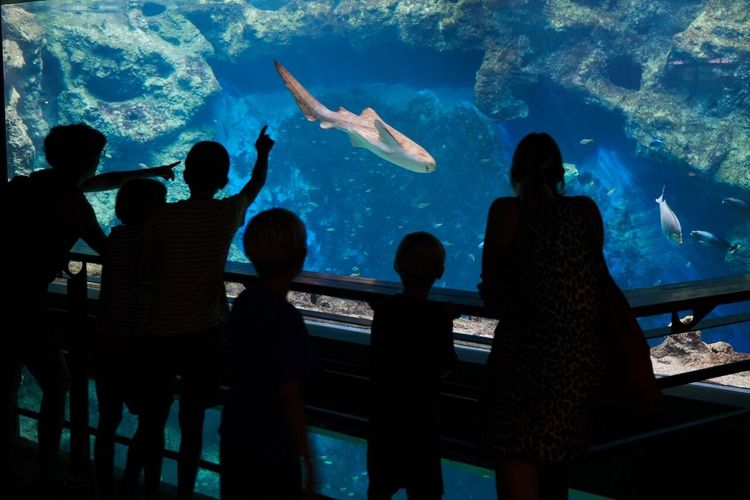
The Aquarium de Lyon (31 Rue du Professor Mathieu, 69310 Pierre-Bénite, rated 3.6/5 on Google from 7,308 reviews) may be the surprise of this guide. In a landlocked city, 300 kilometres from the nearest sea, who would expect a worthwhile aquarium? And yet: with around fifty tanks spread across several levels and nearly 300 species of both fresh and salt water, the Pierre-Bénite establishment boasts one of the richest freshwater collections in France.
Lyon's distinctive focus is precisely this: fish from the world's great rivers — the Amazon, Mekong, Congo and Rhône. Piranhas, 2-metre arapaimas, giant catfish and local Alpine species coexist in a museography that celebrates freshwater fauna alongside tropical marine tanks. An approach that few aquariums have adopted with such consistency.
Prices: €14 per adult, €10 per child aged 4 to 14. Allow 2 hours. If you're in Lyon for a longer weekend, Ryo's audio-guided tour of Lyon takes you across 7.9 km and 26 listening points through the two hills and the traboules of the Presqu'île.
10. L'Aquarium du Limousin: Limoges, the Unexpected
The Aquarium du Limousin (1 Boulevard Gambetta, 87000 Limoges, rated 4.5/5 on Google from 2,390 reviews) in Limoges is an absolute outsider in this overview. Far from any coastline, established since 1979 in a town-centre building, it has survived for fifty years thanks to a freshwater collection entirely dedicated to European and worldwide river species.
Its 20 tanks present trout, barbel, pike, perch and lamprey in reconstructions of river biotopes. A more exotic section hosts piranhas, discus and axolotls — those Mexican neotenic salamanders that remain in their larval state throughout their lives. The aquarium is small, the visit lasting 45 minutes to 1 hour, but the modest admission price (€7 per adult) and its intimate atmosphere make it a charming address, especially for fans of non-marine aquatic wildlife.
Limoges is the capital of French porcelain, and the Ryo audio guide of Limoges offers 17 listening points in the historic centre to understand the story of a city whose name is synonymous with exceptional craftsmanship.
11. L'Aquarium Tropical de Paris, the Porte Dorée
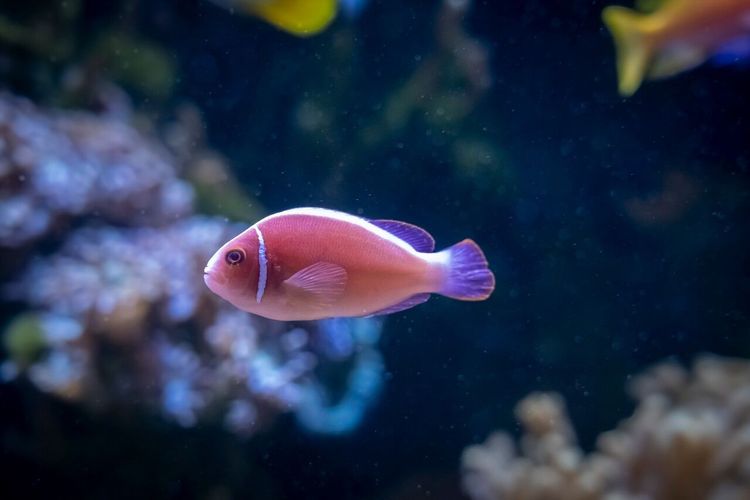
The Aquarium Tropical de la Porte Dorée (293 Avenue Daumesnil, 75012 Paris, rated 4.4/5 on Google from 4,306 reviews) in Paris is probably the oldest in this guide: inaugurated in 1931 for the International Colonial Exhibition, it still occupies the basement of the Palais de la Porte Dorée, today converted into a museum of immigration history. The Art Deco building is itself a classified historic monument.
The collection focuses on fauna from tropical regions — Amazonia, equatorial Africa, Southeast Asia — with around fifty tanks presenting piranhas, clownfish, moray eels and coral reef species. The most remarkable feature: a 400,000-litre circular tank at the centre of the building, populated by reef sharks and sea turtles, surrounded by a period neo-colonial fresco that creates a visually arresting contrast well worth decoding.
Admission is free on the first Sunday of the month. Standard price: €7 per adult, €5 reduced. Accessible from Porte Dorée metro station (line 8). Allow 1.5 hours combining the aquarium and the palace. If Paris is your base, Ryo's audio-guided tours of Paris come in several themes — from Montmartre to Notre-Dame — to explore the capital between provincial excursions.
12. Le Museum-Aquarium de Nancy
The Museum-Aquarium de Nancy (34 Rue Sainte-Catherine, 54000 Nancy, rated 4.5/5 on Google from 4,086 reviews) combines two identities: it is both a natural history museum and a freshwater aquarium. The aquatic collection — around fifty tanks presenting fish from French and African rivers — is integrated into a broader museum complex devoted to zoology, palaeontology and mineralogy.
What makes the place particularly interesting: its taxidermied specimens of rare marine species collected in the 19th century, which offer a historical perspective on French sea fauna before the collapse of certain species' populations. A worthwhile visit for the curious, school-age children and natural history enthusiasts. Admission: €3 to €5. Nancy is a city whose architecture is listed as a UNESCO World Heritage Site; the Place Stanislas is one of the most beautiful squares in Europe. The Ryo audio guide of Nancy takes you across 4 km and 27 listening points through the old ducal city.
How to Choose and Plan Your Visit: Practical Tips
Choosing between these twelve aquariums depends on your profile, your budget and your geographic location. Here are a few criteria to help you narrow down your decision.
For families with young children (under 8), favour venues with touch pools and shorter routes: the Océarium du Croisic, the Aquarium de La Rochelle and the Grand Aquarium de Saint-Malo all offer guided handling zones that are particularly well suited. Avoid July–August visits without advance booking, as queues can discourage the youngest visitors.
For marine science enthusiasts, Océanopolis and Nausicaá are the two unmissable references. Both venues maintain close ties with research laboratories and put on high-level temporary exhibitions. Nausicaá also runs a diving programme reserved for certified divers, allowing you to swim with the sharks — book weeks in advance.
For tight budgets, the Aquarium Tropical de Paris (free on the first Sunday of the month), the Aquarium du Limousin (€7) and the Museum-Aquarium de Nancy (€3 to €5) are very accessible options. Conversely, Nausicaá, Océanopolis and Planet Ocean are the priciest, but justify their admission with the richness of their content.
For passing visitors (less than 2 hours available), the Aquarium du Limousin in Limoges, the Seaquarium du Grau-du-Roi and the Museum-Aquarium de Nancy are the only ones that can be fully appreciated in under an hour and a half. The large aquariums (Nausicaá, Océanopolis, La Rochelle) require a full half-day.
A note on seasonality: most aquariums are open year-round. Nausicaá and the Aquarium de La Rochelle are explicitly open 365 days a year. The Seaquarium du Grau-du-Roi closes between November and March. Planet Ocean may close periodically for maintenance — check the official website before any trip.
Combining aquarium and city: none of these venues merit a standalone trip. Each host city offers enough heritage or natural content to justify an extra night. Saint-Malo and its ramparts, Brest and its citadel, La Rochelle and its Vieux-Port, Nancy and the Place Stanislas — all are reasons to extend your stay. The Ryo app covers a large number of these cities with offline audio-guided routes.



FAQ
What is the largest aquarium in France?
Nausicaá in Boulogne-sur-Mer is the largest aquarium in France, and in Europe. With 10,000 m² of exhibition space, 58,000 animals and 69 tanks, it is also one of the three largest aquariums in the world. It was considerably expanded during its 2018 renovation, which doubled its original surface area.
What is the largest aquarium in Europe?
It is also Nausicaá in Boulogne-sur-Mer that has held this title since its 2018 extension. The Centre National de la Mer surpasses in size the other major European aquariums, including the Oceanarium in Lisbon and the Aquarium in Barcelona.
Is the Monaco Aquarium located in France?
No. The Musée Océanographique de Monaco is located in the Principality of Monaco, which is an independent state and not a member of the European Union. It is not included in this ranking of French aquariums. It is, however, accessible from Nice by train (25 minutes) and is well worth a visit for its architecture and historic collection.
Which French aquarium is best for children?
Several venues are particularly family-friendly: the Grand Aquarium de Saint-Malo (a descending gondola in the shark tank), the Aquarium de La Rochelle (interactive trail, touch pools) and the Océarium du Croisic (local species, starfish handling). For the very largest aquariums with the most spectacular shows, Nausicaá remains the benchmark.
How much does admission cost at major French aquariums?
Prices vary significantly. Premium aquariums (Nausicaá, Océanopolis, Planet Ocean) charge between €20 and €27 per adult. Mid-range venues (La Rochelle, Saint-Malo, Grand Aquarium du Croisic) range from €13 to €19. Smaller aquariums (Limoges, Nancy, Seaquarium) display prices between €3 and €13. The Aquarium Tropical de Paris is free on the first Sunday of each month.
Can you visit several aquariums on the same trip?
Yes, several geographic groupings are possible. Brittany + Normandy: Océanopolis (Brest), Grand Aquarium de Saint-Malo, Cité de la Mer (Cherbourg) — a very comprehensive 3-day circuit. Atlantic Coast: Aquarium de La Rochelle and Océarium du Croisic, 3 hours apart by road. Languedoc: Planet Ocean (Montpellier) and Seaquarium (Grau-du-Roi), 45 minutes from each other.
Conclusion
From the hammerhead sharks of Boulogne to the piranhas of Lyon, from the penguins of Brest to the nuclear submarine of Cherbourg, France's largest aquariums form a network of complementary experiences rather than a simple ranking to follow from first to last. Each venue has a strong identity and its own perspective on the oceans and aquatic life.
If you're planning a stay in one of these cities, the Ryo app offers offline audio-guided routes to extend your discovery well beyond the tanks: from Brest to Nantes, the Atlantic and Loire coastlines will hold no more secrets for you.