© Shutterstock
 Votre guide Ryo
Visiting Saint-Malo in 3 Days: Complete Itinerary Between Ramparts, Islands, and the Open Sea (2026)
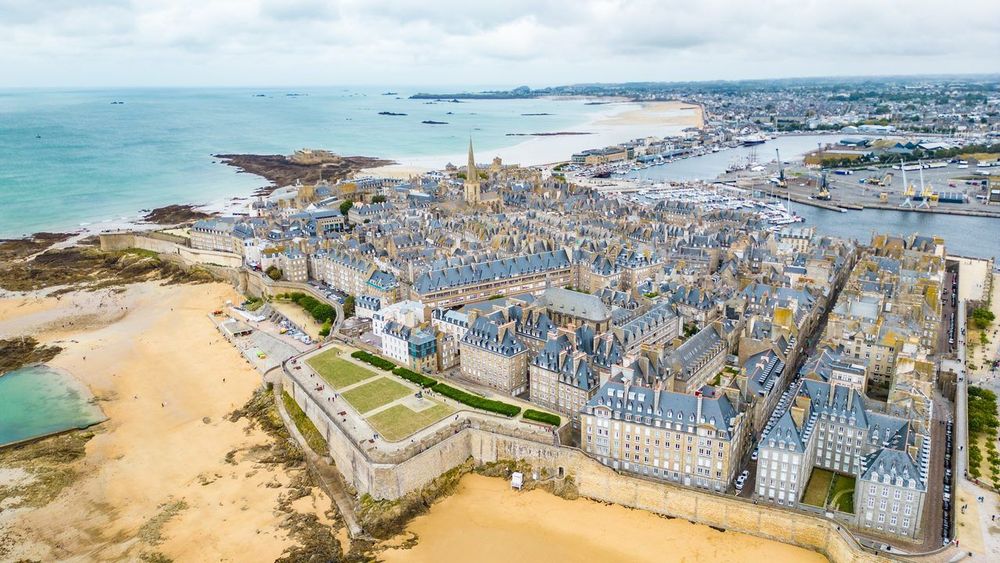
At low tide, the sea retreats several kilometers from Saint-Malo, revealing a firm sand path leading to two fortified islands standing before the ramparts like twin granite sentinels. Visiting Saint-Malo in 3 days means learning to read the tide calendar before even planning your itinerary: six hours later, that same path has vanished beneath nearly thirteen meters of water, one of the largest tidal ranges in Europe. This constant shift between land and sea shapes an entire art of exploring the corsair city, and it is exactly what our Ryo audio-guided tour À l'abordage is designed to do — work with the tides rather than against them.
Three days allow you to unfold this program without rushing: one day for the intra-muros old town and its 1.8-kilometer rampart walk, one day for the islands of Grand Bé and Petit Bé, accessible on foot according to the tide schedule, and a final day for Saint-Servan, the strange sculptures of Rothéneuf, and a boat trip to the île de Cézembre. In between, an aquarium filled with sharks and phosphorescent jellyfish, beaches that change completely every six hours, and excursions less than an hour away to Dinard, Dinan, or Mont-Saint-Michel. Plenty to fill three full days without ever retracing your steps.
Why Visit Saint-Malo, the Corsair City
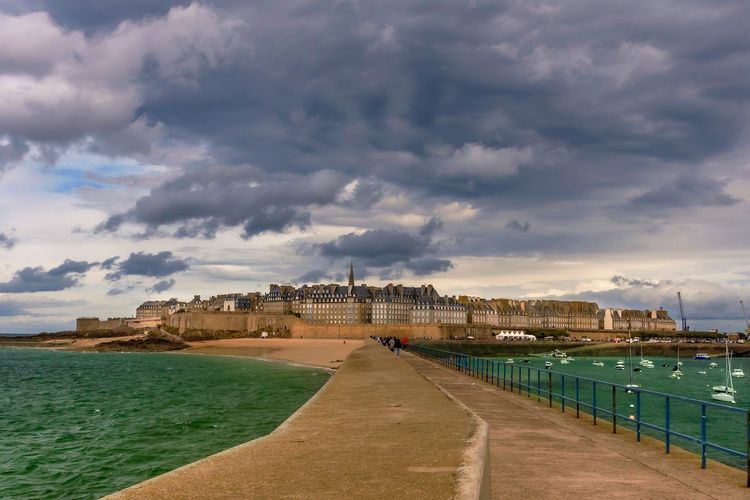
Saint-Malo owes its nickname to a handful of shipowners who, between the 16th and 18th centuries, obtained letters of marque from the king: the legal right to attack and plunder enemy vessels. Robert Surcouf and René Duguay-Trouin are the most famous of these privateers, whose fortunes financed a good part of the grand townhouses you will come across in the walled city. This privateering economy, combined with maritime trade to Newfoundland and the Indies, made Saint-Malo a wealthy and fortified port long before Vauban came to reinforce its defenses at the end of the 17th century.
Yet the city you visit today is almost entirely rebuilt. In August 1944, the fighting during the Liberation devastated Intra-Muros: the walled city emerged from the siege roughly 80% destroyed, reduced to a field of rubble from which only the ramparts, the castle, and a few wall sections survived. Rather than modernizing the layout, architect Louis Arretche chose to rebuild to the original design, using granite from the same local quarries and the original slate roofs. The construction lasted about fifteen years. The result: the alleyways are as old as a 1960s building, but their layout and facades faithfully reproduce the 18th-century city.
This dual history — of privateering and of reconstruction — explains why Saint-Malo deserves more than a brief afternoon stop. A quick visit allows you to tick off the ramparts and the cathedral. Three days leave time to add the islands, the beaches according to the tides, and at least one excursion into the hinterland, without ever turning the stay into a race against the clock. It is also the length that gives you the luxury of rescheduling a visit depending on the Breton sky, which can change three times in the same day.
Day 1: Intra-Muros, Ramparts, and Historic Monuments
The Rampart Walk and the Bastions
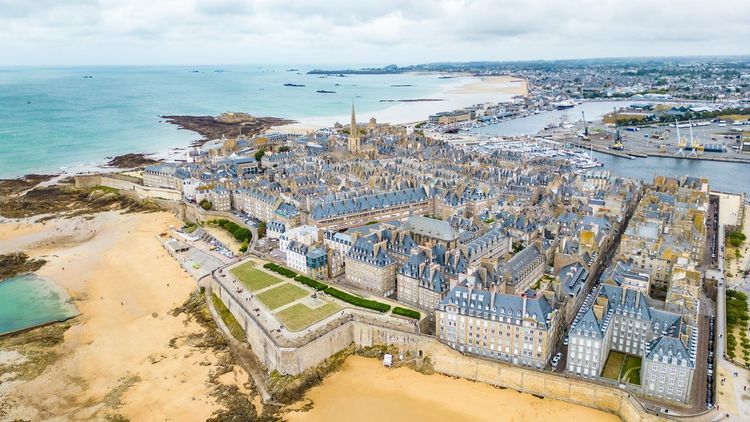
Start with the full circuit of the Saint-Malo ramparts, a 1.8-kilometer wall walk that completely encircles the walled city. Access is free year-round via several staircases dotted around the town: the Porte Saint-Vincent, the Grande Porte, and the Porte Saint-Thomas. Allow about an hour of leisurely walking, longer if you stop frequently for photos. The promenade follows a history of fortifications that began in the 12th century and was completed through the 18th, with several bastions punctuating the route: the Bastion de la Reine, the Bastion de la Hollande, and the Bastion Saint-Philippe each offer a different angle over the bay and the slate rooftops of the city.
Two practical details nobody mentions before you go up: the wall walk has neither continuous railings on the town side nor any shelter, making it a genuinely bracing experience on westerly wind days, and the only access points are stone staircases — not suitable for pushchairs. Going counterclockwise, starting from the Porte Saint-Vincent, saves the best for last: the north-facing façade overlooking the islands.
You will also pass the Tour Bidouane, a former horseshoe-shaped powder magazine built onto the northern rampart, and the Poterne d'Estrées, a small discreet passage that once led directly down to the beach. If you can only choose one moment of the day, make it late afternoon near the Tour Bidouane and the statue of Surcouf: the raking light over the bay and the islands at that hour is worth the trip on its own. To follow this walk without having to locate every landmark on a paper map, Ryo's audio-guided tour of Saint-Malo, À l'abordage features 30 audio stops across 6.6 kilometers of route, roughly 2 hours and 45 minutes of listening synced to this path.
Saint-Vincent Cathedral, the Castle, and the Corsair's House
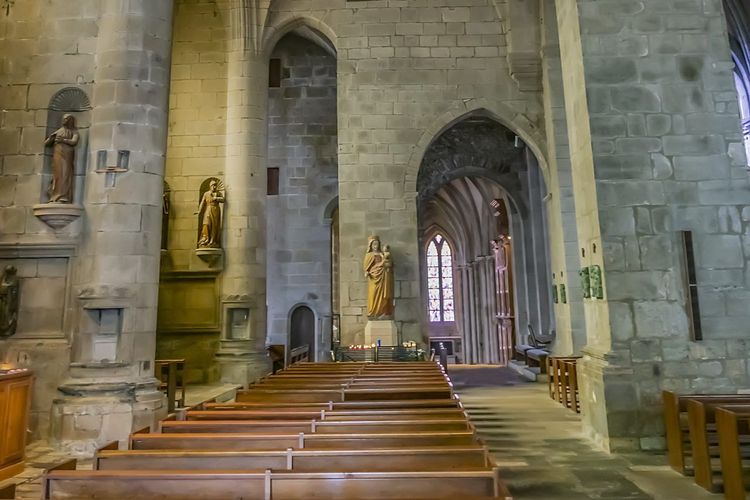
Heading back toward the center, Saint-Vincent-de-Saragosse Cathedral deserves a pause. Heavily damaged in 1944, it lost its spire and part of its nave before being gradually restored through to the 1970s. The interior blends a 12th-century Romanesque nave, a Gothic choir, and contemporary stained-glass windows whose reds and blues deliberately contrast with the ancient stone. It houses the tomb of Jacques Cartier, the Malouin navigator who sailed up the Saint Lawrence River in the 16th century, as well as a stone slab commemorating the blessing he received here before departing for Canada. Admission is free.
Nearby, the Château de la Duchesse Anne retains its massive keep and its tower nicknamed Quic-en-Groigne, named after the retort launched by Duchess Anne of Brittany at the Malouins who contested its construction. One wing houses the town hall, proof that the city has always coexisted with its defenses rather than relegating them to the outskirts, and another wing houses the city history museum, which tells the story of privateering and cod fishing off Newfoundland through ship models and maritime objects. This museum is undergoing a long-running renovation linked to the future Saint-Malo museum complex: check its opening status with the tourist office before building your morning around it.
To understand the daily life of these merchants enriched by privateering, step inside the Demeure de Corsaire, the Hôtel Magon d'Asfeld, an 18th-century shipowner's house open for guided visits. You descend into the vaulted cellars where goods were stored, see the state rooms and the owner's private apartment: it is the only place in the city where you truly grasp what privateering brought to those who funded it.
Place Chateaubriand and the Streets of Intra-Muros
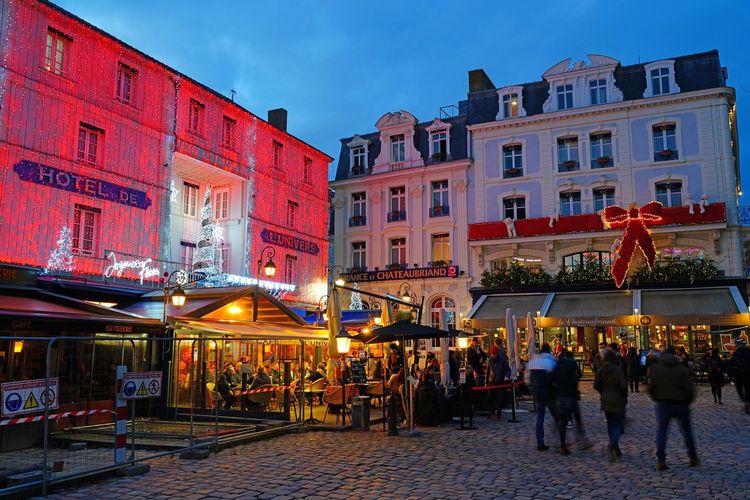
The Place Chateaubriand, just behind the Porte Saint-Vincent, is lined with café terraces and serves as an easy reference point if you lose your bearings. François-René de Chateaubriand was born in 1768 a few alleyways away, in the Hôtel de la Gicquelais, a shipowner's house now occupied by a private establishment: a plaque on the façade marks the birthplace, but it is not open to visitors. He recalled in his memoirs a childhood spent between the ramparts and the sound of the sea, and his name will follow you throughout your stay — here, on the Grand Bé the following day, and at the Château de Combourg if you venture into the hinterland. From the square, wander without a fixed plan through the pedestrian streets: the Rue Saint-Vincent, the main shopping thoroughfare, the Rue de Dinan with its restaurants, and the side lanes that plunge between grey granite facades and slate-blue rooftops.
Sooner or later you will pass under the Grande Porte, the historic gateway to the city with its two 15th-century machicolated towers, which opens directly onto the harbor and the fishing boats. It is also the starting point, the following day, for the crossing to the islands of Grand Bé and Petit Bé. End the day on the Môle des Noires, the long jetty that closes off the harbor: it is the best vantage point to watch the walled city light up against the night.
Day 2: Fort National, Île du Grand Bé, and Petit Bé
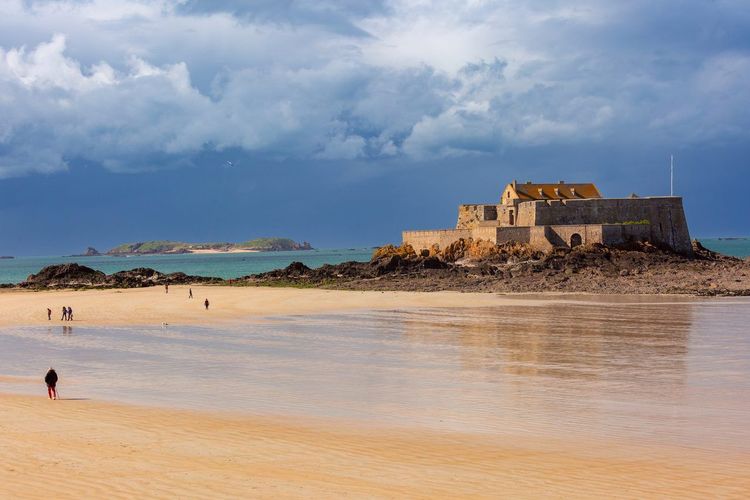
This second day is built the other way around: it is not you who sets the schedule, it is the tide. The three sites of the day — Fort National, Grand Bé, and Petit Bé — can only be reached on foot across exposed sand, within a window that opens and closes twice a day. Check the tide table the evening before, note the time of low water, and build your day around it, always keeping a one-hour margin before the water returns.
Fort National, the Fortress Accessible at Low Tide
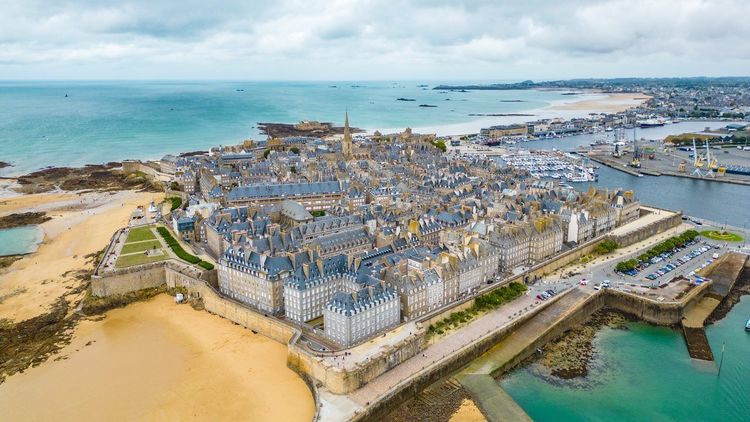
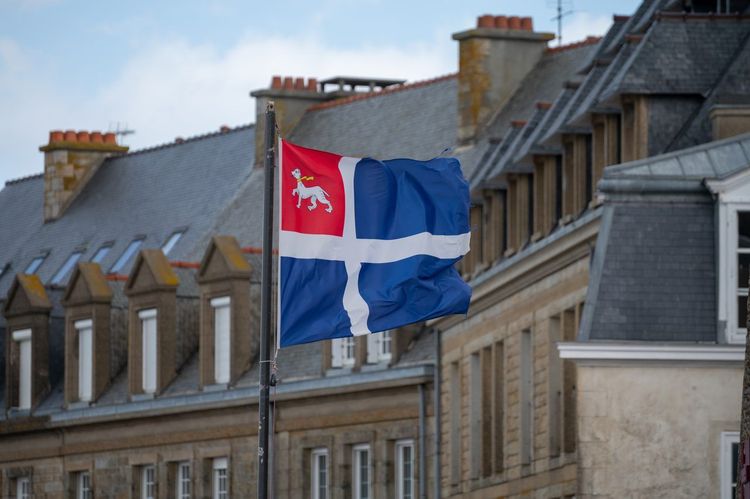
The Fort National, built in 1689 to Vauban's plans by engineer Siméon Garangeau to protect the port and anchorage, stands on a rocky islet facing the ramparts. It can only be reached at low tide, via a ten-minute walk across the sand from the Plage de l'Éventail. The visit is exclusively guided, with the guide opening the dungeons, the cistern, and the well carved into the rock, and recounting the famous duel of the Chevalier de Kéranguen or the siege of 1693. The flag hoisted at the top of the fort signals opening days, governed by both the tide and the season, mainly from April to September and during school holidays. Expect a small entrance fee of a few euros per adult, half price for children, payable in cash at the fort entrance.
Île du Grand Bé and Chateaubriand's Tomb
The Île du Grand Bé is also crossed at low tide, in a ten-minute walk from the Plage de Bon-Secours, along a causeway of sand and rocks that can be slippery. Access is free. It is home to Chateaubriand's tomb, a simple granite slab topped with a cross, bearing no name or date, exactly as the writer had requested in his will. He wanted to hear only the wind and the sea from his final resting place, and the chosen position, facing the open sea and turned westward, keeps that promise.
A piece of advice that resurfaces every season from local rescue workers: do not linger on the island past the time posted on the tide signs at the entrance to the causeway. Visitors regularly find themselves stranded, forced to wait several hours for the sea to recede or to call for help. Climb the rocky mound at the center of the island, where the remains of a German bunker still stand, for a full view over the walled city, then head back in good time.
Île du Petit Bé and Its Fort
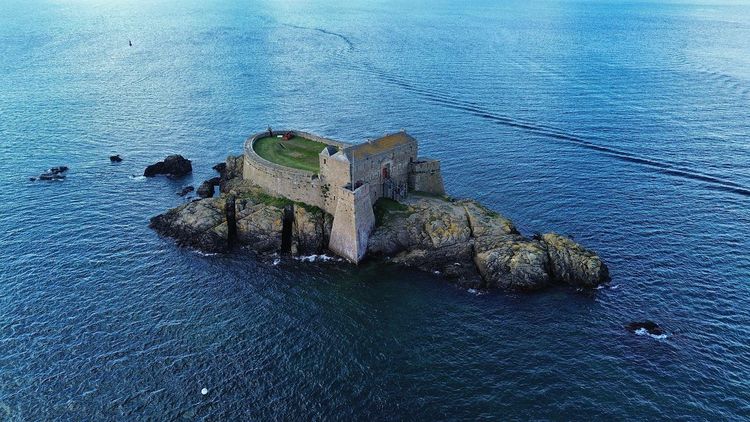
To the west of Grand Bé, the Île du Petit Bé (Île du Petit Bé, 35400 Saint-Malo, rated 4.5/5 on Google based on 336 reviews) is also reachable on foot, along a narrower, rockier path that is generally far less crowded. The fort occupying it, built at the end of the 17th century as part of the same defensive system as the Fort National, had fallen into ruin before being restored from the early 2000s onward by an enthusiast and a local association. The guided visit explains the logic of interlocking fire between the bay's forts and ends on the artillery terrace. The view on the way back toward the ramparts, with the walled city cut out low against the water, is completely different from the one offered by Grand Bé and is well worth spending the end of the morning here.
Keep a safety margin on both crossings: at high tidal coefficients, the sea rises at the pace of a brisk walk and can cut off access to both islands almost simultaneously, with no emergency walkway between them. If the day's tide window falls at an inconvenient time, swap the order of your program and save the islands for the following morning, simply moving the Saint-Servan day forward.
Day 3: Saint-Servan, Rothéneuf, and Boat Trips
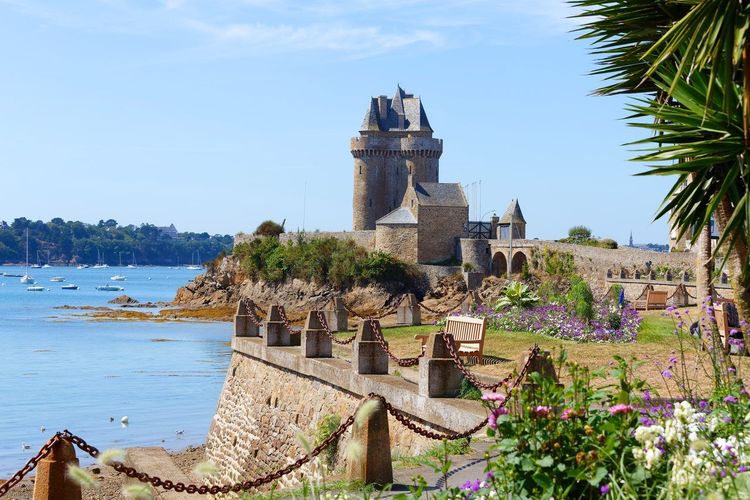
Tour Solidor and the Cité d'Alet in Saint-Servan
About a twenty-minute walk from Intra-Muros, the district of Saint-Servan feels completely different: less touristy, more residential, with a more everyday relationship to the sea, between boatyards and moored vessels. The Tour Solidor, in reality three towers joined together and linked by curtain walls, was built at the end of the 14th century by Duke Jean IV of Brittany to monitor — and above all tax — traffic on the Rance estuary. It long housed the international Cape Horners museum dedicated to sailors who rounded Cape Horn; its opening conditions have varied since, so check before climbing the 104 spiral steps. We cover its full history in our article on the Tour Solidor.
Just behind it, the headland of the Cité d'Alet layers three eras on a single promontory: the remains of the Gallo-Roman town that preceded Saint-Malo, a ruined early medieval cathedral, and the bunkers of the Atlantic Wall, one of which houses a memorial dedicated to the battle of 1944. The path that loops around it, a circuit of about two kilometers, offers one of the finest views over the walled city, Dinard, and the mouth of the Rance, and remains surprisingly little visited. Our dedicated article on the Cité d'Alet explores these different historical layers.
Rothéneuf and the Sculptures of Abbé Fouré
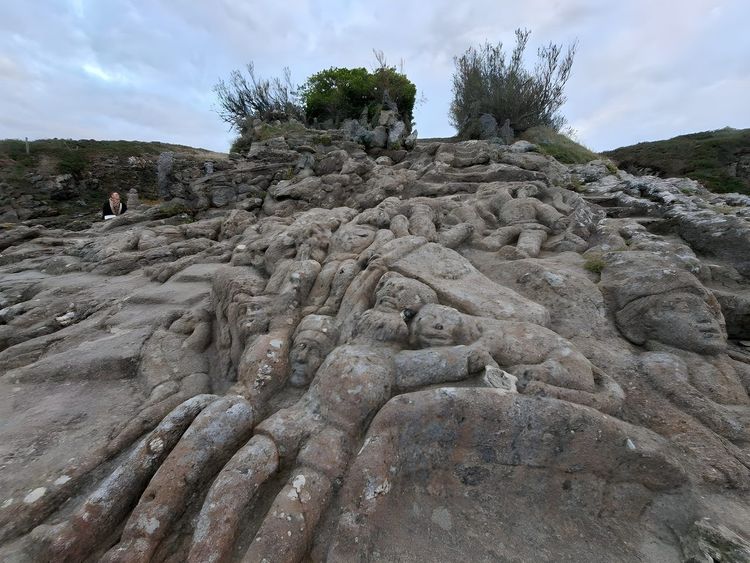
To the east, in the district of Rothéneuf, several hundred figures carved directly into the cliff face tell a local legend of a family of pirates turned to stone by divine wrath. The creator of this work, Abbé Fouré, a priest who became deaf and mute following a stroke, carved these rocks between 1894 and the early 1900s, alone, with a chisel, facing the sea. The site is privately owned, access is paid and seasonal, and the visit also depends on the tide: at low tide, you can approach the lowest carved groups, invisible at other times. Check the opening days before crossing town, as they change from one season to the next. Our article on the rochers sculptés de Rothéneuf details the best time slot for the visit.
Bay Cruise and Île de Cézembre
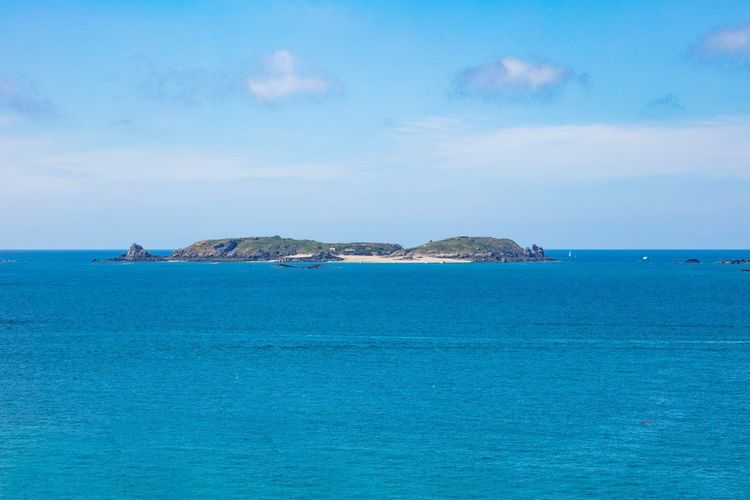
End the day on the water, because it is from there that the walled city truly comes into its own. Several companies offer bay trips departing from the Gare Maritime du Naye, some aboard the Étoile du Roy, a replica 18th-century privateer frigate moored at Saint-Malo that sets sail in season for two-to-three-hour voyages. Other services head to the Île de Cézembre (Baie de Saint-Malo, 35400 Saint-Malo, rated 4.7/5 on Google based on 49 reviews), a twenty-minute boat ride away, open to the public in summer only, or further west toward the Archipel des Ébihens, off Saint-Jacut-de-la-Mer: a handful of islets connected at low tide by pale sandbars, with a Vauban tower on the high point and translucent water that always surprises first-time visitors. Allow a full half day for this last option, including the crossing.
Cézembre bears a scar that explains its strangeness: heavily bombed in 1944 when it served as a German artillery position, the island remains riddled with unexploded ordnance. Only its south beach, facing full sun and fringed with turquoise water that surprises in Brittany, is accessible; the rest of the island remains off-limits and the path is signposted accordingly. A seasonal restaurant serves seafood with your feet in the sand. If you prefer to stay on land, a stroll along the harbor at sunset, among the sailing boats and the last fishing vessels coming in, closes the day on an equally Malouin note.
The Best Beaches in Saint-Malo
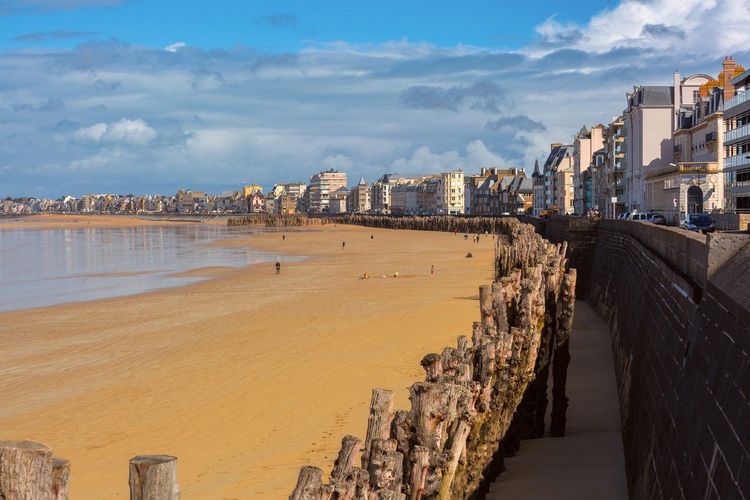
Saint-Malo lines up nearly ten kilometers of beaches that are all very different from one another, from the natural seawater pool backed against the ramparts to the wild coves around Rothéneuf. Our Saint-Malo beach guide covers them all with their best tide windows; here are the must-sees by district.
Intra-Muros Beaches: Bon-Secours and Le Môle
Backed against the ramparts, the Plage de Bon-Secours conceals a seawater pool carved into the rock and enclosed by a low wall, filled at high tide and remaining swimmable even when the sea retreats several hundred meters. Its concrete diving board, planted in the middle of the basin, is one of the city's most recognizable images. It is the most central beach, and therefore the most crowded in August, but also the one that offers the best view of the walled city from the water, and the departure point of the causeway to Grand Bé. A little further along, the Plage du Môle, smaller and sheltered by the jetty, draws fewer visitors while remaining just a five-minute walk from the ramparts.
Grande Plage du Sillon, Plage de l'Éventail, and Paramé
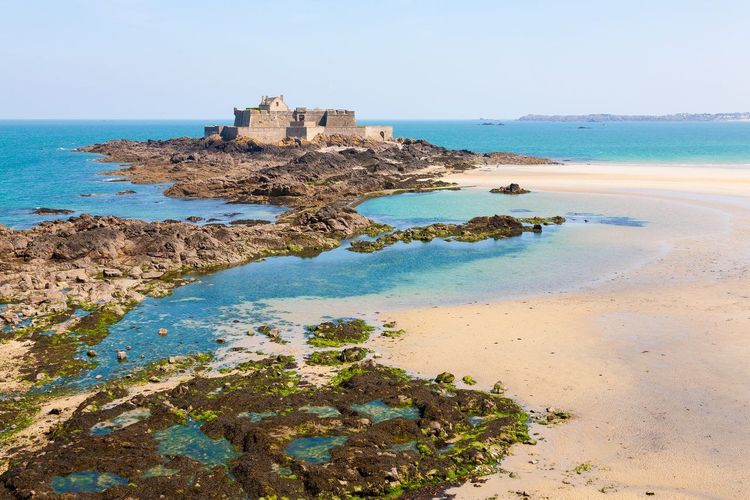
At the foot of the northern ramparts, the Plage de l'Éventail opens the long strip of sand stretching eastward. It is the departure point for the crossing to the Fort National, whose silhouette looms directly above it, making it both a practical and highly photogenic beach in the late afternoon.
It continues into the Grande Plage du Sillon (Chaussée du Sillon, 35400 Saint-Malo, rated 4.8/5 on Google based on 636 reviews), more than two kilometers of fine sand lined by a seafront promenade and studded with rows of oak piles, the breakwaters planted in the 19th century to break the swell and hold the sand in place. This is the beach to choose for a proper swim, for land sailing, or for a kitesurfing session at low tide. It borders Paramé, a former seaside resort that became a district of Saint-Malo, whose Belle Époque villas can be read from the promenade. At its far end, the Digue de Rochebonne extends the walk to the more family-friendly beaches of Courtoisville and du Pont.
Saint-Servan Beaches and Rothéneuf Coves
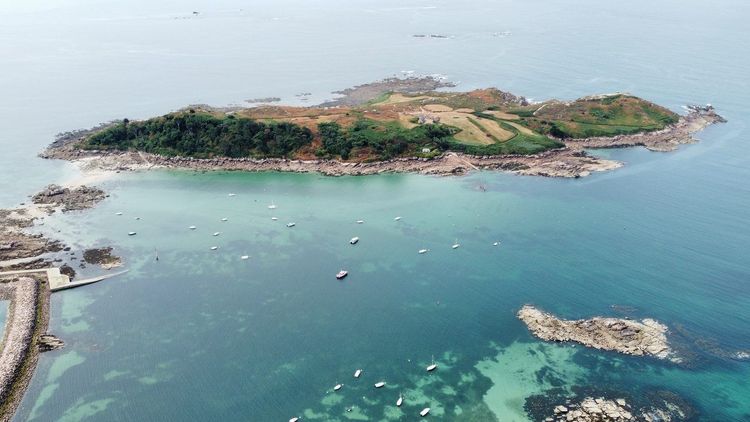
On the Saint-Servan side, the Plage des Bas-Sablons, sheltered in the Rance estuary behind the marina, offers calmer water and a gentle slope appreciated by families with young children. Its neighbor, the Plage du Val, more secluded, opens up considerably at low tide. On the opposite side of the city, near Rothéneuf and Saint-Ideuc, small rocky coves such as Le Nicet or Le Val require a short walk along the coastal path but reward you with their tranquility, especially outside July and August.
One practical point to know before planning your swims: the very large tidal range here radically changes the appearance of the beaches within hours. A vast beach at low tide can shrink to a narrow strip of sand at high tide, and on days of high tidal coefficients combined with a depression, waves wash over the Sillon seawall, which is then closed to both traffic and pedestrians. Always check the day's tide times and coefficient before settling in, and watch the flags at the lifeguard stations, which are active in July and August on the Sillon and at Bon-Secours.
Activities and Leisure in Saint-Malo Beyond the Obvious
Between days of walking, Saint-Malo also offers a few activities that stray from the historical trail. Our article on the best things to do in Saint-Malo covers all the options; here are the ones that best complement a three-day stay.
Grand Aquarium, Micro Zoo, and the Tourist Train
About ten minutes by car or bus from the center, the Grand Aquarium de Saint-Malo features around fifty tanks, including a sea ring where sharks and rays circle around visitors, a touch pool where you can handle rays, and the Nautibus, a small submarine that dives into a shipwreck setting. Allow two to three hours and expect a full-price ticket of around twenty euros: it is the reliable choice for families and rainy mornings. Right next door, the Micro Zoo takes the opposite approach by showcasing tiny animals — insects, arachnids, and small reptiles — along a short trail suited to young children.
If you are traveling with children tired out by the previous days' walking, the tourist train departing from the Porte Saint-Vincent, which runs along the Sillon and through the main districts, offers a commented overview of the city in around thirty minutes, with no effort required. Older children will prefer a land sailing initiation on the Sillon or a kayak trip to the bay islets, two activities offered by several Saint-Malo sailing clubs from April to October.
Thalassotherapy and Wellness at the Thermes Marins
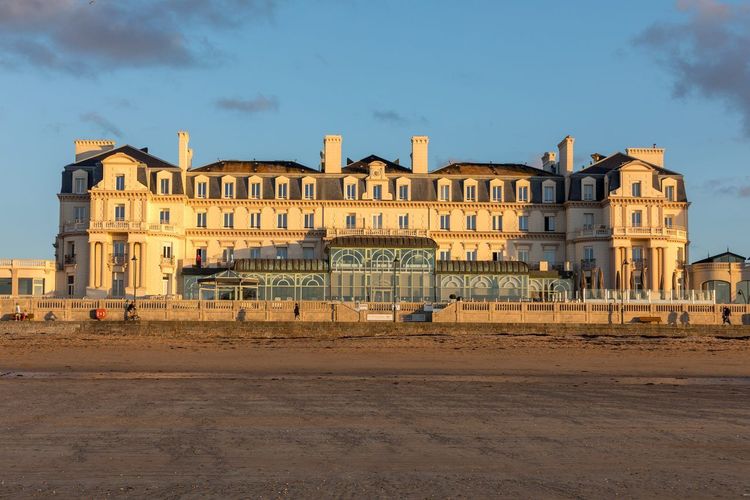
Saint-Malo is also a historic capital of thalassotherapy, born from the same idea as 19th-century sea bathing: healing through heated seawater. The Thermes Marins de Saint-Malo (Grande Plage du Sillon, 35400 Saint-Malo, rated 4.4/5 on Google based on 2,780 reviews), located on the seafront on the Grande Plage du Sillon, offer day-access packages including an aquatonic circuit, heated seawater pools, a hammam, and targeted treatments. Book in advance, especially on rainy days: it is the first reflex of all visitors when the sky closes in, and time slots fill up quickly during school holidays.
What to Do Around Saint-Malo
Dinard and Dinan, Two Must-Sees Within an Hour
On the other side of the estuary, Dinard is reachable in ten minutes by the sea bus that crosses the Rance from the ferry terminal, a seasonal service far more pleasant than the car detour via the dam. The resort has a distinctly British air, inherited from the English aristocracy who frequented it from the 19th century onward: Belle Époque villas stepping down along the Promenade du Clair de Lune, the Plage de l'Écluse framed by blue-and-white striped beach tents, and a British film festival that animates late September.
About thirty minutes by car, Dinan offers an entirely different setting: a medieval town perched 75 meters above the Rance, ringed by nearly three kilometers of ramparts, with its castle, its Tour de l'Horloge, and above all the Rue du Jerzual, a steeply cobbled street lined with craftsmen's workshops that tumbles down to the river port. The viaduct spanning the valley gives the best overall photograph. Allow half a day to enjoy it without rushing, and note that in season a boat connects Dinan to Saint-Malo along the Rance, a three-hour descent punctuated by the passage through the Châtelier lock.
Cancale, Pointe du Grouin, and Mont-Saint-Michel
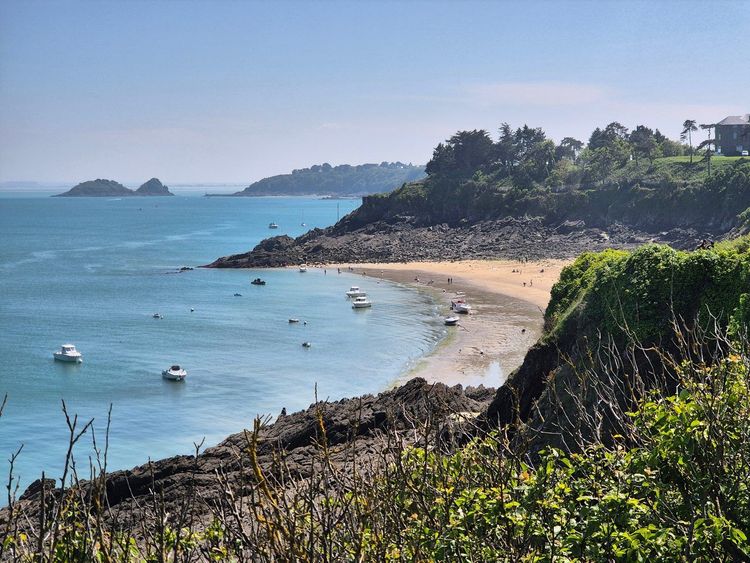
Heading east, Cancale lives to the rhythm of its oyster beds, visible at low tide from the Cale de la Fenêtre and sold directly at the harbor market by the producers, to be eaten standing up facing the bay. The customs officers' path, which follows the GR34 here, connects the harbor to the Pointe du Grouin in two hours of walking: a wind-battered headland with a view over the Île des Landes, a bird reserve home to the largest colony of shags in Brittany.
Mont-Saint-Michel, about an hour's drive away, lends itself well to a full-day excursion from Saint-Malo. Parking is on the mainland, more than two kilometers from the rock, with a free shuttle or a walk along the footbridge. If possible, time your visit to coincide with a high tide: when the coefficient exceeds 110, the sea completely encircles the Mont, a sight entirely unlike the vast exposed flats of most visits. On the way, Dol-de-Bretagne and its Saint-Samson Cathedral, along with the Mont-Dol rising above the marshes, deserve a one-hour stop and prevent the journey from feeling like a motorway run.
Cap Fréhel, Fort la Latte, and the Rance Valley
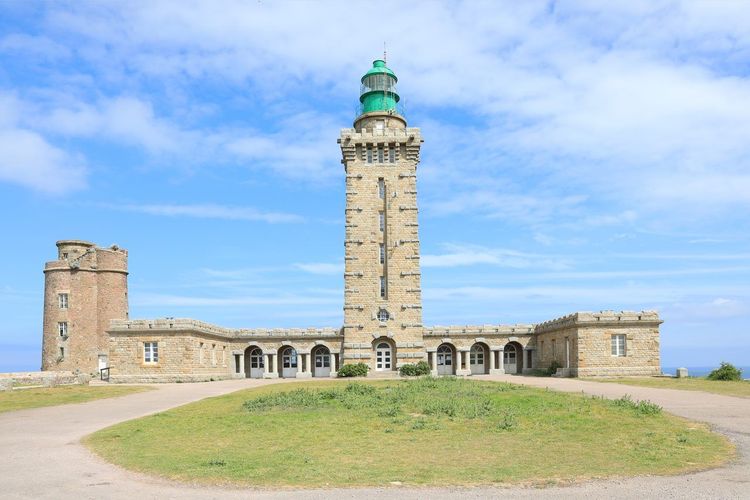
To the west, Cap Fréhel raises its pink sandstone cliffs some 70 meters above the Channel, covered in heather and gorse moorland that turns violet in late summer, and topped by a lighthouse you can visit. A few kilometers away, Fort la Latte, a medieval fortress perched on a rocky spur separated from the land by two natural fissures, has served as a film set for several productions including The Vikings and remains one of the most photogenic visits on the Emerald Coast. The stretch of the GR34 linking the two sites, roughly two hours of walking, ranks among the finest in Brittany: our article on the best hikes around Saint-Malo details this route step by step.
Heading up the estuary, the Rance Valley deserves a half day of its own: Saint-Suliac, listed among the most beautiful villages in France, with its fishermen's lanes and replanted hillside vines, the Rance tidal barrage, the world's first tidal power plant, commissioned in 1966, and the Château de Combourg (35270 Combourg, rated 4.2/5 on Google based on 3,078 reviews), where Chateaubriand spent part of his adolescence and whose haunted reputation he himself cultivated in his memoirs. Our article on the most beautiful villages around Saint-Malo lists the most photogenic stops in this valley.
Two more distant excursions are also worth the trip if your stay stretches out: Rennes, about an hour by car or fifty minutes by train, for its Breton Parliament and half-timbered houses, and above all Jersey or Guernsey, an hour and a half by ferry from the ferry terminal. The Channel Islands can be visited in a day, drive on the left, use pounds sterling, and require a valid passport since Brexit: check before booking, as an identity card is no longer sufficient. Back from either excursion, Ryo's audio-guided tour of Saint-Malo is a relaxed way to ease back into the walled town.
How to Get to Saint-Malo, Where to Park, and How to Get Around

Getting There by Train, Car, or Ferry
From Paris Montparnasse, the direct TGV reaches Saint-Malo station in 2h15 on the fastest services, more like 2h30 to 3h at other times of day. The station is about 1.5 kilometers from Intra-Muros, roughly a twenty-minute walk along the Avenue Louis Martin or a few minutes by urban bus. By car, allow around four hours from Paris via the A11 then A81 to Rennes, and finally the N137: the journey is manageable for a long weekend, but the final kilometers come at a high cost in July and August. Saint-Malo is also an international port: ferries connect the city to Portsmouth as well as to Jersey and Guernsey, which explains the regular flow of British travelers encountered in the streets of Intra-Muros. Finally, Dinard-Bretagne Airport, about twenty minutes away, serves a few low-cost routes from the United Kingdom.
Parking and Getting Around on Foot or Without a Car
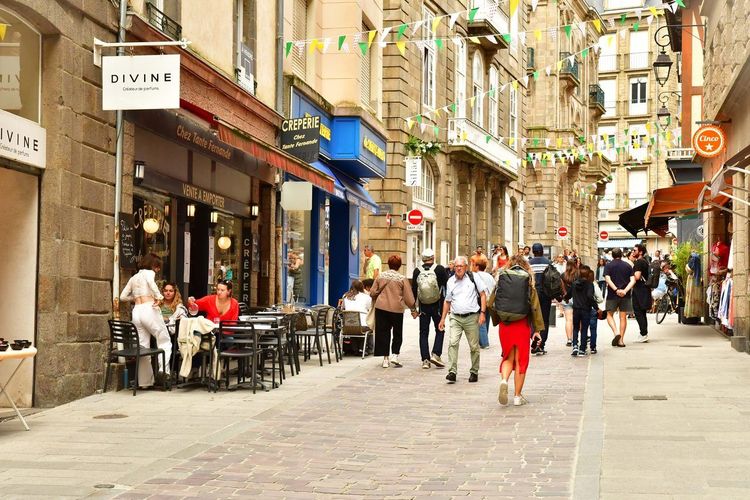
A quick look at the Saint-Malo map saves a lot of unnecessary detours: the city is organized in districts aligned along the coast — Intra-Muros at the tip, Saint-Servan to the south on the other side of the harbor, then Paramé and Rothéneuf to the east. Everything fits within a six-kilometer radius, making a car largely unnecessary once you have arrived.
Parking within Intra-Muros, mainly on the Esplanade Saint-Vincent and in the Parking des Remparts, is paid, time-limited, and full by mid-morning in high season. For free parking, head to the peripheral park-and-ride lots on the outskirts, near Paul Féval or the main beaches, all connected to the center by the urban bus network. It is perfectly possible to visit Saint-Malo without a car: the main sites, from the ramparts to the harbor, are reachable on foot in under twenty minutes, more outlying districts such as Saint-Servan or Rothéneuf are served by the urban bus, and the sea bus connects Dinard in season. The city is also very well suited to cycling, with a continuous cycle path along the Sillon and several hire shops near the station and Intra-Muros.
Where to Stay and Where to Eat in Saint-Malo
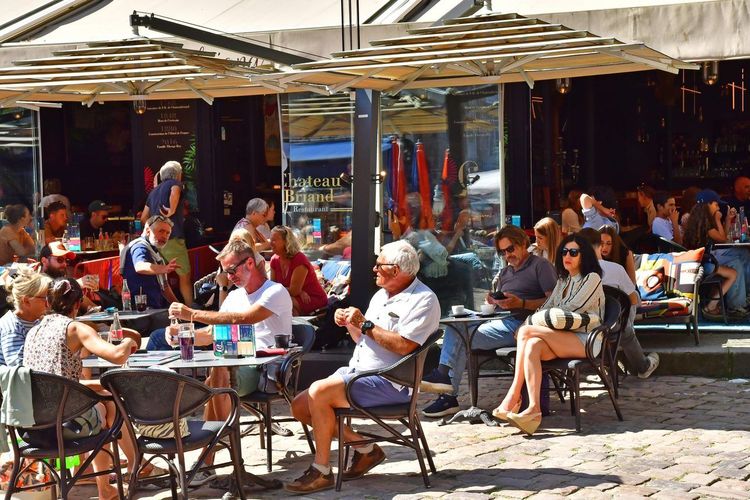
Where to Stay: Intra-Muros, Paramé, or Saint-Servan
Staying in Intra-Muros puts everything within arm's reach and lets you enjoy the ramparts at sunrise, when the walled city still belongs to the Malouins. On the downside, rates here are the highest in town, rooms are often small in buildings without lifts, and summer nights can be noisy around the Rue de Dinan. Paramé and the Sillon seafront suit families well: hotels and apartment complexes with sea views, direct access to the beach and the promenade, and a fifteen-minute walk to the ramparts. Saint-Servan, more residential, generally offers gentler rates, characterful guesthouses, and quick access to the Tour Solidor and the Cité d'Alet, at the cost of a slightly longer walk. Book early for July and August as well as for Saint-Malo's major events, when the city fills up months in advance.
Good Addresses for Eating and Tasting Local Specialties
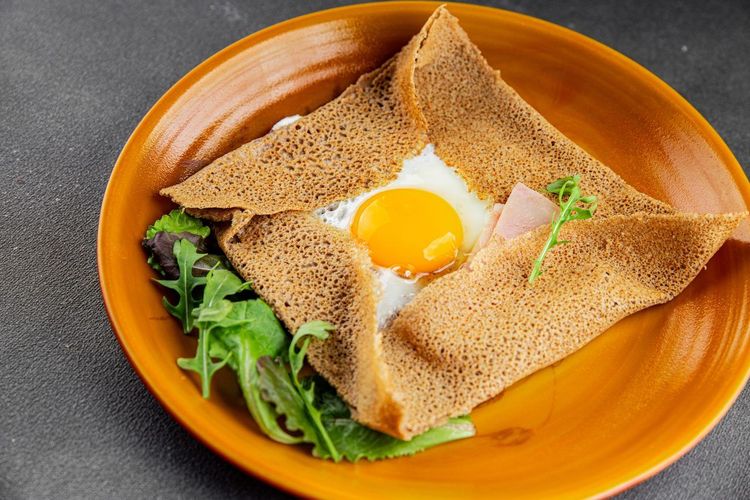
In Saint-Malo, a crêperie is always a safe bet: savory buckwheat galettes and sweet crêpes are on the menu at every address in the center, often accompanied by a bowl of dry cider. Seafood lovers will find platters, Cancale oysters, and moules marinières at the restaurants lining the harbor and the Rue Jacques Cartier, while more creative tables have set up in Saint-Servan and around the Rocabey market, which is far less touristy. For something sweet, kouign-amann, far breton, and craquelins — those small puffed biscuits unique to Saint-Malo — are best enjoyed at the city's biscuit shops; the local demi-sel butter, churned just a few kilometers away, is their other ambassador. Our article on the culinary specialties of Saint-Malo lists the best addresses for tasting these products, from biscuit makers to cider producers.
When to Go and How Long to Allow
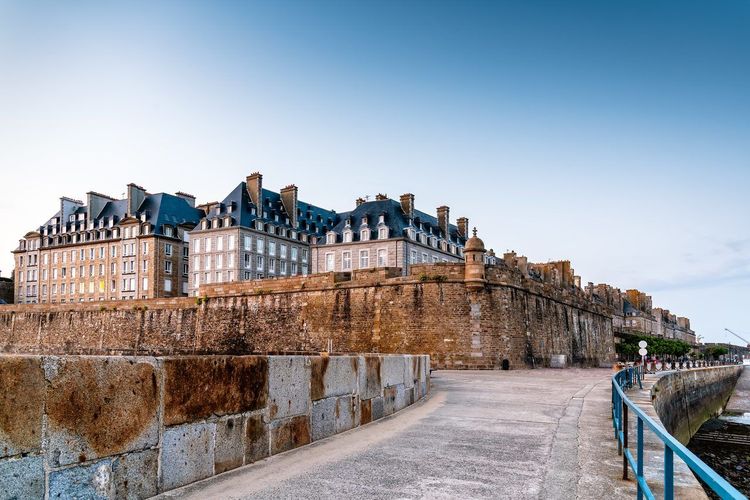
May, June, and September remain the most comfortable windows for visiting Saint-Malo: the oceanic climate is mild, with highs around 18 to 20 degrees Celsius, the days are long, and the August crowds give way to a more breathable city. July and August concentrate the bulk of the visitor numbers, particularly on the beaches and when accessing the islands, where queues lengthen during low-tide hours. Winter has its devotees: the city empties, westerly storms put on a dramatic show from the sea wall, and accommodation rates fall by half. Just pack a windproof jacket — rain here arrives fast and leaves just as quickly.
On the question of how many days to allow, two profiles emerge. If you limit yourself to Intra-Muros, the nearby beaches, and one boat trip, two days are more than enough. Three days become necessary as soon as you add the fortified islands, the Saint-Servan district, and Rothéneuf, or an excursion to Dinard, Dinan, or Mont-Saint-Michel. Allow four to five days to combine several excursions without a military pace. The high tides, whose coefficients peak around the March and September equinoxes, are worth checking before fixing your dates: they govern access to the islands and turn the Sillon sea wall into a spectacle.
The Saint-Malo calendar also weighs on availability. The Étonnants Voyageurs festival at Whitsun, the Quai des Bulles comics festival in autumn, and every four years the start of the Route du Rhum race to Guadeloupe all fill the city and its hotels: the next edition sets off from Saint-Malo in November 2026 — worth knowing if you are planning an autumn visit. In case of rain, keep in mind that the Grand Aquarium, the Micro Zoo, the Thermes Marins, and the city's museums each offer two to three hours of indoor activity — more than enough to put together a coherent program. Before you leave, the short version of the Ryo audio-guided tour also lets you fit a condensed Intra-Muros experience into a single low tide, should your stay shrink to two days.
FAQ
How Much Time Do You Need to Visit Saint-Malo?
Two days are enough for Intra-Muros, the ramparts, and the nearby beaches. Allow three days to add the fortified islands, Saint-Servan, Rothéneuf, and a boat trip, and up to five days if you include one or two excursions to Dinard, Dinan, or Mont-Saint-Michel.
Do You Have to Pay to Walk the Ramparts of Saint-Malo?
No, the walk around the ramparts is free and open year-round, day and night. Only the monuments they surround, such as the Fort National, the fort du Petit Bé, or the city's museums, require an entrance ticket.
Where Can You Park for Free in Saint-Malo?
Free parking is available outside Intra-Muros, in the peripheral park-and-ride lots and near the main beaches, all connected to the center by the urban bus network. It is a far more relaxing option than circling in search of a paid spot near the ramparts in the middle of August.
Can You Visit Saint-Malo Without a Car?
Yes, most of the main sites are within a twenty-minute walk from Intra-Muros, and the TGV station is about a twenty-minute walk away. For Saint-Servan or Rothéneuf, the urban bus easily complements walking, and the sea bus serves Dinard in season. Only excursions to Dinan, Cap Fréhel, or Mont-Saint-Michel require a car, a coach, or an organized tour.
What Is the Best Time of Year to Visit Saint-Malo?
May, June, and September offer the best balance between pleasant weather and manageable crowds. July and August are the warmest months but also the busiest, particularly on the beaches and when accessing the islands.
When Are the Big Tides in Saint-Malo?
The highest tidal coefficients occur around the equinoxes, in March and September, with secondary episodes throughout the lunar cycle. Check the local tide calendar before your stay if you want to see the sea rise dramatically along the ramparts, or walk out to the islands in the best possible conditions.
What Can You Do in Saint-Malo When It Rains?
The Grand Aquarium, the Micro Zoo, the city's museums, and the Thermes Marins each offer several hours of indoor activities. The crêperies, biscuit shops, and bookshops of Intra-Muros are also a pleasant option while waiting for a break in the weather, which often arrives sooner than expected.
Is Saint-Malo a Good Destination for Children?
Yes, between the Grand Aquarium, the Micro Zoo, the tourist train, the walk to the islands, and the shallow beaches at the Sillon or Bas-Sablons, Saint-Malo offers a good range of activities for families. Just bring sturdy shoes for the ramparts and keep an eye on the tide schedule.
Leaving With the Urge to Come Back
Three days in Saint-Malo rarely feel like enough to exhaust the city: between the tides that reshape the landscape morning and evening, the excursions to Dinard or Mont-Saint-Michel that always tempt you a little more, and the less-visited districts like Saint-Servan that reward unhurried exploration, there is always a good reason to stay longer. Ryo's audio-guided tour of Saint-Malo, À l'abordage, remains the best starting point for structuring your first day effortlessly, ramparts and Intra-Muros alleyways included.
Whether you follow this three-day itinerary to the letter or adapt it to your own interests and the tide times, keep one thing in mind: Saint-Malo reveals itself just as well from the water as from its ramparts. A short boat trip or a crossing to Dinard, however brief, completely transforms your perspective on the city you have just explored on foot.
À lire également