© Shutterstock
 Votre guide Ryo
Angers with Kids: The Complete Family Guide for 2026
A fortress with seventeen black-and-white striped towers, a tapestry filled with dragons, a zoo carved into the rock: visiting Angers with children is the perfect way to captivate young visitors without sacrificing heritage. The city owes its nickname of "green city" to its parks and gardens, but it is above all its human scale that makes it so easy to navigate with little ones — almost everything can be done on foot. The Ryo audio-guided tour of Angers is the ideal way to start in the historic heart, among ramparts and half-timbered houses, before venturing out to the great natural sites in the surrounding area.
On the programme in this guide: a medieval tapestry almost a hundred metres long, a lake where you can try paddleboarding, one of France's finest aviation museums, a troglodyte zoo with 2,000 animals, and a vanished sea to explore underground at Doué-la-Fontaine. You will also find all the practical information — transport, accommodation, budget, and the best time to visit — to plan a trip that mixes heritage, fresh air, and indoor options for rainy days.
The Château d'Angers and the Historic City Centre with Kids
The Royal Fortress and the Tapestry of the Apocalypse
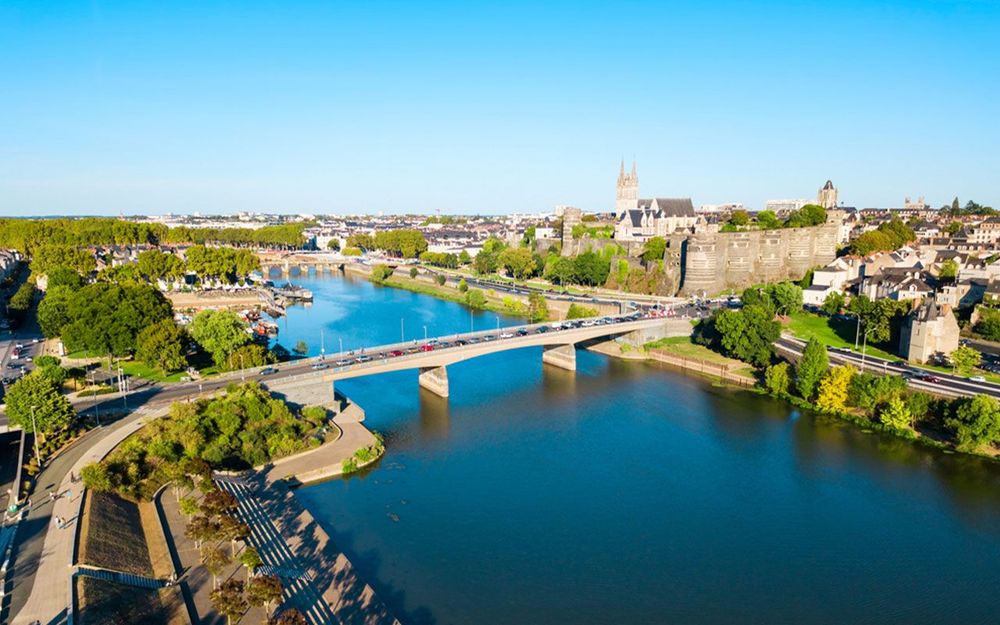
The Château d'Angers rises above the Maine with its 17 towers alternating dark schist and pale tuffeau, a silhouette visible from the riverbanks long before you reach the gates. Unlike Chambord or Chenonceau, it was never converted into a pleasure residence: its 13th-century ramparts still tell the story of the military fortress commissioned by Blanche de Castille, and its dry moats, now laid out as gardens, can be admired from the walkway along the battlements.
Inside awaits the Tapestry of the Apocalypse, woven between 1373 and 1382 for Duke Louis I of Anjou. Of the original 140 metres, around a hundred survive: it is the largest collection of medieval tapestries preserved anywhere in the world. Faced with seven-headed beasts and giant horsemen, your young visitors will quickly forget they are having a history lesson. Turn the visit into a game: each child picks "their" monster and has to find it again in the gallery.
Good to know: entry is free for under-18s (and for 18–25-year-olds resident in the European Union), so only adults pay. Allow 1h30 to 2 hours on site, slightly less with very young children.
A Stroll through the Historic City: Maison d'Adam and Cathédrale Saint-Maurice
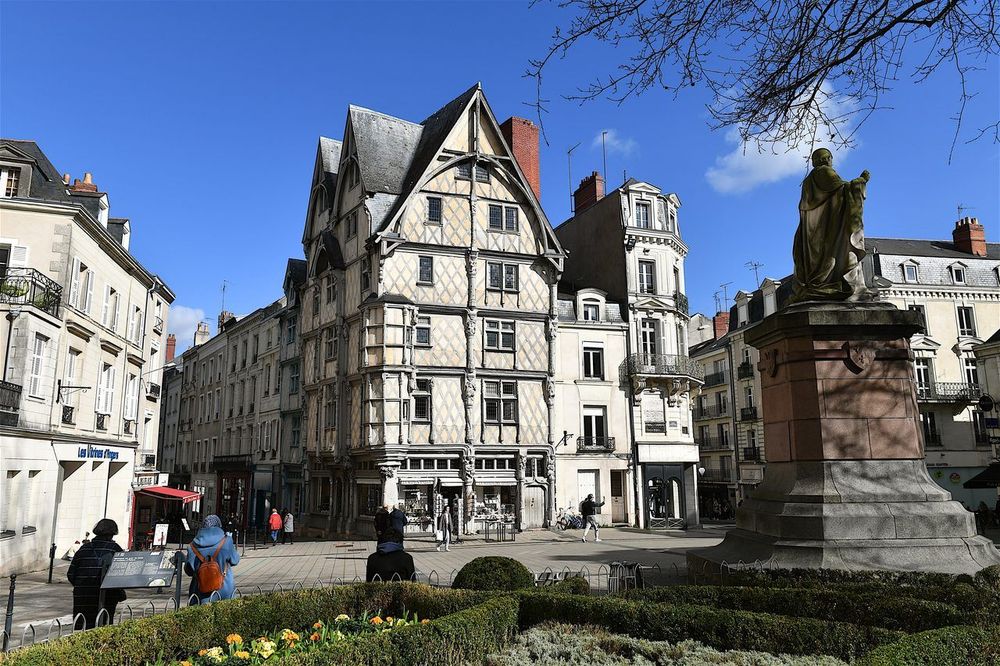
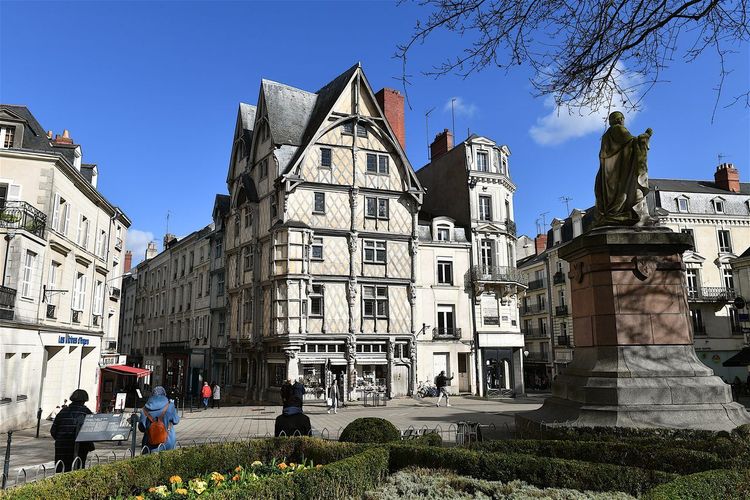
Leaving the castle, the historic city centre is just a few minutes' walk away. The Maison d'Adam (1 Place Sainte-Croix, 49100 Angers, rated 4.7/5 on Google from 734 reviews), built around 1491, is one of the finest half-timbered houses in France. It takes its name from the apple tree carved on its corner post, around which Adam and Eve once appeared: challenge the children to spot the dozens of figures and creatures that populate the façade.
Just nearby, the Cathédrale Saint-Maurice impresses with its three-tower façade and its 12th-century stained-glass windows, among the oldest in France still in situ. On the Maine side, the montée Saint-Maurice — a grand stairway climbing from the quays up to the cathedral square — offers an open view over the slate rooftops: a good challenge for little legs and a great photo at the top.
If you would rather have the stories told to you than read information panels, the Ryo audio-guided tour devoted to the fortress and the historic city centre offers 2h15 of narrated walking, with anecdotes about the ramparts and the Tapestry of the Apocalypse delivered step by step, at your own pace.
Terra Botanica: a Full-Scale Plant Kingdom Park
Explorations, Gardens, and Attractions
On the northern edge of Angers, Terra Botanica (Route d'Épinard, 49000 Angers, rated 4.5/5 on Google from 17,692 reviews) bills itself as Europe's first park dedicated entirely to the plant world, which sets it apart from a conventional theme park. The site is organised into five themed worlds where visitors learn through play — where plants come from, how they travel, and what they are used for.
On the attractions front, young children love the Tractocabines de Cléamolette and the little plant train, while older kids head straight for the 4D Adventure or the Botanical Odyssey. The Bird Canopy and the Giants' Trail round off the day, with play areas to let off steam between shows. The scenery changes considerably with the seasons: the flowerbeds of spring give way to autumn colours, making a second visit worthwhile for those who live nearby.
Practical Information: Opening Times, Prices, and Getting There
Terra Botanica is generally open from spring to autumn, with extended hours in July and August: check the 2026 calendar on the park's website before booking your date. Allow half a day for the highlights, or a full day if you want to take in shows and attractions back to back.
Tickets are reduced for children, and very young children enter free; booking online often saves a few euros compared to buying at the gate. The park is about fifteen minutes by car from the city centre. To prepare for each area, our Ryo article on Terra Botanica covers the map and the must-see attractions by age group.
Museums and Culture: Angers from a Different Angle with Young Visitors
The Muséum des Sciences Naturelles and the Galerie David d'Angers
First good news: Angers' municipal museums are free for under-26s, and for everyone between 5 pm and 6 pm. The Muséum des sciences naturelles occupies the elegant neoclassical Hôtel Demarie-Valentin with its circular courtyard, and the former town hall built against the ramparts. Its collections hold some 830,000 specimens: 3,000 stuffed birds, thousands of insects, and more than 150,000 fossils, including rare plesiosaur remains that never fail to impress young fans of marine reptiles.
A few streets away, the Galerie David d'Angers (33bis Rue Toussaint, 49100 Angers, rated 4.7/5 on Google from 1,022 reviews) occupies the former Toussaint abbey church, whose nave topped with a glass roof bathes the monumental sculptures of the Angevin artist in light. At €4 for adults, it makes for a short but rewarding stop, ideal for a breather between more active visits.
The Collégiale Saint-Martin and Its Angevin Statues
The Collégiale Saint-Martin, deconsecrated in 2006 and now open as a visitor and exhibition space, spans around fifteen centuries of architecture: Carolingian foundations visible in the crypt, elements from the 10th and 11th centuries, and a choir in the Angevin Gothic style. Several dozen Angevin statues are on display, making it easy to organise a small investigation: which one has the most expression, which one has lost its nose?
The Ryo audio guide that winds through the historic district passes right by the Collégiale and the Doutre quarter, with the historical context provided before you even step inside the museums. For more ideas, our Ryo Top 5 Things to Do in Angers article offers further suggestions.
The Loire, the Lac de Maine, and the Gardens: Angers in the Open Air
A Loire River Cruise with Loire Odyssée and Waterside Walks
About twenty minutes east of Angers, Loire Odyssée is based at Saint-Mathurin-sur-Loire, between Angers and Saumur. From April to October, its guided cruises let you discover the Loire — often described as Europe's last wild river — in a way no photograph can capture: sandbanks, terns, and herons drift past as the guide recounts the lives of the river boatmen of old. The exhibition route "La Loire, d'une rive à l'autre" rounds off the outing on dry land. In summer, several hire companies also offer canoeing on the Maine and the Loire for teenagers who want to paddle.
There is no need to travel far to walk alongside the water: Angers is built on the Maine, and its landscaped quays, stretching between the Pont de la Basse-Chaîne and the Parc de Balzac, form a flat promenade of several kilometres, perfect for pushchairs or scooters. The Loire itself flows a few kilometres to the south, near Bouchemaine and les Ponts-de-Cé.
Lac de Maine and Jardin des Plantes: Picnics, Play, and Walks
The Lac de Maine (Avenue du Lac de Maine, 49000 Angers, rated 4.6/5 on Google from 3K reviews), an artificial lake created from former gravel pits to the south-west of the city, packs enough into one day: paddleboard and canoe hire from the watersports centre housed in its pyramid, paths around the water, and wide lawns for picnics and ball games. Supervised swimming is organised in summer when water quality permits (it has previously been suspended due to cyanobacteria), so check before packing the swimsuits.
More centrally located, the Jardin des Plantes is worth even a short detour: century-old trees, a pond, and a play area make it an easy stop between two visits in the city centre, with no booking or opening-time constraints.
To link these green stops without getting lost, the Ryo audio-guided tour of Angers follows the banks of the Maine and sets the river in its history: 22 audio stops over 5.6 km, with easy pauses by the water.
Tourist Train and Cycling around Angers
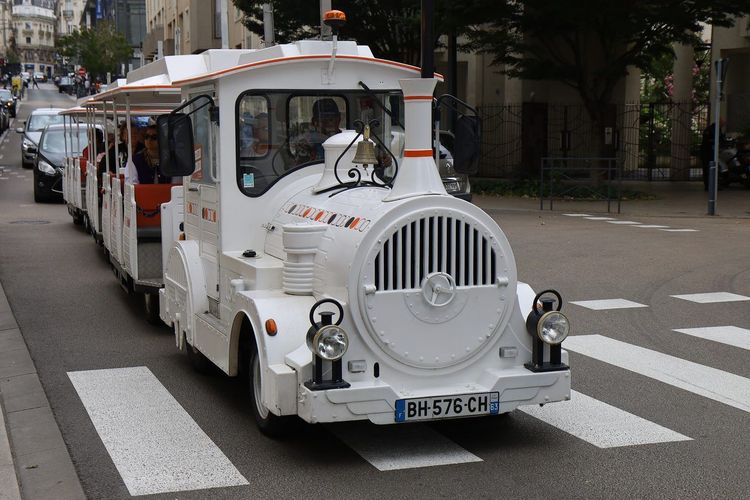
For a first look at the city without tiring little legs, the Angers tourist train (Rue du Président Kennedy, 49100 Angers, rated 4.5/5 on Google from 501 reviews) is a reliable choice. The roughly 45-minute circuit departs from the foot of the castle, passes through the historic city centre, and continues up towards the cathedral, with a commentary that generally appeals more to under-8s than a long walk with information panels.
More active families will prefer cycling. Angers has a good network of cycle paths, and the Loire à Vélo route passes through the city before reaching Bouchemaine: a flat ride, largely car-free, manageable with a child seat or trailer. Allow a good hour there and back to the Lac de Maine at a leisurely pace.
On foot, the Ryo audio tour stops follow a route close to that of the tourist train: you cover the same itinerary at your own pace, stopping wherever you like. Our Ryo article on What to Do in Angers and the Surrounding Area lists further ideas to vary the experience.
Unusual Activities and Indoor Options for Rainy Days
Espace Air Passion: an Aviation Museum
Located at Angers-Marcé airport, about twenty minutes to the north-east, the Espace Air Passion houses around 150 aircraft, around twenty of which are airworthy: it is France's second-largest aeronautical museum by number of planes, after Le Bourget. Unique prototypes, pioneer gliders, engines, and scale models fill 3,500 m² of exhibition space, with a section dedicated to the Second World War that will fascinate teenagers.
The museum closes occasionally (for example for a few days in September): check its website before making the trip.
Palomano and Other Indoor Options
When the Loire Valley weather intervenes, or the heat drives everyone to seek shade, Palomano Angers (21 Rue du Hanipet, 49124 Saint-Barthélemy-d'Anjou, rated 4.7/5 on Google from 410 reviews), in Saint-Barthélemy-d'Anjou, offers an air-conditioned solution for children aged 0–10. Across 715 m², a miniature town recreates a supermarket, a fire station, a hairdressing salon, and a vet's surgery, with a quiet area reserved for 0–2-year-olds. Sessions last a maximum of two hours, socks are compulsory, and booking is strongly recommended.
Keep it in reserve rather than scheduling it automatically. Other options exist in the city for bad weather: the museums mentioned above, all indoors, allow you to put together a full day under cover, from the Muséum to the Galerie David d'Angers and the Collégiale Saint-Martin.
Day Trips around Angers, in the Heart of Anjou
The Île de Béhuard: a Quirky Village along the Loire
16 km south-west of Angers, Béhuard is one of only two French communes that occupy an entire river island. The village is reached via the D106 road, but it remains in a flood zone: during the 1910 flood, the water rose to 7 metres, which explains the elevated medieval houses. The church of Notre-Dame, perched on a rocky outcrop, is said to have been built under Louis XI after the king narrowly escaped drowning. The lanes can be explored in an hour or two, and the site is part of the UNESCO-listed Val de Loire.
Saumur and the Château du Plessis-Bourré
About fifty minutes by road, Saumur deserves a day to itself. Its castle, perched above the Loire and recognisable by its slender turrets, houses a museum of decorative arts and a museum of the horse — a nod to the town's equestrian tradition that young riding enthusiasts will particularly enjoy.
North of Angers, the Château du Plessis-Bourré, built between 1468 and 1473 for Jean Bourré, impresses with its wide moats still filled with water and its drawbridge. Inside, a rare 15th-century painted ceiling covered in enigmatic scenes lends itself perfectly to a guessing game. The castle is open in 2026, with tickets from €7 for children. Since Saumur and the Plessis-Bourré lie on opposite sides of Angers, it is best to dedicate two separate outings to them.
The Bioparc de Doué-la-Fontaine and Its 2,000 Animals
About forty minutes to the south, the Bioparc de Doué-la-Fontaine claims to be the world's only troglodyte zoo: its more than 2,000 animals live in former stone quarries converted into landscaped enclosures, complete with natural tunnels. Giraffes, rhinoceroses, and okapis can be observed in a setting that avoids any cage-like feel. In high season, a full day is sometimes not quite enough, between the enclosures and the educational activities.
Le Mystère des Faluns: a Journey beneath a Vanished Sea
Also in Doué-la-Fontaine, at the Perrières site, the Mystère des Faluns (7 Rue d'Anjou, 49700 Doué-en-Anjou, rated 4.7/5 on Google from 3,211 reviews) offers a far rarer experience: an artistic installation inside troglodyte caves carved from falun, the rock made of fossilised shells left by a sea that covered Anjou millions of years ago. The cool, dimly lit route makes for a complete change of pace after a sunny morning, making it an excellent complement to the Bioparc.
For a multi-day break taking in Angers, Saumur, and the great châteaux, the Ryo audio-guided tour of the Loire Valley châteaux extends the day spent in Saumur, with audio commentary at every stop along the route. Our Ryo article on Visiting Angers in 3 Days also offers a complete itinerary for combining city sightseeing and day trips without rushing.
Where to Eat: Local Specialities and Good Addresses in Angers
Anjou has a few specialities that appeal to young and old alike. Rillauds angevins, slowly braised pieces of pork belly, are eaten warm with bread, while the crémet d'Anjou, a light dessert made from whipped cream and beaten egg whites, always goes down well with a red fruit coulis. For those with a sweet tooth, the quernon d'ardoise — a small square of nougatine coated in blue chocolate — is a nod to the city's slate rooftops.
For places to eat, the crêperies in the centre are a reliable choice, as children's menus are almost standard there, or try the terraces around the place du Ralliement, handy for keeping an eye on a pushchair. For a picnic, the market and the food shops in the centre make it easy to put together a simple meal before heading to the Jardin des Plantes or the Lac de Maine. Our Ryo article on Angers' culinary specialities covers all the essentials.
Practical Information for Planning Your Stay in Angers
Getting to and around Angers (Transport and Parking)
Angers is easy to reach by train, with direct TGV services from Paris Montparnasse taking around 1h30: a very accessible destination for a long weekend without a car. By road, the A11 motorway connects the city directly from Paris or Nantes.
Once there, the historic centre is entirely walkable, and the Irigo network (three tram lines and buses) serves the outer districts. For parking, several underground car parks border the city centre; with a pushchair, slightly out-of-centre surface car parks are often easier to navigate.
Where to Stay (Hotels, Gîtes, Campsites)
For a stay of several days, rural gîtes in Maine-et-Loire generally offer more space than a hotel for the same budget, with a fully equipped kitchen and an enclosed garden — a real bonus with very young children. The Gîtes de France Anjou network regularly features offers combining accommodation and activities, worth comparing if you plan to mix city sightseeing with day trips.
If you prefer to stay in the city centre, several hotels are within walking distance of the castle, while campsites in the surrounding area — particularly by the Lac de Maine — are well suited to an active summer stay.
Angers City Pass, Budget, and Money-Saving Tips
The Angers City Pass, sold by the Destination Angers tourist office, bundles access to several museums and monuments for a limited period. Do the sums before buying: since the castle and the municipal museums are already free for under-18s and under-26s, the pass only pays off for adults visiting several paid sites.
On the budget front, a day out for four (two adults, two children) including a paid attraction such as Terra Botanica or the Bioparc, lunch at a restaurant, and a few journeys generally comes to between €100 and €180. A heritage day in the city costs considerably less, thanks to the free entry at the castle and museums.
When to Go: School Holidays or Off-Peak?
Outside school holidays, Angers breathes more easily: shorter queues at the castle, less crowded terraces, and sometimes lower hotel rates during the week. During school holidays, however, most sites (Terra Botanica, Bioparc, museums) put on events designed for younger visitors, which more than makes up for the higher visitor numbers.
Spring and early autumn remain the most comfortable periods for combining city visits with outdoor excursions, before the heat of July and August sets in. To fine-tune your day-by-day programme, our Ryo article on Visiting Angers in 2 Days offers a ready-made itinerary that is easy to adapt.


FAQ
How many days should you plan to visit Angers with young children?
Two days are enough for the castle, the historic city centre, and Terra Botanica. Allow three to four days if you want to add the Lac de Maine, a museum, and a trip to Saumur or the Bioparc de Doué-la-Fontaine without rushing.
What free activities are there in Angers for young children?
The Jardin des Plantes, a stroll around the Maison d'Adam and the cathedral, the banks of the Maine, and the Lac de Maine (excluding equipment hire) are all free. The castle and the municipal museums are also free for under-18s and under-26s respectively.
What budget should you plan for a day out in Angers for four?
For two adults and two children, budget between €100 and €180 for a day that includes a paid attraction, lunch, and a few journeys. A day focused on the city's heritage costs significantly less.
Where should you stay in Angers with young children?
The city centre is ideal for a short heritage-focused stay, within walking distance of the castle. For a longer trip combining excursions and flexibility, consider options further out.
What is the best time of year to visit Angers?
Spring and early autumn offer pleasant weather and manageable crowds. School holidays are still worth considering to take advantage of events at Terra Botanica, the Bioparc, and the museums, despite higher visitor numbers.
Is the Angers City Pass worth it with young children?
Rarely for them, since the castle and municipal museums are already free. It can, however, pay off for adults visiting several paid sites in a short space of time.
What can you do in Angers on a rainy day?
The Muséum des sciences naturelles, the Galerie David d'Angers, the Collégiale Saint-Martin, the Espace Air Passion, and the indoor play area Palomano all allow you to put together a full day under cover.
Conclusion
Angers delivers on its promise of a well-balanced stay: enough heritage to feed curiosity, enough nature to ensure nobody burns out, and plenty of indoor options so the weather never has the final say. Between the fortress, the troglodyte zoo at Doué-la-Fontaine, and the banks of the Maine where you can wander without a timetable, the city is just as well suited to a quick weekend break as to a week in Anjou.
To kick off the exploration without spending hours piecing together an itinerary, the Ryo audio-guided tour of Angers remains the simplest starting point: 22 narrated stops over 5.6 km and 2h15 of listening, to follow on foot between snack breaks, so that children and adults alike can discover the city's history at their own pace.
À lire également