






Créé par Romane, le 17 nov. 2026
Votre guide Ryo
Albufeira, Portugal
The Saint-Tropez of Portugal
Parcours audioguidé pour visiter Albufeira en 1 jour
A lively seaside resort in the Algarve, Albufeira combines spectacular beaches, a festive atmosphere, and its heritage as a fishing village. With its whitewashed streets, ocean views, and nightlife, the town offers a sunny and dynamic getaway.
Quand partir à Albufeira ?
Jan.
13°
7
Feb.
14°
6
March
15°
5
April
17°
5
May
20°
3
June
24°
1
July
27°
0
Aug.
28°
0
Sept.
26°
2
Oct.
22°
4
Nov.
18°
6
Dec.
15°
7
Albufeira enjoys mild temperatures throughout the year. The best time to visit is between May and October, when daytime temperatures rise above 20°C and the sea is at its warmest for swimming. The weather remains pleasant even in the cooler months of January and December, with daytime highs of 16 to 17°C and nighttime temperatures above 10°C. No matter the season you choose, you’re likely to dodge the rain—Albufeira boasts an average of 300 days of sunshine a year!
Départ conseillé
No need to worry about where to begin! Our tours are designed as a loop, so you can jump in wherever you are. The navigation system and audioguide will automatically adjust to your location. However, if you happen to be nearby, we do have a preferred starting point: Engenheiro Duarte Pacheco Square.
Parking à proximité
Avenida 25 de abril car park
À savoir
The currency in Albufeira is the euro.
Découvrez 21 lieux d'intérêt pour visiter Albufeira






What to see in Albufeira on your 2h30 tour?
This 6 km loop takes about two and a half hours and links 18 sights. From Engenheiro Duarte Pacheco Square, it heads down Rua 5 de Outubro and through the tunnel to Peneco Beach, follows the colourful marina and its ocean viewpoints, climbs back past the Clock Tower and the Porta do Norte up to Republic Square, then drops down again to Praia dos Pescadores and the Miradouro do Pau da Bandeira. With the Ryo app in your ears, every whitewashed lane tells the soul of the Algarve.
Information checked in November 2026 and subject to change.
1 - Engenheiro Duarte Pacheco Square
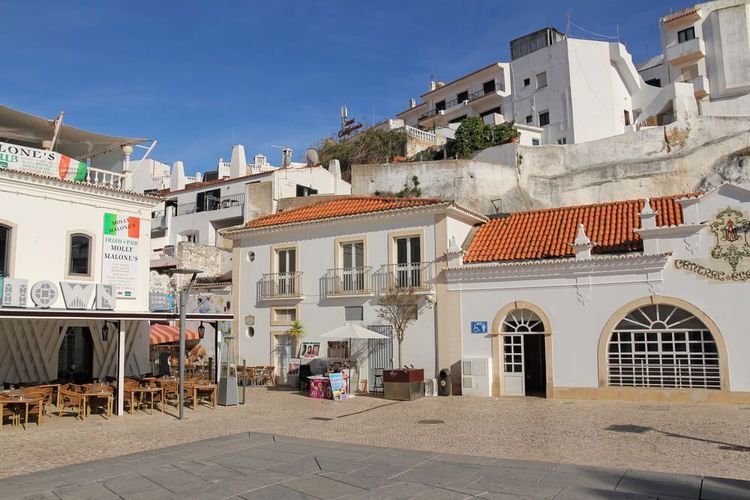
This wide esplanade, lined with white façades and colourful trims, is the favourite meeting point for locals before a night out. The building facing it now houses a gallery devoted to Samora Barros, a 20th-century Portuguese painter: originally a power plant built in 1926, it was turned into a cultural space in the late 1980s.
Free entry · Best in the evening
2 - Rua 5 de Outubro
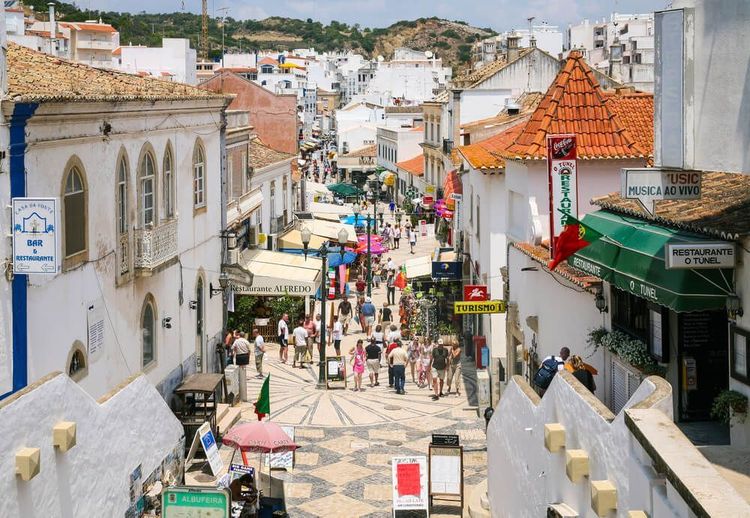
Cobbled and lively, this shopping street packs in boutiques, café terraces and local craft stalls, capturing the town's energy in one stretch. It's worth wandering through by day to pick up a souvenir, then coming back after dark to sample regional dishes at one of its many outdoor tables.
Free entry · Best in the evening
3 - Outubro Tunnel
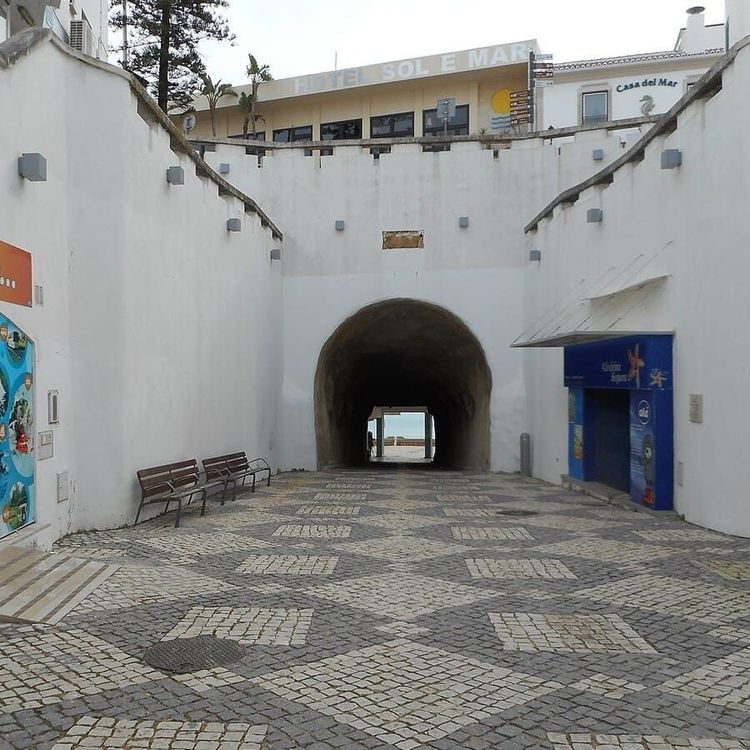
This passage, carved beneath the town, leads straight to Peneco Beach, drawing hundreds of swimmers through it every day in season. It also marks the end of the shopping street you've just left, and its name recalls a major turning point for the country: the day Portugal became a republic, in October 1910.
Free entry
4 - Saint Sebastian Church
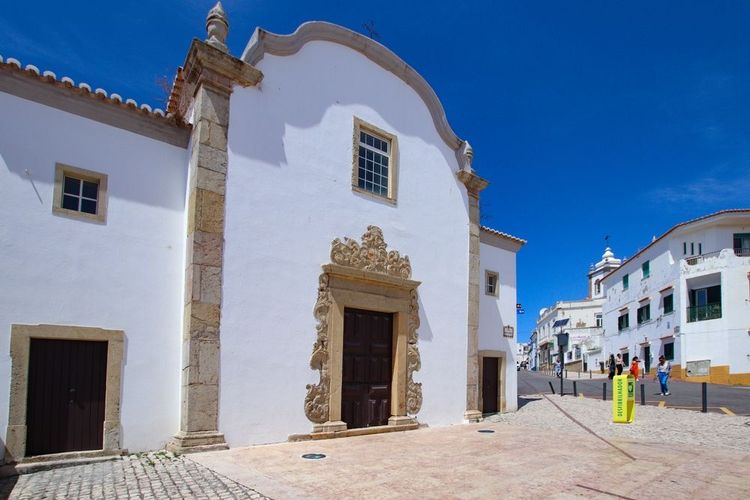
Like most façades in Albufeira, this church owes its brilliant white to a coat of limewash, a legacy of the Moorish period that shaped the town's architecture. Similar forms can be found in villages of northern Maghreb, a reminder of the constant exchange between the two shores of the Mediterranean over the centuries.
Free entry
5 - Sant’Ana Church
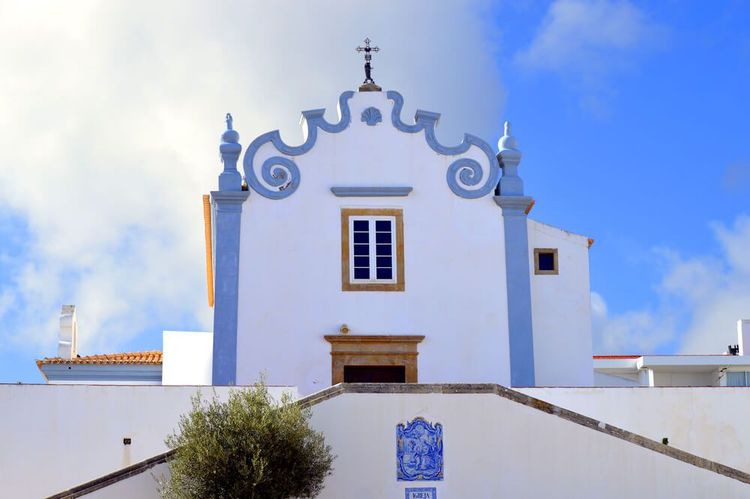
Also built in the 18th century, this neighbouring church combines the same limewashed walls with a distinctly Baroque façade. Inside, a polychrome wooden altarpiece in Rococo style decorates the main chapel; from its forecourt, turn around to take in both the ocean and the white rooftops of the district in a single glance.
Free entry
6 - Gastronomy in Albufeira

A fishing town long before it became a beach resort, Albufeira puts the ocean at the centre of its plates: cuttlefish in ink, razor clam rice, clam cataplana and fish stew all feature on the menus of the many restaurants nearby. Those with a sweet tooth aren't left out either, with small local treats made from almonds, egg yolk and pumpkin jam.
Free entry
7 - Marina
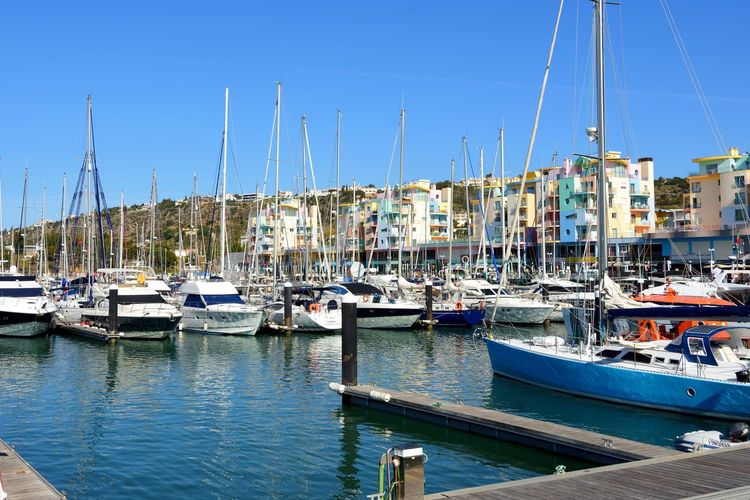
The scenery shifts completely as you enter this recently built leisure port, lined with brightly coloured façades quite different from the historic centre. Considered one of the safest in the country, the marina gathers bars, restaurants and shops around its moored boats, far from the bustle of the whitewashed lanes.
Free entry
8 - Viewpoint over the Marina
From here, the eye takes in the marina's multicoloured façades all at once, with the historic centre perched on its cliffs forming the backdrop. It's the ideal spot to capture the town's most characteristic image before continuing the walk, among moored boats and quays busy with other visitors equally drawn to the view.
Free entry · Best late in the day
9 - Ocean Viewpoint
The path toward the historic centre offers one Atlantic panorama after another, with boats entering the harbour and people heading to the beach, towel under their arm. This string of views largely explains Albufeira's reputation as one of Portugal's most sought-after seaside towns, so take your time here and keep the camera within reach.
Free entry · Best late in the day
10 - Albufeira Observation Deck
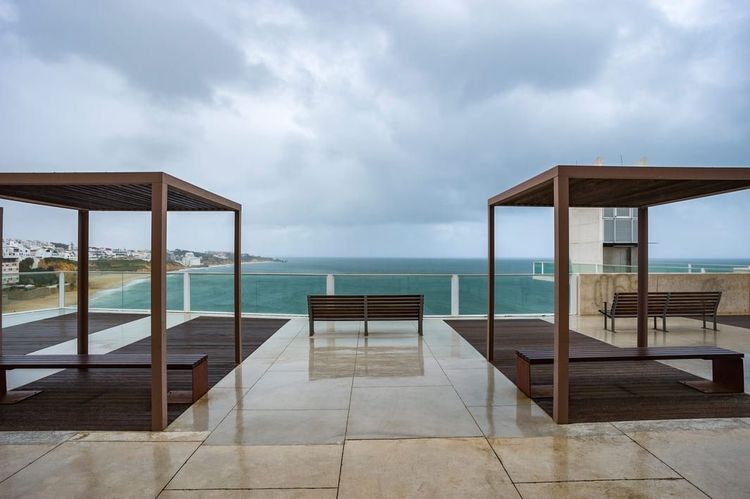
One of the town's best-known lookouts opens up here over the sea, which breaks against the cliffs and beaches below. A few benches invite a quiet pause, away from the bustle of the centre, before heading back down toward the whitewashed lanes and picking up the pace of the walk again.
Free entry · Best late in the day
11 - Elevador do Peneco
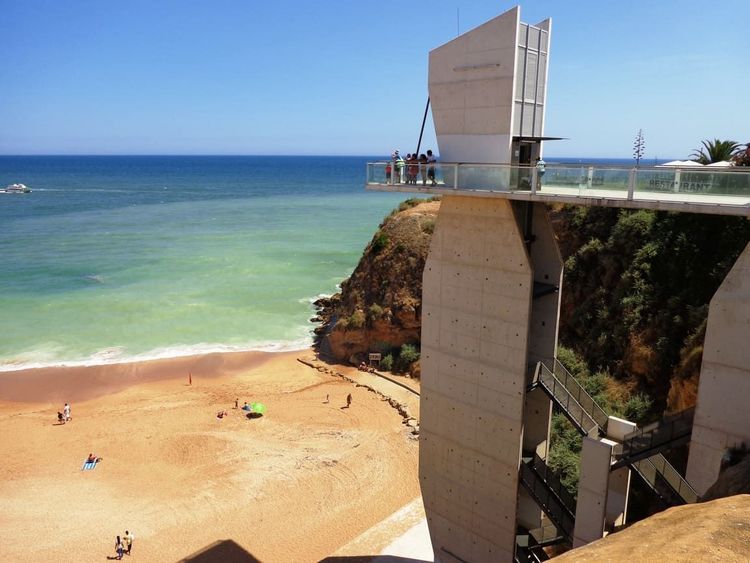
Designed by architect Joao Castro Ferreira and opened in 2008, this concrete lift covers a 28-metre drop, bridging the gap between the upper district and one of Albufeira's busiest beaches, and carrying up to 13 passengers at a time. Its viewing platform alone is worth the stop, with a wide-open outlook over swimmers, boats and the whitewashed houses of the centre.
12 - Peneco Beach
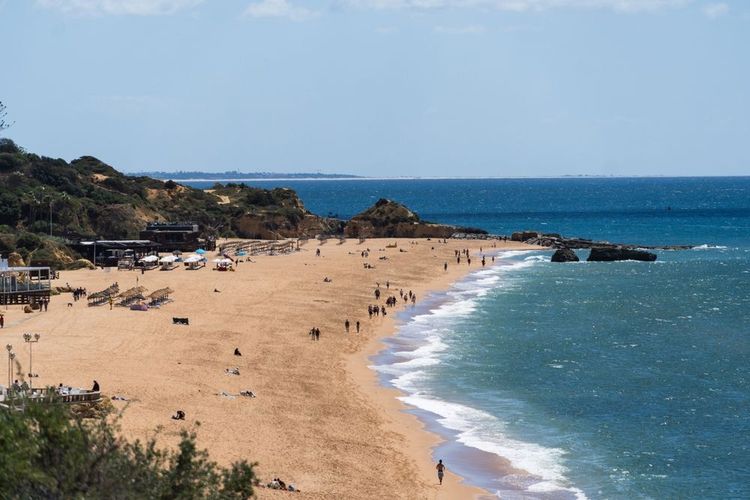
Framed by yellow sandstone cliffs, this fine-sand beach owes its popularity to its location just steps from the centre, linked to it by the tunnel and lift you've just used. Spacious enough for both swimmers and sunbathers, it also draws surfers keen on its waves, and gets especially lively through the summer months.
Free entry
13 - Clock Tower
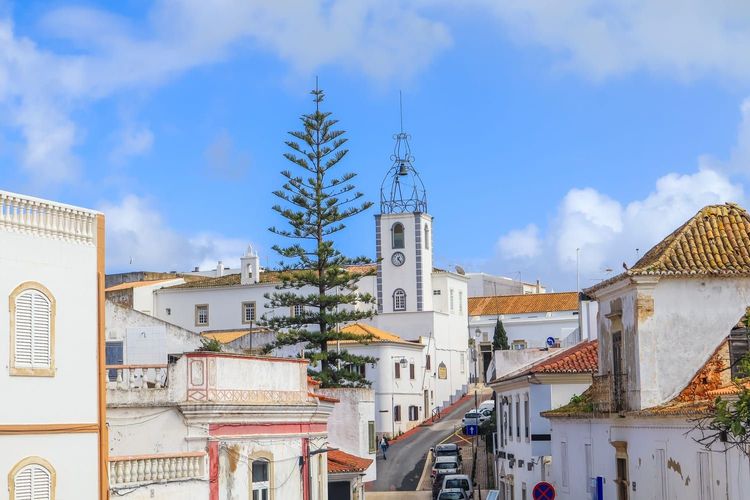
While the clock and bell crowning it only date from the 20th century, the tower itself is far older: it started out as a defensive structure built into the town's medieval fortifications, tasked both with keeping watch over the approaches and marking the entrance to the city, long before the surrounding street took on its current lively character.
Free to see from outside
14 - Porta do Norte
Only a handful of stones remain from this former fortified gate, but they're enough to mark where a medieval stronghold, raised here in the 1200s, once welcomed visitors into the city. Works carried out in 1993 helped showcase this modest yet precious relic, which has survived nearly nine centuries on this very spot, now a quiet street corner.
Free to see from outside
15 - Republic Square
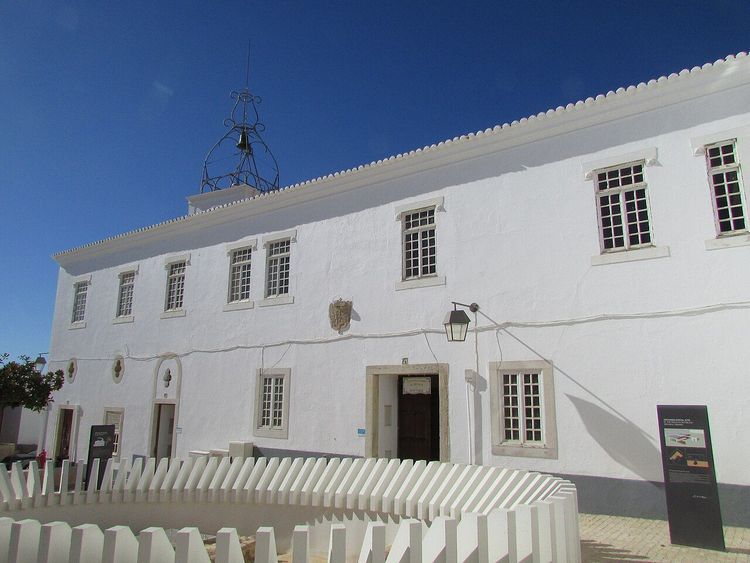
The historic heart of Albufeira, this square brings together typical white houses, the municipal archaeology museum and the remains of two 12th- and 13th-century dwellings, from the days when a military castle stood watch over the ocean here. More than eight centuries of history overlap on this now peaceful esplanade.
Free entry
16 - The Municipal Museum of Archaeology
The objects gathered here, unearthed during excavations across the region, trace the successive layers of local history: prehistory, Roman occupation, the Islamic period, right through to the town's more recent rise as a tourist destination. A good way to understand how a modest village became what some now call the Saint-Tropez of Portugal.
Paid entry (about €3)
17 - Praia dos Pescadores
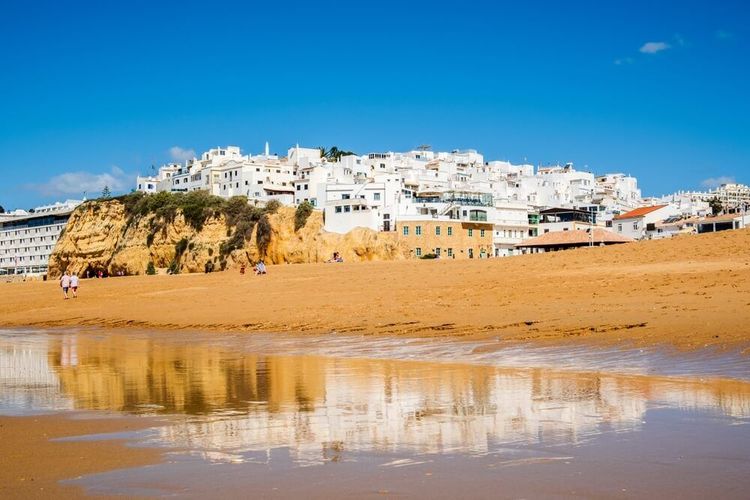
Its name, Fishermen's Beach, recalls that Albufeira was once a simple fishing village long before becoming the large seaside resort it is today. Lined with bars and restaurants, this wide, family-friendly stretch of sand remains one of the town's most popular, drawing both locals and visitors alike.
Free entry
18 - Miradouro do Pau da Bandeira
This viewpoint sits right at the border of the old town and has earned a well-deserved reputation for its sunsets over the Atlantic. From here, the eye takes in both the Algarve coastline and the fishermen's beach below, before you can head down to enjoy the lively evening atmosphere once the sun finally dips below the horizon.
Free entry · Best late in the day
Which neighbourhoods does the tour cross?
In a single loop, the route links the districts that tell Albufeira's story, from the old town perched above to the beaches below.
It starts at Engenheiro Duarte Pacheco Square, the heart of the old town, and runs down Rua 5 de Outubro, a lively cobbled street, passing the two small churches, Saint Sebastian and Sant'Ana, both restored after the 1755 earthquake (stops 1 to 5).
The route then reaches the marina district, a modern harbour with colourful houses, takes in viewpoints over the harbour and the ocean, then drops to Peneco Beach by the panoramic lift before climbing back up past the Clock Tower and the Porta do Norte, a remnant of the old walls (stops 6 to 14).
The loop closes at Republic Square, home to the Municipal Museum of Archaeology, then at Praia dos Pescadores, a legacy of the old fishing village, and the Miradouro do Pau da Bandeira, one of the town's favourite spots for watching the sunset (stops 15 to 18).
How much does it cost to visit Albufeira?
Of the route's 18 stops, 14 are freely open, from historic squares to beaches. The other four are seen differently:
- the Clock Tower and the Porta do Norte, two landmarks of the old town seen from the street;
- the Municipal Museum of Archaeology, whose full-price ticket costs €3.13, free for children up to 14, retirees, students, teachers and Albufeira residents;
- the Elevador do Peneco, the lift linking the old town to the beach, a practical facility rather than a sight.
Information checked in November 2026 and subject to change.
Where to stop for a bite along the tour?
The route devotes a whole stop to the flavours of the sea.
At stop 6, it's time for Albufeira's specialities: seafood, cuttlefish in ink, fish stews and rice, and above all cataplana, the signature dish simmered in a copper pot. Grilled sardines and octopus round out the menu, best enjoyed on a terrace by the water.
Sweet treats inherited from the Moors, made with almonds and figs, make a fitting end to the meal.
What should you know before visiting Albufeira?
A few practical points help you enjoy the route without a hitch.
The Outubro Tunnel, linking the old town to Peneco Beach, gets very busy at beach time in season; the Elevador do Peneco, whose hours change with the season, offers another way down, as do the stairs.
On Peneco Beach and Praia dos Pescadores, both lifeguarded in season, it's best to stay within the watched areas, depending on the day's sea conditions.
Albufeira enjoys a mild climate year round, with an average of 300 days of sunshine; from May to October temperatures top 20°C and the water warms up, while January and December, the coolest months, still reach 16 to 17°C by day.
Le plein d'inspirations
Explorez le monde en totale liberté, à pied au cœur des villes ou au fil des routes. Nos guides audios transforment chaque destination en une découverte culturelle immersive et unique.










FAQ for visiting Albufeira
When is the best time to visit Albufeira?
The ideal time to visit Albufeira runs from May to October, when temperatures easily climb above 20°C and the ocean water is perfect for swimming. This seaside resort in the Algarve enjoys a privileged climate with around 300 days of sunshine a year, making it a pleasant destination all year round. Even in winter, temperatures remain mild, with daytime averages of 16 to 17°C. If you are looking for buzz and a festive atmosphere, opt for July and August, but expect more crowds on the beaches. For a quieter stay while still enjoying fine weather, the months of May, June and September are perfect.
How long do you need to visit Albufeira?
A stay of 3 to 4 days lets you fully explore Albufeira and its surroundings. In two days, you can discover the historic centre with its typical white lanes, enjoy the main beaches and soak up the local atmosphere. An extra day gives you time to explore the more distant beaches or take a trip to the neighbouring villages of the Algarve. If you really want to enjoy the laid-back pace of this seaside resort and alternate between sightseeing, the beach and nightlife, a week is not too much. The Ryo audioguide accompanies you in discovering the town with a narrated tour that covers the must-sees in a half-day of walking.
How do you get to Albufeira from Faro airport?
Faro airport is located about 40 kilometres from Albufeira, and several options are available to reach the seaside resort. The taxi remains the most direct means, with a journey of about 30 to 40 minutes depending on traffic. Private and shared shuttles also offer this transfer, often to be booked in advance. For tighter budgets, the public bus regularly connects the airport to Albufeira, although the journey generally takes longer and sometimes requires a connection. Car rental remains an excellent option if you plan to explore the Algarve region during your stay, with the A22 motorway making it easy to reach Albufeira from the airport.
What are the most beautiful beaches in Albufeira?
Albufeira boasts some of the most beautiful beaches in the Algarve, each with its own unique character. Praia dos Pescadores, close to the historic centre, appeals with its accessibility and its lively atmosphere. For more spectacular scenery, head to Praia da Falésia with its impressive ochre cliffs stretching over several kilometres. Praia de São Rafael enchants visitors with its golden rock formations and crystal-clear waters, perfect for snorkelling. Families are particularly fond of Praia da Oura for its calm waters and its many amenities. For more privacy, explore the small coves such as Praia do Evaristo or Praia da Coelha, true hidden gems among the rocks.
What can you do in Albufeira when it rains?
Even though rain remains rare in Albufeira, a few indoor activities let you make the most of your day. The Algarve Shopping mall offers shops and restaurants for spending a few hours in the dry. Culture lovers can visit the municipal archaeology museum, which traces the history of the region from prehistory onwards. The covered market of Albufeira is also worth the detour to discover local products in an authentic atmosphere. For a relaxing experience, several spas and wellness centres welcome you for treatments and massages. Families with children can turn to Zoomarine, a covered water park located nearby, which offers dolphin shows and indoor attractions.
Where can you park in Albufeira?
Parking in Albufeira can be a challenge, especially in high season in the historic centre. Several paid public car parks are available around the old town, generally well signposted. The car park near the municipal market remains a handy option for exploring the centre on foot. Along the main beaches, you will find paid parking areas, but they fill up quickly in summer. For the more distant beaches, parking is often free but may require a short walk. If your accommodation is on the outskirts, opt for public transport or taxis to reach the centre, which will save you the hassle of parking. Off-season, the situation becomes much easier with more spaces available.
Is Albufeira a family destination?
Albufeira is perfectly suited to families, offering a balance between activities for all ages and adapted facilities. The main beaches have lifeguards in summer and offer generally calm waters, ideal for children. Many restaurants happily welcome families with children's menus and high chairs. The Albufeira marina makes a pleasant stroll with its shops and cafés, away from the nightlife bustle of the centre. There is no shortage of activities: water parks, boat trips to watch dolphins, or bike rides along the coast. Be careful, however, to choose your neighbourhood of residence, as some areas are very lively at night, particularly around the Strip; it is better to opt for quieter neighbourhoods for a family stay.
What is there to see in Albufeira's old town?
The old town is built around Engenheiro Duarte Pacheco square and Rua 5 de Outubro, a shopping street that drops down to the sea through a tunnel cut into the cliff. Along the way you will find the church of São Sebastião, topped by a white bell tower and now home to a museum of sacred art, the small Clock Tower perched on the heights, and the archaeology museum, which gathers traces of the Roman and Arab periods.
The cobbled lanes, whitewashed façades and stepped streets invite you to wander without a set route, ideally in the late afternoon once the heat drops. Below, Praia dos Pescadores recalls the town's fishing village past, with colourful boats pulled up on the sand. The Ryo audio guide offers a dedicated Albufeira route that links these places and tells their story.
How can you explore the sea caves from Albufeira?
The ochre cliffs of the Algarve are hollowed out with arches and caves that can only be reached from the water. Boats leave Albufeira marina throughout the day for the best known of them, including Benagil with its circular opening above the sand. Some trips are done by kayak or stand-up paddleboard, the only craft allowed inside several of the caves.
Aim for the morning, when the sea is generally calmer and the light inside the caves is softer. Departures can be cancelled when there is a swell, so it is wise to keep a fallback slot in your schedule if this excursion matters to you. Many boats round off the route with a search for dolphins offshore, common in these waters depending on the season.
Where can you go out at night in Albufeira?
Nightlife is split between two very different areas. Up on the heights, the avenue better known as The Strip lines up bars, clubs and terraces in the Montechoro district. The atmosphere there is loud and festive, carries on late into the night and draws a mostly young crowd, especially at the height of summer.
In the old town the tone is gentler. Terraces on the main square and the surrounding lanes serve tapas and grilled fish, and a few places offer live music without excessive volume. The seafront and the marina provide a third option, more family friendly and pleasant for a drink at sunset before walking back up towards the centre.
Vos commentaires, idées et suggestions
Aucun avis pour le moment
