© Shutterstock
 Votre guide Ryo
The Most Beautiful Beaches in France: Our Selection by Region (2026)
Naming the most beautiful beach in France is an impossible task given the vast choice: with over 5,500 kilometers of coastline, some beaches surpass all others — whether through the unreal color of their water, the purity of their sand, or a landscape that exists nowhere else in the world. From the limestone cliffs of Normandy to the pink granite coves of Brittany, from the long Landes beaches battered by Atlantic swells to the Corsican lagoons that could be mistaken for the Caribbean, France's diversity has little to envy from tropical destinations. Before setting off to explore the coastline on foot, the Ryo audio guide of Marseille is a great starting point for combining beach and urban exploration on the Mediterranean.
This guide covers the country's most beautiful shores, organized by region. You will find the plage de Palombaggia in Corsica, whose sand is as white as that of neighboring Sardinia, the plage de Donnant on Belle-Île whose waves make it one of Europe's most formidable surf spots, the Calanques d'En-Vau accessible only on foot or by kayak, and the Grande Plage de Biarritz where surfing was born in France. With 20 coastal regions, seasonal tips, and recommendations for every type of traveler.
Côte d'Opale and the Channel: When the North Surprises
The beaches of the North look like nothing else. At Wissant, between Cap Gris-Nez and Cap Blanc-Nez, the wind sculpts the sand into shifting crests and the water turns a deep green even in the height of August. The beach stretches 5 kilometers long without a single building as far as the eye can see — a space that feels almost Scandinavian. It is one of France's most highly regarded kitesurfing spots, and the sunsets facing England (visible on clear days) are worth the trip on their own.
Further north, Ryo's audio-guided tour of Dunkerque extends the stroll: the city of Jean Bart has its own lesser-known beaches, where Flemish and Belgian visitors have been swimming for generations. Malo-les-Bains retains its Belle Époque charm with its brick villas and estaminets just steps from the sand.
The Plage de la Slack at Ambleteuse is also worth a visit. Framed by a listed Vauban fort, this fine sandy beach exposes its rocks at low tide, forming natural pools where green crabs and sea urchins hide. The photographic setting is exceptional, and footfall remains reasonable even in summer.
Étretat: Cliffs Like Nowhere Else
The beach at Étretat (Boulevard René Coty, 76790 Étretat, rated 4.7/5 on Google with 8,017 reviews) cannot be explained — it must be felt. Wedged between the cliffs of Aval and Amont, this light grey pebble beach is among the most photographed natural sites in France, and yet seeing it in person always comes as a surprise. The Aiguille, rising 70 meters out of the water offshore from the Porte d'Aval, is a limestone arch sculpted by millennia of marine erosion. The site has inspired everyone from Monet (who came to paint here in all weathers) to Maurice Leblanc, who set the adventures of Arsène Lupin here.
Avoid July and August on weekdays: the car park overflows and the beach becomes packed by 10am. Opt for a morning in September or October, when the raking light changes the color of the cliffs every twenty minutes.
Deauville and the Côte Fleurie
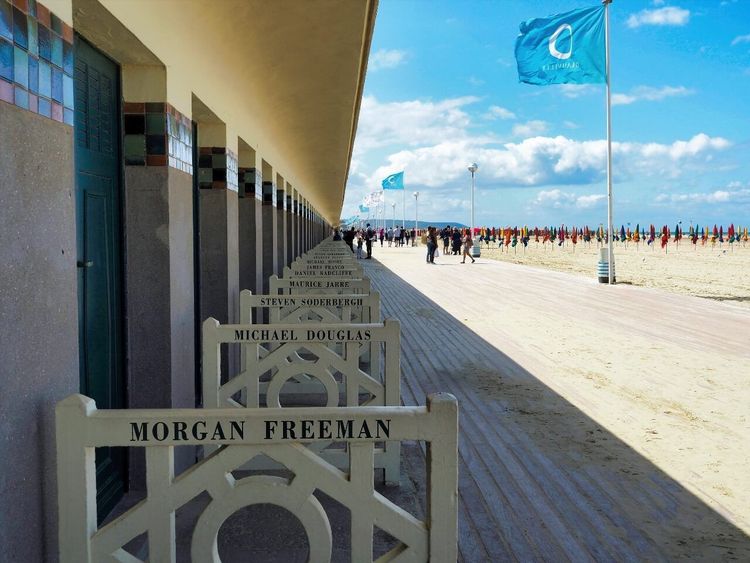
The beach at Deauville has an identity that few French beaches can claim: its 150 white-painted boardwalks lined up facing the sea, and beach cabins bearing the names of Hollywood stars, give it a unique character. It may not be the most wild, but it is certainly one of the most elegant. The Ryo audio tour of Deauville recounts the history of the boardwalks and the celebrities who have walked this sand.
Omaha Beach: When History Washes Ashore
Omaha Beach (Avenue de la Libération, 14710 Saint-Laurent-sur-Mer, rated 4.7/5 on Google with 6,482 reviews) at Saint-Laurent-sur-Mer is a beach unlike any other. On 6 June 1944, on these 7 kilometers of Norman sand, thousands of Allied soldiers lost their lives in the opening hours of the D-Day landings. Today, the beach is wide and peaceful, with a sea that shifts color throughout the day. Remnants of German defensive tank traps still protrude here and there from the sand. Coming here means holding two registers at once: the raw beauty of a northern Atlantic coastline, and the weight of a memory that does not dissolve with time.
The Omaha Memorial and the American cemetery at Colleville-sur-Mer, which overlooks the beach from a grassy cliff, are unmissable. The Ryo audio-guided tour of Caen completes the picture with a walk through the city that was 75% destroyed during the Battle of Normandy.
Northern Brittany: Saint-Malo, Saint-Cast, Keremma
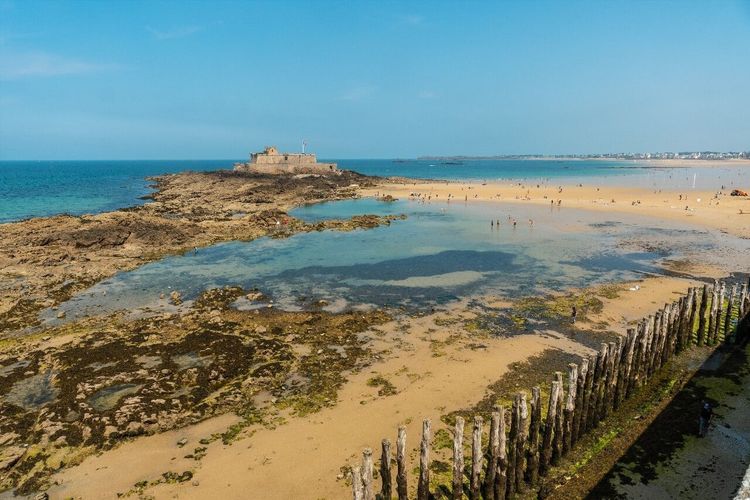
Brittany may well concentrate the greatest density of remarkable beaches per square meter in all of France. The north starts strong with the Plage du Sillon in Saint-Malo, a 3-kilometer strip of sand separating the corsair city from the sea. At high tide, waves crash against the ramparts — a spectacle few other coastal towns can offer. The Ryo audio walking tour of Saint-Malo features 29 audio tracks to explore the lanes of the old walled city after a swim.
At Saint-Cast-le-Guildo, on the Côtes-d'Armor, the Grande Plage stretches for 2.5 kilometers of fine sand facing due south — rare in northern Brittany. The water is warmer than the Breton average, and the beach remains less crowded than those of neighboring resorts. The village retains a human scale with its pink granite houses and fishing nets drying on the quays.
The plage de Keremma (Route de Keremma, 29430 Tréflez, rated 4.8/5 on Google with 195 reviews) in Finistère is something else entirely: 7 kilometers of dunes inhabited by hundreds of migratory bird species, a sea with powerful currents not recommended for swimming, but a natural spectacle of uncommon intensity. Windsurfers and kitesurfers know it well. The site is classified as a Natura 2000 zone, which explains its exceptional state of preservation.
To extend the visit with a city, the Ryo audio-guided tour of Brest is 45 minutes away and makes a solid base for exploring Finistère.
Southern Brittany: Presqu'île de Crozon and Belle-Île-en-Mer
The presqu'île de Crozon is often cited as one of the most beautiful natural spaces in France. Its beaches — Pentrez, La Palue, Postolonnec — each have very different characters depending on their orientation. La Palue, on the Atlantic side, receives powerful swells that make it a playground for experienced surfers. Pentrez, facing the Brest roadstead, offers 4 kilometers of calm sand with views over the islands. The Breton light — that luminous grey that 19th-century painters came to seek — is particularly striking here in the late afternoon.
Belle-Île-en-Mer brings together several major beaches within a few kilometers. The plage de Donnant is the most spectacular: set in a valley between two schist cliffs, accessible only on foot from a forest car park, it receives unfiltered ocean waves. Swimming is supervised and strictly delimited — beyond the markers, the current is dangerous. The first 30 minutes of a July morning, as the first surfers arrive, are worth all the sea poetry ever written.
The plage des Grands Sables (Île de Groix, 56590 Groix, rated 4.8/5 on Google with 249 reviews) on the île de Groix (Morbihan) deserves a detour: it is one of the few convex beaches in Europe, a geological anomaly visible to the naked eye. The sand is composed of fragments of green amphibolite and red garnet — minerals deposited against the current on this east-facing beach. The Ryo audio guide of Vannes is a good base for organizing the ferry excursion to Groix.
The Atlantic Coast: Vendée, Charente-Maritime, Royan
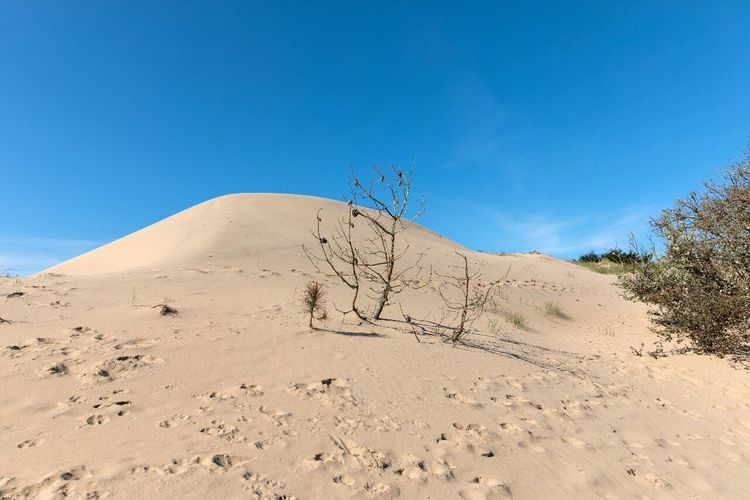
The Vendée is not the first region that comes to mind when thinking of legendary beaches — wrongly so. The Plage du Veillon at Talmont-Saint-Hilaire stretches for 4 kilometers between the mouth of the Payré river and wooded dunes. It is a family beach par excellence: little current, fine sand, and waters that warm up quickly in summer. Naturists have claimed the northern section for decades.
Further south, the Côte Sauvage de Royan (Route de la Grande Côte, 17200 Royan, rated 4.8/5 on Google with 82 reviews) in Charente-Maritime offers landscapes one might expect to find in Portugal. White sand dunes, pine forests that slope down to the beach, Atlantic water still cold even in August — but clean, transparent in the hollows of the waves. The Ryo audio walking tour of Royan tells the story of this city entirely rebuilt after 1945, giving it a remarkably unique modernist architecture.
The Plage de la Grande Côte at Saint-Palais-sur-Mer and the beaches of the île d'Oléron round out this Atlantic picture: vast open spaces exposed to westerly winds, perfect for water sports and walks outside the summer season.
Bassin d'Arcachon and the Dune du Pilat
The Bassin d'Arcachon is a special case on the French coastline. Its 22 kilometers of interior shores alternate between fine sandy beaches, oyster beds, and navigation channels. The Plage du Moulleau in Arcachon is the gentlest: warm, calm water sheltered by the basin, ideal for children and inexperienced swimmers. For those who want the open sea, the Plage de la Salie just south of the Pilat passage offers full Atlantic swells.
But the main attraction remains the Dune du Pilat: Europe's highest dune at 106 meters (constantly evolving), dominating the entrance to the basin. The view from the summit — Bassin d'Arcachon on one side, Gascony pine forest on the other — is among the most breathtaking in France. The Ryo audio tour of Arcachon covers the history of the Ville d'Hiver villas and the basin's oyster-farming economy.
Basque Country: Biarritz, Hossegor, Anglet
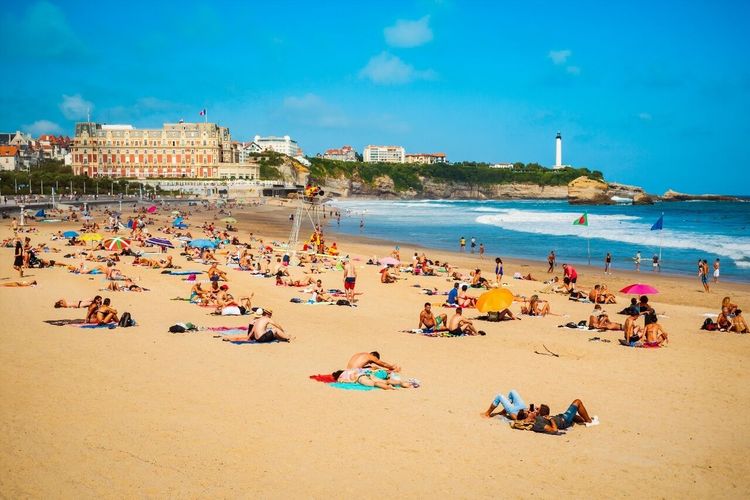
The Grande Plage de Biarritz (Boulevard du Maréchal Leclerc, 64200 Biarritz, rated 4.6/5 on Google with 5,400 reviews) is one of the most famous beaches in France and one of the most historically significant. It was here that Eugénie de Montijo, wife of Napoléon III, launched the fashion for sea bathing in the mid-19th century, transforming a fishing village into an imperial resort. Today, the Belle Époque casino watches over the beach like a sentinel, and surfers have been riding its waves since the late 1950s, when the filming of the movie "The Sun Also Rises", in which screenwriter Peter Viertel participated, introduced the surfboard to the Basque Coast. The Grande Plage stretches 700 meters along the North Atlantic, with regular waves that attract beginners and professionals alike.
To explore the city beyond the sand, the Ryo audio guide of Biarritz tells 16 stories about the transformation of the Basque city into the world capital of surfing.
Hossegor (Landes) is another institution. The beaches of the Côte des Landes are long, straight, and pounded by powerful swells from the open ocean. The La Gravière beach is renowned as one of Europe's most technically demanding surf spots — a shifting sandbar that produces perfect tubes on certain autumn days. The Rip Curl Pro Hossegor has drawn the world's best surfers here every October since 1979.
Anglet completes the Basque triptych. Its 11 consecutive beaches form a continuous seafront from La Barre (the mouth of the Adour) to the edge of Biarritz. Each beach has its own personality: La Chambre d'Amour is the most photogenic with its erosion-sculpted rocks, La Salie the most wild for waves. To discover the Basque hinterland on foot, Ryo's audio-guided tour of Bayonne offers a walk through the fortified old city just 5 kilometers from the beaches.
Languedoc-Roussillon: Gruissan, L'Espiguette, Collioure
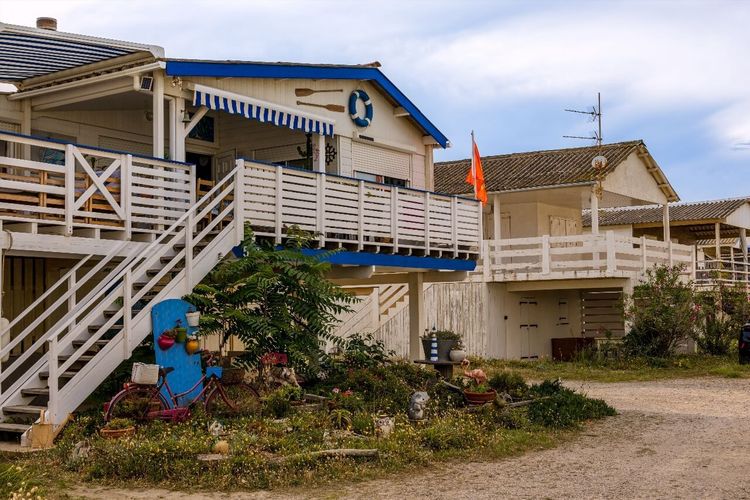
The Languedoc is the least-known stretch of the French Mediterranean coast, which paradoxically makes it the least touristy. Gruissan-Plage in the Aude is a curiosity: hundreds of colorful stilt chalets planted in the dunes, looking as though they stepped out of a Jacques Tati film. The beach itself is long, exposed to the wind (the mistral blows hard here), and bordered by a natural lagoon where flamingos and grey herons share the water. It gained a certain fame through the film "Betty Blue" ("37°2 le matin"), partially shot here in 1986.
At the mouth of the Rhône, the Plage de l'Espiguette (Route de l'Espiguette, 30240 Le Grau-du-Roi, rated 4.4/5 on Google with 1,815 reviews) at Le Grau-du-Roi (Gard) is one of the largest and most unspoiled beaches on the French Mediterranean: 10 kilometers of sand with no infrastructure whatsoever, accessible only on foot or by bicycle from the car park, with preserved dune vegetation. The water is turquoise, the currents nonexistent, and the beach is virtually empty outside July and August.
Collioure is in a category of its own. This Catalan village with its ochre and pink facades, whose fortified church plunges its foundations into the sea, has small pebble beaches that fired the imagination of Matisse, Derain, and the Fauves in 1905. It may not be the largest beach, but it is perhaps the finest postcard image on the entire French Mediterranean. The Ryo audio-guided tour of Collioure explores in 21 audio tracks what transformed this fishing village into the capital of Fauvism.
Côte d'Azur: Porquerolles, Pampelonne, Nice
The Côte d'Azur remains France's number-one seaside destination, with its 300 days of sunshine a year, translucent waters, and limestone cliffs. But not all its beaches are equal, and the best ones are often those the crowds never easily find.
The île de Porquerolles (Var) is home to the Plage Notre-Dame, regularly cited among the most beautiful beaches in Europe. Fine white sand, turquoise water ranging between shades of emerald and sapphire, umbrella pines leaning over the shoreline — the scene is almost unreal for a French island. Access is exclusively by ferry from Hyères (20 minutes), which naturally limits visitor numbers. No cars on the island, no beach vendors. To discover Hyères before boarding, the Ryo audio tour of Hyères covers the old town and its tropical gardens.
The Plage de Pampelonne (Route des Plages, 83350 Ramatuelle, rated 4.4/5 on Google with 70 reviews) at Ramatuelle is the Saint-Tropez beach par excellence — or rather, the collection of beaches that gave birth to the myth. 5 kilometers of fine sand with a backdrop of Provençal vineyards and the Maures hills. The central section is occupied by beach clubs (including the legendary Tahiti Beach, founded in 1949, which has welcomed everyone from Brigitte Bardot to contemporary celebrities), but the ends remain freely accessible. The Ryo audio walking tour of Saint-Tropez tells the 21 stories that explain how a fishing village became a global myth.
In Nice, the Promenade des Anglais and its pebble beaches carry a melancholy resonance after the events of 2016, but the city has reclaimed its color and its beaches remain among the most pleasant on the Côte d'Azur for their central location. The Ryo audio-guided tour of Nice features 27 audio tracks to explore the Vieux-Nice and the old town from the pebbles.
Menton closes the Riviera beautifully: its small colorful pebble beaches set against the yellow and orange facades of the old seafront form one of the most picturesque seaside panoramas in France. The Ryo audio guide of Menton discovers in 22 audio tracks this border town between France and Italy.
The Calanques of Marseille
Technically, the calanques are not beaches. But to call them anything else would be to diminish them. The Calanque d'En-Vau is the jewel of the Parc national des Calanques: a white limestone cove dropping sheer into water of an almost opaque blue, accessible only on foot (2h30 walk from the Gardiole car park) or by kayak from Cassis. Swimming is delightful but cool even in August, as the cliffs block the sun for much of the day.
The Calanque de Sormiou (Chemin de Sormiou, 13009 Marseille, rated 4.5/5 on Google with 371 reviews) and the Calanque de Morgiou, closer to Marseille, are accessible by shuttle from the city. Their water, a dense blue, turns meadow-green depending on the angle of the sun. To explore Marseille beyond the calanques, the Ryo audio-guided tour of Marseille offers 24 audio tracks across the Phocaean city, from the Vieux-Port to the Bonne-Mère.
Practical tips: car access to the calanques is prohibited from 1 June to 30 September. Bring hiking shoes, at least one liter of water, and set off early — car parks close once capacity is reached.
Corsica: Beaches in a League of Their Own
Corsica plays in a league of its own. The island concentrates beaches that would make most Mediterranean destinations blush, and even some tropical ones. The secret? A preserved coastline (construction within 100 meters of the shoreline has been banned since 1979), exceptionally clear water thanks to the absence of coastal industries, and sand with a high proportion of white silica giving it that characteristic milky hue.
Palombaggia (Porto-Vecchio, Corse-du-Sud) is the island's most famous and most photographed beach. Its perfect arc of pinkish-white sand beneath leaning umbrella pines, its pink granite rocks emerging from turquoise water — this combination has been reproduced on millions of travel posters. Better to go in May or September: in July and August, the car park charges steeply and the beach is packed by 9am. Outside those two months, you will often have the beach to yourself in the morning.
The Plage de Saleccia (Désert des Agriate, 20217 Saint-Florent, rated 4.8/5 on Google with 157 reviews) in the Désert des Agriate (Haute-Corse) represents the other extreme: wild, stretching 1.5 kilometers, accessible only by boat from Saint-Florent (30 minutes) or on foot via the Sentier du Littoral (3 hours from Bocca di a Fazziola). The sand is as white and fine as in Polynesia, the sea just as transparent. There are no sun loungers for hire, no bar, no lifeguard. You bring everything you need. Some filmmakers have shot scenes here meant to take place in the Caribbean — the setting lends itself perfectly.
Rondinara (Bonifacio) is an almost fully enclosed circular cove, sheltered from the winds by a pink granite peninsula. The water is exceptionally calm and clear, and the posidonia seabed is visible 3 meters down from the surface. It is the beach that sailors choose for anchoring, giving it a different kind of life: sailing boats and catamarans offshore, kayaks exploring the shoreline.
Loto and Ghignu, also in the Désert des Agriate, share the same qualities as Saleccia but with even fewer visitors. For those who want to combine a Corsican beach with a city, the Ryo audio-guided tour of Ajaccio (18 audio tracks, 2h30 on foot) covers Napoleon's birthplace, and the audio walking tour of Bastia explores the island's northern gem.
What About the French Overseas Territories?
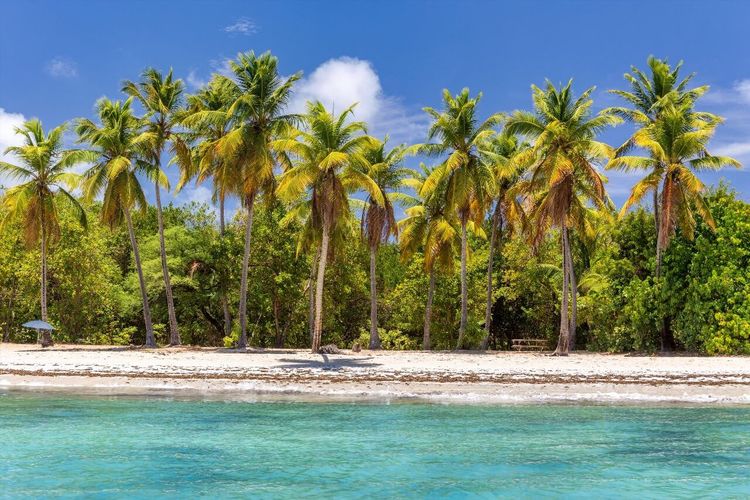
If you are willing to broaden the definition, the Plage des Salines in Martinique and Grande-Anse at Deshaies in Guadeloupe consistently feature in global top lists — white sand, water at 28°C, palm trees, coral reefs. L'Ermitage on Réunion is a lagoon beach with waters protected by a coral barrier. These beaches are fully French, but they operate in an entirely different climatic and geographical register. This guide has focused on metropolitan France, but the overseas departments deserve a dedicated article.
What Season Is Best for French Beaches?
The answer depends on the region and what you are looking for.
Mediterranean (Côte d'Azur, Languedoc, Corsica): the season runs from mid-May to mid-October. September is often the best month: water still warm (24–26°C), smaller crowds, autumnal light. July–August: perfect water temperatures but peak prices and saturated crowds at well-known beaches.
Atlantic (Basque Country, Landes, Arcachon, Charente, Vendée): water reaches 19–22°C in August, sometimes 23°C in the Bassin d'Arcachon. Swell is present year-round — ideal for surfing but to be watched by novice swimmers. June and September offer the best balance of price and conditions.
Brittany and Normandy: the water is never truly warm (15–18°C in August), but wetsuits are common. Breton beaches are often at their most beautiful outside summer: shifting light, winds, spectacular tides at high coefficients. March–April for photographers, May–June for coastal hikers.
Côte d'Opale: open year-round to lovers of wide open skies, wind, and deserted beaches. Summer is short but luminous. Avoid public holiday weekends in May and the month of August if you want peace and quiet.
How to Choose a Beach That Suits You
Looking for the longest beach in France? The Côte de Beauté between Royan and the Gironde lines up kilometers of near-uninterrupted sand. The beach at Soulac-sur-Mer stretches 3 kilometers without a break, but it is the Landes coast that offers the longest continuous stretches — up to 30 kilometers between Biscarrosse and Mimizan.
Want a beautiful beach close to home (from the Paris region)? Dieppe in Normandy is 2 hours from Paris with pebble beaches of a very distinctive atmosphere. Étretat is 2h30. The Ryo audio tour of Dieppe perfectly completes a Norman seaside weekend.
For families with children: the beaches of the Bassin d'Arcachon, those of southern Finistère (Bénodet, Fouesnant), and the bay of La Baule (Loire-Atlantique, 8 kilometers of sand) offer calm, shallow waters. La Baule is often ranked among the largest beaches in Europe.
For sports enthusiasts and surfers: Hossegor, Lacanau, Capbreton for Atlantic spots; Leucate in the Languedoc for windsurfing and kitesurfing; Crozon and Douarnenez in Brittany for sea kayaking.
FAQ
What is the most beautiful beach in France?
The answer is subjective, but several beaches consistently appear in every ranking: Palombaggia in Corsica for its white sand and turquoise waters, the Plage Notre-Dame on the île de Porquerolles, and the Calanque d'En-Vau near Cassis for its exceptional character. In Brittany, the Plage de Donnant on Belle-Île-en-Mer is often cited as one of the most wild and spectacular. The choice ultimately depends on what you are looking for: scenery, swimming, solitude, or activity.
What is the largest beach in France?
The Plage de La Baule (Loire-Atlantique) is often presented as the largest natural beach in Europe, with its 8 kilometers of continuous sand in the bay of La Baule-Escoublac. In terms of coastal length, the Landes coast between Biscarrosse and Hossegor offers dozens of kilometers of almost uninterrupted sand, but these beaches are distinct from one another.
What are the most beautiful beaches in the south of France?
For the Mediterranean south: Porquerolles (Plage Notre-Dame), Pampelonne (Saint-Tropez), the Calanque d'En-Vau (Cassis), and the Corsican beaches (Palombaggia, Saleccia, Rondinara). For the Atlantic south: the Grande Plage de Biarritz, the beaches of Hossegor, and those of the Landes coast. Each 'south' has its own aesthetic — Mediterranean azure versus Atlantic swells.
Are there beautiful beaches in Brittany?
Yes, and among the most beautiful in France. The plage de Donnant on Belle-Île-en-Mer, the plage de Keremma in Finistère, the beaches of the presqu'île de Crozon, the Plage du Sillon in Saint-Malo, and the plage des Grands Sables on the île de Groix all feature in every major ranking. Brittany also offers a unique light and landscapes that the Mediterranean cannot rival.
Which beaches are best for surfing in France?
The Atlantic coast concentrates the best spots: Hossegor (La Gravière and les Estagnots) for experienced surfers, Lacanau and Capbreton for all levels, Biarritz for its historic surf culture. In Brittany, La Palue on the presqu'île de Crozon and the beaches of Quiberon host national-level competitions. For beginners, the surf schools of Biarritz remain the French reference.
Which beaches in Corsica are free to access?
The vast majority of Corsican beaches are free and openly accessible. Palombaggia is free to access; only the parking is paid during the season (around €8–10 per day). Saleccia requires a boat from Saint-Florent (round-trip ticket between €18 and €22 depending on the operator) or a 3-hour walk. Rondinara has paid parking but the beach itself is free. In Corsica, coastal law prohibits any privatization of natural beaches.
Conclusion
From Norman pebbles to Corsican coves, from Landes dunes to the calanques of Marseille, the most beautiful beaches in France represent a natural heritage whose richness many travelers underestimate. You do not need to cross an ocean to find clear water or white sand: Porquerolles, Saleccia, Belle-Île-en-Mer, and the Basque coast are just a few hours by train or car from most major French cities. To combine beach with exploration of the coastal towns that border them, the Ryo audio tour of Arcachon or the Ryo audio guide of Cannes add another dimension to your seaside stay.
À lire également